Biosafety Cabinet
ProductOverview
A Class II biosafety cabinet (BSC) is a biological safety device providing combined protection to the operator, the specimen/culture, and the laboratory environment. It uses HEPA-filtered positive-pressure air supply and recirculated exhaust to create a sterile, contained workspace for handling biohazardous materials (BSL-2 and BSL-3 organisms, viral vectors, oncogenic material). Unlike open bench work, the cabinet's downward laminar airflow and inward-facing sash prevent aerosolized pathogens from escaping to the room, while supply-side HEPA filtration protects the culture from room contaminants.
How it works
Air Supply (Positive Pressure): Ambient room air enters the cabinet through a ceiling or side inlet, passes through a coarse pre-filter (G4) removing dust and lint, then through a HEPA supply cartridge (H13, 99.95% efficient at 0.3 µm). The HEPA cartridge is mounted horizontally in an elevated plenum. Filtered, sterile air flows downward through the work zone at 0.4–0.5 m/s face velocity, slow enough to prevent turbulence that might entrain contaminants, fast enough to capture aerosols generated during pipetting or inoculation.
Work Zone: The operator sits at the open front of the cabinet. The transparent sash (usually positioned at 300 mm opening height) allows reach-in access while limiting pathogen escape. The work surface is perforated stainless steel (0.5 mm holes, 5 mm spacing), allowing downward airflow to continue. Directly below the work surface is a drain pan collecting spills.
Exhaust (Negative Pressure Return): Air drawn down through the work zone is captured by an exhaust plenum below the work surface. This exhausted air is NOT recirculated directly into the room. Instead, it passes through a secondary HEPA filter cartridge (exhaust stage), ensuring any aerosolized pathogens are trapped before room discharge. The blower motor (located outside or above the cabinet in some designs) pulls air through both the intake and exhaust HEPA cartridges in series, creating negative pressure in the exhaust plenum (relative to the room).
Airflow Monitoring: A vane anemometer or differential-pressure transducer continuously monitors face velocity. If the velocity drops >10% (indicating a partially-clogged intake HEPA), an audible alarm and visual indicator alert the operator to change the cartridge. Typically, intake HEPA cartridges are replaced every 3–6 months; exhaust cartridges last longer (12–24 months) due to lower aerosol load.
Pressure Balancing: The cabinet is supplied more air than exhausted, creating a slight positive pressure inside relative to the room. This prevents room air (and potential contaminants) from being drawn in through gaps. The sash and seals are adjusted to achieve this balance without excessive noise.
Operator Protection
Airflow protects the operator by:
- Capturing aerosols: Pipetting, vortexing, and other manipulations generate aerosols; the downward flow captures these before they rise toward the operator's breathing zone.
- Sash barrier: The transparent sash provides a physical barrier and airflow path that carries aerosols downward, not into the operator's face.
- Inward face velocity: Air flows INTO the cabinet (0.4–0.5 m/s inward), not outward.
However, the cabinet is NOT a substitute for aseptic technique or proper training. Unsafe practices (placing head inside, creating turbulence by rapid arm movements) can disrupt airflow and cause aerosol escape.
Culture Protection
The supply-side HEPA filtration ensures that room dust, bacteria, and fungi do not contaminate sterile cultures. Filtered air flowing downward over the work surface creates a sterile microenvironment (not truly "laminar", that term is reserved for unidirectional flow in cleanrooms, but heavily filtered).
Environmental Protection
If the operator's culture escapes the work zone due to an accident (spill, tube rupture), the exhaust HEPA filter catches it. The cabinet can be decontaminated by running it unoccupied with UV light or formaldehyde vapor. The drain pan and quick-accessible collection point allow safe removal and incineration of spill waste.
Types & Variations
Class I cabinets: Simple negative-pressure enclosure with exhaust HEPA only; protects environment and contains culture, but NOT operator. Rarely used for mammalian cell work.
Class II cabinets (described here): Operator + culture + environment protection; standard in virology, cell biology, and microbiology labs.
Class III cabinets: Fully sealed, front-loading access ports and rubber gloves; for BSL-4 agents. Rare and expensive.
Proper Use
Certification: New cabinets and filters are certified by a qualified technician using dioctyl phthalate (DOP) or Polydisperse Aerosol Generator (PAG) tests. After filter changes, recertification is required. Perform at least annually.
Run time: Turn on the cabinet 5–10 minutes before beginning work to stabilize airflow.
Operator technique: Keep elbows inside the sash opening. Move arms slowly to avoid disrupting airflow. Do not place your head inside.
Work placement: Position culture tubes and plates 6 inches back from the sash to stay within the sterile field.
Decontamination: At end of work, allow the cabinet to run idle for 5 minutes to purge any residual aerosols. Wipe down work surface with 70% ethanol or 0.5% sodium hypochlorite. Close sash when leaving.
Spill response: Small spills (<10 mL) can be cleaned with absorbent towels and disinfectant without stopping airflow. Large spills should trigger cabinet shutdown and decontamination by trained personnel.
Maintenance
- Intake HEPA: Replace every 3–6 months (depends on lab dust levels and usage). Cost ~$50–100 per cartridge.
- Exhaust HEPA: Replace every 12–24 months (lower particle load due to intake pre-filtering).
- Pre-filter pad: Replace monthly to extend HEPA lifespan.
- Blower motor: Check bearing noise; replace every 5–10 years. Typical cost ~$200–400.
- Sash seals: Replace gasket every 2–3 years if audible air leaks develop.
- Work surface & drain pan: Clean daily. Replace drain pan if corrosion occurs (typically stainless lasts 10+ years).
Regulatory Standards
Biosafety cabinets are regulated by:
- NSF/ANSI 49 (USA): Certification and performance standards.
- EN 12469 (Europe): Equivalent standard.
- IEC 61010-2-080 (International): Electrical safety for biosafety cabinets.
Certification includes:
- HEPA filter integrity (DOP test: <0.003% penetration at 0.3 µm).
- Airflow uniformity (face velocity ±20% across opening).
- Inward face velocity (0.4–0.5 m/s typical; minimum 0.38 m/s by NSF).
- No backflow to room.
Annual recertification is standard; NIH and CDC recommend recertification every 12 months or after filter changes.
Safety Notes
- Chemical compatibility: HEPA filters trap particles, not vapors. Volatile hazardous chemicals (chloroform, benzene) require dedicated chemical fume hoods with activated carbon filters, not biosafety cabinets.
- Spillage: Minor spills are contained in the drain pan. Biological waste in the pan should be autoclaved (121 °C, 15–30 min at 15 psi) before disposal.
- Tuberculosis precautions: Mycobacterium tuberculosis is transmissible via respiratory aerosols. Work with TB cultures in a Class II cabinet with recirculation disabled (hard-ducted exhaust to outdoors or HEPA → room), and use N95 respirators.
Biosafety Cabinet parts and their functions
8 top-level parts · 33 parts in total · full bill of materials below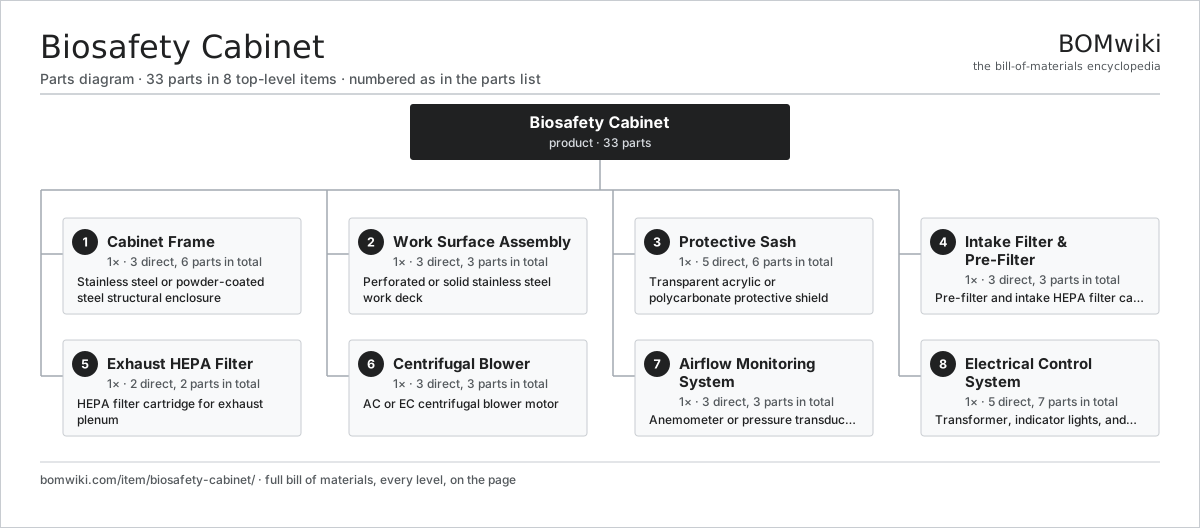
| # | Part | Qty | What it does |
|---|---|---|---|
| 1 | Cabinet Frame 3 parts | 1× | Stainless steel or powder-coated steel structural enclosure |
| 2 | Work Surface Assembly 3 parts | 1× | Perforated or solid stainless steel work deck |
| 3 | Protective Sash 5 parts | 1× | Transparent acrylic or polycarbonate protective shield |
| 4 | Intake Filter & Pre-Filter 3 parts | 1× | Pre-filter and intake HEPA filter cartridge (supply air) |
| 5 | Exhaust HEPA Filter 2 parts | 1× | HEPA filter cartridge for exhaust plenum |
| 6 | Centrifugal Blower 3 parts | 1× | AC or EC centrifugal blower motor |
| 7 | Airflow Monitoring System 3 parts | 1× | Anemometer or pressure transducer monitoring cabinet airflow rate |
| 8 | Electrical Control System 5 parts | 1× | Transformer, indicator lights, and safety interlocks |
3D model
No 3D model yet. Have a CAD file of this? Add a 3D model. STL renders right on this page; STEP, FreeCAD, and OpenSCAD sources are welcome too (openly licensed, like all 3D models on BOMwiki).
Build & assembly graph
expand / collapse · shared sub-assemblies converge · links to related products · est. labourTap an assembly to expand/collapse · tap a part to open it · use “Open page” for any node · drag to pan, scroll to zoom.
Bill of materials for Biosafety Cabinet
8 top-level lines · 35 rows shown · 33 parts total · indented to 3 levels| # | Item / sub-assembly | Part no. | Qty/assy | Ext. qty | Parts | Type |
|---|---|---|---|---|---|---|
| 1 | Cabinet Frame 3 parts | biosafety-cabinet-frame | 1× | 1 | 6 | assembly |
| 1.1 | Cabinet Body | biosafety-cabinet-frame-body | 1× | 1 | · | part |
| 1.2 | Cabinet Feet | biosafety-cabinet-frame-feet | 4× | 4 | · | part |
| 1.3 | Sheet Metal Panel | sheet-panel | 1× | 1 | · | part |
| 2 | Work Surface Assembly 3 parts | biosafety-cabinet-work-surface | 1× | 1 | 3 | assembly |
| 2.1 | Perforated Deck | biosafety-cabinet-deck-tray | 1× | 1 | · | part |
| 2.2 | Drain Collection Pan | biosafety-cabinet-drain-pan | 1× | 1 | · | part |
| 2.3 | Drain Ball Valve | biosafety-cabinet-drain-valve | 1× | 1 | · | part |
| 3 | Protective Sash 5 parts | biosafety-cabinet-sash | 1× | 1 | 6 | assembly |
| 3.1 | Sash Pane | biosafety-cabinet-sash-pane | 1× | 1 | · | part |
| 3.2 | Sash Frame | biosafety-cabinet-sash-frame | 1× | 1 | · | part |
| 3.3 | Sash Guide Channel | biosafety-cabinet-sash-guide | 2× | 2 | · | part |
| 3.4 | Counterweight Assembly | biosafety-cabinet-sash-counterweight | 1× | 1 | · | part |
| 3.5 | Sash Height Stop | biosafety-cabinet-sash-lock | 1× | 1 | · | part |
| 4 | Intake Filter & Pre-Filter 3 parts | biosafety-cabinet-hepa-intake | 1× | 1 | 3 | assembly |
| 4.1 | Pre-Filter Pad | biosafety-cabinet-prefilter-pad | 1× | 1 | · | part |
| 4.2 | Supply HEPA Cartridge | biosafety-cabinet-hepa-cartridge-supply | 1× | 1 | · | part |
| 4.3 | Filter Mount Frame | biosafety-cabinet-filter-frame | 1× | 1 | · | part |
| 5 | Exhaust HEPA Filter 2 parts | biosafety-cabinet-hepa-exhaust | 1× | 1 | 2 | assembly |
| 5.1 | Exhaust HEPA Cartridge | biosafety-cabinet-hepa-cartridge-exhaust | 1× | 1 | · | part |
| 5.2 | Exhaust Filter Housing | biosafety-cabinet-filter-casing | 1× | 1 | · | part |
| 6 | Centrifugal Blower 3 parts | biosafety-cabinet-blower | 1× | 1 | 3 | assembly |
| 6.1 | Blower Motor | blower-motor | 1× | 1 | · | part |
| 6.2 | Blower Impeller | biosafety-cabinet-blower-impeller | 1× | 1 | · | part |
| 6.3 | Motor Mount Elastomer | biosafety-cabinet-blower-mount | 1× | 1 | · | part |
| 7 | Airflow Monitoring System 3 parts | biosafety-cabinet-airflow-monitor | 1× | 1 | 3 | assembly |
| 7.1 | Anemometer Sensor | biosafety-cabinet-anemometer | 1× | 1 | · | part |
| 7.2 | Bare PCB | pcb-bare | 1× | 1 | · | part |
| 7.3 | Alarm Module | biosafety-cabinet-alarm-module | 1× | 1 | · | part |
| 8 | Electrical Control System 5 parts | biosafety-cabinet-electrical | 1× | 1 | 7 | assembly |
| 8.1 | Power Supply | power-supply | 1× | 1 | · | part |
| 8.2 | Bare PCB | pcb-bare | 1× | 1 | · | part |
| 8.3 | Relay | relay | 2× | 2 | · | part |
| 8.4 | SMD Passive (R/C/L) | smd-passives | 1× | 1 | · | part |
| 8.5 | Connector | connector | 2× | 2 | · | part |
Something wrong in this list? Report a problem with this BOM.
Related products
same domain, ranked by shared parts Climate Test Chamber
64 parts · shares 4 with this page
Superconductor Materials Lab
1,846 parts · shares 4 with this page
Climate Test Chamber
64 parts · shares 4 with this page
Superconductor Materials Lab
1,846 parts · shares 4 with this page
 Digital Refractometer
42 parts · shares 3 with this page
Digital Refractometer
42 parts · shares 3 with this page
 Atomic Absorption Spectrometer
648 parts · shares 3 with this page
Freeze Dryer
317 parts · shares 3 with this page
Atomic Absorption Spectrometer
648 parts · shares 3 with this page
Freeze Dryer
317 parts · shares 3 with this page
 Gas Chromatograph
450 parts · shares 3 with this page
Gas Chromatograph
450 parts · shares 3 with this page
Sourcing: possible vendors
Browse the supplier directory → Prices, MOQ, and lead times are algorithmic estimates, not quotes, and not claims about these companies. Company mappings are curated by keyword; est. price band $1k–$500k. How estimates work| Vendor | HQ | Specialty | MOQ | Lead time |
|---|---|---|---|---|
| thermofisher.com ↗ | Waltham, US | Lab instruments | 100 units | 10–18 wks |
|
🇺🇸Agilent
agilent.com ↗
|
Santa Clara, US | Analytical instruments | 100 units | 10–18 wks |
|
🇺🇸Bruker
bruker.com ↗
|
Billerica, US | Scientific instruments | 100 units | 10–18 wks |
|
🇯🇵Shimadzu
shimadzu.com ↗
|
Kyoto, JP | Analytical instruments | 100 units | 10–18 wks |
|
🇺🇸Waters
waters.com ↗
|
Milford, US | Chromatography & MS | 100 units | 10–18 wks |
1,115-word article