Blacksmith Power Hammer
ProductOverview
A blacksmith power hammer is a powered striking machine that automates the repetitive impact work of hand forging. Unlike a drop hammer that relies on gravity, a power hammer uses a Drive System to drive a heavy Tup up and down against a Anvil Assembly, delivering precisely timed blows at adjustable frequency. This machine is fundamental to small-to-medium metalworking shops, enabling blacksmiths to shape steel billets, draw-out stock, and perform upset forging without hand-powered hammer work.
The machine's engineering elegance lies in its mechanical simplicity: a motor drives a flywheel and crank, which operates connecting rods and a cam follower that raise the Tup to a fixed height and release it to fall. Springs provide the rebound energy, and a foot pedal clutch lets the operator engage and disengage strikes at will. This passive spring-return mechanism, unlike hydraulic or pneumatic systems, is inherently reliable and tolerates prolonged shock loading without fluid loss or compressor dependency.
Manufacturing scales range from small hobby-shop units (50-lb tup) to industrial-scale hammers (200+ lbs) found in die forges and automotive component shops. The Anvil Assembly must be isolated from the Frame to prevent vibration transmission to the building foundation. Heavy cast-iron bases and sometimes concrete piers beneath the entire assembly are common.
How it works
The operator starts the motor, which turns the Crank Shaft (crank shaft) at constant speed (typically 300–500 rpm). As the shaft rotates, its crank pin rides against a Cam Follower roller, which is attached to the Connecting Rod. This upstroke motion pulls the Tup against the Spring Linkage.
At the top of the stroke, the crank pin passes dead center, and the springs push the tup downward as the crank descends. The tup accelerates under gravity and spring tension, striking the workpiece against the Anvil with great force. The foot pedal operates a Clutch Mechanism that engages or disengages the driving linkage; when disengaged, the tup remains raised and safe.
Strike frequency is adjusted by changing belt positions on the Pulley Set: moving the belt to a smaller pulley on the motor side raises rpm, increasing strike rate; conversely, larger pulleys reduce frequency. This allows a single machine to forge light ornamental work at high frequency or heavy structural steel at slower, more powerful strokes.
The Cooling System ensures continuous oil circulation to all linkage joints and the main shaft bearings, which endure millions of acceleration cycles. Splash lubrication alone would quickly fail; forced circulation is essential for machine longevity.
Interchangeable Dies and Forging Workflow
The Anvil Assembly typically accepts dies – pairs of shaped blocks that fit into the anvil and are held against the tup by the force of the strike. By swapping dies, a blacksmith can move a billet through multiple profile-forming stations: drawing (lengthening), upsetting (thickening), or full-profile forging in minutes rather than hours of hand work.
A typical small forge has 6–12 die pairs stored on a Tongs Rack, allowing rapid die changes between operations. The Anvil Base is designed with square or rectangular cavities to accept both top and bottom dies, ensuring precise alignment and repeatability.
Maintenance and Durability
Given the thousands of impact cycles per hour, reliability demands robust design. The Main Beam and cross braces are typically welded or bolted steel, designed to flex slightly and dissipate impact vibration rather than transmit it to the foundation. The Flywheel provides rotational inertia so that the motor does not stall during a heavy strike; it smooths power draw and reduces electrical demand spikes.
Oil analysis is essential: wear metals from the linkages and bearings accumulate in the Oil Reservoir, so the Oil Filter must be changed every 100–200 operating hours. Bearing noise and oil smell are early warning signs of imminent failure; a neglected machine can seize catastrophically mid-stroke.
The Clutch Mechanism is the weakest link for operators: disengaging cleanly requires timing, and worn friction surfaces can slip unpredictably, leading to light or missed strikes. Regular inspection and adjustment keep it reliable.
Historical and Modern Use
Power hammers have been in use since the 1800s, first water-driven and later electric. They remain central to traditional and contemporary blacksmithing, art metalwork, and small-batch forging. Modern hobby blacksmiths often restore or build replica power hammers; industrial users employ large air-driven or spring-driven units in automotive forging plants. The fundamental design has barely changed in 150 years, testament to its mechanical elegance and durability.
Blacksmith Power Hammer parts and their functions
7 top-level parts · 34 parts in total · full bill of materials below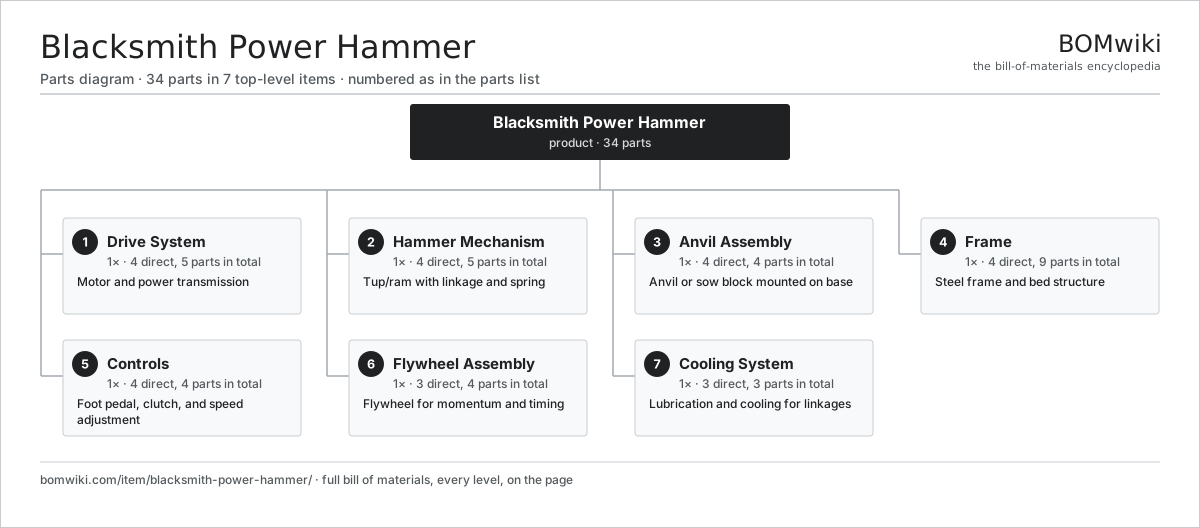
| # | Part | Qty | What it does |
|---|---|---|---|
| 1 | Drive System 4 parts | 1× | Motor and power transmission |
| 2 | Hammer Mechanism 4 parts | 1× | Tup/ram with linkage and spring |
| 3 | Anvil Assembly 4 parts | 1× | Anvil or sow block mounted on base |
| 4 | Frame 4 parts | 1× | Steel frame and bed structure |
| 5 | Controls 4 parts | 1× | Foot pedal, clutch, and speed adjustment |
| 6 | Flywheel Assembly 3 parts | 1× | Flywheel for momentum and timing |
| 7 | Cooling System 3 parts | 1× | Lubrication and cooling for linkages |
3D model
No 3D model yet. Have a CAD file of this? Add a 3D model. STL renders right on this page; STEP, FreeCAD, and OpenSCAD sources are welcome too (openly licensed, like all 3D models on BOMwiki).
Build & assembly graph
expand / collapse · shared sub-assemblies converge · links to related products · est. labourTap an assembly to expand/collapse · tap a part to open it · use “Open page” for any node · drag to pan, scroll to zoom.
Bill of materials for Blacksmith Power Hammer
7 top-level lines · 33 rows shown · 34 parts total · indented to 3 levels| # | Item / sub-assembly | Part no. | Qty/assy | Ext. qty | Parts | Type |
|---|---|---|---|---|---|---|
| 1 | Drive System 4 parts | blacksmith-power-hammer-drive-system | 1× | 1 | 5 | assembly |
| 1.1 | Motor Housing | motor-housing | 1× | 1 | · | part |
| 1.2 | Drive Belt | drive-belt | 2× | 2 | · | part |
| 1.3 | Pulley Set | blacksmith-power-hammer-pulley-set | 1× | 1 | · | part |
| 1.4 | Fastener Set | fastener-set | 1× | 1 | · | part |
| 2 | Hammer Mechanism 4 parts | blacksmith-power-hammer-hammer-mechanism | 1× | 1 | 5 | assembly |
| 2.1 | Tup | blacksmith-power-hammer-tup | 1× | 1 | · | part |
| 2.2 | Connecting Rod | blacksmith-power-hammer-connecting-rod | 2× | 2 | · | part |
| 2.3 | Spring Linkage | blacksmith-power-hammer-spring-linkage | 1× | 1 | · | part |
| 2.4 | Cam Follower | blacksmith-power-hammer-cam-follower | 1× | 1 | · | part |
| 3 | Anvil Assembly 4 parts | blacksmith-power-hammer-anvil-assembly | 1× | 1 | 4 | assembly |
| 3.1 | Anvil | blacksmith-power-hammer-anvil | 1× | 1 | · | part |
| 3.2 | Anvil Base | blacksmith-power-hammer-anvil-base | 1× | 1 | · | part |
| 3.3 | Die Set | blacksmith-power-hammer-die-set | 1× | 1 | · | part |
| 3.4 | Tongs Rack | blacksmith-power-hammer-tongs-rack | 1× | 1 | · | part |
| 4 | Frame 4 parts | blacksmith-power-hammer-frame | 1× | 1 | 9 | assembly |
| 4.1 | Main Beam | blacksmith-power-hammer-main-beam | 2× | 2 | · | part |
| 4.2 | Cross Brace | blacksmith-power-hammer-cross-brace | 4× | 4 | · | part |
| 4.3 | Sheet Metal Panel | sheet-panel | 2× | 2 | · | part |
| 4.4 | Fastener Set | fastener-set | 1× | 1 | · | part |
| 5 | Controls 4 parts | blacksmith-power-hammer-controls | 1× | 1 | 4 | assembly |
| 5.1 | Foot Pedal | blacksmith-power-hammer-foot-pedal | 1× | 1 | · | part |
| 5.2 | Clutch Mechanism | blacksmith-power-hammer-clutch-mechanism | 1× | 1 | · | part |
| 5.3 | Speed Lever | blacksmith-power-hammer-speed-lever | 1× | 1 | · | part |
| 5.4 | Relay | relay | 1× | 1 | · | part |
| 6 | Flywheel Assembly 3 parts | blacksmith-power-hammer-flywheel-assembly | 1× | 1 | 4 | assembly |
| 6.1 | Flywheel | blacksmith-power-hammer-flywheel | 1× | 1 | · | part |
| 6.2 | Shaft Bearing | blacksmith-power-hammer-shaft-bearing | 2× | 2 | · | part |
| 6.3 | Crank Shaft | blacksmith-power-hammer-shaft | 1× | 1 | · | part |
| 7 | Cooling System 3 parts | blacksmith-power-hammer-cooling-system | 1× | 1 | 3 | assembly |
| 7.1 | Oil Pump | blacksmith-power-hammer-oil-pump | 1× | 1 | · | part |
| 7.2 | Oil Reservoir | blacksmith-power-hammer-oil-reservoir | 1× | 1 | · | part |
| 7.3 | Oil Filter | blacksmith-power-hammer-filter | 1× | 1 | · | part |
Something wrong in this list? Report a problem with this BOM.
Related products
same domain, ranked by shared parts Centrifugal Disc Finishing Machine
326 parts · shares 2 with this page
Cold Heading Machine
40 parts · shares 2 with this page
Centrifugal Disc Finishing Machine
326 parts · shares 2 with this page
Cold Heading Machine
40 parts · shares 2 with this page
 Crankshaft Grinder
511 parts · shares 2 with this page
Crankshaft Grinder
511 parts · shares 2 with this page
Sourcing: possible vendors
Browse the supplier directory → Prices, MOQ, and lead times are algorithmic estimates, not quotes, and not claims about these companies. Company mappings are curated by keyword; est. price band $10k–$1M. How estimates work| Vendor | HQ | Specialty | MOQ | Lead time |
|---|---|---|---|---|
|
🇩🇪DMG MORI
dmgmori.com ↗
|
Bielefeld, DE | Machine tools | 5 units | 12–20 wks |
|
🇯🇵Mazak
mazak.com ↗
|
Oguchi, JP | Machine tools | 5 units | 12–20 wks |
| haascnc.com ↗ | Oxnard, US | CNC machine tools | 5 units | 12–20 wks |
|
🇯🇵Okuma
okuma.com ↗
|
Niwa, JP | Machine tools | 5 units | 12–20 wks |
|
🇩🇪Trumpf
trumpf.com ↗
|
Ditzingen, DE | Laser & sheet-metal machines | 5 units | 12–20 wks |
849-word article