Abrasive Blast Cabinet
ProductOverview
An abrasive blast cabinet is an enclosed chamber for cleaning and surface preparation of metal parts using high-velocity abrasive particles. A hand-held gun mixes compressed air with media (steel shot, grit, glass beads, or oxide) and accelerates the mixture against the part, stripping rust, paint, and scale. The sealed enclosure contains the ricochet and dust, and a recirculation system recovers used media for reuse.
Blast cabinets are essential in automotive, tool, and manufacturing shops. A rusted transmission housing cleaned by hand with wire wheels and solvents takes hours; in a cabinet, the same part is cleaned in 5 minutes. The result is bare, clean metal ready for coating (paint, powder coat, electroplating) or reassembly.
The operator's hands access the work area via neoprene gloves mounted in the cabinet wall, allowing safe manipulation of parts while viewing through a tempered glass window. Most cabinets are benchtop or floor models, operating continuously in heavy production or occasionally in small shops.
Cabinet design and containment
The outer shell is welded steel with interior rubber lining (1/2" thick natural rubber) protecting the steel from abrasive impact and acoustic vibration. The rubber absorbs energy, reducing noise from about 120 dB to 100–105 dB, still loud, but tolerable with hearing protection.
The work grate is welded 1/2" steel mesh suspended inside the cabinet on rubber isolation feet. Parts are placed on the grate; spent media and dust fall through the mesh to the cabinet floor, where a drain plug allows periodic emptying of settled media and fines (particles too small to recirculate).
The front panel has three primary openings: the viewing window (tempered glass 12" × 8") at eye level, and two neoprene glove ports at shoulder height. The access door swings open for loading large parts or cleaning the cabinet interior. All openings have sealing gaskets preventing media escape.
Viewport and hand access
The tempered glass window is 1/4" thick borosilicate glass, the same material used in laboratory glassware, resistant to thermal shock and abrasive impact. The glass is protected by a steel guard frame with stand-off spacers creating an air gap, the frame, not the glass itself, takes impacts. If the glass cracks or becomes too scratched to see through, it's quickly replaced by loosening spring clips and pulling out the old pane.
The neoprene gloves are industrial sleeve gloves, 32" long and 14mm thick (about the thickness of a winter coat). Neoprene is oil-resistant and abrasion-resistant, lasting 6–12 months with normal use before the fingertips thin and require replacement. Each glove has a stainless steel cuff ring (4" diameter) with a quick-disconnect coupling, the glove slips off by rotating the ring and pulling, and a fresh glove spins back on in seconds.
A pivoting support arm holds each glove at a natural height, reducing fatigue during long blasting sessions. The gloves are positioned at shoulder width to allow both hands to work simultaneously, one hand can position a part while the other manipulates the blast gun.
Media hopper and feeding
The overhead hopper (40 lbs capacity) sits atop the cabinet and gravity-feeds abrasive media down to the gun body. A sliding gate with incremental adjustment controls flow rate, opening the gate wider increases media flow to the gun, resulting in denser, more aggressive blasting. A small electric vibrator (120V, 1800 rpm) shakes the hopper, preventing media from bridging (clogging) if the media is damp or contains fines.
The media flows down a flexible hose (3/4" diameter, 8 feet) to the gun body. The hose is long enough to allow the operator freedom of movement inside the cabinet while blasting.
Blast gun and mixing
The hand-held gun is the business end of the system. It has a cast aluminum or steel body with three ports: air inlet (from shop compressor), media inlet (from hopper), and mixed outlet (to work). A venturi mixing chamber inside the gun draws media into the compressed air stream via a pressure differential, mixing them just before the nozzle tip.
The nozzle tip is a hardened tungsten carbide orifice (3/16" diameter) that further accelerates the media-air mixture to supersonic velocity (typically 300–400 fps) as it exits. Tungsten carbide is one of the hardest materials, but even it wears over time, a well-used cabinet might replace nozzles quarterly. Worn nozzles produce a larger, less focused jet stream, reducing efficiency.
A trigger valve controls air flow to the gun; pulling the trigger opens the valve, pressurizing the gun and forcing air and media out through the nozzle. Releasing the trigger closes the valve and stops blasting. A spring-loaded safety lock prevents accidental discharge if the gun is bumped or the trigger is snagged.
Media recovery and recycling
The recirculation system recovers 85–95% of the abrasive media for reuse, minimizing waste and cost. Spent media and dust fall through the work grate to the cabinet floor, where a cyclone separator swirls the material. Heavier media (shot, grit) falls straight down into a collection hopper, while lighter dust particles spiral upward and out toward the dust collector.
An air-operated diaphragm pump powered by shop air draws media from the hopper below and lifts it up through a 1.5" hose back to the overhead hopper, completing the recycling loop. A 100 micron mesh screen in the return line removes fines that might otherwise clog the hopper metering gate. The pump runs only when the operator is blasting, powered by shop air pressure; when pressure drops below a threshold, the pump shuts off.
Over time, the recycled media becomes contaminated with paint chips, rust dust, and part degradation products. Most operators empty and replace media every 50–100 operating hours, depending on the type of blasting and media choice.
Dust collection and emissions
The dust collector removes fine particles (fumes, powder, paint dust) from the cabinet air before it exhausts to the shop. A baghouse chamber contains two pleated polyester cartridge filters (9.5" diameter, 12" long each) that trap particles as air passes through. A 1/2 hp blower motor draws 150 CFM (cubic feet per minute) of air through the cabinet and filters.
A solenoid pulse-clean valve with a timer periodically reverses air flow briefly through the filters, dislodging accumulated dust into a collection bin below. This cleaning extends filter life, cartridges typically last 6–12 months before requiring replacement. The outlet hose (2" diameter) vents collected air to the shop or outside, depending on facility design. Most shops plumb the outlet to a ceiling duct system or exterior wall.
Dust collection is critical for shop air quality and regulatory compliance. Abrasive dust (especially silicon carbide or aluminum oxide) is a respiratory hazard; federal OSHA standards limit airborne silica exposure. A functioning dust collector reduces airborne particle concentration by 95%, protecting operator lungs.
Media types and applications
Different abrasives suit different tasks:
- Steel Shot: Spherical hardened steel particles (SAE S-110 to S-330 sizes). Excellent for removing rust and paint; rapid, aggressive action. Rebounds cleanly, minimizing dust. Most common choice.
- Steel Grit: Angular hardened steel particles (SAE G-25 to G-170 sizes). More angular than shot, cuts deeper into pitted surfaces. Produces more fines/dust than shot.
- Glass Beads: Spherical glass 50–200 microns. Gentle, used for cleaning aluminum, magnesium, and stainless without warping or pitting. Lower velocity and higher cost than steel.
- Aluminum Oxide: Angular ceramic particles. Aggressive, used for preparing surfaces for coating. Creates significant dust and respiratory hazard if not contained.
An operator selects media based on the part material and desired finish. Steel parts being restored might use steel shot; aluminum engine blocks might use glass beads to avoid etching. The hopper is drained and refilled when changing media types, and the reclaim filter and cabinet drain are cleared of residual media.
Safety and operational practices
Eye and respiratory protection are mandatory. Operators wear a full-face shield or welding helmet over the viewing window and a respirator rated for abrasive dust (HEPA-filtered). The gloves provide hand protection; the gun's safety lock prevents accidental discharge.
A typical blasting cycle: (1) Load part on grate. (2) Close access door. (3) Put on eye and respiratory protection. (4) Open hopper metering gate slightly. (5) Grip gun, engage safety lock, pull trigger. (6) Blast for 2–5 minutes, rotating part as needed. (7) Release trigger. (8) Open access door and remove clean part. (9) Monitor dust collector filter status.
Most cabinet operators develop a rhythm: small parts take 30 seconds to a few minutes, while larger or heavily corroded parts might require 10–15 minutes of blasting. The moisture separator and regulator in the air supply must be checked daily to ensure clean, dry air reaches the gun; wet air fosters media bridging and corrosion.
Abrasive Blast Cabinet parts and their functions
9 top-level parts · 65 parts in total · full bill of materials below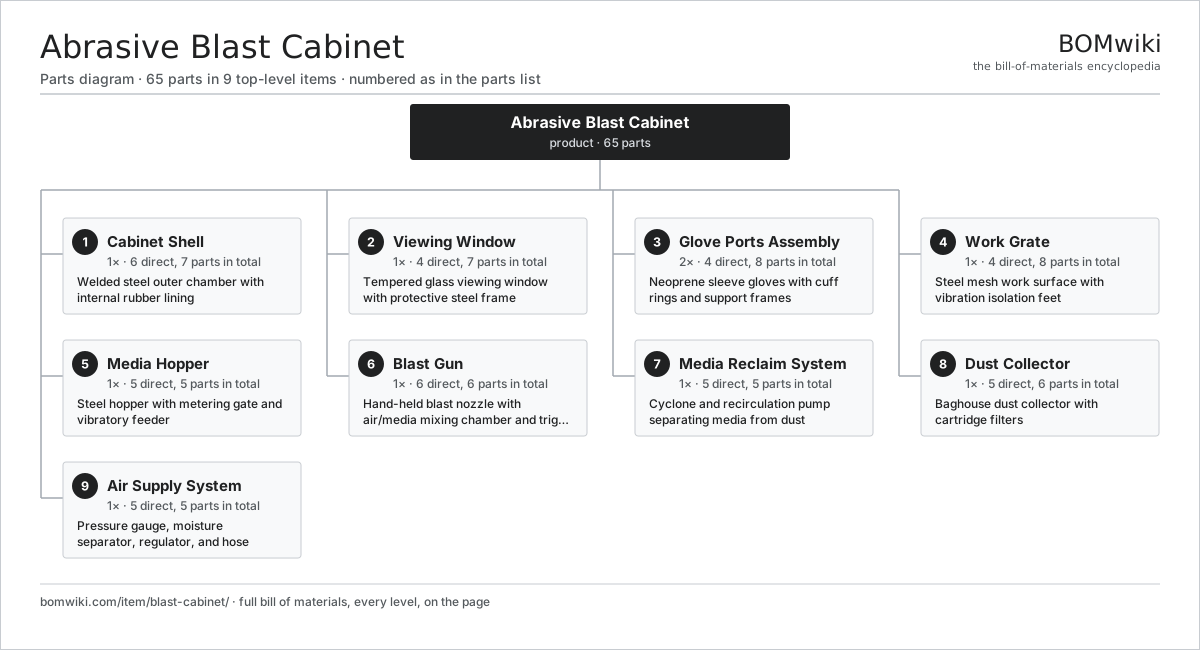
| # | Part | Qty | What it does |
|---|---|---|---|
| 1 | Cabinet Shell 6 parts | 1× | Welded steel outer chamber with internal rubber lining |
| 2 | Viewing Window 4 parts | 1× | Tempered glass viewing window with protective steel frame |
| 3 | Glove Ports Assembly 4 parts | 2× | Neoprene sleeve gloves with cuff rings and support frames |
| 4 | Work Grate 4 parts | 1× | Steel mesh work surface with vibration isolation feet |
| 5 | Media Hopper 5 parts | 1× | Steel hopper with metering gate and vibratory feeder |
| 6 | Blast Gun 6 parts | 1× | Hand-held blast nozzle with air/media mixing chamber and trigger |
| 7 | Media Reclaim System 5 parts | 1× | Cyclone and recirculation pump separating media from dust |
| 8 | Dust Collector 5 parts | 1× | Baghouse dust collector with cartridge filters |
| 9 | Air Supply System 5 parts | 1× | Pressure gauge, moisture separator, regulator, and hose |
3D model
No 3D model yet. Have a CAD file of this? Add a 3D model. STL renders right on this page; STEP, FreeCAD, and OpenSCAD sources are welcome too (openly licensed, like all 3D models on BOMwiki).
Build & assembly graph
expand / collapse · shared sub-assemblies converge · links to related products · est. labourTap an assembly to expand/collapse · tap a part to open it · use “Open page” for any node · drag to pan, scroll to zoom.
Bill of materials for Abrasive Blast Cabinet
9 top-level lines · 53 rows shown · 65 parts total · indented to 3 levels| # | Item / sub-assembly | Part no. | Qty/assy | Ext. qty | Parts | Type |
|---|---|---|---|---|---|---|
| 1 | Cabinet Shell 6 parts | blast-cabinet-cabinet-shell | 1× | 1 | 7 | assembly |
| 1.1 | Frame Structure | blast-cabinet-shell-frame | 1× | 1 | · | part |
| 1.2 | Side Panel | blast-cabinet-shell-side-panel | 2× | 2 | · | part |
| 1.3 | Front Panel | blast-cabinet-shell-front-panel | 1× | 1 | · | part |
| 1.4 | Access Door | blast-cabinet-shell-door | 1× | 1 | · | part |
| 1.5 | Rubber Lining | blast-cabinet-shell-rubber-lining | 1× | 1 | · | part |
| 1.6 | Drain Plug | blast-cabinet-shell-drain-plug | 1× | 1 | · | part |
| 2 | Viewing Window 4 parts | blast-cabinet-window-viewport | 1× | 1 | 7 | assembly |
| 2.1 | Tempered Glass | blast-cabinet-window-glass | 1× | 1 | · | part |
| 2.2 | Guard Frame | blast-cabinet-window-guard-frame | 1× | 1 | · | part |
| 2.3 | Window Gasket | blast-cabinet-window-gasket | 1× | 1 | · | part |
| 2.4 | Window Clip | blast-cabinet-window-mounting-clip | 4× | 4 | · | part |
| 3 | Glove Ports Assembly 4 parts | blast-cabinet-glove-ports | 2× | 2 | 8 | assembly |
| 3.1 | Neoprene Glove | blast-cabinet-glove-neoprene | 2× | 4 | · | part |
| 3.2 | Cuff Ring | blast-cabinet-glove-cuff-ring | 2× | 4 | · | part |
| 3.3 | Glove Support | blast-cabinet-glove-support-frame | 2× | 4 | · | part |
| 3.4 | Seal Gland | blast-cabinet-glove-seal-gland | 2× | 4 | · | part |
| 4 | Work Grate 4 parts | blast-cabinet-work-grate | 1× | 1 | 8 | assembly |
| 4.1 | Mesh Grate | blast-cabinet-grate-mesh | 1× | 1 | · | part |
| 4.2 | Grate Frame | blast-cabinet-grate-frame | 1× | 1 | · | part |
| 4.3 | Isolation Foot | blast-cabinet-grate-support-foot | 4× | 4 | · | part |
| 4.4 | Height Post | blast-cabinet-grate-height-adjuster | 2× | 2 | · | part |
| 5 | Media Hopper 5 parts | blast-cabinet-media-hopper | 1× | 1 | 5 | assembly |
| 5.1 | Hopper Shell | blast-cabinet-hopper-shell | 1× | 1 | · | part |
| 5.2 | Metering Gate | blast-cabinet-hopper-metering-gate | 1× | 1 | · | part |
| 5.3 | Vibrator Motor | blast-cabinet-hopper-vibrator | 1× | 1 | · | part |
| 5.4 | Outlet Hose | blast-cabinet-hopper-outlet-hose | 1× | 1 | · | part |
| 5.5 | Hopper Bracket | blast-cabinet-hopper-support-bracket | 1× | 1 | · | part |
| 6 | Blast Gun 6 parts | blast-cabinet-blast-gun | 1× | 1 | 6 | assembly |
| 6.1 | Gun Body | blast-cabinet-gun-body | 1× | 1 | · | part |
| 6.2 | Mixing Chamber | blast-cabinet-gun-mixing-chamber | 1× | 1 | · | part |
| 6.3 | Nozzle Tip | blast-cabinet-gun-nozzle-tip | 1× | 1 | · | part |
| 6.4 | Trigger Valve | blast-cabinet-gun-trigger | 1× | 1 | · | part |
| 6.5 | Safety Lock | blast-cabinet-gun-safety-lock | 1× | 1 | · | part |
| 6.6 | Gun Hose | blast-cabinet-gun-hose-assembly | 1× | 1 | · | part |
| 7 | Media Reclaim System 5 parts | blast-cabinet-media-reclaim-system | 1× | 1 | 5 | assembly |
| 7.1 | Cyclone | blast-cabinet-reclaim-cyclone | 1× | 1 | · | part |
| 7.2 | Reclaim Pump | blast-cabinet-reclaim-pump | 1× | 1 | · | part |
| 7.3 | Lift Hose | blast-cabinet-reclaim-hose-lift | 1× | 1 | · | part |
| 7.4 | Check Valve | blast-cabinet-reclaim-check-valve | 1× | 1 | · | part |
| 7.5 | Reclaim Filter | blast-cabinet-reclaim-filter | 1× | 1 | · | part |
| 8 | Dust Collector 5 parts | blast-cabinet-dust-collector | 1× | 1 | 6 | assembly |
| 8.1 | Collector Housing | blast-cabinet-collector-housing | 1× | 1 | · | part |
| 8.2 | Filter Cartridge | blast-cabinet-collector-cartridge-filter | 2× | 2 | · | part |
| 8.3 | Pulse Valve | blast-cabinet-collector-pulse-valve | 1× | 1 | · | part |
| 8.4 | Blower Motor | blast-cabinet-collector-motor-blower | 1× | 1 | · | part |
| 8.5 | Discharge Outlet | blast-cabinet-collector-discharge-outlet | 1× | 1 | · | part |
| 9 | Air Supply System 5 parts | blast-cabinet-air-compressor-supply | 1× | 1 | 5 | assembly |
| 9.1 | Air Hose | blast-cabinet-air-hose | 1× | 1 | · | part |
| 9.2 | Moisture Separator | blast-cabinet-air-moisture-separator | 1× | 1 | · | part |
| 9.3 | Air Regulator | blast-cabinet-air-regulator | 1× | 1 | · | part |
| 9.4 | Control Valve | blast-cabinet-air-control-valve | 1× | 1 | · | part |
| 9.5 | Safety Relief | blast-cabinet-air-safety-relief | 1× | 1 | · | part |
Something wrong in this list? Report a problem with this BOM.
Sourcing: possible vendors
Browse the supplier directory → Prices, MOQ, and lead times are algorithmic estimates, not quotes, and not claims about these companies. Company mappings are curated by keyword; est. price band $30–$800. How estimates work| Vendor | HQ | Specialty | MOQ | Lead time |
|---|---|---|---|---|
| stanleyblackanddecker.com ↗ | New Britain, US | Tools (DeWalt, Craftsman) | 500 units | 6–12 wks |
| bosch-professional.com ↗ | Leinfelden, DE | Power tools | 500 units | 6–12 wks |
| ttigroup.com ↗ | Hong Kong, CN | Tools (Milwaukee, Ryobi) | 500 units | 6–12 wks |
|
🇯🇵Makita
makita.com ↗
|
Anjo, JP | Power tools | 500 units | 6–12 wks |
|
🇨🇭Hilti
hilti.com ↗
|
Schaan, CH | Construction tools | 500 units | 6–12 wks |
1,706-word article