Blood Donation Bus
ProductOverview
A blood donation bus is a mobile collection facility operated by blood banks and the American Red Cross, collecting whole blood and blood components (plasma, platelets) from volunteer donors. The vehicle travels a rotating circuit, different neighborhoods, workplaces, colleges, and events weekly or monthly, bringing donation access to underserved populations and increasing the donor pool for blood banks.
A typical bus collects 40–60 units of blood daily, generating 10,000–15,000 units annually (at 200–250 collection days/year). A single unit of whole blood serves ~3 patients (after testing and fractionation), so one mobile collection program supplies blood to hundreds of hospital patients annually.
Phlebotomy Stations
The Phlebotomy Stations are the operational core. Four simultaneously operating collection chairs enable the blood bank to process 4 donors in parallel; a skilled phlebotomist team (2–3 technicians) can manage 40–60 collections per 8-hour shift.
Donor chair design: Reclining chair (180 degrees) with armrest for blood draw stability. An integrated BP Monitor (automated cuff) measures baseline BP before and after donation; a drop > 20 mmHg systolic signals orthostatic hypotension and potential vasovagal response (fainting risk).
Collection process (8–10 min per donor):
- Phlebotomist validates donor identity and medical history.
- BP cuff inflates, records baseline.
- Phlebotomist inserts sterile needle into antecubital vein (elbow crook).
- Blood flows via gravity into a sterile collection bag (450 mL whole blood = standard dose; plasma donors give 500 mL at lower collection rate due to anticoagulant).
- Bag is gently agitated to mix with anticoagulant (prevents clotting).
- After reaching target volume, needle is removed, pressure applied, bandage applied.
- Donor proceeds to recovery lounge.
Safety features:
- Sharps Container: Sharps containers at each station comply with OSHA bloodborne pathogen standards.
- Label Printer: Automated ID label printer produces donor ID bracelets and matching tube labels (barcoded for traceability).
- Needle safety devices: Single-use, retractable needles prevent needlestick injury to staff.
Refrigerated Storage
The Refrigerated Blood Storage maintains a strict 1–4 °C cold chain, critical for blood viability. Whole blood stored at 1–4 °C (with additive solution) remains usable for 42 days. Platelets (separated from whole blood) require room temperature (20–24 °C) agitation and last only 5 days.
Equipment:
- Blood bank refrigerator: Medical-grade unit (vs. standard commercial fridge) with precise temperature control ±0.5 °C and backup systems.
- Temperature data logger: Continuous recording (hourly minimum) of internal temperature, with automatic alerts if temp rises above 4 °C or below 1 °C. FDA requires these records for 5+ years (traceability in event of recalled blood).
- Backup inverter: If generator fails or is shut down for fuel savings, a Battery Inverter (48 VDC to 120 VAC, 30 min capacity) powers the refrigerator, buying time to start the generator or transfer blood to external cold storage.
Failure modes:
- Generator failure: Modern diesel generators are reliable, but any failure immediately triggers transition to battery backup. Operators must monitor generator status continuously.
- Power loss: Even brief shore power glitches can cause temp spikes if the automatic transfer switch does not detect loss quickly.
- Refrigerator compressor failure: Rare but catastrophic; entire donation inventory (100+ units, $5,000+ value) is lost. Mitigation: regular maintenance, spare compressor on hand, redundant cooling units in large operations.
Biohazard containment: Blood is a biohazard; any spill must be contained and disinfected per OSHA bloodborne pathogen standards. The fridge bay includes sealed drainage and absorbent pads to capture leaks.
Donor Interview and Screening
The Health Screening Interview Room is a private space where donors complete the health history questionnaire and undergo brief screening. Questions assess eligibility:
- Travel history: Recent travel to malaria/West Nile/dengue endemic regions (deferral).
- Medical conditions: Heart disease, hepatitis, HIV, cancer (most donors with these are deferred).
- Medications: Blood thinners, antibiotics (some medications require deferral periods).
- Recent vaccines: Live vaccines (MMR, varicella, yellow fever) cause temporary deferral (~4 weeks).
- Tattoos/piercings: Recent (< 3 months) cause deferral due to infection risk.
- Blood pressure: Must be 90–180 systolic, 50–100 diastolic to donate safely.
FDA and AABB (blood bank) regulations require documented screening; failure to properly screen can allow ineligible blood to enter the transfusion supply, risking patient harm (HIV, hepatitis transmission). Donors are deferred (permanently or temporarily) if they fail screening; this is a critical quality gate.
Privacy: Donor interviews are conducted in a private consultation room (curtain partition minimum) to avoid public disclosure of sensitive health information.
Donor Comfort and Recovery
The Donor Lounge and Recovery Area provides a comfortable post-donation recovery environment. Donors rest 15–20 minutes, consuming juice and snacks to replenish blood volume and stabilize blood sugar.
Potential adverse events (managed on-site):
- Vasovagal response: Sudden drop in heart rate and BP causing fainting. Occurs in ~3–5% of donors, especially first-time donors. Prevention: lying down during collection (chair recline). Treatment: keep donor supine, legs elevated, monitor BP, call EMS if prolonged.
- Hematoma: Bruising from vein puncture. Typically resolves in 2–3 weeks; ice applied during recovery reduces swelling.
- Dehydration: Donation removes 450 mL fluid; inadequate rehydration causes dizziness post-donation. Mitigation: encourage water/juice intake, donor education pre-donation.
A nurse or paramedic is staffed at the bus; protocols require EMS availability within 5 minutes for medical emergencies.
Electrical System and Generator
The Electrical and Generator System must reliably power the refrigerator 24/7 (if the bus is parked overnight at a service location) and all phlebotomy equipment, lighting, and climate control during operations.
Load profile:
- Refrigerator: 5–10 A continuous.
- Lighting: 5–10 A.
- AC/heating: 15–20 A.
- Phlebotomy equipment (BP monitors, compressor for vacuum system): 5 A.
- Computer/network: 2 A.
- Total: 30–50 A sustained.
Power sources:
- Diesel generator (30–50 kW): Runs during collection days, supplying power to the bus. Fuel consumption: 5–10 gallons/day operation. A 75-gallon onboard tank provides 1.5–2 weeks autonomy without refueling.
- Shore power inlet: 50–100 A service (at a blood bank, hospital, or facility with dedicated power). Most cost-effective for multi-day stationary sites (no generator fuel, reduced noise).
- UPS battery backup: 15–30 minute capacity provides emergency power if generator fails or shore power is interrupted.
Operational considerations:
- Generator noise (75–85 dB) can disturb residential neighborhoods. Schedule collections during business hours or use shore power when available.
- Fuel cost: $150–300/week (depending on generator use and fuel prices).
- Automatic transfer switch: Seamlessly transfers between engine alternator (while driving), shore power (when parked at facility), and generator (when parked without shore power). Manual oversight required to monitor which power source is active.
Water System and Sanitation
The Water and Handwashing System provides handwashing and cleaning water. Infection control is paramount; staff must wash hands between donors, and all surfaces must be disinfected (blood contact).
Water capacity: 50–100 gallons freshwater suffices for a day's operations (~1 gallon per 10 donors for handwashing, plus cleaning solutions). Waste water tank similarly stores used water for proper disposal (sent to municipal wastewater treatment, not dumped on-site).
Handwashing: Foot-pedal or sensor-activated sinks prevent contamination (hands do not touch the faucet). Automatic soap/sanitizer dispensers ensure adequate hand hygiene.
Cleaning protocols: After each donor, the phlebotomy station is cleaned with disinfectant (70% isopropyl alcohol or approved healthcare disinfectant) to kill pathogens. At day's end, full bus surfaces receive hospital-grade disinfection.
HVAC and Climate Control
The HVAC and Air Quality Control maintains donor comfort and operational conditions:
- Temperature: 68–74 °F (20–23 °C). Cold environments cause vasoconstriction, making venipuncture difficult; warm environments increase fainting risk.
- Humidity: 40–60% RH. Excessive humidity promotes mold; excessive dryness causes static electricity (hazardous near electrical equipment).
- Filtration: HEPA (or high-MERV) filters remove airborne pathogens, protecting staff from respiratory transmission of donor illnesses (flu, COVID-19).
- Air changes: 8–10 per hour (typical for healthcare environments).
Seasonal challenges:
- Summer (hot climates): 24,000+ BTU AC required. Failure in summer heat can cause heat stress or loss of refrigeration.
- Winter (cold climates): Optional diesel heater (Webasto or Eberspächer) provides warmth without running main engine (saves fuel, reduces emissions).
Operational Workflow
Typical collection day (8-hour session, 40–60 units collected):
- Arrival and setup (30 min): Park at collection site, connect shore power (if available). Start generator if no shore power. Verify refrigerator temp is 1–4 °C. Test BP monitors, printers, needle safety devices.
- Staff briefing (10 min): Phlebotomist team reviews donor schedule, special needs (wheelchair access, etc.), and emergency protocols.
- Donor intake (6.5 hours): Donors pre-registered or walk-in. Screening (10 min), phlebotomy (8–10 min), recovery (15 min). 4 stations × 6–7 donors per station per day = 40–60 donations.
- Equipment cleanup and specimen processing (30 min): Blood units are labeled, inventoried, and refrigerated. Phlebotomy stations are disinfected. Sharps containers are sealed and staged for biohazard disposal.
- Shutdown (20 min): Generator shut down, refrigerator switched to shore power (or engine alternator if driving). Fridge doors secured. Bus made ready for next location.
Staffing: Typically 1 registered nurse (collection supervisor) + 2 phlebotomists + 1 administrative coordinator per bus.
Regulatory and Safety Compliance
Blood bank regulations (FDA, AABB):
- Donor deferral guidelines: Strict criteria for who can donate (mandatory FDA rules).
- Specimen handling: Chain of custody, barcode tracking, temperature logging.
- Quality assurance: Daily equipment maintenance, temperature monitoring, donor adverse event reporting.
- Testing: All donations are tested for HIV, hepatitis B/C, syphilis, and other pathogens; any positive result is confidentially reported to the donor and the donation is discarded.
Transportation regulations (DOT, OSHA):
- Bloodborne pathogen standard: Sharps safety, personal protective equipment (gloves, aprons), exposure control plan.
- Medical waste disposal: Sharps and contaminated materials are shipped to licensed medical waste incinerator.
Cost of compliance: $2,000–5,000 annually for permits, testing oversight, and medical waste disposal.
Cost of Ownership
Capital:
- Used transit bus (5–10 years old): $40,000–60,000.
- Phlebotomy equipment retrofit (chairs, refrigerator, generator, interview setup): $60,000–100,000.
- Total: $100,000–160,000 per vehicle.
Operating cost (annual, 200 collection days/year):
- Fuel: $8,000–12,000 (generator + driving, 10–15 gal/day × 200 days).
- Maintenance: $3,000–5,000.
- Medical waste disposal: $2,000–3,000.
- Staffing: $120,000–150,000 (nurse + 2 phlebotomists).
- Testing and supplies: $5,000–8,000.
- Insurance: $3,000–5,000.
- Depreciation: $8,000–10,000.
- Total: $149,000–193,000 per year.
Revenue: Blood banks are nonprofit or government-operated; no direct revenue. Funding comes from:
- Government health departments.
- Hospital blood bank contracts (buy units at ~$250–350 per unit wholesale).
- American Red Cross operating budget.
Break-even: At 50 units/day × 200 days = 10,000 units/year at $300 wholesale cost = $3,000,000 revenue stream to blood bank. Against $170,000 operating cost per bus, the economics are strong (17:1 revenue:cost ratio). This why most blood banks operate 5–20 mobile collection vehicles.
Blood Donation Bus parts and their functions
8 top-level parts · 124 parts in total · full bill of materials below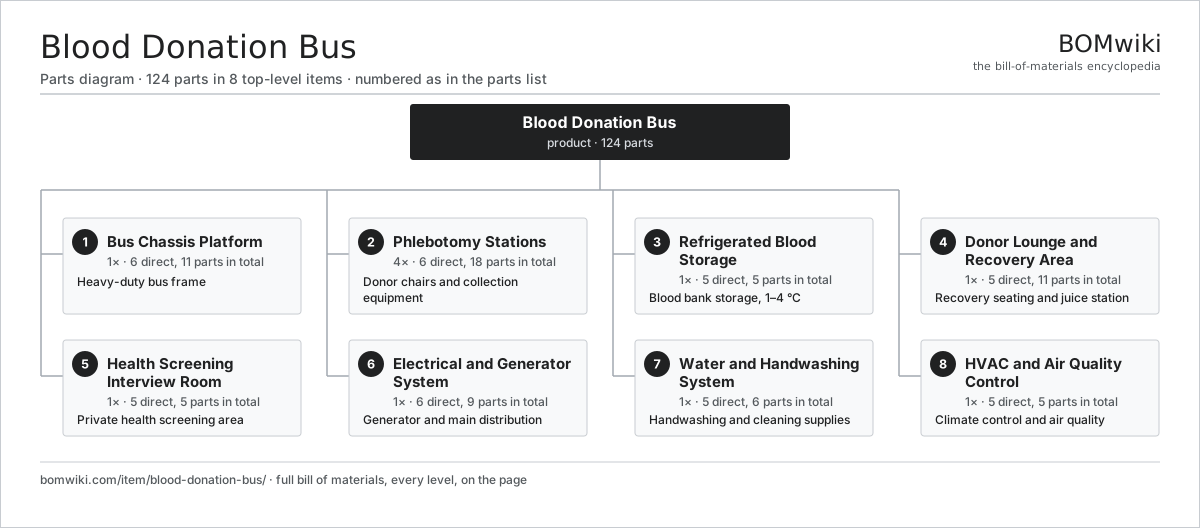
| # | Part | Qty | What it does |
|---|---|---|---|
| 1 | Bus Chassis Platform 6 parts | 1× | Heavy-duty bus frame |
| 2 | Phlebotomy Stations 6 parts | 4× | Donor chairs and collection equipment |
| 3 | Refrigerated Blood Storage 5 parts | 1× | Blood bank storage, 1–4 °C |
| 4 | Donor Lounge and Recovery Area 5 parts | 1× | Recovery seating and juice station |
| 5 | Health Screening Interview Room 5 parts | 1× | Private health screening area |
| 6 | Electrical and Generator System 6 parts | 1× | Generator and main distribution |
| 7 | Water and Handwashing System 5 parts | 1× | Handwashing and cleaning supplies |
| 8 | HVAC and Air Quality Control 5 parts | 1× | Climate control and air quality |
3D model
No 3D model yet. Have a CAD file of this? Add a 3D model. STL renders right on this page; STEP, FreeCAD, and OpenSCAD sources are welcome too (openly licensed, like all 3D models on BOMwiki).
Build & assembly graph
expand / collapse · shared sub-assemblies converge · links to related products · est. labourTap an assembly to expand/collapse · tap a part to open it · use “Open page” for any node · drag to pan, scroll to zoom.
Bill of materials for Blood Donation Bus
8 top-level lines · 51 rows shown · 124 parts total · indented to 3 levels| # | Item / sub-assembly | Part no. | Qty/assy | Ext. qty | Parts | Type |
|---|---|---|---|---|---|---|
| 1 | Bus Chassis Platform 6 parts | blood-donation-bus-chassis | 1× | 1 | 11 | assembly |
| 1.1 | Frame | blood-donation-bus-frame | 1× | 1 | · | part |
| 1.2 | Engine | blood-donation-bus-engine | 1× | 1 | · | part |
| 1.3 | Transmission | blood-donation-bus-transmission | 1× | 1 | · | part |
| 1.4 | Suspension | blood-donation-bus-suspension | 1× | 1 | · | part |
| 1.5 | Wheels and Tires | blood-donation-bus-wheels-tires | 6× | 6 | · | part |
| 1.6 | Brake System | blood-donation-bus-brake-system | 1× | 1 | · | part |
| 2 | Phlebotomy Stations 6 parts | blood-donation-bus-phlebotomy-stations | 4× | 4 | 18 | assembly |
| 2.1 | Donor Chair | blood-donation-bus-donor-chair | 4× | 16 | · | part |
| 2.2 | BP Monitor | blood-donation-bus-blood-pressure-monitor | 4× | 16 | · | part |
| 2.3 | Bag Holder | blood-donation-bus-collection-bag-holder | 4× | 16 | · | part |
| 2.4 | Sharps Container | blood-donation-bus-needle-disposal | 4× | 16 | · | part |
| 2.5 | Collection Kit | blood-donation-bus-collection-kit-supplies | 1× | 4 | · | part |
| 2.6 | Label Printer | blood-donation-bus-wrist-band-printer | 1× | 4 | · | part |
| 3 | Refrigerated Blood Storage 5 parts | blood-donation-bus-refrigerated-storage | 1× | 1 | 5 | assembly |
| 3.1 | Blood Bank Refrigerator | blood-donation-bus-blood-bank-unit | 1× | 1 | · | part |
| 3.2 | Temperature Controller | blood-donation-bus-temperature-controller | 1× | 1 | · | part |
| 3.3 | Battery Inverter | blood-donation-bus-backup-battery-inverter | 1× | 1 | · | part |
| 3.4 | Data Logger | blood-donation-bus-temperature-data-logger | 1× | 1 | · | part |
| 3.5 | Biohazard Containment | blood-donation-bus-biohazard-containment | 1× | 1 | · | part |
| 4 | Donor Lounge and Recovery Area 5 parts | blood-donation-bus-donor-lounge | 1× | 1 | 11 | assembly |
| 4.1 | Recovery Chair | blood-donation-bus-recovery-seating | 6× | 6 | · | part |
| 4.2 | Juice Station | blood-donation-bus-juice-station | 1× | 1 | · | part |
| 4.3 | Monitoring Station | blood-donation-bus-monitoring-chair | 1× | 1 | · | part |
| 4.4 | Waste Container | blood-donation-bus-trash-bins | 2× | 2 | · | part |
| 4.5 | Restroom | blood-donation-bus-restroom-access | 1× | 1 | · | part |
| 5 | Health Screening Interview Room 5 parts | blood-donation-bus-interview-room | 1× | 1 | 5 | assembly |
| 5.1 | Interview Partition | blood-donation-bus-interview-partition | 1× | 1 | · | part |
| 5.2 | Interview Desk | blood-donation-bus-interview-desk | 1× | 1 | · | part |
| 5.3 | Questionnaire Kiosk | blood-donation-bus-health-questionnaire-kiosk | 1× | 1 | · | part |
| 5.4 | BP Cuff | blood-donation-bus-bp-cuff-interview | 1× | 1 | · | part |
| 5.5 | Records Storage | blood-donation-bus-confidentiality-storage | 1× | 1 | · | part |
| 6 | Electrical and Generator System 6 parts | blood-donation-bus-electrical-system | 1× | 1 | 9 | assembly |
| 6.1 | Diesel Generator | blood-donation-bus-diesel-generator | 1× | 1 | · | part |
| 6.2 | Breaker Panel | blood-donation-bus-main-breaker-panel | 1× | 1 | · | part |
| 6.3 | Transfer Switch | blood-donation-bus-transfer-switch | 1× | 1 | · | part |
| 6.4 | Shore Power Inlet | blood-donation-bus-shore-power-inlet | 1× | 1 | · | part |
| 6.5 | UPS System | blood-donation-bus-ups-uninterruptible-power | 1× | 1 | · | part |
| 6.6 | Lighting Circuit | blood-donation-bus-lighting-circuits | 4× | 4 | · | part |
| 7 | Water and Handwashing System 5 parts | blood-donation-bus-water-system | 1× | 1 | 6 | assembly |
| 7.1 | Fresh Water Tank | blood-donation-bus-fresh-water-tank | 1× | 1 | · | part |
| 7.2 | Handwash Sink | blood-donation-bus-handwash-station | 2× | 2 | · | part |
| 7.3 | Sanitizer Dispenser | blood-donation-bus-soap-sanitizer-dispenser | 1× | 1 | · | part |
| 7.4 | Waste Water Tank | blood-donation-bus-waste-water-tank | 1× | 1 | · | part |
| 7.5 | Supply Storage | blood-donation-bus-cleaning-supply-storage | 1× | 1 | · | part |
| 8 | HVAC and Air Quality Control 5 parts | blood-donation-bus-hvac | 1× | 1 | 5 | assembly |
| 8.1 | AC Unit | blood-donation-bus-ac-unit | 1× | 1 | · | part |
| 8.2 | Furnace | blood-donation-bus-furnace | 1× | 1 | · | part |
| 8.3 | HEPA Filter | blood-donation-bus-hepa-filter | 1× | 1 | · | part |
| 8.4 | Exhaust Vent | blood-donation-bus-exhaust-vent | 1× | 1 | · | part |
| 8.5 | Thermostat | blood-donation-bus-thermostat-control | 1× | 1 | · | part |
Something wrong in this list? Report a problem with this BOM.
Sourcing: possible vendors
Browse the supplier directory → Prices, MOQ, and lead times are algorithmic estimates, not quotes, and not claims about these companies. Company mappings are curated by keyword; est. price band $500k–$60M. How estimates work| Vendor | HQ | Specialty | MOQ | Lead time |
|---|---|---|---|---|
|
🇨🇳CRRC
crrcgc.cc ↗
|
Beijing, CN | Rolling stock & rail systems | made to order | 40–72 wks |
|
🇫🇷Alstom
alstom.com ↗
|
Saint-Ouen, FR | Rail rolling stock | made to order | 40–72 wks |
| mobility.siemens.com ↗ | Munich, DE | Rail systems | made to order | 40–72 wks |
| stadlerrail.com ↗ | Bussnang, CH | Rail rolling stock | made to order | 40–72 wks |
|
🇺🇸Wabtec
wabteccorp.com ↗
|
Pittsburgh, US | Rail equipment | made to order | 40–72 wks |
1,836-word article