Blow Molding Machine
ProductOverview
Blow molding is the industrial process for manufacturing hollow plastic articles, beverage bottles, fuel tanks, detergent jugs, buoys, industrial drums, and complex multi-chamber fluid reservoirs. The Extrusion Head Assembly extrudes a parison (a hollow tube of hot plastic) that hangs into an open mold cavity. The mold closes around the parison, and compressed air from the Blow Air Distribution inflates it to the cavity walls, where it cools and solidifies. When cooled, the mold opens and the part is ejected.
Single-station EBM machines are common in small to mid-volume production; carousel or rotary machines with 4–8 stations increase throughput by allowing multiple cycles to progress simultaneously. The process is energy-efficient because material exits the extruder as a soft parison that is already at the right temperature, avoiding the cooling and reheating penalty of injection molding.
Extrusion subsystem
The Barrel & Screw Assembly assembly feeds resin into the Extrusion Head Assembly. As it enters, the barrel is maintained at 200–280 °C (depending on polymer: HDPE 230 °C, PET 270 °C, PVC 190 °C). The screw rotates at 30–80 RPM to compress, heat, and plasticize the pellets into a uniform melt. Pressure builds behind the Head Die, which consists of an annular (ring-shaped) opening around a fixed mandrel; this geometry extrudes the parison as a hollow tube, typically 3–8 mm wall thickness at this stage.
The Die Heater maintains the die 10–20 °C above melt temperature to prevent premature cooling and skin formation. Parison wall thickness is controlled by the die gap and by varying the screw speed (faster screw = thicker parison wall because more material is pushed toward the die per unit time). Excess parison is allowed to accumulate; every cycle, the parison drops into the open mold, and the old excess (if any) is trimmed and recycled.
Mold clamping and closure
The Mold Clamp Assembly is hydraulically actuated and generates 50–500 tons of clamping force, depending on the required internal blow pressure and part size. The Clamp Cylinder (one or two, depending on machine design) extends, pushing the Clamp Plate together and closing the mold. The Clamp Guide Bush bushings maintain strict alignment so the two Mold Cavity Half halves meet flush and do not misalign under uneven pressure.
Mold closure must be rapid (1–3 seconds) to catch the falling parison before it sags too much. A Clamp Safety Latch provides mechanical safety: an over-center toggle that locks the mold and prevents unintended opening even if hydraulic pressure is lost.
Blow sequence and air pressure
Once the mold is closed, the parison is still hot and soft inside the cavity. High-pressure air from the Compressed Air System is introduced into the cavity through the Blow Air Manifold, which channels it through Blow Needle pins built into the mold. The air inflates the parison against the cavity walls. The blow pressure is typically 5–10 bar (50–100 psi), applied for 2–10 seconds depending on part size and wall thickness.
During the blow phase, the part cools rapidly against the mold walls because mold temperature is controlled at 40–70 °C (chilled via integrated cooling lines or external chillers). The Check Valve (Air) prevents backflow of air, and Solenoid Valve (Blow) modules meter the air pulse duration and venting under PLC control.
Cooling and ejection
The part must cool long enough to achieve sufficient mechanical strength for ejection without distortion, typically 5–30 seconds depending on polymer and wall thickness. Once solid, the Cooling Core (water passages in the mold) speeds cooling. The mold opens, and Eject Pin springs push the finished part from the cavity into a chute or conveyor.
The excess parison (the "flash" or "trim") remains attached to the part. In high-end machines, inline trim dies or pneumatic shears cut it off; in others, a secondary manual or automated trimming station completes the process. The flash is regrind and recycled back into the hopper.
Hydraulics and control
The Hydraulic System subsystem supplies pressure for mold clamping and any auxiliary functions (secondary injectors, rotary platens). A variable-displacement Hydraulic Pump driven by a 7.5–15 kW motor supplies 150–250 bar nominal, with a Pressure Relief Valve relief set at 280 bar. The pump displacement varies under load feedback, reducing energy consumption during idle phases of the cycle. The Accumulator buffers pressure spikes and provides reserve volume for rapid mold opening.
The Controller & Sequencer (a PLC or dedicated sequencer) orchestrates the entire cycle: trigger extrusion, monitor extrusion time, fire the mold-close solenoid, wait for pressure confirmation, pulse the blow air, wait for cooling, and signal mold open and eject. Proximity Sensor feedback tells the controller when the mold is fully open and fully closed; Pressure Transducer inputs monitor hydraulic and cavity pressure to detect fault conditions (mold not closing, insufficient blow pressure, etc.).
Compressed air system
High-quality blow air is critical: moisture and particulate cause part defects and dimensional drift. The Air Compressor (if not shared plant air) delivers 100–300 L/min at 5–10 bar. This flows through the Air Receiver Tank tank (buffer), a Air Dryer (refrigerant or desiccant) reducing dew point to below −20 °C, a Air Filter to 3 µm, and finally a Air Regulator that sets the blow pressure for the mold. No oil or moisture can reach the blow circuit.
Multi-station and rotary machines
High-volume plants use rotary or carousel blow-molding machines: a rotating turret with 4, 6, or 8 mold stations arranged in a circle. While one station blows and cools, the others are in different phases, extrusion phase, cooling phase, ejection phase. This pipeline increases throughput dramatically; a machine with 8 stations running on a 30-second cycle produces parts at six times the rate of a single-station machine.
Blow Molding Machine parts and their functions
8 top-level parts · 83 parts in total · full bill of materials below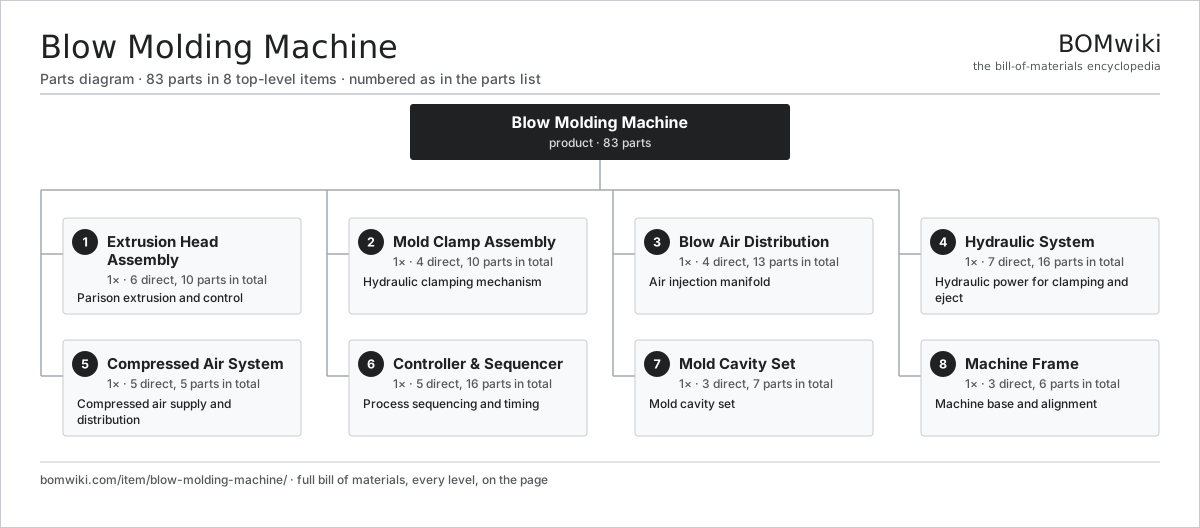
| # | Part | Qty | What it does |
|---|---|---|---|
| 1 | Extrusion Head Assembly 6 parts | 1× | Parison extrusion and control |
| 2 | Mold Clamp Assembly 4 parts | 1× | Hydraulic clamping mechanism |
| 3 | Blow Air Distribution 4 parts | 1× | Air injection manifold |
| 4 | Hydraulic System 7 parts | 1× | Hydraulic power for clamping and eject |
| 5 | Compressed Air System 5 parts | 1× | Compressed air supply and distribution |
| 6 | Controller & Sequencer 5 parts | 1× | Process sequencing and timing |
| 7 | Mold Cavity Set 3 parts | 1× | Mold cavity set |
| 8 | Machine Frame 3 parts | 1× | Machine base and alignment |
3D model
No 3D model yet. Have a CAD file of this? Add a 3D model. STL renders right on this page; STEP, FreeCAD, and OpenSCAD sources are welcome too (openly licensed, like all 3D models on BOMwiki).
Build & assembly graph
expand / collapse · shared sub-assemblies converge · links to related products · est. labourTap an assembly to expand/collapse · tap a part to open it · use “Open page” for any node · drag to pan, scroll to zoom.
Bill of materials for Blow Molding Machine
8 top-level lines · 45 rows shown · 83 parts total · indented to 3 levels| # | Item / sub-assembly | Part no. | Qty/assy | Ext. qty | Parts | Type |
|---|---|---|---|---|---|---|
| 1 | Extrusion Head Assembly 6 parts | blow-molding-machine-extrusion-head | 1× | 1 | 10 | assembly |
| 1.1 | Extrusion Barrel | blow-molding-machine-barrel | 1× | 1 | · | part |
| 1.2 | Extrusion Screw | blow-molding-machine-screw | 1× | 1 | · | part |
| 1.3 | Head Die | blow-molding-machine-head-die | 1× | 1 | · | part |
| 1.4 | Die Heater | blow-molding-machine-die-heater | 1× | 1 | · | part |
| 1.5 | Ball Bearing | ball-bearing | 4× | 4 | · | part |
| 1.6 | Oil Seal | oil-seal | 2× | 2 | · | part |
| 2 | Mold Clamp Assembly 4 parts | blow-molding-machine-mold-clamp | 1× | 1 | 10 | assembly |
| 2.1 | Clamp Cylinder | blow-molding-machine-clamp-cylinder | 2× | 2 | · | part |
| 2.2 | Clamp Plate | blow-molding-machine-clamp-plate | 2× | 2 | · | part |
| 2.3 | Clamp Guide Bush | blow-molding-machine-clamp-guide | 4× | 4 | · | part |
| 2.4 | Clamp Safety Latch | blow-molding-machine-clamp-latch | 2× | 2 | · | part |
| 3 | Blow Air Distribution 4 parts | blow-molding-machine-blow-pins | 1× | 1 | 13 | assembly |
| 3.1 | Blow Air Manifold | blow-molding-machine-blow-manifold | 1× | 1 | · | part |
| 3.2 | Blow Needle | blow-molding-machine-blow-needle | 4× | 4 | · | part |
| 3.3 | Check Valve (Air) | blow-molding-machine-check-valve | 4× | 4 | · | part |
| 3.4 | Solenoid Valve (Blow) | blow-molding-machine-solenoid-valve | 4× | 4 | · | part |
| 4 | Hydraulic System 7 parts | blow-molding-machine-hydraulics | 1× | 1 | 16 | assembly |
| 4.1 | Hydraulic Pump | blow-molding-machine-hydraulic-pump | 1× | 1 | · | part |
| 4.2 | Pump Drive Motor | blow-molding-machine-hydraulic-motor | 1× | 1 | · | part |
| 4.3 | Hydraulic Tank | blow-molding-machine-hydraulic-tank | 1× | 1 | · | part |
| 4.4 | Pressure Relief Valve | blow-molding-machine-pressure-valve | 2× | 2 | · | part |
| 4.5 | Directional Valve | blow-molding-machine-directional-valve | 2× | 2 | · | part |
| 4.6 | Accumulator | blow-molding-machine-accumulator | 1× | 1 | · | part |
| 4.7 | Hose & Fittings | blow-molding-machine-hose-fittings | 8× | 8 | · | part |
| 5 | Compressed Air System 5 parts | blow-molding-machine-air-system | 1× | 1 | 5 | assembly |
| 5.1 | Air Compressor | blow-molding-machine-air-compressor | 1× | 1 | · | part |
| 5.2 | Air Receiver Tank | blow-molding-machine-air-receiver | 1× | 1 | · | part |
| 5.3 | Air Dryer | blow-molding-machine-air-dryer | 1× | 1 | · | part |
| 5.4 | Air Regulator | blow-molding-machine-air-regulator | 1× | 1 | · | part |
| 5.5 | Air Filter | blow-molding-machine-air-filter | 1× | 1 | · | part |
| 6 | Controller & Sequencer 5 parts | blow-molding-machine-controller | 1× | 1 | 16 | assembly |
| 6.1 | PLC Module | blow-molding-machine-plc | 1× | 1 | · | part |
| 6.2 | Operator Panel | blow-molding-machine-operator-panel | 1× | 1 | · | part |
| 6.3 | Pressure Transducer | blow-molding-machine-pressure-transducer | 2× | 2 | · | part |
| 6.4 | Proximity Sensor | blow-molding-machine-proximity-sensor | 4× | 4 | · | part |
| 6.5 | Relay | relay | 8× | 8 | · | part |
| 7 | Mold Cavity Set 3 parts | blow-molding-machine-mold | 1× | 1 | 7 | assembly |
| 7.1 | Mold Cavity Half | blow-molding-machine-mold-cavity | 2× | 2 | · | part |
| 7.2 | Cooling Core | blow-molding-machine-mold-cooling-core | 1× | 1 | · | part |
| 7.3 | Eject Pin | blow-molding-machine-eject-pin | 4× | 4 | · | part |
| 8 | Machine Frame 3 parts | blow-molding-machine-frame | 1× | 1 | 6 | assembly |
| 8.1 | Base Frame | blow-molding-machine-baseframe | 1× | 1 | · | part |
| 8.2 | Tie Bar | blow-molding-machine-tie-bar | 4× | 4 | · | part |
| 8.3 | Fastener Set | fastener-set | 1× | 1 | · | part |
Something wrong in this list? Report a problem with this BOM.
Related products
same domain, ranked by shared parts Briquetting Press
92 parts · shares 2 with this page
Briquetting Press
92 parts · shares 2 with this page
Sourcing: possible vendors
Browse the supplier directory → Prices, MOQ, and lead times are algorithmic estimates, not quotes, and not claims about these companies. Company mappings are curated by keyword; est. price band $5k–$2M. How estimates work| Vendor | HQ | Specialty | MOQ | Lead time |
|---|---|---|---|---|
| atlascopco.com ↗ | Stockholm, SE | Compressors & industrial | 10 units | 12–20 wks |
|
🇦🇹Andritz
andritz.com ↗
|
Graz, AT | Process plants & machinery | 10 units | 12–20 wks |
| buhlergroup.com ↗ | Uzwil, CH | Food & materials processing | 10 units | 12–20 wks |
| gea.com ↗ | Düsseldorf, DE | Process technology | 10 units | 12–20 wks |
| mhi.com ↗ | Tokyo, JP | Heavy machinery | 10 units | 12–20 wks |
1,049-word article