Boat Trailer
ProductOverview
A boat trailer is a specialised towed vehicle designed for single-use: holding a leisure boat securely while being towed to and from the launch site on public roads. The Frame Structure is welded steel, engineered for the repetitive flexing and impact loads of repeated ramp launches. The Bunk System cradles the boat hull on soft Pad Material, distributing the weight evenly. The Axle Assembly and Braking System are sized for the loaded weight (boat plus gear). The Winch Assembly draws the boat up the launching ramp; the Coupling and Hitch couples to the tow vehicle.
Boat trailers are ubiquitous in recreational boating. The average leisure boat owner uses a trailer 30–40 times per year, launching and retrieving the boat at public ramps. A well-maintained trailer can operate for 15–20 years with minimal expense; poor maintenance (missing wheel bearings, corroded brake lines, seized suspension) leads to failure and expensive towing bills.
Frame design
The Frame Structure is all-welded mild steel, typically formed from C-channel or I-beam Main Rails running the full length. Cross-bracing consists of eight or more Cross Member angle or tube sections bolted or welded at regular intervals. The Tongue extends forward, receiving the Coupling and Hitch; it must be rigid and designed to handle a tongue load of 5–10% of the total trailer weight (100–300 kg), concentrated at a single point.
Wheel Mounting Plate are welded at the axle positions; the Axle Assembly bolts rigidly to these pads. Corner Bracket gussets stiffen the frame at corners. Small Frame Drain Hole drilled in the channel section prevent water accumulation inside the tube; water trapped inside causes rapid rust and structural failure.
The entire frame is painted with a two-part epoxy or polyester primer and topcoat; touch-ups are needed annually to prevent flash rust on bare welds.
Axle and wheels
The Axle Assembly carries the boat's weight on a Axle Beam (typically a forged or fabricated drop-axle or torsion-bar axle). Each wheel is supported by a Hub Assembly containing Wheel Bearing (tapered roller or ball type). The bearings must be packed with waterproof grease quarterly and the wheel removed and inspected annually.
The Wheel Rim is typically 14–15 inches diameter, rated for the axle load. A common failure point is overloading: boat trailers are often loaded with extra gear (fuel cans, fishing tackle, camping equipment) that pushes the payload beyond the rated capacity, causing rapid bearing wear and potential wheel failure at highway speed.
Each wheel is fastened by five Wheel Stud and Lug Nut; the nuts must be torqued to factory spec (typically 80–120 N⋅m) and rechecked after the first few trips.
Braking system
The Braking System is typically a surge brake, a Master Cylinder mounted on the tongue behind the hitch, actuated by the tow vehicle's deceleration. When the tow vehicle brakes and decelerates, the trailer's inertia compresses the master cylinder via the coupling ball-socket, which pressurises brake fluid and activates the wheel cylinders, causing the Brake Pad Kit or brake shoes to grip the Brake Drum.
Surge brakes are simple and require no electrical connection, making them reliable in harsh saltwater environments. Brake Line run the length of the frame in metal tubing, connected to each wheel. A Brake Proportioning Valve (a pressure-limiting valve in the master cylinder) ensures the rear axles do not lock before the front, preventing jackknifing.
Modern trailers often use electric-over-hydraulic brakes instead: an electrical signal from the tow vehicle activates an electric motor on the trailer, which pressurises the brake fluid. This allows smoother proportioning and backup control if the trailer becomes detached.
Brake Fluid Reservoir holds DOT-3 or DOT-4 fluid; the fluid should be changed every 1–2 years to remove moisture (brake fluid is hygroscopic). Corrosion of Brake Line and calipers is a common failure mode in trailers stored near saltwater or in damp climates.
Suspension
The Suspension System isolates wheels from the frame, reducing shock transmission to the boat. Most boat trailers use Leaf Spring (3–4 leaves, curved steel plates clipped and bolted in a stack) mounted beneath the frame. As the wheel rises over a bump, the spring flexes, absorbing the energy gradually. Shock Absorber hydraulic dampers prevent oscillation after the bump passes. Bump Stop rubber blocks limit maximum spring compression, protecting the frame.
Leaf springs are inexpensive and robust; they require minimal maintenance except for occasional greasing of the shackle pins. Torsion-bar suspension (a rotational spring element inside a tube) is found on some trailers; it is more compact but less serviceable.
Bunk system and launching
The Bunk System cradles the boat hull. Each bunk consists of a Bunk Support transverse beam padded with Pad Material (closed-cell polyethylene or EVA foam sheet, 5–10 cm thick). The soft pads protect the bottom paint and prevent stress concentration on sharp frame edges.
The bunks are positioned so the boat sits on two or three pads along its keel line; this distributes the weight evenly and prevents the hull from rocking side-to-side on the road. Side Guide vertical arms or rollers on each side keep the boat centred; they are critical during launching, when the boat is floating and could shift laterally as it floats free.
When launching, the skipper backs the trailer down the ramp until the bunks submerge to roughly 60–70% of the trailer's height. The boat begins to float; the skipper continues backing slowly until the boat is floating freely. The Adjustable Roller (a rotating drum amidships) allows the boat to slide freely aft as it floats, without friction. Retrieving is the reverse: the skipper winches the floating boat forward onto the bunks, then drives the trailer up the ramp.
Winch assembly
The Winch Assembly is mounted on the tongue and draws the boat up the ramp during retrieval. Most winches are electric (Winch Motor, 12 V or 24 V DC), powered by the tow vehicle's battery. The motor drives a Winch Drum (a metal spool) which winds the Winch Cable (typically 3/8 inch galvanised steel wire rope, 15–25 m long). The cable exits through a Cable Fairlead roller and is attached to the boat via a Cable Hook shackled to the boat's bow eye.
A Winch Control Switch (wireless remote or wired pendant) allows the skipper to control the winch direction from the ramp while standing beside the boat. A Rope Guard cage prevents entanglement or abrasion of the cable.
Winch failure is a common problem: seized bearings, stripped gears, or corroded cables. The cable should be inspected for rust and kinks before every season; if corrosion is visible, it should be replaced immediately. Manual winches (crank-handle types) are found on older or very small trailers; they are slow but extremely reliable.
Lighting and coupling
The Lighting System system is required on all trailers in most jurisdictions. Typically, a Tail Light and Brake Light (red LEDs) are mounted on the rear. A License Light (white) illuminates the number plate. Clearance Light (amber) mark the sides. All lights are connected via a Wiring Harness to a Light Connector that plugs into the tow vehicle's electrical socket (typically a 7-pin or 4-pin standard connector).
The Coupling and Hitch is the critical interface. Most recreational trailers use a 2 5/16 inch Ball Hitch, a standardised ball stud bolted to the tongue, received by a socket on the tow vehicle. The hitch must be rated for both vertical tongue load and horizontal towing load; over-towing (hitching a trailer heavier than the vehicle's rated capacity) causes brake failure and loss of steering.
Safety Chain (Grade-70 chain, crossing under the tongue) and a Breakaway Cable (a mechanical cable pulling the brake master cylinder if the ball joint detaches) are required by law; they are your backup if the hitch fails.
Parking and storage
A Jack Leg (manual screw or electric motor) allows the skipper to raise and lower the tongue for parking. When parked, the jack leg supports the tongue weight, removing load from the tow vehicle bumper and hitch ball.
Storage should be in a dry, covered location. Trailers left outside in rain and salt spray deteriorate rapidly: rust propagates in wheel bearings, brake lines corrode internally, the frame welds crack under repeated flexing. A boat cover protects the hull; a trailer cover (canvas tarp or fiberglass frame) protects the frame and bunks.
Maintenance schedule
Regular maintenance is inexpensive and keeps a trailer reliable for decades:
- Before each launch: Visual inspection of tyres, lights, winch cable and safety chains.
- Quarterly: Repack wheel bearings with waterproof grease, rinse the frame with fresh water.
- Annually: Replace wheel bearing seals, inspect brake pads, change brake fluid, touch up paint on welds.
- Every 2–3 years: Replace brake hose, inspect axle welds for cracks.
- Every 5 years: Overhaul winch motor, replace winch cable if corroded.
Trailers that are poorly maintained often suffer catastrophic failure (wheel seizure, brake failure, hitch fracture) at highway speed, potentially causing an accident. Regular inspections are not optional.
Boat Trailer parts and their functions
8 top-level parts · 161 parts in total · full bill of materials below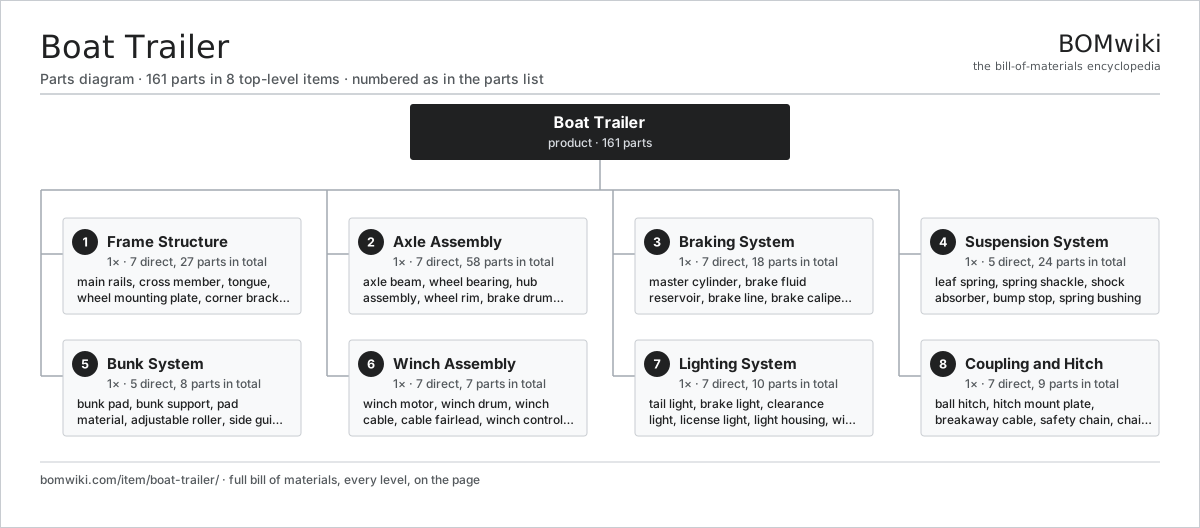
| # | Part | Qty | What it does |
|---|---|---|---|
| 1 | Frame Structure 7 parts | 1× | Welded steel channel and angle forming the structural backbone and cross-members. |
| 2 | Axle Assembly 7 parts | 1× | Drum or disc brake axles with wheels and bearings, typically tandem (two axles) for boats over 4 tonnes. |
| 3 | Braking System 7 parts | 1× | Surge or hydraulic brakes, master cylinder, brake lines and brake shoes. |
| 4 | Suspension System 5 parts | 1× | Leaf springs or torsion bars isolating wheels from frame, with shock absorbers. |
| 5 | Bunk System 5 parts | 1× | Support pads or rollers cradling the boat hull and distributing load. |
| 6 | Winch Assembly 7 parts | 1× | Electric or manual winch mounted on the tongue, drawing the boat up the ramp. |
| 7 | Lighting System 7 parts | 1× | LED or incandescent tail lights, brake lights and licence-plate illumination. |
| 8 | Coupling and Hitch 7 parts | 1× | Ball or pintle hitch coupling the trailer to the tow vehicle, with safety chains. |
3D model
No 3D model yet. Have a CAD file of this? Add a 3D model. STL renders right on this page; STEP, FreeCAD, and OpenSCAD sources are welcome too (openly licensed, like all 3D models on BOMwiki).
Build & assembly graph
expand / collapse · shared sub-assemblies converge · links to related products · est. labourTap an assembly to expand/collapse · tap a part to open it · use “Open page” for any node · drag to pan, scroll to zoom.
Bill of materials for Boat Trailer
8 top-level lines · 60 rows shown · 161 parts total · indented to 3 levels| # | Item / sub-assembly | Part no. | Qty/assy | Ext. qty | Parts | Type |
|---|---|---|---|---|---|---|
| 1 | Frame Structure 7 parts | boat-trailer-frame-structure | 1× | 1 | 27 | assembly |
| 1.1 | Main Rails | boat-trailer-main-rails | 2× | 2 | · | part |
| 1.2 | Cross Member | boat-trailer-cross-member | 8× | 8 | · | part |
| 1.3 | Tongue | boat-trailer-tongue | 1× | 1 | · | part |
| 1.4 | Wheel Mounting Plate | boat-trailer-wheel-mounting-plate | 2× | 2 | · | part |
| 1.5 | Corner Bracket | boat-trailer-corner-bracket | 8× | 8 | · | part |
| 1.6 | Fender Bracket | boat-trailer-fender-bracket | 2× | 2 | · | part |
| 1.7 | Frame Drain Hole | boat-trailer-frame-drain-hole | 4× | 4 | · | part |
| 2 | Axle Assembly 7 parts | boat-trailer-axle-assembly | 1× | 1 | 58 | assembly |
| 2.1 | Axle Beam | boat-trailer-axle-beam | 2× | 2 | · | part |
| 2.2 | Wheel Bearing | boat-trailer-wheel-bearing | 4× | 4 | · | part |
| 2.3 | Hub Assembly | boat-trailer-hub-assembly | 4× | 4 | · | part |
| 2.4 | Wheel Rim | boat-trailer-wheel-rim | 4× | 4 | · | part |
| 2.5 | Brake Drum | boat-trailer-brake-drum | 4× | 4 | · | part |
| 2.6 | Wheel Stud | boat-trailer-wheel-stud | 20× | 20 | · | part |
| 2.7 | Lug Nut | boat-trailer-lug-nut | 20× | 20 | · | part |
| 3 | Braking System 7 parts | boat-trailer-braking-system | 1× | 1 | 18 | assembly |
| 3.1 | Master Cylinder | boat-trailer-master-cylinder | 1× | 1 | · | part |
| 3.2 | Brake Fluid Reservoir | boat-trailer-brake-fluid-reservoir | 1× | 1 | · | part |
| 3.3 | Brake Line | boat-trailer-brake-line | 8× | 8 | · | part |
| 3.4 | Brake Caliper | boat-trailer-brake-caliper | 2× | 2 | · | part |
| 3.5 | Brake Pad Kit | boat-trailer-brake-pad-kit | 1× | 1 | · | part |
| 3.6 | Brake Proportioning Valve | boat-trailer-brake-proportioning-valve | 1× | 1 | · | part |
| 3.7 | Brake Hose | boat-trailer-brake-hose | 4× | 4 | · | part |
| 4 | Suspension System 5 parts | boat-trailer-suspension | 1× | 1 | 24 | assembly |
| 4.1 | Leaf Spring | boat-trailer-leaf-spring | 4× | 4 | · | part |
| 4.2 | Spring Shackle | boat-trailer-spring-shackle | 8× | 8 | · | part |
| 4.3 | Shock Absorber | boat-trailer-shock-absorber | 2× | 2 | · | part |
| 4.4 | Bump Stop | boat-trailer-bump-stop | 2× | 2 | · | part |
| 4.5 | Spring Bushing | boat-trailer-spring-bushing | 8× | 8 | · | part |
| 5 | Bunk System 5 parts | boat-trailer-bunk-system | 1× | 1 | 8 | assembly |
| 5.1 | Bunk Pad | boat-trailer-bunk-pad | 2× | 2 | · | part |
| 5.2 | Bunk Support | boat-trailer-bunk-support | 2× | 2 | · | part |
| 5.3 | Pad Material | boat-trailer-pad-material | 1× | 1 | · | part |
| 5.4 | Adjustable Roller | boat-trailer-adjustable-roller | 1× | 1 | · | part |
| 5.5 | Side Guide | boat-trailer-side-guide | 2× | 2 | · | part |
| 6 | Winch Assembly 7 parts | boat-trailer-winch-assembly | 1× | 1 | 7 | assembly |
| 6.1 | Winch Motor | boat-trailer-winch-motor | 1× | 1 | · | part |
| 6.2 | Winch Drum | boat-trailer-winch-drum | 1× | 1 | · | part |
| 6.3 | Winch Cable | boat-trailer-winch-cable | 1× | 1 | · | part |
| 6.4 | Cable Fairlead | boat-trailer-cable-fairlead | 1× | 1 | · | part |
| 6.5 | Winch Control Switch | boat-trailer-winch-control-switch | 1× | 1 | · | part |
| 6.6 | Rope Guard | boat-trailer-rope-guard | 1× | 1 | · | part |
| 6.7 | Cable Hook | boat-trailer-cable-hook | 1× | 1 | · | part |
| 7 | Lighting System 7 parts | boat-trailer-lighting | 1× | 1 | 10 | assembly |
| 7.1 | Tail Light | boat-trailer-tail-light | 2× | 2 | · | part |
| 7.2 | Brake Light | boat-trailer-brake-light | 2× | 2 | · | part |
| 7.3 | Clearance Light | boat-trailer-clearance-light | 2× | 2 | · | part |
| 7.4 | License Light | boat-trailer-license-light | 1× | 1 | · | part |
| 7.5 | Light Housing | boat-trailer-light-housing | 1× | 1 | · | part |
| 7.6 | Wiring Harness | boat-trailer-wiring-harness | 1× | 1 | · | part |
| 7.7 | Light Connector | boat-trailer-light-connector | 1× | 1 | · | part |
| 8 | Coupling and Hitch 7 parts | boat-trailer-coupling-hitch | 1× | 1 | 9 | assembly |
| 8.1 | Ball Hitch | boat-trailer-ball-hitch | 1× | 1 | · | part |
| 8.2 | Hitch Mount Plate | boat-trailer-hitch-mount-plate | 1× | 1 | · | part |
| 8.3 | Breakaway Cable | boat-trailer-breakaway-cable | 1× | 1 | · | part |
| 8.4 | Safety Chain | boat-trailer-safety-chain | 2× | 2 | · | part |
| 8.5 | Chain Shackle | boat-trailer-chain-shackle | 2× | 2 | · | part |
| 8.6 | Jack Leg | boat-trailer-jack-leg | 1× | 1 | · | part |
| 8.7 | Surge Brake Actuator | boat-trailer-surge-brake-actuator | 1× | 1 | · | part |
Something wrong in this list? Report a problem with this BOM.
Sourcing: possible vendors
Browse the supplier directory → Prices, MOQ, and lead times are algorithmic estimates, not quotes, and not claims about these companies. Company mappings are curated by keyword; est. price band $2k–$500M. How estimates work| Vendor | HQ | Specialty | MOQ | Lead time |
|---|---|---|---|---|
| hd.com ↗ | Ulsan, KR | Shipbuilder | made to order | 52–104 wks |
| fincantieri.com ↗ | Trieste, IT | Shipbuilder | made to order | 52–104 wks |
| damen.com ↗ | Gorinchem, NL | Shipbuilder | made to order | 52–104 wks |
| brunswick.com ↗ | Mettawa, US | Marine & boats | made to order | 52–104 wks |
|
🇨🇳CSSC
cssc.net.cn ↗
|
Shanghai, CN | Shipbuilding conglomerate | made to order | 52–104 wks |
1,639-word article