Multi-Station Bolt Former
ProductOverview
A multi-station bolt former, or "transfer machine," produces complete fasteners from wire stock in a single, fully automated cycle. Unlike separate operations, heading, then thread rolling, a bolt former integrates wire feed, cutoff, progressive heading, thread rolling, and ejection all on one machine.
The machine consists of a main camshaft driven by a 25–40 kW electric motor. This camshaft orchestrates mechanical motion to all forming and transfer stations. Wire stock enters one end, and finished bolts exit the other, with cycle times of 0.75 to 2.0 seconds per part depending on size and head complexity.
Bolt formers are economical for high-volume production of metric bolts, carriage bolts, and socket-head cap screws. They eliminate intermediate handling and reduce labor compared to running separate heading and threading machines. A single bolt former can replace two dedicated machines while occupying less floor space.
How it works
Wire enters the feed system, where it is straightened and positioned against the cutoff station. A cam-actuated reciprocating blade shears the wire to precise blank length (±0.05 mm), typically 15–40 mm depending on the target bolt.
The severed blank drops into a transfer pocket. A cam-driven mechanism with transfer fingers grips the blank and lifts it into the heading station. An upper die descends and forges the blank against a lower die, forming the bolt head in one or two strokes. Forming pressure reaches 1000–2500 MPa at the die contact.
Once heading is complete, the transfer cam opens the fingers and advances the blank to the thread rolling station. The blank is seated against the rolling dies. A pneumatic or hydraulic cylinder applies 30–100 tonnes of clamping force. As the blank rotates (driven by a cam-actuated spindle or by rolling die motion), threads are formed on the shank in 1–3 revolutions, depending on pitch.
After threading is complete, the knockout system ejects the finished bolt into a collection chute or screw feeder. The entire cycle, cutoff, heading, transfer, threading, and ejection, occurs once per main camshaft revolution, which rotates at 30–120 rpm, producing 30–80 finished bolts per minute.
Synchronization and timing
The main drive is the heart of the machine. A single electric motor drives a gearbox and main camshaft. This shaft has multiple precision-ground lobes:
- One lobe for cutoff blade actuation
- One or more lobes for transfer finger sequencing
- One for heading die closing (punch linkage)
- One for thread roller pressure application
- One for knockout pin ejection
Each lobe is a precisely cut profile. As the shaft rotates, rotating or reciprocating followers ride on the lobes, converting rotary motion into reciprocating or sequential motion for each station. This mechanical orchestration is the core of reliable, high-speed forming.
A flywheel (typically 150–300 kg cast iron) is mounted on the camshaft or main spindle. This flywheel stores rotational inertia, providing reserve power during the high-load forming strokes. Without a flywheel, the motor would experience severe speed drops during forming, reducing precision and increasing power demand.
Heading dynamics
The heading operation is the most demanding. Blank velocity, die temperature, and pressure must be coordinated. The blank accelerates into the lower die, then decelerates sharply as plastic deformation begins. The forming force rises to a peak as the die cavity fills, then drops as the punch retracts.
Machines often use adjustable punch resistance (pneumatic or hydraulic cushioning) to control the punch return stroke and prevent damage to dies and bearings. Modern machines employ load-sensing hydraulics to detect when forming is complete and automatically adjust dwell time to ensure full cavity fill without unnecessary dwell.
Threading performance
After heading, the blank has a formed head (typically hex or socket form) and a straight shank ready for threading. The threading dies roll a complete metric thread (M4 to M12) in 1–3 shaft revolutions, depending on pitch and blank rotation speed.
Threading dies are the second highest-wear item after the forming dies. They endure 50,000 to 100,000 parts before requiring resharpening. Thread quality, pitch tolerance (±0.05 mm), runout, and surface finish, is excellent because rolling displaces material smoothly without chips or tool chatter.
Die changeover and flexibility
Changing from M8 bolts to M10 bolts requires:
- Removing the heading dies and thread dies
- Adjusting the feed nose and blank length for the new size
- Resetting the speed controller and forming pressures
A complete changeover takes 60–90 minutes. Some operators stock multiple die sets and perform partial swaps without full disassembly, reducing changeover time to 30–40 minutes for related sizes (e.g., M8 to M10).
Changing bolt head style, from hex to socket head cap screw, requires swapping only the heading dies. The blanking, transfer, and threading functions remain unchanged, reducing changeover to 30–45 minutes.
Quality control and consistency
Bolt formers produce parts with remarkable consistency across a production run of 10,000+ parts. Pitch tolerance remains ±0.05 mm. Head diameter varies by less than ±0.1 mm. Surface finish is excellent, the thread has a bright, work-hardened appearance typical of rolled threads.
However, setup errors can propagate across thousands of parts. A blank length that is 0.2 mm too short will result in insufficient material to fill the head cavity, and all bolts in that run will be undersized. Pressure settings that are too low will result in incomplete head fill and inconsistent thread depth. Modern machines employ in-cycle measurement sensors (optical or inductive) to detect out-of-tolerance conditions and automatically shut down or alarm.
Maintenance and lifecycle
Bolt formers require scheduled maintenance:
- Camshaft lobes inspected for wear every 500,000 parts
- Bearing preload adjusted every 1,000,000 parts
- Oil changes every 40 operating hours
- Forming dies replaced every 100,000–200,000 parts
- Thread dies replaced every 50,000–100,000 parts
Total cost of ownership includes motor, gearbox, and frames (typically lasting 10+ years), plus consumable dies. A single die set (forming + threading) costs 2000–4000 EUR. Over 5 years with three changeovers per year, die costs total 30,000–60,000 EUR.
Applications and volumes
Bolt formers are economical for annual volumes exceeding 500,000 parts of a single size. Single-shift operation produces 1.8–4.8 million parts per year. They are standard in:
- Metric hex bolts (ISO 4014, DIN 933) M4–M16
- Socket head cap screws (ISO 4762, DIN 912) M4–M10
- Carriage bolts and coach screws M5–M12
- Fasteners for automotive, construction, machinery, and infrastructure
The global fastener industry operates approximately 15,000–20,000 bolt formers, primarily in Germany, China, and East Asia, producing approximately 50 billion bolts per year.
Economics
A new bolt former costs 150,000 to 350,000 EUR, depending on size, automation level, and control complexity. Used machines are available for 50,000–150,000 EUR. A typical installation includes motor, gearbox, cooling system, and automatic part chute, bringing installed cost to 200,000–400,000 EUR.
Per-part production cost (labor, dies, tooling) is 0.02–0.08 EUR depending on bolt size and market material prices. For high-volume commodity bolts, margins compress to 0.005–0.03 EUR per piece.
Multi-Station Bolt Former parts and their functions
8 top-level parts · 38 parts in total · full bill of materials below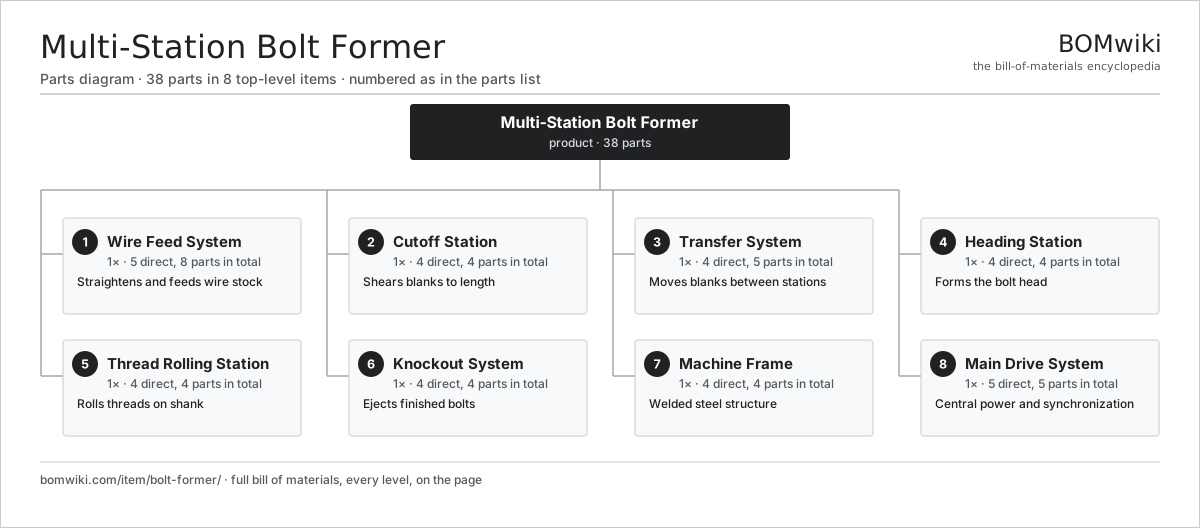
| # | Part | Qty | What it does |
|---|---|---|---|
| 1 | Wire Feed System 5 parts | 1× | Straightens and feeds wire stock |
| 2 | Cutoff Station 4 parts | 1× | Shears blanks to length |
| 3 | Transfer System 4 parts | 1× | Moves blanks between stations |
| 4 | Heading Station 4 parts | 1× | Forms the bolt head |
| 5 | Thread Rolling Station 4 parts | 1× | Rolls threads on shank |
| 6 | Knockout System 4 parts | 1× | Ejects finished bolts |
| 7 | Machine Frame 4 parts | 1× | Welded steel structure |
| 8 | Main Drive System 5 parts | 1× | Central power and synchronization |
3D model
No 3D model yet. Have a CAD file of this? Add a 3D model. STL renders right on this page; STEP, FreeCAD, and OpenSCAD sources are welcome too (openly licensed, like all 3D models on BOMwiki).
Build & assembly graph
expand / collapse · shared sub-assemblies converge · links to related products · est. labourTap an assembly to expand/collapse · tap a part to open it · use “Open page” for any node · drag to pan, scroll to zoom.
Bill of materials for Multi-Station Bolt Former
8 top-level lines · 42 rows shown · 38 parts total · indented to 3 levels| # | Item / sub-assembly | Part no. | Qty/assy | Ext. qty | Parts | Type |
|---|---|---|---|---|---|---|
| 1 | Wire Feed System 5 parts | bolt-former-wire-feed-system | 1× | 1 | 8 | assembly |
| 1.1 | Payoff Reel | bolt-former-payoff-reel | 1× | 1 | · | part |
| 1.2 | Straightener Unit | bolt-former-straightener | 1× | 1 | · | part |
| 1.3 | Feed Nose | bolt-former-feed-nose | 1× | 1 | · | part |
| 1.4 | Ball Bearing | ball-bearing | 4× | 4 | · | part |
| 1.5 | Wire Bundle | wire-bundle | 1× | 1 | · | part |
| 2 | Cutoff Station 4 parts | bolt-former-cutoff-station | 1× | 1 | 4 | assembly |
| 2.1 | Cutoff Blade | bolt-former-cutoff-blade | 1× | 1 | · | part |
| 2.2 | Blade Holder | bolt-former-blade-holder | 1× | 1 | · | part |
| 2.3 | Cutoff Cam | bolt-former-cutoff-cam | 1× | 1 | · | part |
| 2.4 | Fastener Set | fastener-set | 1× | 1 | · | part |
| 3 | Transfer System 4 parts | bolt-former-transfer-system | 1× | 1 | 5 | assembly |
| 3.1 | Transfer Fingers | bolt-former-transfer-fingers | 1× | 1 | · | part |
| 3.2 | Transfer Cam | bolt-former-transfer-cam | 1× | 1 | · | part |
| 3.3 | Transfer Linkages | bolt-former-transfer-linkages | 1× | 1 | · | part |
| 3.4 | Ball Bearing | ball-bearing | 2× | 2 | · | part |
| 4 | Heading Station 4 parts | bolt-former-heading-station | 1× | 1 | 4 | assembly |
| 4.1 | Heading Upper Die | bolt-former-heading-upper-die | 1× | 1 | · | part |
| 4.2 | Heading Lower Die | bolt-former-heading-lower-die | 1× | 1 | · | part |
| 4.3 | Heading Punches | bolt-former-heading-punches | 1× | 1 | · | part |
| 4.4 | Heading Die Holder | bolt-former-die-holder | 1× | 1 | · | part |
| 5 | Thread Rolling Station 4 parts | bolt-former-thread-roller-station | 1× | 1 | 4 | assembly |
| 5.1 | Thread Upper Die | bolt-former-thread-upper-die | 1× | 1 | · | part |
| 5.2 | Thread Lower Die | bolt-former-thread-lower-die | 1× | 1 | · | part |
| 5.3 | Thread Die Holder | bolt-former-thread-holder | 1× | 1 | · | part |
| 5.4 | Roller Pressure Cylinder | bolt-former-roller-pressure-cylinder | 1× | 1 | · | part |
| 6 | Knockout System 4 parts | bolt-former-knockout-system | 1× | 1 | 4 | assembly |
| 6.1 | Knockout Pin | bolt-former-knockout-pin | 1× | 1 | · | part |
| 6.2 | Knockout Actuator | bolt-former-knockout-actuator | 1× | 1 | · | part |
| 6.3 | Knockout Block | bolt-former-knockout-block | 1× | 1 | · | part |
| 6.4 | O-Ring Set | oring-set | 1× | 1 | · | part |
| 7 | Machine Frame 4 parts | bolt-former-machine-frame | 1× | 1 | 4 | assembly |
| 7.1 | Base Frame | bolt-former-base-frame | 1× | 1 | · | part |
| 7.2 | Work Table | bolt-former-work-table | 1× | 1 | · | part |
| 7.3 | Side Enclosure | bolt-former-side-enclosure | 1× | 1 | · | part |
| 7.4 | Sheet Metal Panel | sheet-panel | 1× | 1 | · | part |
| 8 | Main Drive System 5 parts | bolt-former-main-drive | 1× | 1 | 5 | assembly |
| 8.1 | Electric Motor | bolt-former-motor | 1× | 1 | · | part |
| 8.2 | Gearbox | bolt-former-gearbox | 1× | 1 | · | part |
| 8.3 | Main Camshaft | bolt-former-main-cam-shaft | 1× | 1 | · | part |
| 8.4 | Flywheel | bolt-former-flywheel | 1× | 1 | · | part |
| 8.5 | Drive Belt | drive-belt | 1× | 1 | · | part |
Something wrong in this list? Report a problem with this BOM.
Related products
same domain, ranked by shared parts Centrifugal Disc Finishing Machine
326 parts · shares 3 with this page
Cold Heading Machine
40 parts · shares 3 with this page
Centrifugal Disc Finishing Machine
326 parts · shares 3 with this page
Cold Heading Machine
40 parts · shares 3 with this page
 Crankshaft Grinder
511 parts · shares 3 with this page
Crankshaft Grinder
511 parts · shares 3 with this page
 Creep-Feed Grinder
571 parts · shares 3 with this page
Creep-Feed Grinder
571 parts · shares 3 with this page
Sourcing: possible vendors
Browse the supplier directory → Prices, MOQ, and lead times are algorithmic estimates, not quotes, and not claims about these companies. Company mappings are curated by keyword; est. price band $10k–$1M. How estimates work| Vendor | HQ | Specialty | MOQ | Lead time |
|---|---|---|---|---|
|
🇩🇪DMG MORI
dmgmori.com ↗
|
Bielefeld, DE | Machine tools | 5 units | 12–20 wks |
|
🇯🇵Mazak
mazak.com ↗
|
Oguchi, JP | Machine tools | 5 units | 12–20 wks |
| haascnc.com ↗ | Oxnard, US | CNC machine tools | 5 units | 12–20 wks |
|
🇯🇵Okuma
okuma.com ↗
|
Niwa, JP | Machine tools | 5 units | 12–20 wks |
|
🇩🇪Trumpf
trumpf.com ↗
|
Ditzingen, DE | Laser & sheet-metal machines | 5 units | 12–20 wks |
1,307-word article