Book Sewing Machine
ProductOverview
Book sewing machines are precision industrial equipment used in bookbinding to stitch multiple folded sections (signatures) along their spines. They are essential for hardcover book production and high-durability softcover binding, creating thread-sewn structures that withstand decades of reading and handling.
The machine operates in a four-stage cycle: a vacuum gripper picks a folded signature from a stack and positions it on the sewing head's spine-locating guides. As the signature feeds in, multiple reciprocating needles pierce the spine and form stitches using hooks that catch thread loops. A tension regulator maintains consistent stitch formation. Once sewn, the book advances to an ejector arm that pushes it onto a delivery conveyor, and the cycle repeats for the next signature.
Traditional book sewing machines use multiple needle bars running in parallel to achieve high throughput. Modern machines include electronic stitch counters and PLC control to ensure consistent signature feed and prevent mis-stitching. Vacuum levels, thread tension, and cycle timing are all monitored and adjustable via the control panel.
How it works
The Signature Feeder uses a vacuum pump to create 0.8–1.2 bar suction. The gripper belt advances a folded signature toward alignment guides that position its spine edge at the needle line. The Drive Transmission converts motor rotation through HTD timing belts into synchronized motion for the feeder advance and sewing head reciprocation.
The Sewing Head contains a needle bar held in a cam-driven linkage. As the bar reciprocates, needles pierce the spine at 15–20 mm intervals. After each needle passage, a rotating hook assembly catches the thread loop and holds it until the next needle passes, forming a chain stitch down the spine. The Thread System distributes thread from multiple spools through guides to each needle, maintaining tension between 0.5–3 N depending on thread weight and book signature count.
After stitching, the Book Delivery pivots an ejector arm that pushes the sewn book onto a conveyor belt moving at 0.3 m/s. A PLC in the Control Panel coordinates all timing, counts stitches, and signals completion via the operator display.
Materials and Construction
The Frame Structure is welded structural steel, rated for distributed loads of 2 kN. All rotating shafts and pins use rolling-element Ball Bearing bearings to minimize friction and wear over millions of cycles. The Needle Bar is hardened tool steel (60–62 HRC) to resist deformation from needle impact.
The motor is a 1.5–2 kW three-phase AC motor mounted via the Clutch-Brake Unit unit. This allows the operator to engage the feeder without running the sewing head continuously, reducing energy consumption during setup and thread changes.
Thread is typically 40–100 weight polyester or natural linen (for heritage binding). The Thread System breaks off excess thread after hook release, preventing thread buildup inside the machine.
Performance and Maintenance
Industrial book sewing machines run at 30–60 cycles per minute, with throughput ranging from 40 to 80 books per hour depending on signature count per book. A machine sewing 20-signature books might process 60 books/hour; a 6-signature book might reach 80 books/hour.
Key maintenance includes daily needle inspection for burrs or bent tips (which cause mis-stitching), weekly thread tension verification, and monthly vacuum pump cleaning. The vacuum pump requires air filtration to prevent dust accumulation on gripper surfaces.
Signature feed misalignment causes skewed stitching or double-piercing. Proper Alignment Guide adjustment is critical. Modern machines include stitch counters that detect when a signature has moved during stitching and alert the operator before the book is ejected.
Variants and Adaptations
Single-needle machines exist for small-run binding but are rare in commercial print shops. Multi-needle designs (three needle bars in parallel) are the industry standard for volume production. Some machines add a folding or trimming head downstream of the sewing head.
Industrial rotary sewing machines (like those from Kolbus or Müller Martini) can sew 100+ books/hour on large production runs. Smaller tabletop or semi-automatic models operate at 20–40 books/hour and are suited to small presses and binderies.
The Control Panel on modern machines can store recipes for different book sizes, automatically adjusting feeder position and thread tension for repeat jobs without manual calibration.
Book Sewing Machine parts and their functions
7 top-level parts · 48 parts in total · full bill of materials below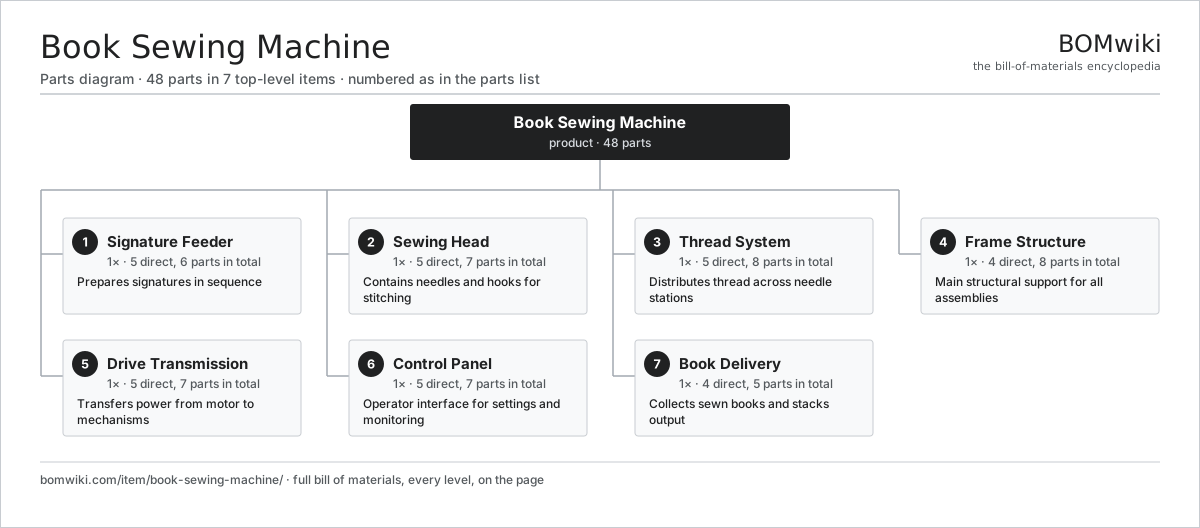
| # | Part | Qty | What it does |
|---|---|---|---|
| 1 | Signature Feeder 5 parts | 1× | Prepares signatures in sequence |
| 2 | Sewing Head 5 parts | 1× | Contains needles and hooks for stitching |
| 3 | Thread System 5 parts | 1× | Distributes thread across needle stations |
| 4 | Frame Structure 4 parts | 1× | Main structural support for all assemblies |
| 5 | Drive Transmission 5 parts | 1× | Transfers power from motor to mechanisms |
| 6 | Control Panel 5 parts | 1× | Operator interface for settings and monitoring |
| 7 | Book Delivery 4 parts | 1× | Collects sewn books and stacks output |
3D model
No 3D model yet. Have a CAD file of this? Add a 3D model. STL renders right on this page; STEP, FreeCAD, and OpenSCAD sources are welcome too (openly licensed, like all 3D models on BOMwiki).
Build & assembly graph
expand / collapse · shared sub-assemblies converge · links to related products · est. labourTap an assembly to expand/collapse · tap a part to open it · use “Open page” for any node · drag to pan, scroll to zoom.
Bill of materials for Book Sewing Machine
7 top-level lines · 40 rows shown · 48 parts total · indented to 3 levels| # | Item / sub-assembly | Part no. | Qty/assy | Ext. qty | Parts | Type |
|---|---|---|---|---|---|---|
| 1 | Signature Feeder 5 parts | book-sewing-machine-signature-feeder | 1× | 1 | 6 | assembly |
| 1.1 | Vacuum Pump | book-sewing-machine-vacuum-pump | 1× | 1 | · | part |
| 1.2 | Gripper Belt | book-sewing-machine-gripper-belt | 1× | 1 | · | part |
| 1.3 | Alignment Guide | book-sewing-machine-alignment-guide | 1× | 1 | · | part |
| 1.4 | Feed Roller | book-sewing-machine-feed-roller | 1× | 1 | · | part |
| 1.5 | Ball Bearing | ball-bearing | 2× | 2 | · | part |
| 2 | Sewing Head 5 parts | book-sewing-machine-sewing-head | 1× | 1 | 7 | assembly |
| 2.1 | Needle Bar | book-sewing-machine-needle-bar | 1× | 1 | · | part |
| 2.2 | Hook Assembly | book-sewing-machine-hook-assembly | 1× | 1 | · | part |
| 2.3 | Sewing Needle Set | book-sewing-machine-needle-set | 3× | 3 | · | part |
| 2.4 | Actuator Linkage | book-sewing-machine-actuator-linkage | 1× | 1 | · | part |
| 2.5 | Fastener Set | fastener-set | 1× | 1 | · | part |
| 3 | Thread System 5 parts | book-sewing-machine-thread-system | 1× | 1 | 8 | assembly |
| 3.1 | Thread Spool Holder | book-sewing-machine-thread-spool-holder | 1× | 1 | · | part |
| 3.2 | Tension Regulator | book-sewing-machine-tension-regulator | 1× | 1 | · | part |
| 3.3 | Thread Guide | book-sewing-machine-thread-guide | 4× | 4 | · | part |
| 3.4 | Loop Breaker | book-sewing-machine-loop-breaker | 1× | 1 | · | part |
| 3.5 | Wire Bundle | wire-bundle | 1× | 1 | · | part |
| 4 | Frame Structure 4 parts | book-sewing-machine-frame | 1× | 1 | 8 | assembly |
| 4.1 | Main Beam | book-sewing-machine-main-beam | 1× | 1 | · | part |
| 4.2 | Side Plate | book-sewing-machine-side-plate | 2× | 2 | · | part |
| 4.3 | Base Pedestal | book-sewing-machine-base-pedestal | 1× | 1 | · | part |
| 4.4 | Ball Bearing | ball-bearing | 4× | 4 | · | part |
| 5 | Drive Transmission 5 parts | book-sewing-machine-drive-transmission | 1× | 1 | 7 | assembly |
| 5.1 | Motor Housing | motor-housing | 1× | 1 | · | part |
| 5.2 | Blower Motor | blower-motor | 1× | 1 | · | part |
| 5.3 | Drive Belt | drive-belt | 2× | 2 | · | part |
| 5.4 | Clutch-Brake Unit | book-sewing-machine-clutch-brake | 1× | 1 | · | part |
| 5.5 | Timing Pulley | book-sewing-machine-timing-pulley | 2× | 2 | · | part |
| 6 | Control Panel 5 parts | book-sewing-machine-control-panel | 1× | 1 | 7 | assembly |
| 6.1 | LCD Panel | lcd-panel | 1× | 1 | · | part |
| 6.2 | Microcontroller | mcu | 1× | 1 | · | part |
| 6.3 | Relay | relay | 3× | 3 | · | part |
| 6.4 | Bare PCB | pcb-bare | 1× | 1 | · | part |
| 6.5 | SMD Passive (R/C/L) | smd-passives | 1× | 1 | · | part |
| 7 | Book Delivery 4 parts | book-sewing-machine-book-delivery | 1× | 1 | 5 | assembly |
| 7.1 | Ejector Arm | book-sewing-machine-ejector-arm | 1× | 1 | · | part |
| 7.2 | Delivery Conveyor | book-sewing-machine-delivery-conveyor | 1× | 1 | · | part |
| 7.3 | Ball Bearing | ball-bearing | 2× | 2 | · | part |
| 7.4 | O-Ring Set | oring-set | 1× | 1 | · | part |
Something wrong in this list? Report a problem with this BOM.
Related products
same domain, ranked by shared parts Gravure Printing Press
2,094 parts · shares 4 with this page
Case Packer
163 parts · shares 3 with this page
Gravure Printing Press
2,094 parts · shares 4 with this page
Case Packer
163 parts · shares 3 with this page
 Offset Printing Press
1,931 parts · shares 3 with this page
Offset Printing Press
1,931 parts · shares 3 with this page
 Aerosol Filling Machine
119 parts · shares 3 with this page
Aerosol Filling Machine
119 parts · shares 3 with this page
 Capping Machine
172 parts · shares 3 with this page
Tray Shrink Packer
386 parts · shares 3 with this page
Capping Machine
172 parts · shares 3 with this page
Tray Shrink Packer
386 parts · shares 3 with this page
Sourcing: possible vendors
Browse the supplier directory → Prices, MOQ, and lead times are algorithmic estimates, not quotes, and not claims about these companies. Company mappings are curated by keyword; est. price band $10k–$3M. How estimates work| Vendor | HQ | Specialty | MOQ | Lead time |
|---|---|---|---|---|
| heidelberg.com ↗ | Heidelberg, DE | Printing presses | 10 units | 12–22 wks |
|
🇨🇭Bobst
bobst.com ↗
|
Lausanne, CH | Packaging machinery | 10 units | 12–22 wks |
| koenig-bauer.com ↗ | Würzburg, DE | Printing presses | 10 units | 12–22 wks |
| wuh-group.com ↗ | Lengerich, DE | Flexible packaging machines | 10 units | 12–22 wks |
| markandy.com ↗ | Chesterfield, US | Label presses | 10 units | 12–22 wks |
748-word article