Library Book Sorter
ProductOverview
A library book sorter is an automated material-handling system designed to route returned books to their destination shelves or carts without human intervention. It combines RFID or barcode reading, conveyor transport, and pneumatic diverting gates to achieve throughputs of 300–600 books per hour. Libraries with high return volumes use these systems to accelerate the sort-and-shelf cycle, reducing labor costs and accelerating book availability.
The core principle is simple: a book enters a reader portal, its RFID tag or barcode is scanned, the system looks up its destination (call number, library section, or cart assignment), and a series of pneumatic gates route it down the correct chute into a pre-positioned bin. Multiple readers stationed along the conveyor validate decisions and can redirect missorts.
How It Works
An operator (or automated return sorter) feeds books spine-first into the Induction Gate & Reader. The RFID Portal Antenna or Barcode Laser Scanner captures the book's identifier as it enters, transmitting it to the PLC Controller control cabinet.
The PLC looks up the book in its database, determining which destination bin (1–8) it should reach. As the book travels along the Main Conveyor Belt & Drive at 0.3–0.5 m/s, it passes each Pneumatic Diverter Gates pneumatic gate in sequence. When the book reaches the gate corresponding to its destination, the Solenoid Valve Manifold activates that gate, diverting the book down the matching Chute Panel.
The Pneumatic Supply & Regulation supplies compressed air at 6 bar to the Pneumatic Actuator actuators, which snap the spring-return gates open and closed in milliseconds. Reader modules positioned above and below the conveyor validate the divert decision; if a book misses its gate, a secondary reader detects it and the PLC flags the event for manual recovery.
Speed control is managed by the Variable Frequency Drive driving the Conveyor Drive Motor, which powers the conveyor via a Helical Gearbox. The encoder on the conveyor shaft feeds position data to the PLC, allowing precise timing of gate activation.
The operator monitors throughput, missorters, and bin fill levels on the HMI Touchscreen.
RFID vs. Barcode Operation
Most modern systems use RFID tags embedded in the spine or back cover of library books. An RFID tag stores call number and destination metadata, allowing read-from-any-angle detection without line-of-sight. The RFID Portal Antenna at the entry gate reads at 1.0–1.5 m distance.
However, older libraries with barcode-labeled books rely on the book-sorting-machine-barcode-laser-scanner positioned above the conveyor belt. Barcode requires 30–50 cm working distance and direct line-of-sight to the spine label. Many modern systems integrate both: RFID as primary (faster), barcode as fallback for untagged books or damage recovery.
Gate Timing and Diverter Design
The pneumatic Diverter Gate Leaf actuators must engage within 200–500 milliseconds of a book passing, depending on book thickness. Spring-return design ensures gates return to default position (straight-through) if power is lost or air pressure drops, preventing books from becoming jammed.
Diverter spacing is typically 40–60 cm apart, handling book widths of 15–35 cm. High-speed systems (600 books/hour) require tighter synchronization and faster gate response (<100 ms).
Chute & Bin Architecture
Angled chutes guide books by gravity into wheeled carts or fixed bin stacks. Plastic chutes reduce noise and friction; steel chutes offer durability in high-volume settings. Adjustable dividers separate lanes so books do not cross into adjacent bins.
Each destination bin is a standard 60 liter plastic lug, mounted on wheeled carts for manual push to shelving areas. A large library may operate 3–4 carts simultaneously, rotating them as they fill.
Throughput and Reliability
At 400 books/hour, a single sorter clears 1600 returns per 4-hour shift. Throughput depends on:
- Book size variation (triggers conveyor speed reduction for large books)
- Reader accuracy (mis-ID requires operator intervention and re-scan)
- Gate reliability (stuck gates cause line stoppage)
Misread rates should be <1% with RFID. Barcode-only systems see 2–5% misreads due to label damage or obscuration.
Maintenance and Integration
Conveyor belts require monthly tension checks and quarterly cleaning to remove dust and paper debris. Pneumatic cylinders are sealed and maintenance-free; the Coalescing Air Filter must be drained weekly in humid climates.
The PLC integrates with library management systems (Evergreen, Koha, Sirsi) via flat file or API, allowing real-time sort destination updates and missorter tracking.
Noise is a concern in quiet reading rooms: 75–80 dB at full speed. Some libraries isolate the sorter in a separate workroom or add acoustic shrouding around the chutes.
Library Book Sorter parts and their functions
8 top-level parts · 68 parts in total · full bill of materials below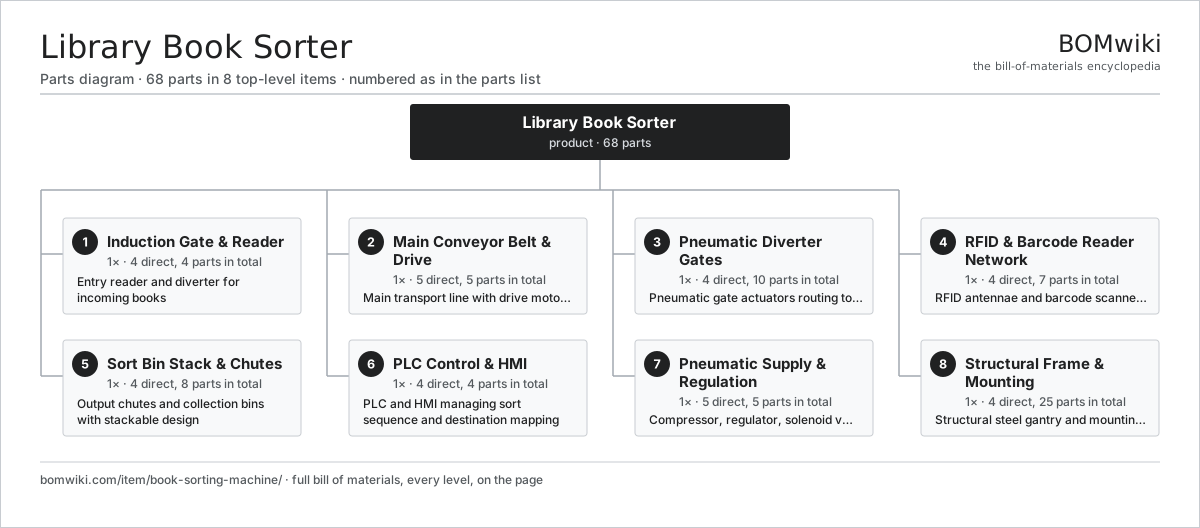
| # | Part | Qty | What it does |
|---|---|---|---|
| 1 | Induction Gate & Reader 4 parts | 1× | Entry reader and diverter for incoming books |
| 2 | Main Conveyor Belt & Drive 5 parts | 1× | Main transport line with drive motor and rollers |
| 3 | Pneumatic Diverter Gates 4 parts | 1× | Pneumatic gate actuators routing to sort bins |
| 4 | RFID & Barcode Reader Network 4 parts | 1× | RFID antennae and barcode scanners at decision points |
| 5 | Sort Bin Stack & Chutes 4 parts | 1× | Output chutes and collection bins with stackable design |
| 6 | PLC Control & HMI 4 parts | 1× | PLC and HMI managing sort sequence and destination mapping |
| 7 | Pneumatic Supply & Regulation 5 parts | 1× | Compressor, regulator, solenoid valves for diverters |
| 8 | Structural Frame & Mounting 4 parts | 1× | Structural steel gantry and mounting brackets |
3D model
No 3D model yet. Have a CAD file of this? Add a 3D model. STL renders right on this page; STEP, FreeCAD, and OpenSCAD sources are welcome too (openly licensed, like all 3D models on BOMwiki).
Build & assembly graph
expand / collapse · shared sub-assemblies converge · links to related products · est. labourTap an assembly to expand/collapse · tap a part to open it · use “Open page” for any node · drag to pan, scroll to zoom.
Bill of materials for Library Book Sorter
8 top-level lines · 42 rows shown · 68 parts total · indented to 3 levels| # | Item / sub-assembly | Part no. | Qty/assy | Ext. qty | Parts | Type |
|---|---|---|---|---|---|---|
| 1 | Induction Gate & Reader 4 parts | book-sorting-machine-induction-gate | 1× | 1 | 4 | assembly |
| 1.1 | Gate Portal Frame | book-sorting-machine-gate-frame | 1× | 1 | · | part |
| 1.2 | RFID Portal Antenna | book-sorting-machine-rfid-antenna | 1× | 1 | · | part |
| 1.3 | Barcode Laser Scanner | book-sorting-machine-barcode-scanner | 1× | 1 | · | part |
| 1.4 | Connector | connector | 1× | 1 | · | part |
| 2 | Main Conveyor Belt & Drive 5 parts | book-sorting-machine-conveyor-system | 1× | 1 | 5 | assembly |
| 2.1 | Conveyor Drive Motor | book-sorting-machine-drive-motor | 1× | 1 | · | part |
| 2.2 | Helical Gearbox | book-sorting-machine-gearbox | 1× | 1 | · | part |
| 2.3 | Conveyor Belt & Rollers | book-sorting-machine-belt-roller | 1× | 1 | · | part |
| 2.4 | Pillow Block Bearings | book-sorting-machine-bearing-blocks | 1× | 1 | · | part |
| 2.5 | Encoder | encoder | 1× | 1 | · | part |
| 3 | Pneumatic Diverter Gates 4 parts | book-sorting-machine-diverter-array | 1× | 1 | 10 | assembly |
| 3.1 | Solenoid Valve Manifold | book-sorting-machine-solenoid-valve-block | 1× | 1 | · | part |
| 3.2 | Pneumatic Actuator | book-sorting-machine-pneumatic-cylinder | 4× | 4 | · | part |
| 3.3 | Diverter Gate Leaf | book-sorting-machine-diverter-gate | 4× | 4 | · | part |
| 3.4 | Connector | connector | 1× | 1 | · | part |
| 4 | RFID & Barcode Reader Network 4 parts | book-sorting-machine-reader-network | 1× | 1 | 7 | assembly |
| 4.1 | RFID Fixed Reader | book-sorting-machine-rfid-module | 3× | 3 | · | part |
| 4.2 | RFID Multiplexer PCB | book-sorting-machine-reader-pcb | 1× | 1 | · | part |
| 4.3 | Barcode Scanner Optics | book-sorting-machine-barcode-lens | 2× | 2 | · | part |
| 4.4 | Connector | connector | 1× | 1 | · | part |
| 5 | Sort Bin Stack & Chutes 4 parts | book-sorting-machine-bin-assembly | 1× | 1 | 8 | assembly |
| 5.1 | Chute Panel | book-sorting-machine-chute-sheet | 4× | 4 | · | part |
| 5.2 | Wheeled Bin Cart | book-sorting-machine-bin-cart | 2× | 2 | · | part |
| 5.3 | Chute Divider Rails | book-sorting-machine-divider-rails | 1× | 1 | · | part |
| 5.4 | Fastener Set | fastener-set | 1× | 1 | · | part |
| 6 | PLC Control & HMI 4 parts | book-sorting-machine-control-logic | 1× | 1 | 4 | assembly |
| 6.1 | PLC Controller | book-sorting-machine-plc | 1× | 1 | · | part |
| 6.2 | Variable Frequency Drive | book-sorting-machine-vfd | 1× | 1 | · | part |
| 6.3 | HMI Touchscreen | book-sorting-machine-hmi-screen | 1× | 1 | · | part |
| 6.4 | Bare PCB | pcb-bare | 1× | 1 | · | part |
| 7 | Pneumatic Supply & Regulation 5 parts | book-sorting-machine-air-system | 1× | 1 | 5 | assembly |
| 7.1 | Rotary Screw Compressor | book-sorting-machine-air-compressor | 1× | 1 | · | part |
| 7.2 | Compressed Air Reservoir | book-sorting-machine-air-tank | 1× | 1 | · | part |
| 7.3 | Coalescing Air Filter | book-sorting-machine-air-filter | 1× | 1 | · | part |
| 7.4 | Pressure Regulator | book-sorting-machine-air-regulator | 1× | 1 | · | part |
| 7.5 | Connector | connector | 1× | 1 | · | part |
| 8 | Structural Frame & Mounting 4 parts | book-sorting-machine-frame | 1× | 1 | 25 | assembly |
| 8.1 | Steel Beam Section | book-sorting-machine-steel-beam | 4× | 4 | · | part |
| 8.2 | Linear Guide Rail | book-sorting-machine-aluminum-rail | 8× | 8 | · | part |
| 8.3 | Steel Mounting Bracket | book-sorting-machine-mounting-bracket | 12× | 12 | · | part |
| 8.4 | Fastener Set | fastener-set | 1× | 1 | · | part |
Something wrong in this list? Report a problem with this BOM.
Related products
same domain, ranked by shared parts Cash Deposit Machine
64 parts · shares 1 with this page
Coin Counting Kiosk
63 parts · shares 1 with this page
Envelope Addressing Printer
32 parts · shares 1 with this page
Cash Deposit Machine
64 parts · shares 1 with this page
Coin Counting Kiosk
63 parts · shares 1 with this page
Envelope Addressing Printer
32 parts · shares 1 with this page
 Guillotine Paper Cutter
261 parts · shares 1 with this page
Guillotine Paper Cutter
261 parts · shares 1 with this page
Sourcing: possible vendors
Browse the supplier directory → Prices, MOQ, and lead times are algorithmic estimates, not quotes, and not claims about these companies. Company mappings are curated by keyword; est. price band $50–$15k. How estimates work| Vendor | HQ | Specialty | MOQ | Lead time |
|---|---|---|---|---|
|
🇯🇵Canon
canon.com ↗
|
Tokyo, JP | Imaging & optics | 500 units | 8–12 wks |
|
🇯🇵Ricoh
ricoh.com ↗
|
Tokyo, JP | Office imaging | 500 units | 8–12 wks |
|
🇺🇸Xerox
xerox.com ↗
|
Norwalk, US | Printers & copiers | 500 units | 8–12 wks |
|
🇯🇵Epson
epson.com ↗
|
Suwa, JP | Printers & projectors | 500 units | 8–12 wks |
|
🇯🇵Brother
brother.com ↗
|
Nagoya, JP | Printers & sewing | 500 units | 8–12 wks |
809-word article