Book Vending Machine
ProductOverview
A book vending machine is an automated kiosk that stores 20–30 book titles in a rotating carousel, allows customers to browse titles via a touchscreen, and mechanically retrieves the selected book via an elevator lift and gripper mechanism, presenting it for pickup at a front-facing window. Unlike beverage or snack vending, books require careful handling to prevent spine damage or creasing, and the mechanical complexity of indexing, lifting, and gripping delicate objects is substantial.
The Book Carousel Assembly, a rotating turntable, holds individual books in indexed slots. When a customer selects a title via the User Interface Display, the Carousel Drive Motor rotates the carousel to align the selected book with the Elevator Lift Mechanism. The elevator, a motorized vertical lift on linear rails, rises to the book's height and positions the Book Gripper & Ejection behind it. The gripper's jaws close around the book's spine. The Lift Drive Motor then lowers the entire elevator carriage (with gripper and book) to a fixed dispense height. The Push-Out Arm, driven by the Push Motor, slides forward horizontally, pushing the gripped book toward the customer-accessible window. The gripper jaws release, and the book rests on a shallow tray. The customer removes it, triggering a sensor that signals the machine to retract the arm and prepare for the next transaction.
These machines are deployed in libraries, bookstores, transit stations, and university campuses as 24/7 self-service book rental or retail points. The challenge is reliable mechanical positioning, damage-free gripper design, and the ability to handle books of varying spine thicknesses.
How it works
The Book Carousel Assembly is a heavy-duty rotary turntable mounted on a sealed ball bearing assembly. Twenty to thirty book slots are machined or fastened around its circumference, spaced at regular 12° increments (360° / 30 = 12° per slot). Each slot is an aluminum-lined shelf with spring-loaded retention clips on either side that hold the book's spine upright without crushing it. The carousel wheel is fixed to a vertical shaft passing through the center bearing.
The Carousel Drive Motor, a NEMA 23 stepper motor (with torque ≥300 oz-in) connected via a 5:1 gearbox, rotates the carousel. The Master Control Board, upon receiving a book selection from the User Interface Display, calculates the number of steps needed to bring the target book to the elevator's position. For example, if the customer selects title #5 and the carousel is currently at position #1, the control board sends 4×N steps to the stepper motor (where N is the number of microsteps per full step, typically 16). An optical home sensor confirms when the carousel reaches a known reference position after each transaction, ensuring indexing accuracy. Typical positioning error is less than ±0.5°, sufficient to keep the book spine within the gripper's jaw envelope.
Once the carousel is indexed, the Elevator Lift Mechanism, a vertical linear mechanism, comes into play. The elevator consists of a stainless steel Linear Guide Rail (300 mm vertical travel) and a linear bearing Elevator Carriage that slides smoothly along the rail. The carriage is connected to a timing belt (HTD profile, 10 mm pitch) driven by a Lift Drive Motor (brushed DC motor, 200 W, with optical Encoder feedback providing position resolution ±2 mm). Pulleys at the top and bottom of the rail drive the carriage up or down.
The Book Gripper & Ejection, mounted on the carriage, is the critical book-handling component. It consists of two rubber-lined Gripper Jaw Pads, each facing inward 30 mm apart (adjustable for different book spine thicknesses). The jaws are driven by a 24 V DC Gripper Solenoid, a linear solenoid that, when energized, pulls a mechanical link, closing both jaws simultaneously with 50–100 N clamping force (adjustable via spring preload). The rubber padding (1–2 mm neoprene or silicone) distributes force and prevents permanent spine deformation.
When the carousel is indexed with a book spine aligned with the gripper, the elevator motor drives the carriage upward. As it rises, the gripper jaws approach the book. Once the carriage has risen to within 20 mm of the book, the Gripper Solenoid solenoid is energized, clamping the book spine. The elevator then descends to a fixed dispense height (typically 100 mm above the customer-accessible tray), bringing the gripped book to the front of the machine.
At this height, the Push Motor, a DC servo (100 W, with limit switches), activates. The motor drives a lead screw or rack-and-pinion mechanism, extending the Push-Out Arm forward in a horizontal sliding motion. The push arm, shaped like a curved paddle, is positioned against the back of the gripped book. As it extends (200 mm travel at ~50 mm/sec), it slides the book forward out of the gripper's jaws and onto a shallow stainless tray positioned at the front access port. Once the push arm reaches the end-of-travel limit, it reverses, retracting back into the machine. Simultaneously, the gripper solenoid is de-energized, releasing the jaw pressure. The elevator carriage also rises back to its home position.
The book is now resting on the tray, accessible to the customer. A simple mechanical switch or beam sensor under the tray detects when the book is removed (weight or blocking). Once removed, the Master Control Board logs the transaction (payment captured, inventory updated) and is ready for the next order.
The User Interface Display, a 7 inch IPS LCD panel with 1024×600 resolution, displays the current catalog of available books. The screen shows thumbnail cover images, titles, authors, brief synopses, and prices. The Touch Digitizer is capacitive, allowing finger input. The customer scrolls and taps to select. A EMV & NFC Payment Terminal terminal integrated into or adjacent to the display accepts payment (EMV chip cards, contactless NFC for Apple Pay/Google Pay, QR codes for mobile wallets). The machine is networked (WiFi or cellular) to validate card transactions and update inventory in real time.
The Interior Illumination System system uses addressable RGB LED strips mounted inside the cabinet, facing the carousel. These RGB LED Light Strips illuminate the book spines and covers, making the display visually appealing. A LED Controller, a microcontroller with PWM outputs, can adjust brightness, colour temperature, and even create slow cycling animations (fade in/fade out, colour transitions) to draw attention to featured or new titles.
Power is supplied by a 500 W industrial Power Supply converting 240 V AC to 24 V DC (for controls, solenoids, LED strips) and 12 V DC (for motors). Peak power draw occurs during simultaneous carousel rotation, elevator lift, and push motor operation, typically 300–400 W. A 10 A Circuit Breaker, a 10 A thermal circuit breaker, protects the mains input.
Maintenance is minimal: weekly visual inspection of gripper jaws for tears, monthly lubrication of the elevator rail and bearings (light machine oil), and quarterly software updates to the catalog and payment systems. The most common failure mode is wear of the linear bearing seals (allowing dust ingress and friction), typically requiring seal replacement every 12–18 months in dusty environments.
Book Vending Machine parts and their functions
10 top-level parts · 108 parts in total · full bill of materials below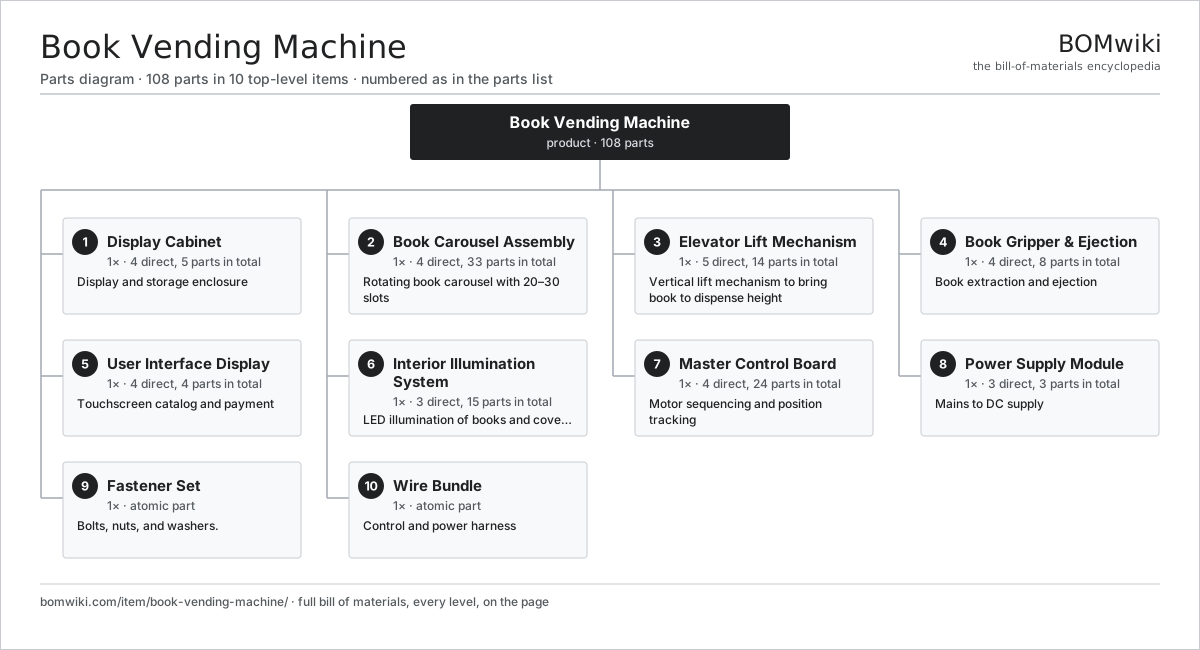
| # | Part | Qty | What it does |
|---|---|---|---|
| 1 | Display Cabinet 4 parts | 1× | Display and storage enclosure |
| 2 | Book Carousel Assembly 4 parts | 1× | Rotating book carousel with 20–30 slots |
| 3 | Elevator Lift Mechanism 5 parts | 1× | Vertical lift mechanism to bring book to dispense height |
| 4 | Book Gripper & Ejection 4 parts | 1× | Book extraction and ejection |
| 5 | User Interface Display 4 parts | 1× | Touchscreen catalog and payment |
| 6 | Interior Illumination System 3 parts | 1× | LED illumination of books and cover artwork |
| 7 | Master Control Board 4 parts | 1× | Motor sequencing and position tracking |
| 8 | Power Supply Module 3 parts | 1× | Mains to DC supply |
| 9 | Fastener Set | 1× | Bolts, nuts, and washers. |
| 10 | Wire Bundle | 1× | Control and power harness |
3D model
No 3D model yet. Have a CAD file of this? Add a 3D model. STL renders right on this page; STEP, FreeCAD, and OpenSCAD sources are welcome too (openly licensed, like all 3D models on BOMwiki).
Build & assembly graph
expand / collapse · shared sub-assemblies converge · links to related products · est. labourTap an assembly to expand/collapse · tap a part to open it · use “Open page” for any node · drag to pan, scroll to zoom.
Bill of materials for Book Vending Machine
10 top-level lines · 57 rows shown · 108 parts total · indented to 3 levels| # | Item / sub-assembly | Part no. | Qty/assy | Ext. qty | Parts | Type |
|---|---|---|---|---|---|---|
| 1 | Display Cabinet 4 parts | book-vending-machine-cabinet | 1× | 1 | 5 | assembly |
| 1.1 | Steel Frame Structure | book-vending-machine-frame | 1× | 1 | · | part |
| 1.2 | Tempered Glass Front Panel | book-vending-machine-glass-door | 1× | 1 | · | part |
| 1.3 | Door Gasket | book-vending-machine-seals | 2× | 2 | · | part |
| 1.4 | Base Support Platform | book-vending-machine-base-platform | 1× | 1 | · | part |
| 2 | Book Carousel Assembly 4 parts | book-vending-machine-carousel | 1× | 1 | 33 | assembly |
| 2.1 | Carousel Turntable | book-vending-machine-carousel-wheel | 1× | 1 | · | part |
| 2.2 | Carousel Drive Motor 3 parts | book-vending-machine-carousel-motor | 1× | 1 | 4 | assembly |
| 2.2.1 | Microcontroller | mcu | 1× | 1 | · | part |
| 2.2.2 | Relay | relay | 1× | 1 | · | part |
| 2.2.3 | Connector | connector | 2× | 2 | · | part |
| 2.3 | Carousel Center Bearing 1 parts | book-vending-machine-carousel-bearing | 1× | 1 | 3 | assembly |
| 2.3.1 | Ball Bearing | ball-bearing | 3× | 3 | · | part |
| 2.4 | Book Slot Holder | book-vending-machine-book-holder | 25× | 25 | · | part |
| 3 | Elevator Lift Mechanism 5 parts | book-vending-machine-elevator | 1× | 1 | 14 | assembly |
| 3.1 | Linear Guide Rail | book-vending-machine-elevator-rail | 1× | 1 | · | part |
| 3.2 | Elevator Carriage 1 parts | book-vending-machine-elevator-carriage | 1× | 1 | 4 | assembly |
| 3.2.1 | Ball Bearing | ball-bearing | 4× | 4 | · | part |
| 3.3 | Lift Drive Motor 3 parts | book-vending-machine-elevator-motor | 1× | 1 | 4 | assembly |
| 3.3.1 | Motor Housing | motor-housing | 1× | 1 | · | part |
| 3.3.2 | Encoder | encoder | 1× | 1 | · | part |
| 3.3.3 | Ball Bearing | ball-bearing | 2× | 2 | · | part |
| 3.4 | Drive Belt 2 parts | book-vending-machine-elevator-belt | 1× | 1 | 3 | assembly |
| 3.4.1 | Drive Belt | drive-belt | 1× | 1 | · | part |
| 3.4.2 | Connector | connector | 2× | 2 | · | part |
| 3.5 | End-of-Travel Limit Switch | book-vending-machine-limit-switch | 2× | 2 | · | part |
| 4 | Book Gripper & Ejection 4 parts | book-vending-machine-gripper | 1× | 1 | 8 | assembly |
| 4.1 | Gripper Jaw Pads | book-vending-machine-gripper-jaws | 2× | 2 | · | part |
| 4.2 | Gripper Solenoid 2 parts | book-vending-machine-gripper-actuator | 1× | 1 | 2 | assembly |
| 4.2.1 | Relay | relay | 1× | 1 | · | part |
| 4.2.2 | Connector | connector | 1× | 1 | · | part |
| 4.3 | Push-Out Arm | book-vending-machine-push-arm | 1× | 1 | · | part |
| 4.4 | Push Motor 2 parts | book-vending-machine-push-motor | 1× | 1 | 3 | assembly |
| 4.4.1 | Motor Housing | motor-housing | 1× | 1 | · | part |
| 4.4.2 | Ball Bearing | ball-bearing | 2× | 2 | · | part |
| 5 | User Interface Display 4 parts | book-vending-machine-display | 1× | 1 | 4 | assembly |
| 5.1 | IPS LCD Panel | book-vending-machine-lcd | 1× | 1 | · | part |
| 5.2 | LCD Panel | lcd-panel | 1× | 1 | · | part |
| 5.3 | Touch Digitizer | touch-digitizer | 1× | 1 | · | part |
| 5.4 | EMV & NFC Payment Terminal | book-vending-machine-payment-reader | 1× | 1 | · | part |
| 6 | Interior Illumination System 3 parts | book-vending-machine-lighting | 1× | 1 | 15 | assembly |
| 6.1 | RGB LED Light Strip | book-vending-machine-led-strip | 4× | 4 | · | part |
| 6.2 | LED Controller 2 parts | book-vending-machine-lighting-controller | 1× | 1 | 5 | assembly |
| 6.2.1 | Microcontroller | mcu | 1× | 1 | · | part |
| 6.2.2 | Connector | connector | 4× | 4 | · | part |
| 6.3 | Connector | connector | 6× | 6 | · | part |
| 7 | Master Control Board 4 parts | book-vending-machine-control-system | 1× | 1 | 24 | assembly |
| 7.1 | Bare PCB | pcb-bare | 1× | 1 | · | part |
| 7.2 | Microcontroller | mcu | 1× | 1 | · | part |
| 7.3 | Relay | relay | 8× | 8 | · | part |
| 7.4 | Connector | connector | 14× | 14 | · | part |
| 8 | Power Supply Module 3 parts | book-vending-machine-power-distribution | 1× | 1 | 3 | assembly |
| 8.1 | Power Supply | power-supply | 1× | 1 | · | part |
| 8.2 | 10 A Circuit Breaker | book-vending-machine-breaker | 1× | 1 | · | part |
| 8.3 | Wire Bundle | wire-bundle | 1× | 1 | · | part |
| 9 | Fastener Set | fastener-set | 1× | 1 | · | part |
| 10 | Wire Bundle | wire-bundle | 1× | 1 | · | part |
Something wrong in this list? Report a problem with this BOM.
Related products
same domain, ranked by shared parts Pizza Vending Machine
303 parts · shares 5 with this page
Pizza Vending Machine
303 parts · shares 5 with this page
 Reverse Vending Machine
114 parts · shares 4 with this page
Reverse Vending Machine
114 parts · shares 4 with this page
 Fresh Juice Vending Machine
73 parts · shares 4 with this page
Disc Rental Kiosk
272 parts · shares 4 with this page
Flower Vending Machine
103 parts · shares 4 with this page
Fresh Juice Vending Machine
73 parts · shares 4 with this page
Disc Rental Kiosk
272 parts · shares 4 with this page
Flower Vending Machine
103 parts · shares 4 with this page
 French Fry Vending Machine
65 parts · shares 4 with this page
French Fry Vending Machine
65 parts · shares 4 with this page
Sourcing: possible vendors
Browse the supplier directory → Prices, MOQ, and lead times are algorithmic estimates, not quotes, and not claims about these companies. Company mappings are curated by keyword; est. price band $1k–$30k. How estimates work| Vendor | HQ | Specialty | MOQ | Lead time |
|---|---|---|---|---|
| cranems.com ↗ | Williston, US | Vending machines | 50 units | 10–16 wks |
|
🇪🇸Azkoyen
azkoyen.com ↗
|
Peralta, ES | Vending & payment | 50 units | 10–16 wks |
| fujielectric.com ↗ | Tokyo, JP | Vending & power electronics | 50 units | 10–16 wks |
| sanden-rs.com ↗ | Isesaki, JP | Vending & retail systems | 50 units | 10–16 wks |
| tcnvend.com ↗ | Changsha, CN | Vending machines | 50 units | 10–16 wks |
1,242-word article