BOMwiki the bill-of-materials encyclopedia

Water Booster Pump Product

Overview

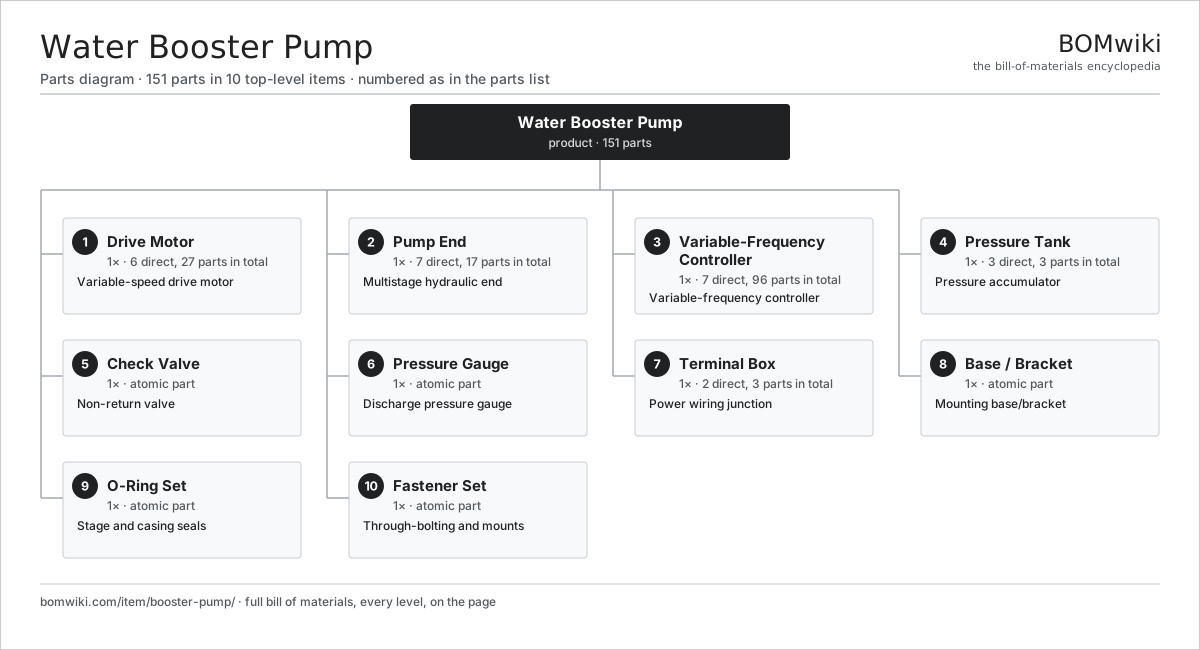
The Water Booster Pump raises and holds domestic water pressure on demand. A variable-frequency drive watches a discharge transducer and trims motor speed so that pressure stays at the setpoint regardless of how many taps are open. The package mounts the Pump End, Drive Motor and Variable-Frequency Controller on a single Base / Bracket, with a small Pressure Tank to absorb minor draws and stop the pump from short-cycling.

Booster pumps serve buildings where the mains pressure is too low or sags under demand: upper floors of apartment blocks, houses on long service lines, and irrigation or filtration loops that need a steady inlet pressure.

How it works

Water enters the Pump End, a vertical stack of five impeller-and-diffuser Pump Stage units sealed inside a stainless casing. Each stage adds head, so the stack can lift pressure far beyond what a single impeller delivers. The Drive Motor, a TEFC induction motor, is close-coupled to the stack and turns the shaft through all stages.

The Variable-Frequency Controller is the brain. A pressure transducer reports discharge pressure to the inverter board, which varies output frequency to hold the setpoint. When demand drops, the drive slows the motor; when several fixtures open at once, it ramps up. This eliminates the pressure swings of a fixed-speed pump cycling on a pressure switch, and it cuts energy use at part load.

The Check Valve holds the column of water in the riser when the pump stops, so the system does not lose prime or hammer on restart. The Pressure Gauge gives a local read of discharge pressure for commissioning. The Pressure Tank carries a butyl bladder over an air pre-charge: a hand wash or toilet refill is met from the stored water without starting the motor, which spares the drive thousands of needless cycles.

Power lands at the Terminal Box, which separates supply and motor leads. The whole hydraulic train rides on a cast base that aligns the motor, pump end and tank and carries the assembly load.', },

'kitchen-faucet': { specs: [ ['Type', 'Single-handle pull-down kitchen mixer'], ['Mounting', 'Single-hole deck mount'], ['Control', 'Ceramic-disc cartridge'], ['Spout reach', '230 mm (9.1 in)'], ['Spout height', '410 mm (16.1 in)'], ['Swivel', '360°'], ['Flow rate', '6.8 L/min (1.8 GPM) aerated'], ['Spray modes', 'Aerated stream / spray'], ['Hose travel', '500 mm (20 in) pull-down'], ['Supply pressure', '0.5–8.0 bar'], ['Connections', '⅜ in compression, hot & cold'], ['Body material', 'Low-lead brass'], ['Finish', 'PVD / electroplated chrome or nickel'], ['Compliance', 'Lead-free wetted brass'], ], body: '## Overview

The Kitchen Faucet is a single-handle pull-down mixer. One lever sets both temperature and flow, and the spray head pulls out of the spout on a hose for filling pots and rinsing the sink. The Spout Body arches high over the basin, the Mixing Cartridge meters and mixes the water, and the Pull-Down Spray Assembly retracts itself back into the spout when released.

Construction

The visible body is the Spout Body: a low-lead brass casting under a PVD or chrome finish, with a swivel tube routing mixed water up to the spray head. Inside the valve pocket sits the Mixing Cartridge, a pair of lapped alumina-ceramic discs that slide across each other to open, throttle and blend the hot and cold feeds. Ceramic discs resist wear and grit far better than the old rubber washers, which is why a good cartridge faucet drips for years before it needs service.

The Handle is a cast lever broached onto the cartridge stem and held by a set screw. Push it back to start flow, swing it left for hot and right for cold.

The Pull-Down Spray Assembly is what makes the faucet a pull-down. The Spray Head carries an aerator for a soft everyday stream and a toggle button that flips an internal diverter to a forceful spray. A braided hose feeds the head and runs down through the spout; a Hose Weight clamped to the hose, plus a spring-and-magnet retraction, pull the head firmly back into its dock when you let go.

Underneath the deck, the Mounting Kit clamps the faucet shank to the countertop with a nut and stabilizer bracket over a base gasket. The Supply Set brings hot and cold up through braided stainless lines, each with a check valve so the two feeds cannot cross-flow inside the cartridge. An Escutcheon finishes the joint where the body meets the deck.', },

'sump-pump': { specs: [ ['Type', 'Submersible pedestal-free sump pump'], ['Motor', 'Oil-filled sealed induction, ½ HP'], ['Power', '370 W (½ HP)'], ['Supply', '115 V / 60 Hz, single-phase'], ['Max flow', '15 m³/h (66 GPM)'], ['Max head', '7.6 m (25 ft)'], ['Discharge', '1½ in NPT, with check valve'], ['Switch', 'Tethered float, mechanical'], ['Solids passage', '13 mm (½ in)'], ['Impeller', 'Thermoplastic vortex'], ['Housing', 'Cast iron / engineered polymer'], ['Max liquid temp', '50 °C (122 °F)'], ['Cord length', '3 m (10 ft) grounded'], ], body: '## Overview

The Sump Pump keeps a basement pit dry. It sits at the bottom of the sump and runs automatically: as groundwater seeps in and the level rises, a float starts the pump, which throws the water up a riser pipe and out of the building. When the pit drains, the float drops and the pump stops. The Submersible Motor and Pump End are stacked into one submersible unit, switched by the Float Switch and sealed against the water it sits in.

How it works

The drive is the Submersible Motor, an oil-filled sealed induction motor. Filling the can with Motor Cooling Oil cools the windings and lubricates the bearings while keeping water out; an Oil Seal at the shaft and a Thermal Overload cutout guard against leaks and overheating. Single-phase starting torque comes from the Run Capacitor housed in the Control Box.

The motor shaft drives the Pump End. A thermoplastic vortex impeller spins inside the Volute Housing and slings water outward by centrifugal force, raising pressure at the rim and pushing flow into the Discharge Assembly. The vortex design keeps the impeller clear of the flow path so the pump can pass small solids without clogging. An Intake Screen blocks larger debris.

The Float Switch sets the run band. A sealed buoyant float on a tether rises with the water and tips an internal microswitch closed at the high level, then opens it again once the pit empties. Adjusting the tether length sets how high the water climbs before the pump fires and how low it pulls the pit down.

On the discharge, a spring Check Valve stops the column of water in the riser from draining back into the pit when the motor stops, which would otherwise refill the sump and cause needless restarts. The Standing Base raises the intake off the pit floor so silt is not drawn straight into the screen, and a molded Carry Handle lets you lift the unit for service.', },

'toilet': { specs: [ ['Type', 'Two-piece gravity-flush toilet'], ['Flush', 'Siphonic, single flush'], ['Flush volume', '4.8 L (1.28 GPF)'], ['Trapway', 'Fully glazed, 51 mm (2 in)'], ['Rough-in', '305 mm (12 in)'], ['Bowl shape', 'Elongated'], ['Rim height', '420 mm (16.5 in), comfort height'], ['Material', 'Vitreous china'], ['Supply', '⅜ in compression, side or bottom inlet'], ['Water pressure', '0.2–8.0 bar'], ['Seat', 'Quick-release, soft-close'], ['Fill valve', 'Anti-siphon ballcock'], ['Mounting', '2 closet bolts on floor flange'], ], body: '## Overview

The Toilet is a two-piece gravity-flush fixture: a Toilet Tank of water sits above a Toilet Bowl, and gravity does the work of the flush. Pressing the lever drops the tank's contents into the bowl fast enough to start a siphon in the trapway, which pulls the bowl contents down the drain. The fixture is assembled from a handful of subsystems — fill, flush, mounting and seat — bolted onto two pieces of vitreous china.

How it works

The Toilet Bowl is a single china casting with the trapway and siphon jet molded in. The Toilet Tank holds the flush water with a lift-off lid. Between flushes the Fill Valve Assembly keeps the tank topped to its waterline: a Float Cup rides the rising water and shuts the Ballcock Fill Valve when the level is reached, while a Refill Tube also restores the bowl's standing water through the overflow.

Pressing the handle works the Flush Valve Assembly. The Flush Lever / Trip Arm lifts the Lift Chain, which raises the Flapper / Canister Seal off its seat. The tank dumps into the bowl through the flush valve, the rim and siphon jet drive the water up and over the trapway weir, and the resulting siphon empties the bowl. As the tank drains the flapper drops back and reseals, and the cycle begins again. The Overflow Tube is a safety drain that routes excess water into the bowl rather than onto the floor.

The two china pieces are joined by the Tank-to-Bowl Kit: tank bolts clamp the tank down and a Spud Gasket seals the flush passage. The Floor Mount Kit sets the bowl over the floor flange, where a Wax Ring Seal seals the outlet to the drain and two Closet Bolt + Cap hold it fast. The Toilet Seat Assembly hinges on top, and the Water Supply Kit feeds the tank through a braided line and an angle stop.', },

'water-meter': { specs: [ ['Type', 'Single-jet mechanical water meter, AMR'], ['Nominal size', 'DN15 (¾ in)'], ['Nominal flow Q3', '2.5 m³/h'], ['Max flow Q4', '3.125 m³/h'], ['Min flow Q1', '15.6 L/h'], ['Accuracy class', 'R160 (MID)'], ['Max pressure', '16 bar (PN16)'], ['Max water temp', '50 °C (cold)'], ['Register', 'Dry-dial, magnetic drive'], ['Readout', 'm³ odometer + LCD'], ['Radio', 'LoRaWAN / NB-IoT AMR'], ['Battery life', '10+ years (lithium)'], ['Body material', 'Lead-free brass'], ['Ingress rating', 'IP68 register'], ], body: '## Overview

The Water Meter totals how much water passes through a service connection, and on this smart variant it also reports the reading over radio for automated meter reading. Water spins a small impeller; a sealed counter tracks the turns and converts them to cubic metres on the dial, while an electronics module emits the same total over a wireless network so a utility never has to send a reader to the curb. The wetted Meter Body, the Measuring Element, the Register and the Electronic Module stack into one tamper-sealed unit.

How it works

Water enters the Meter Body, a lead-free brass casting with threaded tails and an inlet Inlet Strainer that catches grit. Flow passes into the Measuring Element, where a Flow Straightener aims a single jet at the vaned Impeller. The impeller's speed is proportional to flow rate, so counting its turns counts volume. The impeller carries a Neodymium Magnet on its spindle.

The Register reads that rotation without any shaft crossing the pressure boundary. A Follower Magnet follows the impeller's magnet through the chamber wall, so the counter stays bone-dry on the other side. The follower turns a Gear Train that scales the many impeller turns down to readable units, and an Odometer Dials roller totalizer shows cumulative cubic metres under the sealed Register Housing.

The Electronic Module is what makes the meter "smart". A Flow Pickup Sensor — a reed or Hall sensor — detects the rotating register magnet and emits a pulse per unit volume to the Metering Control Board, which totalizes the count, drives an LCD Panel, and runs for a decade on a single Li-ion Cell, 18650. The Radio Module transmits readings over LoRa or NB-IoT to the utility's network. A wire-and-lead Tamper Seal flags any unauthorized opening of the meter.', },

'water-softener': { specs: [ ['Type', 'Ion-exchange (cation) water softener'], ['Regeneration', 'Metered, demand-initiated'], ['Resin volume', '28 L (1 ft³)'], ['Grain capacity', '32,000 grains'], ['Service flow', '2.7 m³/h (12 GPM)'], ['Salt per regen', '2.7 kg (6 lb)'], ['Resin tank', '9 × 48 in FRP'], ['Brine tank', '18 × 33 in polyethylene'], ['Max hardness', '75 gpg feed'], ['Working pressure', '1.4–8.6 bar (20–125 psi)'], ['Water temp', '2–43 °C'], ['Power', '24 VAC plug-in transformer'], ['Connections', '1 in bypass, ½ in drain'], ['Resin type', 'Strong-acid cation, 8% crosslink'], ], body: '## Overview

The Water Softener removes the calcium and magnesium that make water "hard" and leave scale on pipes, heaters and fixtures. It does this by ion exchange: hard water passes through a bed of resin beads that trade their sodium ions for the hardness ions, and once the bed is loaded, a salt brine regenerates it. The system pairs a Resin Mineral Tank with a Brine Tank, topped by a Control Valve Head and run by an electronic Controller Board.

How it works

In service, household water flows down through the Resin Mineral Tank. Its Ion-Exchange Resin Beads are a strong-acid cation resin: each bead grabs the dissolved calcium and magnesium and releases sodium in exchange, so the water leaving the Riser Tube is soft. A Upper Distributor Basket spreads incoming flow across the bed and a Lower Distributor Basket over a Gravel Underbed collects the treated water while holding the beads back.

Resin has a finite capacity, so the Controller Board counts treated gallons through a turbine Turbine Flow Meter and triggers a regeneration when the bed is nearly spent. The Control Valve Head then re-pipes the system through backwash, brine draw and rinse positions. Its Injector / Venturi, a venturi eductor, sucks saturated brine from the Brine Tank, where salt sits on a grid plate over the water and a Brine Float / Safety Valve sets the fill level and guards against overflow. The strong sodium brine floods the resin and reverses the exchange, stripping off the captured hardness and recharging the beads with sodium. The displaced hardness and spent brine go to drain through the Drain Flow Control and Drain Hose.

A geared Valve Drive Unit indexes the rotary valve between these positions on the controller's command, and the Power Transformer supplies low-voltage power. The Bypass Valve lets you isolate the unit for servicing while the house still gets (untreated) water.', },

'macerating-toilet': { specs: [ ['Type', 'Upflush macerating toilet'], ['Bowl', 'Vitreous china, integral trap'], ['Flush volume', '4.8 L (1.28 GPF)'], ['Motor', '400 W capacitor-start, 1.0 HP'], ['Supply', '115 V / 60 Hz'], ['Macerator', 'Stainless rotating cutter blade'], ['Vertical lift', 'Up to 4.6 m (15 ft)'], ['Horizontal run', 'Up to 46 m (150 ft)'], ['Discharge', '25 mm (1 in) pipe'], ['Inlets', '2 side + rear bowl inlet'], ['Start control', 'Diaphragm pressure switch'], ['Housing', 'Polypropylene sump'], ['Vent', 'Activated-carbon filter'], ], body: '## Overview

The Macerating Toilet puts a bathroom where conventional drainage cannot reach. Instead of dropping waste into a gravity sewer below the floor, it grinds the waste to a slurry and pumps it up and away to the main drain through small-diameter pipe. That lets a basement, garage or attic bathroom tie into a soil stack that sits above it. A china Bowl Assembly over a sealed Macerator Pump Unit does the work, fed by a normal Cistern (Tank).

How it works

The Bowl Assembly looks and flushes like an ordinary toilet. The Cistern (Tank) holds the flush water; its Fill Valve refills the tank and its Flush Valve releases the charge into the bowl. The bowl drains rearward into the Macerator Pump Unit rather than straight down.

Inside the sealed Macerator Pump Unit, rising water lifts a Sensing Diaphragm that trips the Pressure Switch and starts the Drive Motor. The motor turns one shaft carrying both the Macerating Grinder and the pump impeller. The grinder's hardened Stainless Cutter Blade spins inside a fixed Grinding Chamber, shearing waste and paper into a fine slurry that will pass through a narrow pipe without blocking.

The same shaft drives the Pump Impeller & Volute, a centrifugal wheel in a volute that lifts the slurry up the rising discharge line; a Check Valve holds the pumped column so it cannot run back into the sump. When the level falls, the pressure switch cuts the motor.

The Inlet Ports add side inlets so a nearby sink or shower can drain into the same unit. A Control Board supplies the motor's Start Capacitor and a thermal cutout, fed by the Power Cord. A Carbon Vent Filter of activated carbon vents the sump and traps odor.', },

'shower-panel': { specs: [ ['Type', 'Thermostatic shower tower / panel'], ['Mounting', 'Wall-mounted, exposed'], ['Panel material', 'Brushed stainless / anodized aluminium'], ['Outlets', 'Rain head, hand shower, body jets, tub spout'], ['Body jets', '4 adjustable nozzles'], ['Temperature control', 'Wax-element thermostatic cartridge'], ['Safety', 'Scald-stop limit at 38 °C'], ['Max set temp', '49 °C (120 °F)'], ['Inlet pressure', '1.5–5.0 bar, balanced'], ['Rain head flow', '~12 L/min'], ['Connections', '½ in hot & cold wall unions'], ['Display', 'Battery/turbine digital temperature'], ['Valves', 'Ceramic-disc flow & diverter'], ], body: '## Overview

The Thermostatic Shower Panel gathers a whole shower system onto one wall-mounted tower: an overhead rain head, a handheld spray, a bank of body jets and a tub spout, all fed and controlled from a single back panel. The defining feature is thermostatic control — a Thermostatic Mixing Valve holds the water at the temperature you dial in, correcting itself instantly if someone elsewhere draws hot or cold, so the shower never scalds or chills. A Digital Display Module reads the live temperature back to the user.

Construction

Everything hangs on the Back Panel Assembly, a brushed stainless or aluminium face that carries the components, clamps to the wall on its brackets, and routes water through an Internal Water Manifold to each outlet. Supplies arrive through the Inlet Connector Assembly, whose eccentric wall unions, flexible hoses and inlet strainers connect to the plumbing and keep grit out of the cartridges.

Cold and hot meet first at the Thermostatic Mixing Valve. A Wax Thermostatic Element inside it expands and contracts with outlet temperature, sliding a piston that rebalances the hot and cold flow to hold the dialed setpoint; a scald-stop button limits the dial unless deliberately overridden. The blended water then reaches the Flow Control Valve, a quarter-turn ceramic cartridge that turns the shower on and sets its rate, and the Diverter Valve, whose pressure-balanced selector sends the flow to one outlet at a time.

From there the manifold feeds the outlets. The Rain Shower Head Assembly floods a wide drench pattern through rub-clean silicone nozzles on a swivel arm. The Hand Shower Assembly parks a multi-mode handset on a braided hose. The Body Jet Assembly aims four adjustable massage nozzles at the back, each behind a check valve so it cannot siphon back into the manifold, and the Tub Spout delivers a high-volume bath fill. The Digital Display Module reads the outlet through a temperature probe and shows it on a backlit screen.

Build & assembly graph

expand / collapse · shared sub-assemblies converge · links to related products · est. labour
product / assembly shared across products atomic part related product

Tap an assembly to expand/collapse · tap a part to open it · use “Open page” for any node · drag to pan, scroll to zoom.

Bill of materials

10 top-level lines · 44 rows shown · 151 parts total · indented to 3 levels
# Item / sub-assembly Part no. Qty/assy Ext. qty Parts Type
1 Drive Motor 6 parts booster-pump-motor 1 27 assembly
1.1 Stator Assembly 3 parts stator-assembly 1 3 assembly
1.1.1 Stator Core (laminations) stator-core 1 part
1.1.2 Copper Winding copper-winding 1 part
1.1.3 Slot Insulation stator-insulation 1 part
1.2 Rotor Assembly 4 parts rotor-assembly 1 19 assembly
1.2.1 Rotor Shaft rotor-shaft 1 part
1.2.2 Rotor Core rotor-core 1 part
1.2.3 Neodymium Magnet neodymium-magnet 16× 16 part
1.2.4 Ball Bearing ball-bearing 1 part
1.3 Copper Winding copper-winding 1 part
1.4 Motor Housing motor-housing 1 part
1.5 Ball Bearing ball-bearing 2 part
1.6 Oil Seal oil-seal 1 part
2 Pump End 7 parts booster-pump-pump-end 1 17 assembly
2.1 Pump Casing booster-pump-casing 1 part
2.2 Pump Stage 2 parts booster-pump-stage 5 2 assembly
2.2.1 Stage Impeller booster-pump-impeller 5 part
2.2.2 Stage Diffuser booster-pump-diffuser 5 part
2.3 Pump Shaft booster-pump-shaft 1 part
2.4 Stage Wear Ring booster-pump-wear-ring 2 part
2.5 Suction Port booster-pump-suction-port 1 part
2.6 Discharge Port booster-pump-discharge-port 1 part
2.7 O-Ring Set oring-set 1 part
3 Variable-Frequency Controller 7 parts booster-pump-vfd 1 96 assembly
3.1 Bare PCB pcb-bare 1 part
3.2 Microcontroller mcu 1 part
3.3 SMD Passive (R/C/L) smd-passives 90× 90 part
3.4 IGBT Power Module igbt-module 1 part
3.5 LCD Panel lcd-panel 1 part
3.6 Pressure Sensor pressure-sensor 1 part
3.7 Controller Enclosure booster-pump-vfd-enclosure 1 part
4 Pressure Tank 3 parts booster-pump-tank 1 3 assembly
4.1 Tank Shell booster-pump-tank-shell 1 part
4.2 Water Bladder booster-pump-bladder 1 part
4.3 Air Charge Valve booster-pump-air-valve 1 part
5 Check Valve booster-pump-check-valve 1 part
6 Pressure Gauge booster-pump-gauge 1 part
7 Terminal Box 2 parts booster-pump-terminal-box 1 3 assembly
7.1 Wire Bundle wire-bundle 1 part
7.2 Connector connector 2 part
8 Base / Bracket booster-pump-base 1 part
9 O-Ring Set oring-set 1 part
10 Fastener Set fastener-set 1 part

Sourcing — likely vendors

Companies that make this · indicative price $20–$3k · MOQ & lead are typical
VendorHQSpecialtyMOQLead time
🇺🇸Kohler
kohler.com ↗
Kohler, US Plumbing fixtures 1,000 units 6–12 wks
🇯🇵TOTO
toto.com ↗
Kitakyushu, JP Sanitaryware 1,000 units 6–12 wks
🇯🇵LIXIL
lixil.com ↗
Tokyo, JP Plumbing (Grohe, American Std) 1,000 units 6–12 wks
🇺🇸Moen
moen.com ↗
North Olmsted, US Faucets & fixtures 1,000 units 6–12 wks
🇨🇭Geberit
geberit.com ↗
Rapperswil, CH Sanitary systems 1,000 units 6–12 wks

3,313-word article