Bottle Sterilizer
ProductOverview
An electric bottle sterilizer is a small appliance that heats water to boiling temperature, generating pressurized steam that kills bacteria, viruses, and fungi on the surfaces of feeding bottles, nipples, and breast pump parts. The Steam Chamber Housing is a sealed container holding the items to be sterilized, the Water Reservoir holds demineralized water, and the Electric Heating Plate generates the heat.
The sterilization process relies on steam heat. Unlike boiling (100 °C dry heat), steam at atmospheric pressure carries more energy and penetrates crevices more effectively, ensuring that bacteria are not merely denatured but completely eliminated, even in narrow gaps between bottle threads and nipple rings.
Heat generation and steam
The Electric Heating Plate is an electric Heating Element (typically a nichrome-wire coil) submerged in the Water Reservoir. When power is applied, electrical resistance in the coil causes heating; the coil temperature rises to 100 °C or slightly higher, transferring heat to the surrounding water through conduction.
As water temperature rises, Steam Vent allow air to escape; steam (vaporized water) fills the chamber. The Chamber Bottom collects any remaining liquid water; bottles and accessories rest on the Bottle Rack, slightly elevated above the pooled water.
The Thermostat monitors water temperature. Once the temperature reaches a setpoint (typically 98–100 °C), the thermostat triggers a bottle-sterilizer-control-relay that cuts power to the Heating Element, preventing further heating. If temperature drops below the setpoint (steam continues to escape through the vents), the relay re-engages the heating element, cycling on and off to maintain a steady state. This on-off cycling continues throughout the sterilization cycle.
Sterilization principle
Bacteria reproduce by dividing; their cells contain proteins and DNA that are vulnerable to thermal denaturation. Most vegetative cells (growing, metabolically active bacteria) are killed by 60–80 °C; spores (dormant bacterial cells with protective protein coats) require 100+ °C.
Steam at 100 °C penetrates crevices, for example, the gap between a nipple and a bottle rim, and comes into direct contact with microbes in those tight spaces, causing their proteins to denature and their membranes to lyse (burst). The process is rapid: most vegetative bacteria are eliminated within 5 minutes of steam contact.
Sterilization is not instantaneous; a time-temperature curve governs the kinetics. An Control Panel bottle-sterilizer-timer-circuit typically runs the sterilizer for 8–15 minutes after the chamber reaches 100 °C, ensuring that even slow-to-kill pathogens (such as Mycobacterium avium, which is associated with water sources) are eliminated.
Cooling and condensation
After the timer expires, the bottle-sterilizer-heating-element is de-energized. Steam in the chamber begins to cool. As temperature drops, steam condenses back into liquid water, which drips into the Chamber Bottom and exits through the Drain Port.
The cooling process takes 5–10 minutes. Some models include a heated drying cycle: a small heating element beneath the bottle racks gently warms the bottles to evaporate residual moisture, reducing the time bottles sit wet (wet items can be re-colonized by airborne bacteria if left standing).
Water quality
The Water Reservoir should be filled with distilled or demineralized water rather than tap water. Tap water contains dissolved minerals (calcium, magnesium) that accumulate on the Heating Element and Chamber Bottom over many cycles, forming a limescale layer. This insulates the heating element, reducing efficiency, and can eventually clog the Steam Vent, creating a pressure hazard.
Demineralized water has had these minerals removed through ion exchange or distillation, so it leaves no deposits. Most manufacturers recommend descaling the sterilizer every 1–3 months by running a cycle with vinegar or a commercial descaling agent to dissolve accumulated mineral deposits.
Pressure safety
The Steam Chamber Housing is not a pressure cooker; it operates at atmospheric pressure (~1 bar), not elevated pressure. This is important for safety: a burst sterilizer would be a serious injury risk, spraying hot steam and boiling water. To maintain atmospheric pressure, the Steam Vent is left open, allowing excess steam to escape. If the vent were blocked or if the Top Chamber Lid were sealed too tightly, pressure could build, and the vessel could rupture.
Modern sterilizers have a safety lid that rests loosely, allowing steam to escape even if the user intends the lid to seal. Some models have a weighted Steam Outlet on the lid that lifts if internal pressure exceeds a safe threshold, venting steam.
Re-sterilization and storage
Sterilized bottles remain sterile only if stored in a sterile, sealed environment immediately after sterilization. If left exposed to air, airborne spores (present everywhere in the environment) can settle and germinate. Most parents use sterilized bottles within a few hours of sterilization.
If a bottle is not used within 24 hours of sterilization, it should be re-sterilized or rinsed with fresh boiling water before use.
Maintenance and replacements
The Thermostat may drift over time, causing the sterilizer to run cooler or hotter than designed. If sterilization appears incomplete (visible residue or odors), the thermostat may require recalibration or replacement.
The Bottle Rack can crack with repeated use; replacement racks are typically available. The Lid Gasket gasket can dry and crack, reducing the seal quality and allowing steam to escape more freely. A replacement gasket usually restores performance.
The Heating Element eventually burns out and must be replaced; this is a professional repair in most models, as it requires draining the tank and unbolting the element.
Bottle Sterilizer parts and their functions
7 top-level parts · 41 parts in total · full bill of materials below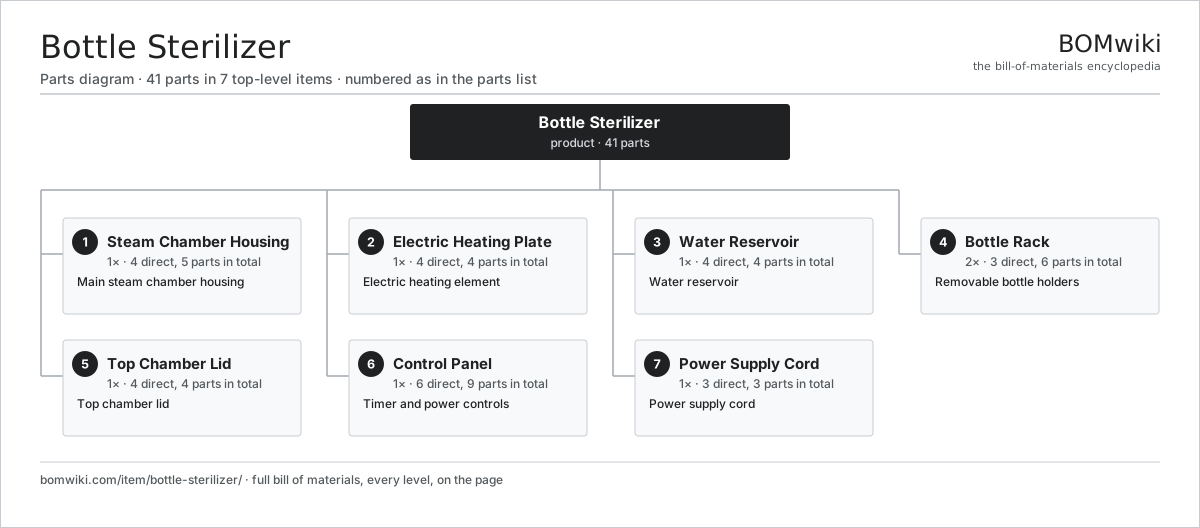
| # | Part | Qty | What it does |
|---|---|---|---|
| 1 | Steam Chamber Housing 4 parts | 1× | Main steam chamber housing |
| 2 | Electric Heating Plate 4 parts | 1× | Electric heating element |
| 3 | Water Reservoir 4 parts | 1× | Water reservoir |
| 4 | Bottle Rack 3 parts | 2× | Removable bottle holders |
| 5 | Top Chamber Lid 4 parts | 1× | Top chamber lid |
| 6 | Control Panel 6 parts | 1× | Timer and power controls |
| 7 | Power Supply Cord 3 parts | 1× | Power supply cord |
3D model
No 3D model yet. Have a CAD file of this? Add a 3D model. STL renders right on this page; STEP, FreeCAD, and OpenSCAD sources are welcome too (openly licensed, like all 3D models on BOMwiki).
Build & assembly graph
expand / collapse · shared sub-assemblies converge · links to related products · est. labourTap an assembly to expand/collapse · tap a part to open it · use “Open page” for any node · drag to pan, scroll to zoom.
Bill of materials for Bottle Sterilizer
7 top-level lines · 35 rows shown · 41 parts total · indented to 3 levels| # | Item / sub-assembly | Part no. | Qty/assy | Ext. qty | Parts | Type |
|---|---|---|---|---|---|---|
| 1 | Steam Chamber Housing 4 parts | bottle-sterilizer-chamber | 1× | 1 | 5 | assembly |
| 1.1 | Chamber Wall | bottle-sterilizer-chamber-body | 1× | 1 | · | part |
| 1.2 | Chamber Bottom | bottle-sterilizer-chamber-bottom | 1× | 1 | · | part |
| 1.3 | Steam Vent | bottle-sterilizer-steam-vent | 2× | 2 | · | part |
| 1.4 | Drain Port | bottle-sterilizer-drain-port | 1× | 1 | · | part |
| 2 | Electric Heating Plate 4 parts | bottle-sterilizer-heating-plate | 1× | 1 | 4 | assembly |
| 2.1 | Heating Element | heating-element | 1× | 1 | · | part |
| 2.2 | Heating Base Plate | bottle-sterilizer-heating-base | 1× | 1 | · | part |
| 2.3 | Thermostat | bottle-sterilizer-thermostat | 1× | 1 | · | part |
| 2.4 | Heating Connector | bottle-sterilizer-heating-connector | 1× | 1 | · | part |
| 3 | Water Reservoir 4 parts | bottle-sterilizer-water-tank | 1× | 1 | 4 | assembly |
| 3.1 | Tank Body | bottle-sterilizer-tank-body | 1× | 1 | · | part |
| 3.2 | Tank Seal Gasket | bottle-sterilizer-tank-seal | 1× | 1 | · | part |
| 3.3 | Water Level Gauge | bottle-sterilizer-water-level-gauge | 1× | 1 | · | part |
| 3.4 | Fill Cap | bottle-sterilizer-fill-cap | 1× | 1 | · | part |
| 4 | Bottle Rack 3 parts | bottle-sterilizer-bottle-racks | 2× | 2 | 6 | assembly |
| 4.1 | Rack Base | bottle-sterilizer-rack-base | 1× | 2 | · | part |
| 4.2 | Bottle Slot | bottle-sterilizer-bottle-holder | 4× | 8 | · | part |
| 4.3 | Rack Handle | bottle-sterilizer-rack-handle | 1× | 2 | · | part |
| 5 | Top Chamber Lid 4 parts | bottle-sterilizer-lid | 1× | 1 | 4 | assembly |
| 5.1 | Lid Panel | bottle-sterilizer-lid-panel | 1× | 1 | · | part |
| 5.2 | Lid Gasket | bottle-sterilizer-lid-seal | 1× | 1 | · | part |
| 5.3 | Lid Lock | bottle-sterilizer-lid-lock | 1× | 1 | · | part |
| 5.4 | Steam Outlet | bottle-sterilizer-steam-outlet | 1× | 1 | · | part |
| 6 | Control Panel 6 parts | bottle-sterilizer-control-panel | 1× | 1 | 9 | assembly |
| 6.1 | LCD Panel | lcd-panel | 1× | 1 | · | part |
| 6.2 | Power Button | bottle-sterilizer-power-button | 1× | 1 | · | part |
| 6.3 | Timer Button | bottle-sterilizer-timer-button | 2× | 2 | · | part |
| 6.4 | Status LED | bottle-sterilizer-indicator-led | 3× | 3 | · | part |
| 6.5 | Bare PCB | pcb-bare | 1× | 1 | · | part |
| 6.6 | Microcontroller | mcu | 1× | 1 | · | part |
| 7 | Power Supply Cord 3 parts | bottle-sterilizer-cord | 1× | 1 | 3 | assembly |
| 7.1 | Internal Wiring | bottle-sterilizer-wire-bundle | 1× | 1 | · | part |
| 7.2 | Power Plug | bottle-sterilizer-power-plug | 1× | 1 | · | part |
| 7.3 | Strain Relief | bottle-sterilizer-strain-relief | 1× | 1 | · | part |
Something wrong in this list? Report a problem with this BOM.
Related products
same domain, ranked by shared parts Air Fryer
61 parts · shares 1 with this page
All-In-One Home Brewing System
43 parts · shares 1 with this page
Air Fryer
61 parts · shares 1 with this page
All-In-One Home Brewing System
43 parts · shares 1 with this page
 Blender
68 parts · shares 1 with this page
Blender
68 parts · shares 1 with this page
 Bread Machine
162 parts · shares 1 with this page
Bread Machine
162 parts · shares 1 with this page
 Bread Maker
66 parts · shares 1 with this page
Bread Maker
66 parts · shares 1 with this page
 Chocolate Melanger
32 parts · shares 1 with this page
Chocolate Melanger
32 parts · shares 1 with this page
Sourcing: possible vendors
Browse the supplier directory → Prices, MOQ, and lead times are algorithmic estimates, not quotes, and not claims about these companies. Company mappings are curated by keyword; est. price band $20–$600. How estimates work| Vendor | HQ | Specialty | MOQ | Lead time |
|---|---|---|---|---|
|
🇦🇺Breville
breville.com ↗
|
Sydney, AU | Kitchen appliances | 2,000 units | 6–10 wks |
| groupeseb.com ↗ | Écully, FR | Cookware & small appliances | 2,000 units | 6–10 wks |
| hamiltonbeach.com ↗ | Glen Allen, US | Small appliances | 2,000 units | 6–10 wks |
| panasonic.com ↗ | Osaka, JP | Electronics & appliances | 2,000 units | 6–10 wks |
|
🇨🇳Midea
midea.com ↗
|
Foshan, CN | Home appliances | 2,000 units | 6–10 wks |
936-word article