Brake Lathe
ProductOverview
A brake lathe is a precision machine tool that resurfaces brake rotors and drums to restore their original flat or cylindrical contact surfaces. When brake pads wear, they gradually abrade the rotor surface, creating hills and valleys. Once a rotor thickness reaches its wear limit (typically 0.5–1 mm), the surface is too roughened and uneven to provide proper pad contact; the brake pedal pulses, indicating warping or uneven thickness. A brake lathe removes a thin layer (0.25–1 mm) from both sides of a rotor simultaneously, restoring flatness and parallelism. The same process applies to brake drums, which are resurfaced from the inside by a boring tool.
Brake lathe work is essential in professional shops. It extends rotor life by years and costs far less than replacement; it also improves brake feel and eliminates pulsation complaints from customers.
Spindle and bearing assembly
The Spindle & Bearing Assembly is the core: a precision steel shaft rotating at 600–3,500 rpm on high-precision ball or roller bearings. The Spindle Shaft (40–60 mm diameter) is dynamically balanced to better than ISO G 2.5, so vibration is minimal even at high speeds. The Spindle Bearing are angular contact or cylindrical roller types, rated for continuous operation.
The Arbor & Cone Set consists of tapered cones and flanges that grip the rotor or drum center hole. Rotors are centered on a cone that seats in the wheel hub hole (typically 50 mm cone angle); the rotor is then clamped with a Rotor / Drum Chuck flange and nut. Once centered, runout should be less than 0.05 mm total indicated runout (TIR), verified by a Runout Dial Gauge dial gauge.
Twin tool head and cutting
The Twin Cutting Tool Head has two opposing Tool Posts, one on each side of the rotor, equipped with Cutting Tools. As the rotor spins, both cutting tools remove material simultaneously, ensuring even thickness. Typical feed rate is 0.05–0.2 mm per revolution; the Axial Feed Drive advances the tool heads at this controlled pace.
The cutting tools are carbide-tipped Cutting Tool Inserts brazed or clamped onto steel shanks. Carbide remains sharp 50–100 times longer than high-speed steel; it is essential for production shops. The tool geometry is optimized for aluminum (alloy wheels) and cast iron (OEM rotors): sharp, high-speed cutting, shallow chip load to minimize heat.
Feed drive mechanism
The Axial Feed Drive is either electric (servo motor) or hydraulic (fluid power). A Feed Screw (ball screw or acme thread) converts motor rotation into linear tool advance. The Feed Nut is preloaded or spring-loaded to eliminate backlash, which is critical: if the tool jerks or hesitates, chatter marks appear on the rotor surface.
Modern machines offer multiple feed rates selectable via a dial or electronic control, allowing the operator to choose a slow feed (finer finish, more time) or fast feed (rougher but quicker). The Feed Carriage supports the tool head on linear rails or ways.
Motor and drive system
The Drive Motor is a 3-phase or single-phase electric motor (2–5 kW). The spindle speed is set by a Drive Belt (V-belt) and pulley ratio. Variable-frequency drives (VFDs) allow stepless speed control; mechanical belt-shift pulleys require manual speed adjustment. Most brake lathes operate at 800–2,000 rpm for production work; thinner aluminum rotors run faster (2,500–3,500 rpm) for better finish.
Base and rigidity
The Base & Work Bench is a heavy cast-iron or welded steel structure (300–500 kg) that absorbs vibration. Poor rigidity causes chatter, visible ripple marks on the rotor surface, that is worse than the original roughness. The Base Casting and Top Plate are precision-ground flat and level-adjusted using Leveling Feet.
The lathe must sit on a flat floor. Placement on a rubber mat or vibration isolators can help, but the machine's own weight (300+ kg) usually provides sufficient isolation from floor vibration.
Centering and runout control
Proper centering is critical. If the rotor is off-center, the cutting tools will remove material unevenly, leaving it thicker on one side. The technician places the rotor on the Arbor & Cone Set tapered cone, tightens the Clamp Nut, then rotates the spindle by hand and observes the Runout Dial Gauge dial gauge. If runout exceeds 0.05 mm, the technician loosens the clamp, adjusts the rotor position slightly, and retightens.
Some machines include an automatic centering feature: the chuck has adjustable fingers that push the rotor into the center. This reduces setup time from 2–3 minutes to 30 seconds.
Sound and vibration damping
Brake lathes are inherently loud, spindle whine, tool chatter, and metal-on-metal friction combine to 75–85 dB(A). The Sound Suppression Band, an elastomeric ring wrapped around the spinning rotor, damps vibration and reduces noise by 5–10 dB(A). Shops without silencer bands often place the lathe in an isolated room or sound booth.
The band is adjusted to lightly contact the rotor face without adding friction or drag; improper adjustment can slow the spindle or mark the rotor.
Surface finish and dimensional control
A sharp tool and slow feed produce a finish of 0.4–0.8 microinches (Ra), which is excellent for brake rotors. A dull tool or fast feed produces 1.6+ microinches, which is acceptable but coarser. The operator can visually inspect the finish after each rotor; a visible ripple pattern indicates chatter and demands reduced speed or feed rate.
Thickness is controlled by the operator's measurement using a micrometer at several points on the rotor. The feed dial on the Infeed Screw indicates total tool advance; the operator stops when the rotor reaches thickness specification (e.g., 11.9 mm minimum).
Rotor and drum processing workflow
(1) Place the rotor on the arbor cone and clamp. (2) Measure runout and adjust centering if needed. (3) Set spindle speed (1,200–2,000 rpm for cast iron, 2,500–3,500 rpm for aluminum). (4) Set feed rate (0.1 mm/rev for finish, 0.2 mm/rev for rough cut). (5) Engage the feed drive. (6) Remove approximately 0.5–1 mm total (0.25–0.5 mm per side). (7) Stop the spindle and measure final thickness. (8) Remove the rotor and inspect the surface finish. (9) Clean the rotor with solvent and air-dry.
A full rotor resurfacing typically takes 3–5 minutes per rotor. Two rotors and two drums for a 4-wheel brake job fit into a 20–30 minute service.
Limitations and wear
Rotors have minimum thickness (printed on the OEM rotor, typically 11.5–12 mm for passenger cars). Once a rotor is machined to minimum thickness, it cannot be remachined; it must be replaced. Drums have a similar maximum diameter limit (usually 0.5–1 mm over OEM). Exceeding these limits risks brake failure.
Extremely warped or hard-spotted rotors cannot be successfully resurfaced: a lathe removes material uniformly, but if the rotor was hardened unevenly during manufacturing, the hard spots will cause the tool to deflect, resulting in poor finish or shallow cuts. Such rotors must be replaced.
Brake Lathe parts and their functions
8 top-level parts · 39 parts in total · full bill of materials below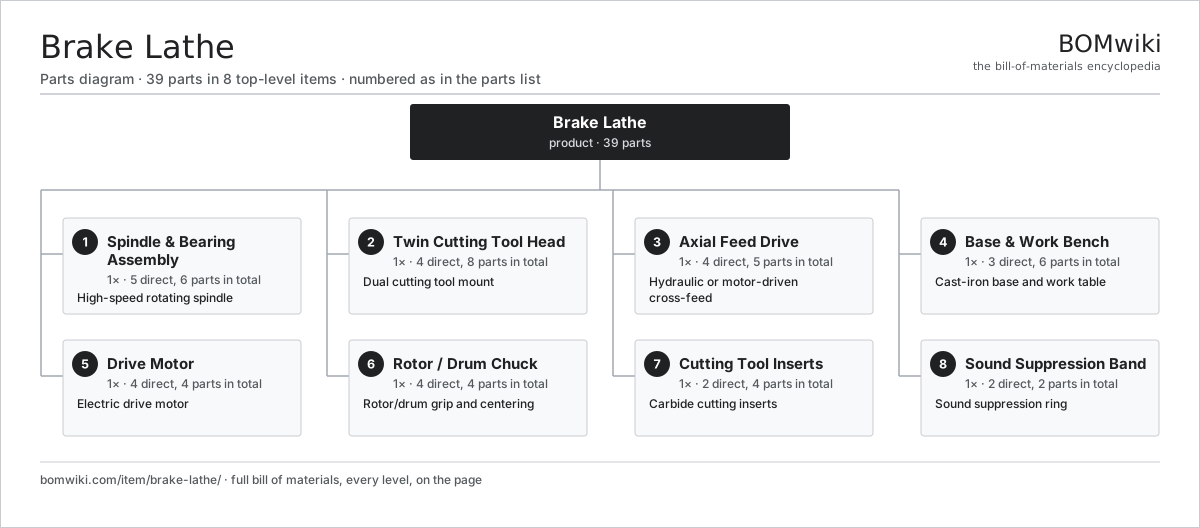
| # | Part | Qty | What it does |
|---|---|---|---|
| 1 | Spindle & Bearing Assembly 5 parts | 1× | High-speed rotating spindle |
| 2 | Twin Cutting Tool Head 4 parts | 1× | Dual cutting tool mount |
| 3 | Axial Feed Drive 4 parts | 1× | Hydraulic or motor-driven cross-feed |
| 4 | Base & Work Bench 3 parts | 1× | Cast-iron base and work table |
| 5 | Drive Motor 4 parts | 1× | Electric drive motor |
| 6 | Rotor / Drum Chuck 4 parts | 1× | Rotor/drum grip and centering |
| 7 | Cutting Tool Inserts 2 parts | 1× | Carbide cutting inserts |
| 8 | Sound Suppression Band 2 parts | 1× | Sound suppression ring |
3D model
No 3D model yet. Have a CAD file of this? Add a 3D model. STL renders right on this page; STEP, FreeCAD, and OpenSCAD sources are welcome too (openly licensed, like all 3D models on BOMwiki).
Build & assembly graph
expand / collapse · shared sub-assemblies converge · links to related products · est. labourTap an assembly to expand/collapse · tap a part to open it · use “Open page” for any node · drag to pan, scroll to zoom.
Bill of materials for Brake Lathe
8 top-level lines · 36 rows shown · 39 parts total · indented to 3 levels| # | Item / sub-assembly | Part no. | Qty/assy | Ext. qty | Parts | Type |
|---|---|---|---|---|---|---|
| 1 | Spindle & Bearing Assembly 5 parts | brake-lathe-spindle-assembly | 1× | 1 | 6 | assembly |
| 1.1 | Spindle Shaft | brake-lathe-spindle-shaft | 1× | 1 | · | part |
| 1.2 | Spindle Bearing | brake-lathe-spindle-bearings | 2× | 2 | · | part |
| 1.3 | Drive Pulley | brake-lathe-spindle-pulley | 1× | 1 | · | part |
| 1.4 | Spindle Housing | brake-lathe-spindle-housing | 1× | 1 | · | part |
| 1.5 | Arbor & Cone Set | brake-lathe-arbor-set | 1× | 1 | · | part |
| 2 | Twin Cutting Tool Head 4 parts | brake-lathe-twin-tool-head | 1× | 1 | 8 | assembly |
| 2.1 | Tool Post | brake-lathe-tool-post | 2× | 2 | · | part |
| 2.2 | Cutting Tool | brake-lathe-cutting-tool | 2× | 2 | · | part |
| 2.3 | Tool Clamp | brake-lathe-tool-clamp | 2× | 2 | · | part |
| 2.4 | Infeed Screw | brake-lathe-infeed-screw | 2× | 2 | · | part |
| 3 | Axial Feed Drive 4 parts | brake-lathe-feed-drive | 1× | 1 | 5 | assembly |
| 3.1 | Feed Motor | brake-lathe-feed-motor | 1× | 1 | · | part |
| 3.2 | Feed Screw | brake-lathe-feed-screw | 1× | 1 | · | part |
| 3.3 | Feed Nut | brake-lathe-feed-nut | 1× | 1 | · | part |
| 3.4 | Feed Carriage | brake-lathe-feed-rack | 2× | 2 | · | part |
| 4 | Base & Work Bench 3 parts | brake-lathe-bench | 1× | 1 | 6 | assembly |
| 4.1 | Base Casting | brake-lathe-base-casting | 1× | 1 | · | part |
| 4.2 | Top Plate | brake-lathe-top-plate | 1× | 1 | · | part |
| 4.3 | Leveling Feet | brake-lathe-leg-feet | 4× | 4 | · | part |
| 5 | Drive Motor 4 parts | brake-lathe-motor | 1× | 1 | 4 | assembly |
| 5.1 | Electric Motor | brake-lathe-electric-motor | 1× | 1 | · | part |
| 5.2 | Drive Belt | brake-lathe-motor-belt | 1× | 1 | · | part |
| 5.3 | Motor Pulley | brake-lathe-motor-pulley | 1× | 1 | · | part |
| 5.4 | Speed Control | brake-lathe-motor-speed-control | 1× | 1 | · | part |
| 6 | Rotor / Drum Chuck 4 parts | brake-lathe-chuck-system | 1× | 1 | 4 | assembly |
| 6.1 | Centering Cone | brake-lathe-chuck-cone | 1× | 1 | · | part |
| 6.2 | Clamping Flange | brake-lathe-chuck-flange | 1× | 1 | · | part |
| 6.3 | Clamp Nut | brake-lathe-chuck-clamp-nut | 1× | 1 | · | part |
| 6.4 | Runout Dial Gauge | brake-lathe-runout-indicator | 1× | 1 | · | part |
| 7 | Cutting Tool Inserts 2 parts | brake-lathe-tool-bits | 1× | 1 | 4 | assembly |
| 7.1 | Carbide Cutting Tool | brake-lathe-carbide-insert | 2× | 2 | · | part |
| 7.2 | HSS Tool Bit | brake-lathe-hss-tools | 2× | 2 | · | part |
| 8 | Sound Suppression Band 2 parts | brake-lathe-silencer-band | 1× | 1 | 2 | assembly |
| 8.1 | Suppression Band | brake-lathe-band-material | 1× | 1 | · | part |
| 8.2 | Band Bracket | brake-lathe-band-mount | 1× | 1 | · | part |
Something wrong in this list? Report a problem with this BOM.
Sourcing: possible vendors
Browse the supplier directory → Prices, MOQ, and lead times are algorithmic estimates, not quotes, and not claims about these companies. Company mappings are curated by keyword; est. price band $0.50–$100. How estimates work| Vendor | HQ | Specialty | MOQ | Lead time |
|---|
1,237-word article