Electric Breast Pump
ProductOverview
An electric breast pump is a medical device that extracts milk from the breast for bottle feeding, milk donation, or reliving engorgement during lactation. The Motor and Vacuum Pump creates suction by driving a Diaphragm Pump, which expands and contracts a flexible membrane, alternately drawing air out of a chamber and allowing it to refill, generating a net outflow. The Breast Flange Assembly fits over the breast, creating a seal, so suction inside the flange draws milk out of the breast tissue.
The Cycling and Strength Controls modulates the suction strength and frequency, allowing the pump to mimic the natural nursing pattern: an initial "letdown" phase of gentle, rapid suction that stimulates milk release, followed by a "expression" phase of slower, deeper pulls that extract milk.
Milk expression physiology
During breastfeeding, the infant s sucking stimulates nerve endings in the breast, which trigger a reflex arc in the mother s hypothalamus (part of the brain). The hypothalamus releases oxytocin, a hormone that causes muscle cells surrounding the milk ducts to contract, forcibly expelling milk. This is the "letdown" or "milk ejection" reflex.
An electric pump cannot trigger oxytocin release directly (only infant suckling or sometimes a mother s own thoughts of her infant can reliably trigger it), but the pump can stimulate the same nerve endings that infant suckling does, increasing the probability of letdown. Once letdown begins, the pump extracts milk as the ducts open and milk flows into the nipple and flange.
The Cycling and Strength Controls mimics this pattern by starting with a Frequency Adjuster set to 40–50 cpm (cycles per minute), which is the natural infant suck rate, and a low Strength Adjuster (suction strength), which is comfortable and stimulating. After 1–2 minutes, the mother activates Mode Switch to "expression" mode, which drops the frequency to 30–40 cpm and increases suction strength, pulling milk more aggressively once the reflex is activated.
Suction mechanism and safety
The Diaphragm Pump is driven by the Electric Motor via a mechanical linkage. As the motor shaft rotates, a cam or crank arm pushes and pulls a flexible rubber or silicone diaphragm. On the push stroke, the diaphragm bulges outward, increasing the volume of the pump chamber and creating a partial vacuum; on the pull stroke, the diaphragm returns to rest, compressing the chamber and forcing air out. A net flow of air is drawn from the Breast Flange Assembly through a tube to the pump chamber.
Safety is paramount: suction strength is capped at 250 mmHg (millimeters of mercury, a unit of pressure). Excessive suction can damage delicate breast tissue, causing bruising and pain. The suction strength is regulated by the Strength Adjuster, which mechanically limits the range of the diaphragm stroke (a shorter stroke = less vacuum = less suction). The breast-pump-control-relay can also electronically modulate the duty cycle (percentage of time the pump is "on" vs. "resting"), reducing average suction strength.
Flange fit and comfort
The Breast Flange Assembly is the critical interface between the pump and the breast. The Flange Cup is the outer rigid cup that seals against the breast skin, and the Flange Insert is a soft, flexible insert that surrounds the nipple, drawing it into a small tunnel within the flange.
Flange size is critical for comfort and milk extraction efficiency. A flange that is too large allows the areola (the dark skin around the nipple) to be drawn into the flange, which is painful and reduces extraction efficiency. A flange that is too small can pinch the nipple, also causing pain. Most pumps include two flange sizes (typically 25 and 28 mm outer diameter at the nipple opening), and larger sizes can be purchased separately.
The Flange Gasket is a rubber seal inside the flange that prevents milk from leaking around the edges of the insert, maintaining suction.
Milk collection and storage
The Milk Collection Bottles bottles are typically food-grade plastic (polyethylene or polypropylene, BPA-free) or glass. They are marked with volume graduations in milliliters and ounces. The Bottle Collar is a connector that screws the bottle directly onto the pump, so milk flows directly from the Breast Flange Assembly into the bottle without spilling.
The One-Way Valve System prevents milk from backing up into the pump. The Inlet Check Valve is a one-way check valve between the flange and the pump; it allows milk to flow toward the bottle but prevents milk from flowing backward into the pump motor (which would ruin the pump). The Outlet Check Valve prevents milk from siphoning backward from the bottle into the pump chamber if the bottle is removed while suction is still active.
Power and portability
Some pumps are mains-powered only (requiring an AC outlet), suitable for home use. Others are cordless, powered by a rechargeable Power Supply battery, allowing a mother to pump discreetly at work or while traveling. Battery-powered pumps are heavier and more expensive, but they offer flexibility.
A rechargeable pump typically has a lithium-ion battery (similar to those in phones) rated for 30–40 charge cycles. The charging port is usually USB-compatible, allowing charging from a laptop, power bank, or car charger. A full charge takes 2–4 hours and provides enough power for 4–8 pumping sessions (depending on session length and suction strength).
Noise and discretion
Hospital-grade pumps (used in lactation clinics and neonatal units) are loud, 70–80 dB, due to industrial motor design. Consumer breast pumps are designed for quieter operation, typically 45–60 dB (similar to quiet conversation). Noise comes primarily from motor vibration transmitted through the Motor Housing to the Pump Chamber; some pumps use rubber isolators to dampen this vibration.
Quieter pumps allow mothers to pump at work without announcing it to colleagues, which is an important privacy consideration.
Hygiene and cleaning
After each use, all parts that contact milk, the Breast Flange Assembly, Milk Collection Bottles bottles, and Pump Tubing, should be rinsed with cool water (not hot; hot water can coagulate protein in milk) and washed with warm soapy water. These parts can be steam-sterilized in a bottle sterilizer or boiled for 5 minutes daily to eliminate bacteria.
The Motor and Vacuum Pump and Pump Chamber should never be submerged in water. Only the wet-contact parts require daily sterilization; the motor and tubing can be wiped down with a damp cloth and air-dried.
Maintenance and durability
The Diaphragm Pump is the consumable part; the rubber or silicone diaphragm fatigues over time and eventually cracks or fails. Most manufacturers recommend replacing the diaphragm every 6–12 months for frequent users. The Electric Motor can burn out after years of use but is designed for 5+ years of typical (daily) use.
The One-Way Valve System can become sticky if milk residue dries inside the one-way valves; daily cleaning prevents this. Valves can be replaced if they lose their one-way function.
The Pump Tubing can degrade in sunlight (UV breaks down vinyl and silicone) and should be stored in a dark bag. Tubing can be replaced; it is usually available in packs.
Electric Breast Pump parts and their functions
7 top-level parts · 39 parts in total · full bill of materials below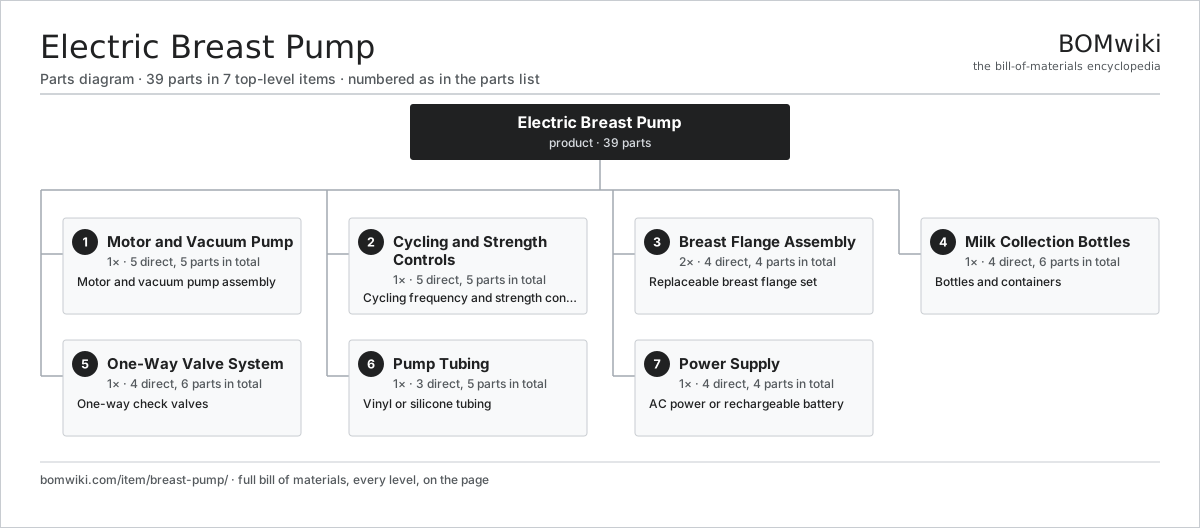
| # | Part | Qty | What it does |
|---|---|---|---|
| 1 | Motor and Vacuum Pump 5 parts | 1× | Motor and vacuum pump assembly |
| 2 | Cycling and Strength Controls 5 parts | 1× | Cycling frequency and strength controls |
| 3 | Breast Flange Assembly 4 parts | 2× | Replaceable breast flange set |
| 4 | Milk Collection Bottles 4 parts | 1× | Bottles and containers |
| 5 | One-Way Valve System 4 parts | 1× | One-way check valves |
| 6 | Pump Tubing 3 parts | 1× | Vinyl or silicone tubing |
| 7 | Power Supply 4 parts | 1× | AC power or rechargeable battery |
3D model
No 3D model yet. Have a CAD file of this? Add a 3D model. STL renders right on this page; STEP, FreeCAD, and OpenSCAD sources are welcome too (openly licensed, like all 3D models on BOMwiki).
Build & assembly graph
expand / collapse · shared sub-assemblies converge · links to related products · est. labourTap an assembly to expand/collapse · tap a part to open it · use “Open page” for any node · drag to pan, scroll to zoom.
Bill of materials for Electric Breast Pump
7 top-level lines · 36 rows shown · 39 parts total · indented to 3 levels| # | Item / sub-assembly | Part no. | Qty/assy | Ext. qty | Parts | Type |
|---|---|---|---|---|---|---|
| 1 | Motor and Vacuum Pump 5 parts | breast-pump-motor-unit | 1× | 1 | 5 | assembly |
| 1.1 | Electric Motor | breast-pump-motor | 1× | 1 | · | part |
| 1.2 | Diaphragm Pump | breast-pump-diaphragm-pump | 1× | 1 | · | part |
| 1.3 | Motor Housing | breast-pump-motor-housing | 1× | 1 | · | part |
| 1.4 | Pump Chamber | breast-pump-pump-chamber | 1× | 1 | · | part |
| 1.5 | Motor Capacitor | breast-pump-motor-capacitor | 1× | 1 | · | part |
| 2 | Cycling and Strength Controls 5 parts | breast-pump-cycle-controller | 1× | 1 | 5 | assembly |
| 2.1 | Frequency Adjuster | breast-pump-frequency-adjuster | 1× | 1 | · | part |
| 2.2 | Strength Adjuster | breast-pump-strength-adjuster | 1× | 1 | · | part |
| 2.3 | Control Circuit | breast-pump-control-circuit | 1× | 1 | · | part |
| 2.4 | Mode Switch | breast-pump-mode-switch | 1× | 1 | · | part |
| 2.5 | Status Display | breast-pump-display | 1× | 1 | · | part |
| 3 | Breast Flange Assembly 4 parts | breast-pump-flange-assembly | 2× | 2 | 4 | assembly |
| 3.1 | Flange Cup | breast-pump-flange-cup | 1× | 2 | · | part |
| 3.2 | Flange Insert | breast-pump-flange-insert | 1× | 2 | · | part |
| 3.3 | Flange Connector | breast-pump-flange-connector | 1× | 2 | · | part |
| 3.4 | Flange Gasket | breast-pump-flange-gasket | 1× | 2 | · | part |
| 4 | Milk Collection Bottles 4 parts | breast-pump-milk-collection | 1× | 1 | 6 | assembly |
| 4.1 | Collection Bottle | breast-pump-collection-bottle | 2× | 2 | · | part |
| 4.2 | Bottle Cap | breast-pump-bottle-cap | 2× | 2 | · | part |
| 4.3 | Bottle Collar | breast-pump-bottle-collar | 1× | 1 | · | part |
| 4.4 | Bottle Adapter | breast-pump-bottle-insert | 1× | 1 | · | part |
| 5 | One-Way Valve System 4 parts | breast-pump-valve-set | 1× | 1 | 6 | assembly |
| 5.1 | Inlet Check Valve | breast-pump-inlet-valve | 1× | 1 | · | part |
| 5.2 | Outlet Check Valve | breast-pump-outlet-valve | 1× | 1 | · | part |
| 5.3 | Valve Seat | breast-pump-valve-seat | 2× | 2 | · | part |
| 5.4 | Valve Spring | breast-pump-valve-spring | 2× | 2 | · | part |
| 6 | Pump Tubing 3 parts | breast-pump-tubing | 1× | 1 | 5 | assembly |
| 6.1 | Main Tube | breast-pump-tube-main | 1× | 1 | · | part |
| 6.2 | Tube Connector | breast-pump-tube-connector | 2× | 2 | · | part |
| 6.3 | Tube Clip | breast-pump-tube-clip | 2× | 2 | · | part |
| 7 | Power Supply 4 parts | breast-pump-power-supply | 1× | 1 | 4 | assembly |
| 7.1 | Power Source | breast-pump-power-source | 1× | 1 | · | part |
| 7.2 | Charge Circuit | breast-pump-charge-circuit | 1× | 1 | · | part |
| 7.3 | Power Switch | breast-pump-power-switch | 1× | 1 | · | part |
| 7.4 | Power LED | breast-pump-indicator-light | 1× | 1 | · | part |
Something wrong in this list? Report a problem with this BOM.
Sourcing: possible vendors
Browse the supplier directory → Prices, MOQ, and lead times are algorithmic estimates, not quotes, and not claims about these companies. Company mappings are curated by keyword; est. price band $500–$3M. How estimates work| Vendor | HQ | Specialty | MOQ | Lead time |
|---|---|---|---|---|
| gehealthcare.com ↗ | Chicago, US | Medical imaging & devices | 100 units | 12–20 wks |
| siemens-healthineers.com ↗ | Erlangen, DE | Medical systems | 100 units | 12–20 wks |
|
🇳🇱Philips
philips.com ↗
|
Amsterdam, NL | Health technology | 100 units | 12–20 wks |
| medtronic.com ↗ | Minneapolis, US | Medical devices | 100 units | 12–20 wks |
|
🇨🇳Mindray
mindray.com ↗
|
Shenzhen, CN | Medical devices | 100 units | 12–20 wks |
1,230-word article