Brewhouse System
ProductAlso known as: Beer Brewhouse
Overview
The brewhouse system is the core production platform for craft and pilot-scale beer production, integrating four purpose-built vessels with automated pump manifolding and temperature control. This four-vessel design, mash tun, lauter tun, kettle, and whirlpool, separates grain bed infusion, wort separation, boiling, and hot break settling into discrete chambers, enabling repeatable all-grain brewing at 40–60 L finished volume per cycle. The pump manifold and PLC controller orchestrate inter-vessel transfers, while the heat recovery module recaptures waste energy for strike water preheating, reducing fuel consumption by up to 35%.
This system bridges the gap between homebrewing (10–20 L single-pot all-in-one systems) and commercial 10 BBL + systems, serving contract breweries, university pilot programs, and small production breweries ramping to direct-to-market sales. The design prioritizes product consistency through automated temperature control and documented recipe repeatability via PLC step logging.
Mash Infusion & Temperature Management
The mash tun serves as the first major thermal operation, where cracked grain absorbs hot water in a starch-to-sugar conversion window (typically 50–70°C over 60–90 minutes). To maintain this critical temperature band, the vessel is heavily insulated and fitted with raking arms that gently circulate the grain bed. These paddles prevent compaction (which would block water flow), minimize temperature stratification, and prepare the grain for even lautering.
The false bottom separates the grain bed from the clear wort underneath; it must be designed to resist grain bed pressure without creating bridging channels where water shortcuts through unmilled grain. A properly designed false bottom slot size (0.75–1.2 mm) blocks crushed grain particles while passing all liquid.
Strike water (the initial hot water added to the grain) is pre-heated either in the hot water tank or directly via the heating elements. The control system monitors mash temperature via thermocouples embedded in the grain bed and adjusts heating to compensate for temperature drop during grain addition. Typical mash rest temperatures:
- Protein rest: 50–55°C (breaks down large proteins)
- Beta-glucan rest: 40–50°C (enhances head retention, enzyme activity)
- Saccharification rest: 62–70°C (primary starch conversion)
- Mash-out: 75–78°C (halts enzyme activity before lautering)
Wort Separation via Lautering
The lauter tun is where clear wort is drawn off from spent grain without pulling solid particles into the kettle. The sparging manifold distributes hot water (72–78°C) in a fine rain across the grain bed surface, pushing liquid down through the grain and out the center drain. The outlet valve controls flow rate, typically 1–2 L/min per liter of grain bed volume to avoid bed compression and stuck runoff.
The circulation pump recirculates the first 10 L of runoff (called "first wort") back onto the grain surface to clarify turbid liquid; this self-filtering step takes 5–10 minutes and ensures crystal-clear wort entering the kettle. Modern systems combine gravity runoff (vessel positioned above kettle) with pump-assisted transfer for consistent flow. Lautering takes 30–50 minutes for a full infusion mash and is the single longest phase in a brew day.
Kettle Boiling & Hop Utilization
The kettle with steam jackets is the second major thermal appliance, where wort undergoes a 60–90 minute rolling boil to sterilize the liquid, denature residual proteins (creating "hot break"), and isomerize alpha acids from hops for bitterness contribution. The steam jacket design heats the entire vessel volume uniformly rather than just the bottom; this prevents scorching and localized hot spots that can degrade delicate wort compounds.
The boil is divided into phases:
- 60-minute mark: First bittering charge (high-alpha hops, ~60 IBU contribution)
- 15-minute mark: Mid-boil flavor additions (moderate alpha, ~20 IBU)
- 0-minute (knockout): Aroma additions (low alpha, volatile essential oils)
The heating control regulates steam inlet flow to maintain a gentle rolling boil (not a vigorous, evaporative loss-heavy boil) at 100°C. A thermostat with 3-degree deadband switches steam solenoid on/off to prevent overshoot. Post-boil, wort is immediately transferred to the whirlpool to halt bittering reactions.
Hot Break Settling & Clarity
The whirlpool chamber exploits centrifugal force to separate suspended solids (coagulated proteins, hop debris, mineral precipitation) from clear wort in 15–20 minutes. Hot wort at ~75°C enters tangentially at the cone's upper wall, inducing a slow rotation (180 rpm). Denser particles spiral inward and downward, settling in a tightly packed cone at the bottom. The center drain draws clear supernatant into the chiller without resuspending the trub pile.
This hot separation is energy-efficient (no cooling penalty) and produces wort clarity equivalent to a decanting method but in half the time. Advanced brewhouses run a small circulation pump through the whirlpool outlet to a secondary settling tank, further polishing clarity before pitching yeast.
Integration & Heat Recovery
The plate heat exchanger recovers 50–80 kW of thermal energy from kettle boiloff steam and whirlpool outlet (~75°C water). This energy is transferred to cooler return water (35–40°C) from the hot water tank, which is recirculated via the tank pump. Over a full brew day, this can preheat strike water by 20–30°C, reducing total fuel consumption by 30–40%.
The PLC-based control system orchestrates all vessel operations: filling, heating, mashing, lautering, boiling, and shutdown. Brew recipes are uploaded as step-by-step sequences (e.g., "Heat to 52°C, hold 20 min, ramp to 67°C at 1°C/min, hold 30 min") and the PLC automatically switches pumps, solenoid valves, and heating elements. Temperature logging provides full traceability for quality audits and recipe optimization.
Typical Brew Schedule
A 45 L brew targeting 1.055 OG and 65 IBU typically requires:
- Grain In–Mash: 15 min (crushing, mashing in)
- First Mash Rest: 60 min at 52°C
- Second Rest: 60 min at 67°C
- Mash-Out & Sparge: 10 min at 78°C
- Lautering: 40 min (gravity runoff, sparging)
- Kettle Boil: 90 min
- Whirlpool & Settling: 20 min
- Chill to Pitch Temperature: 30 min (via counterflow chiller)
- Total Brew Time: ~6.5 hours hands-on, 4.5 hours automated
This modular approach allows a two-person team to brew twice weekly at 40–60 L per batch, scaling to 240–480 L monthly production, suitable for small-batch contract production or taproom supply.
Brewhouse System parts and their functions
7 top-level parts · 52 parts in total · full bill of materials below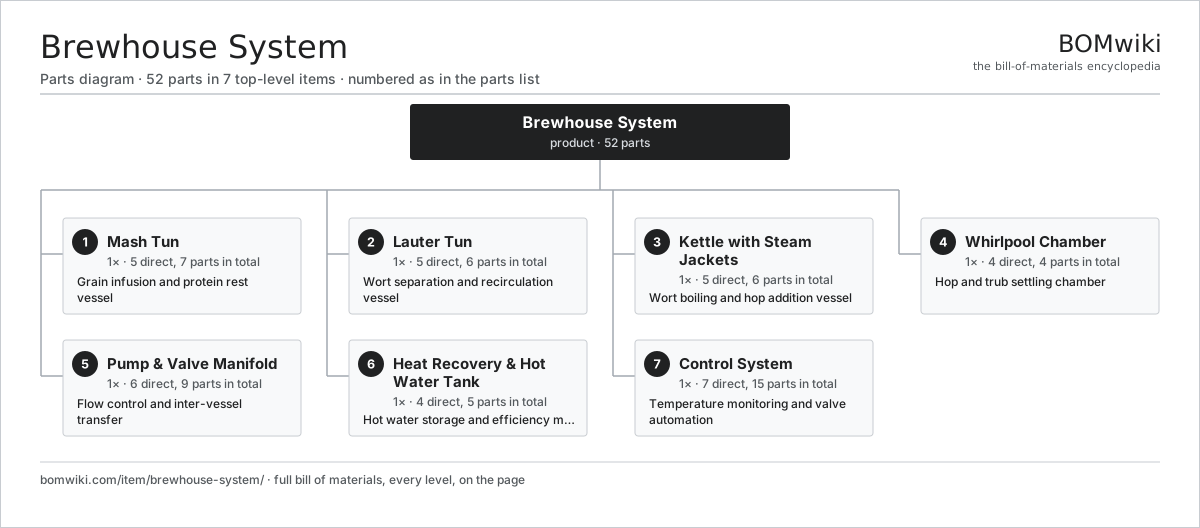
| # | Part | Qty | What it does |
|---|---|---|---|
| 1 | Mash Tun 5 parts | 1× | Grain infusion and protein rest vessel |
| 2 | Lauter Tun 5 parts | 1× | Wort separation and recirculation vessel |
| 3 | Kettle with Steam Jackets 5 parts | 1× | Wort boiling and hop addition vessel |
| 4 | Whirlpool Chamber 4 parts | 1× | Hop and trub settling chamber |
| 5 | Pump & Valve Manifold 6 parts | 1× | Flow control and inter-vessel transfer |
| 6 | Heat Recovery & Hot Water Tank 4 parts | 1× | Hot water storage and efficiency module |
| 7 | Control System 7 parts | 1× | Temperature monitoring and valve automation |
3D model
No 3D model yet. Have a CAD file of this? Add a 3D model. STL renders right on this page; STEP, FreeCAD, and OpenSCAD sources are welcome too (openly licensed, like all 3D models on BOMwiki).
Build & assembly graph
expand / collapse · shared sub-assemblies converge · links to related products · est. labourTap an assembly to expand/collapse · tap a part to open it · use “Open page” for any node · drag to pan, scroll to zoom.
Bill of materials for Brewhouse System
7 top-level lines · 43 rows shown · 52 parts total · indented to 3 levels| # | Item / sub-assembly | Part no. | Qty/assy | Ext. qty | Parts | Type |
|---|---|---|---|---|---|---|
| 1 | Mash Tun 5 parts | brewhouse-system-mash-tun | 1× | 1 | 7 | assembly |
| 1.1 | Mash Tun Body | brewhouse-system-mash-tun-body | 1× | 1 | · | part |
| 1.2 | False Bottom & Frame | brewhouse-system-false-bottom | 1× | 1 | · | part |
| 1.3 | Raking Arm | brewhouse-system-raking-arm | 2× | 2 | · | part |
| 1.4 | Mash Outlet Valve | brewhouse-system-mash-outlet | 1× | 1 | · | part |
| 1.5 | Heating Element | heating-element | 2× | 2 | · | part |
| 2 | Lauter Tun 5 parts | brewhouse-system-lauter-tun | 1× | 1 | 6 | assembly |
| 2.1 | Lauter Tun Body | brewhouse-system-lauter-tun-body | 1× | 1 | · | part |
| 2.2 | Sparging Manifold | brewhouse-system-manifold-assembly | 1× | 1 | · | part |
| 2.3 | Lauter Valve | brewhouse-system-lauter-valve | 2× | 2 | · | part |
| 2.4 | Pressure Sensor | pressure-sensor | 1× | 1 | · | part |
| 2.5 | Wire Bundle | wire-bundle | 1× | 1 | · | part |
| 3 | Kettle with Steam Jackets 5 parts | brewhouse-system-kettle | 1× | 1 | 6 | assembly |
| 3.1 | Kettle Body | brewhouse-system-kettle-body | 1× | 1 | · | part |
| 3.2 | Steam Jacket Zone | brewhouse-system-steam-jacket | 2× | 2 | · | part |
| 3.3 | Heating Control Unit | brewhouse-system-heating-control | 1× | 1 | · | part |
| 3.4 | Kettle Outlet Block | brewhouse-system-kettle-outlet | 1× | 1 | · | part |
| 3.5 | Thermal Fuse | thermal-fuse | 1× | 1 | · | part |
| 4 | Whirlpool Chamber 4 parts | brewhouse-system-whirlpool | 1× | 1 | 4 | assembly |
| 4.1 | Whirlpool Cone | brewhouse-system-whirlpool-body | 1× | 1 | · | part |
| 4.2 | Whirlpool Inlet Nozzle | brewhouse-system-whirlpool-inlet | 1× | 1 | · | part |
| 4.3 | Whirlpool Center Drain | brewhouse-system-whirlpool-outlet | 1× | 1 | · | part |
| 4.4 | Cone Support Structure | brewhouse-system-cone-support | 1× | 1 | · | part |
| 5 | Pump & Valve Manifold 6 parts | brewhouse-system-pump-manifold | 1× | 1 | 9 | assembly |
| 5.1 | Centrifugal Transfer Pump | brewhouse-system-centrifugal-pump | 1× | 1 | · | part |
| 5.2 | Solenoid Valve | brewhouse-system-solenoid-valve | 3× | 3 | · | part |
| 5.3 | Pressure Relief Valve | brewhouse-system-pressure-relief | 1× | 1 | · | part |
| 5.4 | Flow Meter | brewhouse-system-flowmeter | 1× | 1 | · | part |
| 5.5 | Connector | connector | 2× | 2 | · | part |
| 5.6 | Wire Bundle | wire-bundle | 1× | 1 | · | part |
| 6 | Heat Recovery & Hot Water Tank 4 parts | brewhouse-system-heat-recovery | 1× | 1 | 5 | assembly |
| 6.1 | Plate Heat Exchanger | brewhouse-system-plate-hx | 1× | 1 | · | part |
| 6.2 | Hot Water Storage Tank | brewhouse-system-hot-water-tank | 1× | 1 | · | part |
| 6.3 | Tank Circulation Pump | brewhouse-system-tank-pump | 1× | 1 | · | part |
| 6.4 | Pressure Sensor | pressure-sensor | 2× | 2 | · | part |
| 7 | Control System 7 parts | brewhouse-system-control-system | 1× | 1 | 15 | assembly |
| 7.1 | Brewhouse PLC | brewhouse-system-plc | 1× | 1 | · | part |
| 7.2 | I/O Module Set | brewhouse-system-io-module | 2× | 2 | · | part |
| 7.3 | HMI Touchscreen | brewhouse-system-hmi-panel | 1× | 1 | · | part |
| 7.4 | Microcontroller | mcu | 1× | 1 | · | part |
| 7.5 | Bare PCB | pcb-bare | 2× | 2 | · | part |
| 7.6 | Relay | relay | 4× | 4 | · | part |
| 7.7 | Connector | connector | 4× | 4 | · | part |
Something wrong in this list? Report a problem with this BOM.
Related products
same domain, ranked by shared parts Chocolate Enrober
470 parts · shares 7 with this page
Confectionery Depositor
699 parts · shares 7 with this page
Spiral Freezer
179 parts · shares 7 with this page
Chocolate Enrober
470 parts · shares 7 with this page
Confectionery Depositor
699 parts · shares 7 with this page
Spiral Freezer
179 parts · shares 7 with this page
 Chocolate Tempering Machine
141 parts · shares 6 with this page
Chocolate Tempering Machine
141 parts · shares 6 with this page
 Commercial Deep Fryer
65 parts · shares 6 with this page
Commercial Deep Fryer
65 parts · shares 6 with this page
 Commercial Dishwasher
211 parts · shares 6 with this page
Commercial Dishwasher
211 parts · shares 6 with this page
Sourcing: possible vendors
Browse the supplier directory → Prices, MOQ, and lead times are algorithmic estimates, not quotes, and not claims about these companies. Company mappings are curated by keyword; est. price band $1k–$500k. How estimates work| Vendor | HQ | Specialty | MOQ | Lead time |
|---|---|---|---|---|
| gea.com ↗ | Düsseldorf, DE | Process technology | 20 units | 12–20 wks |
| buhlergroup.com ↗ | Uzwil, CH | Food & materials processing | 20 units | 12–20 wks |
| tetrapak.com ↗ | Pully, CH | Food packaging & processing | 20 units | 12–20 wks |
| jbtc.com ↗ | Chicago, US | Food processing equipment | 20 units | 12–20 wks |
| alfalaval.com ↗ | Lund, SE | Heat transfer & separation | 20 units | 12–20 wks |
1,146-word article