Bulk Bag Unloader
ProductOverview
A bulk bag unloader (or FIBC discharger) is an industrial system designed to safely and efficiently empty large flexible intermediate bulk containers (FIBCs, or "big bags") containing 500–2000 kg of dry bulk material. Unlike manually cutting open a bag and pouring its contents, an automated unloader lifts the suspended bag, vibrates it to dislodge stuck material, and opens a discharge valve to allow controlled gravity flow into a downstream process (conveyor, hopper, mixer, etc.).
The system comprises a structural frame (4–5 m tall) with a Lifting Hoist lifting the bag, Vibrating Massage Paddles vibrating the surface to assist discharge, a pneumatic iris valve controlling flow rate, and a Dust Containment Hood with exhaust filtration capturing airborne dust. A PLC automates the cycle: lift, vibrate, discharge, lower, repeat.
How It Works
A full FIBC is positioned on a loading station (typically a pallet or cart). The operator (or automated conveyor) moves it under the Main Frame Assembly. The Bag Lifting Frame with Bag Corner Grips is manually positioned and latched to the four corners of the bag.
The operator presses a "Start" button on the Control Electronics. The Lifting Hoist (electric or pneumatic motor driving a Lift Chain) raises the bag 0.5–1.5 m, lifting it off the ground and positioning its outlet toward the Discharge Spout.
As the bag is raised, gravity begins pulling material toward the outlet. However, material often "bridges", particles form arches within the bag that support overlying material, preventing flow. To overcome this, the Control PLC activates the Vibrating Massage Paddles. A pneumatic motor oscillates the four paddles at 5–10 Hz, vibrating the bag surface and breaking the bridges, allowing material to flow freely.
Simultaneously, the Iris Valve (controlled by a Iris Actuator) is opened to a preset angle (e.g., 50% open). Material flows by gravity from the bag's outlet, down the Spout Cone, through the partially-open iris, and into the Discharge Outlet, which directs it to the downstream equipment (conveyor, hopper, mixers, etc.).
The operator monitors the discharge rate. If it slows, they can increase the iris opening (full manual override available). Dust escaping from the spout is captured by the Dust Containment Hood, drawn through a Filter Cartridge by an Exhaust Fan, and exhausted to the outside or to a central dust collection system.
For stubborn, sticky, or fine powders, the Glove Access Port provides access for the operator to reach into the hood and manually break up clumps or vibrate the bag by hand while wearing protective neoprene gloves.
Once discharge is complete (material stops flowing), the operator closes the iris valve and lowers the bag via the hoist. The empty bag is removed, replaced with a full one, and the cycle repeats.
Mechanical Design
The Main Frame Assembly is a welded structural steel assembly: four vertical Frame Posts (200 × 200 mm Grade 50 box section, 4–5 m tall) connected by cross-members and diagonal bracing. The Top Beam (I-beam, 400 × 200 mm) spans the top and supports the Lifting Hoist.
The Hoist Motor is mounted to the Top Beam via a trolley. It can be:
- Electric: A 230 V or 400 V geared hoist (500 W–1 kW), lift speed 5–10 m/min.
- Pneumatic: A pneumatic air motor (1–2 kW at 6 bar), often preferred in explosive environments (grain, chemical dust).
The hoist drives a Lift Chain (Grade 80 or 100 welded link, 10 mm pitch, rated 5 metric tons) that lifts the Grip Support Frame. The grip frame holds four Bag Corner Grips (mechanical clamps or magnetic pads), one at each corner of the FIBC bag. The grips are adjustable to accommodate bags of slightly different sizes (±100 mm variation).
The Vibrating Massage Paddles are driven by a Paddle Pneumatic Motor (pneumatic piston motor, 2–3 kW at 6 bar) that oscillates four Paddle Assemblies at 5–10 Hz. The arms are tipped with soft nylon or rubber paddles (∅50 mm) that strike the bag gently without damaging it. The paddle assembly is adjustable for height and spread to fit different bag sizes.
The Discharge Spout includes:
- Spout Cone: A stainless steel or mild steel cone (inlet 300 mm, outlet 200 mm).
- Iris Valve: A pneumatic iris or butterfly valve controlling flow. A full butterfly open (100%) allows ~50–100 kg/min of typical powders; partially closed (50%) allows ~25–50 kg/min.
- Iris Actuator: A pneumatic rotary actuator (24 V solenoid pilot, 6 bar main pressure) opening/closing the iris.
- Discharge Outlet: A elbowed pipe directing material downward into downstream equipment.
Dust Containment
The Dust Containment Hood is a critical safety component. A welded steel enclosure (1200 × 1200 × 800 mm) surrounds the spout and discharge area. Fine dust escaping the iris valve or discharged at high velocity is captured by:
- Hood Inlet: Air drawn into the hood from the sides and bottom by the Exhaust Fan.
- Filter Cartridge: A pleated fabric filter element (5–10 µm absolute rating, ~5 m² area) removes dust from the exhaust airstream.
- Pulse Cleaning: A Filter Cleaning System system periodically blasts compressed air backward through the filter, dislodging accumulated dust cake into a collection bin at the hood bottom (gravity drain).
- Exhaust: The cleaned air is exhausted to the outside via the Exhaust Fan (0.5–1.5 kW centrifugal, 1000–2000 m³/h).
The Glove Access Port on the hood side allows the operator to reach inside (wearing protective gloves) to break up material clumps or assist discharge of cohesive materials.
Control & Safety
The Control Electronics is a NEMA 4X stainless steel enclosure housing:
- PLC: An ARM Cortex-M4 processor running cycle automation firmware.
- Display: A 7" LCD touchscreen showing operation status and diagnostics.
- Keypad: Buttons for Start, Stop, Emergency Stop, Manual Iris Control.
- Relay Module: Solenoid drivers for the iris valve actuator and paddle motor solenoid.
Typical cycle automation (programmable by operator):
- Press Start → Hoist begins lifting (ramps to full speed over 2 seconds).
- Hoist reaches upper limit (detected by hoist-limit-switch) → Massage paddles activate at 8 Hz.
- After 5 seconds of vibration → Iris valve opens to 50% (adjustable setpoint).
- Material discharges; operator monitors flowrate.
- When discharge slows to <5 kg/min (timeout threshold), iris closes, massage paddles stop.
- Hoist lowers bag; cycle complete, ready for next bag.
Safety interlocks prevent operator injury:
- Hoist automatically stops if a limit switch fails.
- E-stop button immediately de-energizes hoist and iris solenoids.
- Hood pressure sensor ensures negative pressure (exhaust working) before spout opening.
Advantages & Maintenance
Advantages:
- Eliminates manual bag cutting and shoveling, reducing labor and ergonomic strain.
- Dust containment meets OSHA PEL (Permissible Exposure Limit) and EN standards.
- Faster unloading (typically 10–15 minutes per bag vs. 30+ minutes manual).
- Reduced material loss and contamination.
Maintenance:
- Weekly: Inspect glove sleeves for tears; test iris valve for sticking.
- Monthly: Check filter cartridge for dust loading; estimate remaining life.
- Quarterly: Clean hoist chain and inspect for wear; replace if links show 3+ mm wear.
- Annually: Rebuild hoist gearbox (oil change); replace worn gloves; inspect welds for fatigue cracks.
Filter cartridges typically last 6–12 months; cost ~$200–500 per element.
Applications
- Polymer & Plastics: Emptying FIBC bags of resin pellets into hoppers.
- Food Manufacturing: Unloading flour, sugar, salt from bulk bags into silos or mixers.
- Pharmaceuticals: Discharging active ingredients and excipients; dust control critical for safety.
- Chemicals: Dyes, pigments, catalysts; many toxic or irritant dusts requiring containment.
- Minerals & Cement: Unloading crushed ore, limestone, Portland cement from quarry or mill.
- Recycling: Sorting and processing FIBC-packaged shredded plastic or metal.
Related Reading: Lifting Hoist, Vibrating Massage Paddles, Discharge Spout, Dust Containment Hood.
Bulk Bag Unloader parts and their functions
8 top-level parts · 27 parts in total · full bill of materials below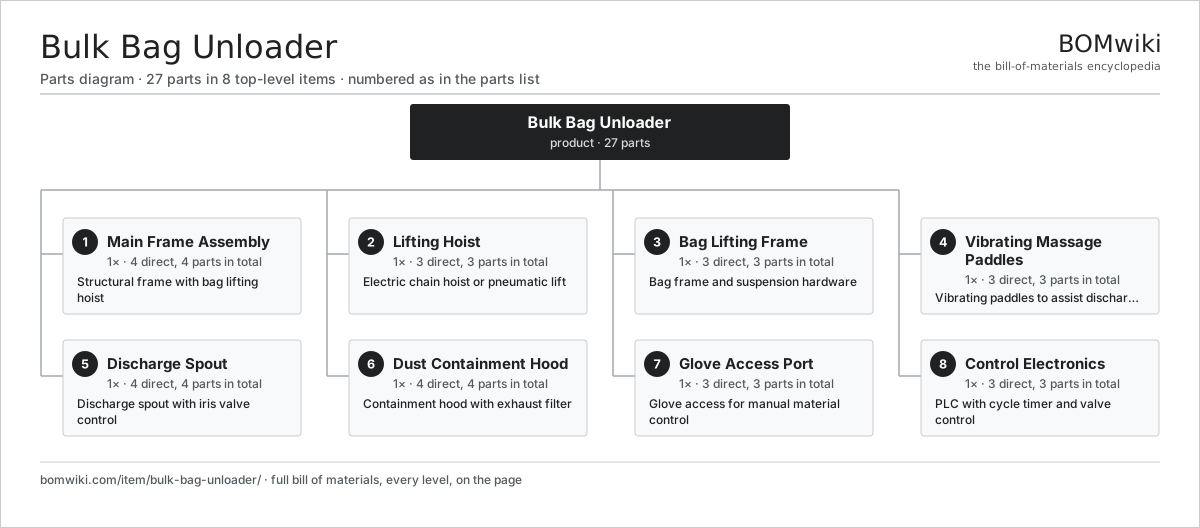
| # | Part | Qty | What it does |
|---|---|---|---|
| 1 | Main Frame Assembly 4 parts | 1× | Structural frame with bag lifting hoist |
| 2 | Lifting Hoist 3 parts | 1× | Electric chain hoist or pneumatic lift |
| 3 | Bag Lifting Frame 3 parts | 1× | Bag frame and suspension hardware |
| 4 | Vibrating Massage Paddles 3 parts | 1× | Vibrating paddles to assist discharge |
| 5 | Discharge Spout 4 parts | 1× | Discharge spout with iris valve control |
| 6 | Dust Containment Hood 4 parts | 1× | Containment hood with exhaust filter |
| 7 | Glove Access Port 3 parts | 1× | Glove access for manual material control |
| 8 | Control Electronics 3 parts | 1× | PLC with cycle timer and valve control |
3D model
No 3D model yet. Have a CAD file of this? Add a 3D model. STL renders right on this page; STEP, FreeCAD, and OpenSCAD sources are welcome too (openly licensed, like all 3D models on BOMwiki).
Build & assembly graph
expand / collapse · shared sub-assemblies converge · links to related products · est. labourTap an assembly to expand/collapse · tap a part to open it · use “Open page” for any node · drag to pan, scroll to zoom.
Bill of materials for Bulk Bag Unloader
8 top-level lines · 35 rows shown · 27 parts total · indented to 3 levels| # | Item / sub-assembly | Part no. | Qty/assy | Ext. qty | Parts | Type |
|---|---|---|---|---|---|---|
| 1 | Main Frame Assembly 4 parts | bulk-bag-unloader-frame | 1× | 1 | 4 | assembly |
| 1.1 | Frame Posts | bulk-bag-unloader-frame-posts | 1× | 1 | · | part |
| 1.2 | Top Beam | bulk-bag-unloader-top-beam | 1× | 1 | · | part |
| 1.3 | Frame Bracing | bulk-bag-unloader-bracing | 1× | 1 | · | part |
| 1.4 | Base Feet | bulk-bag-unloader-base-feet | 1× | 1 | · | part |
| 2 | Lifting Hoist 3 parts | bulk-bag-unloader-hoist | 1× | 1 | 3 | assembly |
| 2.1 | Hoist Motor | bulk-bag-unloader-hoist-unit | 1× | 1 | · | part |
| 2.2 | Lift Chain | bulk-bag-unloader-hoist-chain | 1× | 1 | · | part |
| 2.3 | Position Limit Switches | bulk-bag-unloader-hoist-limit-switch | 1× | 1 | · | part |
| 3 | Bag Lifting Frame 3 parts | bulk-bag-unloader-lift-frame | 1× | 1 | 3 | assembly |
| 3.1 | Bag Corner Grips | bulk-bag-unloader-corner-grips | 1× | 1 | · | part |
| 3.2 | Grip Support Frame | bulk-bag-unloader-grip-frame | 1× | 1 | · | part |
| 3.3 | Grip Adjusters | bulk-bag-unloader-grip-adjustment | 1× | 1 | · | part |
| 4 | Vibrating Massage Paddles 3 parts | bulk-bag-unloader-massage-paddles | 1× | 1 | 3 | assembly |
| 4.1 | Paddle Pneumatic Motor | bulk-bag-unloader-paddle-air-motor | 1× | 1 | · | part |
| 4.2 | Paddle Assemblies | bulk-bag-unloader-paddle-arms | 1× | 1 | · | part |
| 4.3 | Paddle Frame Mount | bulk-bag-unloader-paddle-mount | 1× | 1 | · | part |
| 5 | Discharge Spout 4 parts | bulk-bag-unloader-spout-assembly | 1× | 1 | 4 | assembly |
| 5.1 | Spout Cone | bulk-bag-unloader-spout-cone | 1× | 1 | · | part |
| 5.2 | Iris Valve | bulk-bag-unloader-iris-valve | 1× | 1 | · | part |
| 5.3 | Iris Actuator | bulk-bag-unloader-valve-actuator | 1× | 1 | · | part |
| 5.4 | Discharge Outlet | bulk-bag-unloader-discharge-elbow | 1× | 1 | · | part |
| 6 | Dust Containment Hood 4 parts | bulk-bag-unloader-dust-hood | 1× | 1 | 4 | assembly |
| 6.1 | Hood Enclosure | bulk-bag-unloader-hood-body | 1× | 1 | · | part |
| 6.2 | Filter Cartridge | bulk-bag-unloader-filter-cartridge | 1× | 1 | · | part |
| 6.3 | Filter Cleaning System | bulk-bag-unloader-pulse-jet | 1× | 1 | · | part |
| 6.4 | Exhaust Fan | bulk-bag-unloader-exhaust-blower | 1× | 1 | · | part |
| 7 | Glove Access Port 3 parts | bulk-bag-unloader-glove-box | 1× | 1 | 3 | assembly |
| 7.1 | Glove Port Frame | bulk-bag-unloader-glove-port-frame | 1× | 1 | · | part |
| 7.2 | Glove Sleeves | bulk-bag-unloader-glove-sleeves | 1× | 1 | · | part |
| 7.3 | Glove Gasket Seal | bulk-bag-unloader-glove-gasket | 1× | 1 | · | part |
| 8 | Control Electronics 3 parts | bulk-bag-unloader-control-panel | 1× | 1 | 3 | assembly |
| 8.1 | Control PLC | bulk-bag-unloader-control-plc | 1× | 1 | · | part |
| 8.2 | Control Panel | bulk-bag-unloader-control-enclosure | 1× | 1 | · | part |
| 8.3 | Solenoid Drivers | bulk-bag-unloader-solenoid-drivers | 1× | 1 | · | part |
Something wrong in this list? Report a problem with this BOM.
Sourcing: possible vendors
Browse the supplier directory → Prices, MOQ, and lead times are algorithmic estimates, not quotes, and not claims about these companies. Company mappings are curated by keyword; est. price band $5k–$2M. How estimates work| Vendor | HQ | Specialty | MOQ | Lead time |
|---|---|---|---|---|
| atlascopco.com ↗ | Stockholm, SE | Compressors & industrial | 10 units | 12–20 wks |
|
🇦🇹Andritz
andritz.com ↗
|
Graz, AT | Process plants & machinery | 10 units | 12–20 wks |
| buhlergroup.com ↗ | Uzwil, CH | Food & materials processing | 10 units | 12–20 wks |
| gea.com ↗ | Düsseldorf, DE | Process technology | 10 units | 12–20 wks |
| mhi.com ↗ | Tokyo, JP | Heavy machinery | 10 units | 12–20 wks |
1,434-word article