Burial Vault Handler
ProductOverview
A burial vault handler is a specialized mobile lifting system designed to lower concrete or metal burial vaults into graves safely and with dignity. Burial vaults, outer protective containers surrounding caskets, typically weigh 500–1500 kg depending on material (reinforced concrete being most common). Manual lowering using ropes or cables is dangerous and unreliable; vault handlers automate the process, protecting workers from strain injury and ensuring the vault descends level and smoothly.
Every cemetery and graveyard uses burial vault handlers; they are standard equipment at any facility serving more than a few burials per month. The system is deployed over the grave opening, the vault is positioned over the grave on a lowering apparatus, and the handler gently lowers the vault as mourners observe. Modern handlers are mobile (wheeled), enabling repositioning to different graves throughout the cemetery.
Core subsystems include the Telescoping Boom Arm telescoping boom, the Winch Motor & Drive electric drive, the Cable Spool & Drum Assembly cable spool, the Load Hook & Spreader Bar connection hardware, the Electronic Weight Sensor weight sensor, the Weighted Base Frame weighted base, the Mobile Wheeled Platform wheeled carriage, and the Operator Control Pendant operator interface.
How It Works
A completed grave (6 feet deep typical, lined with green plastic or concrete) awaits the vault. The cemetery worker positions the Mobile Wheeled Platform wheeled carriage over the grave center, locking the Heavy-Duty Mobile Caster brakes to prevent rolling. The Telescoping Boom Arm is already collapsed; the worker extends it to reach over the grave opening using the hydraulic Boom Raise/Lower Cylinder.
The burial vault (typically a rectangular concrete box, 700 × 1300 × 500 mm, weighing 800–1200 kg) is positioned at ground level near the grave. Four nylon straps (similar to those on a Casket Lowering Device) loop under the vault, with their free ends clipped to the Load Hook & Spreader Bar shackle hanging from the Cable Spool & Drum Assembly cable.
The cemetery worker grasps the Operator Control Pendant wireless pendant and presses the "raise" button. The Winch Drive Motor energizes the Speed Reducer Gearbox, rotating the Cable Spool & Drum Assembly slowly (5–10 rpm). The Wire Rope Cable steel cable winds onto the drum, lifting the vault smoothly. The Electronic Weight Sensor continuously measures weight and displays it on the Weight Display Readout pendant screen. Once the vault reaches chest height (approximately 1.5 meters above ground), the operator steadies it over the grave opening using the boom angle adjustment.
Once the vault is positioned above the grave center, the operator presses "lower" on the pendant. The gearbox output reverses, unwinding cable from the drum. The Load-Holding Brake fail-safe brake modulates to prevent free-fall descent, maintaining steady lowering at 5–15 m/min (adjustable). As the vault descends, the weight readout on the display decreases, informing the operator of remaining cable length. At 6 feet depth (approximately 1.8 meters), the vault reaches the grave bottom. The operator releases pressure on the "lower" button; the brake automatically holds the cable tension.
Workers then detach the vault straps from the Load Hook & Spreader Bar shackle, leaving the vault resting on the grave bottom. The empty cable is reeled back up, and the boom is retracted. The handler is repositioned to the next grave.
For graveside services, the vault handler remains positioned as mourners observe the lowering. This is particularly important when family wishes to see the casket lowered (vault is typically lowered before casket placement), or when cemetery custom dictates dignified, visible lowering.
Boom & Reach Design
The Telescoping Boom Arm is the reach mechanism. The boom is a steel or aluminum box-tube (100 × 100 mm section, 3 mm wall thickness) that telescopes from 800–1200 mm retracted length to 2–3 meters extended length. The boom is hinged at its base on a ball-bearing Boom Base Pivot Joint allowing 180°–360° horizontal rotation on the Equipment Platform Deck. A Boom Raise/Lower Cylinder double-acting hydraulic cylinder (bore 80 mm, stroke 1000 mm) raises and lowers the boom angle from horizontal (0°) to 60° vertical reach.
The boom's reach (horizontal and vertical distance from the base) is typically 2–3 meters. This allows the handler to be positioned several meters away from the grave edge while still reaching directly above the grave opening, important for operator safety (avoiding tipping close to the edge) and for stability (wide base, boom cantilevered over shorter distance).
Cable & Winch System
The Cable Spool & Drum Assembly spools stainless steel wire rope Wire Rope Cable (8–10 mm diameter, 6 × 37 construction, common marine and construction grade, minimum breaking strength 2500+ kg). The cable is wound on a steel drum (300 mm diameter, 200 mm face width) that is driven by the Winch Drive Motor through the Speed Reducer Gearbox.
The motor/gearbox combination outputs 5–20 rpm to the drum, resulting in raising speeds of 10–30 meters per minute depending on load and speed setting. This speed is adjustable via variable-frequency drive (VFD) on modern units, allowing fine control during descent. The Load-Holding Brake fail-safe spring-applied solenoid brake is normally engaged; it disengages only when powered. If electrical power is lost, the brake engages automatically, holding the load suspended without slipping. This is critical for safety, if the cable snaps or motor fails, the brake prevents catastrophic free-fall of the 1000+ kg vault.
A Cable Routing Pulley pulley at the boom tip guides the cable downward from the drum toward the vault connection. As the cable unwinds and rewinds, the guide ensures the cable doesn't fray or bind on the boom structure.
Load Measurement & Control
The Electronic Weight Sensor electronic weight sensor is mounted in the cable path between the drum and boom. The cell measures tension (load) continuously during raising and lowering, feeding data to the Load Signal Transmitter signal conditioner, which outputs weight to the Weight Display Readout LCD display on the pendant.
The operator monitors the display in real time. As the vault is raised, weight decreases (less load on the cable as the vault lifts away from ground support), eventually reaching 1500 kg (the vault's actual weight in air). If the load cell detects weight exceeding 1500 kg (indicating multiple vaults or an obstruction), the operator receives an over-weight alarm on the pendant and may reduce speed or stop to investigate.
During descent, weight increases as the vault is lowered into the grave and eventually contacts the grave bottom. When weight suddenly increases (indicating the vault has settled on the grave floor), the operator knows to stop lowering, preventing damage to the vault's bottom or to the casket-in-grave below.
Base Stability & Ballast
The Weighted Base Frame is a heavily welded steel structure, a rectangular frame (typically 1500 × 1500 mm footprint) providing the foundation for the boom, winch, and carriage. The frame itself weighs 400–600 kg empty. To prevent tip-over during lifting (the boom cantilevering a 1500 kg load outward 2–3 meters creates significant overturning moment), the base is ballasted with Removable Ballast Box removable concrete or water-filled weights (typically 100–200 kg per container, 2–4 containers total, adding 400–800 kg ballast).
This ballast effectively counterweights the lifted load, keeping the center of gravity within the base footprint and preventing tipping. In high-wind conditions or at very extended reach, additional anchoring using Anchor Eye-Bolt eye-bolts bolted to the base can secure the unit to ground anchors.
Mobile Platform & Repositioning
The Mobile Wheeled Platform consists of the Equipment Platform Deck steel platform bolted to the Weighted Base Frame, supporting all components. Four Heavy-Duty Mobile Caster locking casters (250 kg per wheel, 200 mm diameter polyurethane wheels) enable the entire unit to be wheeled from grave to grave, a cemetery may lower 5–10 vaults per burial day during active season, so repositioning efficiency is critical.
The casters feature Caster Swivel Bearing double ball bearing swivel bases allowing 360° rotation and smooth movement. Foot-operated mechanical brakes lock all wheels simultaneously, preventing rolling during operation.
Control & Safety
The Operator Control Pendant provides the operator's interface. Large, easy-to-grip buttons control lift (Lift/Raise Button), lower (Lower/Descent Button), and hold (Center Hold Button). A red mushroom Emergency Stop Button emergency stop button cuts all power immediately, triggering the fail-safe brake. The pendant display shows real-time weight and cycle status.
Operators are trained in proper procedures: safe positioning of the base away from grave edges, verification that the vault is securely strapped, confirmation that the load reading is reasonable before raising, and smooth control during lowering to avoid jerking that disturbs mourners.
Variations & Enhancements
Modern vault handlers may include:
- Hydraulic boom actuation: Some models use a separate hydraulic pump and accumulator for boom raising/lowering, providing smooth independent control.
- Dual-cable systems: High-volume facilities may use two cable systems allowing simultaneous vault and casket lowering (casket on one cable, vault on another).
- Automated descent: Some units employ load-sensing regulators automatically controlling descent speed based on load, requiring minimal operator input.
- Integrated strapping: Pre-positioned straps built into the boom frame simplify vault connection.
A well-maintained burial vault handler operates reliably for 15+ years, performing hundreds of lowerings per year without fatigue or failure.
Burial Vault Handler parts and their functions
8 top-level parts · 39 parts in total · full bill of materials below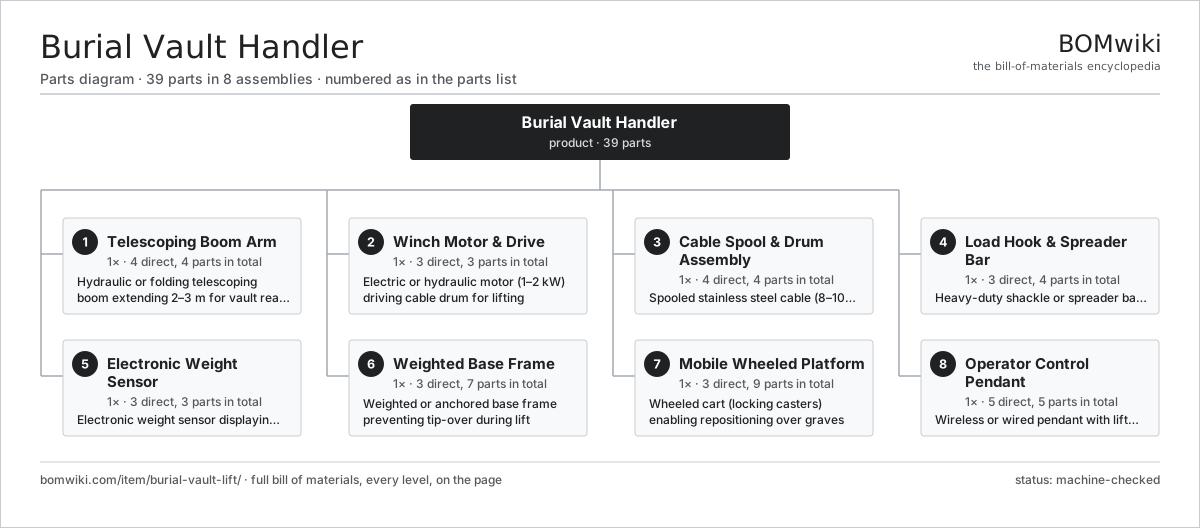
| # | Part | Qty | What it does |
|---|---|---|---|
| 1 | Telescoping Boom Arm 4 parts | 1× | Hydraulic or folding telescoping boom extending 2–3 m for vault reach |
| 2 | Winch Motor & Drive 3 parts | 1× | Electric or hydraulic motor (1–2 kW) driving cable drum for lifting |
| 3 | Cable Spool & Drum Assembly 4 parts | 1× | Spooled stainless steel cable (8–10 mm diameter) with capacity 2000+ kg |
| 4 | Load Hook & Spreader Bar 3 parts | 1× | Heavy-duty shackle or spreader bar connecting cable to vault straps |
| 5 | Electronic Weight Sensor 3 parts | 1× | Electronic weight sensor displaying load and preventing over-lift |
| 6 | Weighted Base Frame 3 parts | 1× | Weighted or anchored base frame preventing tip-over during lift |
| 7 | Mobile Wheeled Platform 3 parts | 1× | Wheeled cart (locking casters) enabling repositioning over graves |
| 8 | Operator Control Pendant 5 parts | 1× | Wireless or wired pendant with lift/lower/stop controls and safety e-stop |
3D model
No 3D model yet. Have a CAD file of this? Add a 3D model — STL renders right on this page; STEP, FreeCAD, and OpenSCAD sources are welcome too (openly licensed, like all 3D models on BOMwiki).
Build & assembly graph
expand / collapse · shared sub-assemblies converge · links to related products · est. labourTap an assembly to expand/collapse · tap a part to open it · use “Open page” for any node · drag to pan, scroll to zoom.
Bill of materials for Burial Vault Handler
8 top-level lines · 36 rows shown · 39 parts total · indented to 3 levels| # | Item / sub-assembly | Part no. | Qty/assy | Ext. qty | Parts | Type |
|---|---|---|---|---|---|---|
| 1 | Telescoping Boom Arm 4 parts | burial-vault-lift-boom-arm | 1× | 1 | 4 | assembly |
| 1.1 | Boom Raise/Lower Cylinder | burial-vault-lift-boom-cylinder | 1× | 1 | · | part |
| 1.2 | Boom Structural Tube | burial-vault-lift-boom-tube | 1× | 1 | · | part |
| 1.3 | Boom Base Pivot Joint | burial-vault-lift-boom-pivot | 1× | 1 | · | part |
| 1.4 | Armored Hydraulic Hose | burial-vault-lift-boom-hose | 1× | 1 | · | part |
| 2 | Winch Motor & Drive 3 parts | burial-vault-lift-winch-motor | 1× | 1 | 3 | assembly |
| 2.1 | Winch Drive Motor | burial-vault-lift-motor | 1× | 1 | · | part |
| 2.2 | Speed Reducer Gearbox | burial-vault-lift-gearbox | 1× | 1 | · | part |
| 2.3 | Load-Holding Brake | burial-vault-lift-brake-solenoid | 1× | 1 | · | part |
| 3 | Cable Spool & Drum Assembly 4 parts | burial-vault-lift-cable-drum | 1× | 1 | 4 | assembly |
| 3.1 | Cable Drum Assembly | burial-vault-lift-drum-hub | 1× | 1 | · | part |
| 3.2 | Wire Rope Cable | burial-vault-lift-cable | 1× | 1 | · | part |
| 3.3 | Cable Routing Pulley | burial-vault-lift-cable-guide | 1× | 1 | · | part |
| 3.4 | Drum Brake Tension Control | burial-vault-lift-cable-adjuster | 1× | 1 | · | part |
| 4 | Load Hook & Spreader Bar 3 parts | burial-vault-lift-lift-hook | 1× | 1 | 4 | assembly |
| 4.1 | Load Shackle or Spreader Bar | burial-vault-lift-shackle | 1× | 1 | · | part |
| 4.2 | Sling Connection Ring | burial-vault-lift-sling-ring | 2× | 2 | · | part |
| 4.3 | Shackle Safety Pin | burial-vault-lift-safety-pin | 1× | 1 | · | part |
| 5 | Electronic Weight Sensor 3 parts | burial-vault-lift-load-cell | 1× | 1 | 3 | assembly |
| 5.1 | Load Cell Sensor | burial-vault-lift-load-cell-unit | 1× | 1 | · | part |
| 5.2 | Load Signal Transmitter | burial-vault-lift-load-transmitter | 1× | 1 | · | part |
| 5.3 | Weight Display Readout | burial-vault-lift-display-unit | 1× | 1 | · | part |
| 6 | Weighted Base Frame 3 parts | burial-vault-lift-base-frame | 1× | 1 | 7 | assembly |
| 6.1 | Base Frame Steel Structure | burial-vault-lift-frame-steel | 1× | 1 | · | part |
| 6.2 | Removable Ballast Box | burial-vault-lift-ballast-container | 2× | 2 | · | part |
| 6.3 | Anchor Eye-Bolt | burial-vault-lift-tie-down-ring | 4× | 4 | · | part |
| 7 | Mobile Wheeled Platform 3 parts | burial-vault-lift-mobile-platform | 1× | 1 | 9 | assembly |
| 7.1 | Heavy-Duty Mobile Caster | burial-vault-lift-wheel-caster | 4× | 4 | · | part |
| 7.2 | Caster Swivel Bearing | burial-vault-lift-caster-bearing | 4× | 4 | · | part |
| 7.3 | Equipment Platform Deck | burial-vault-lift-platform-deck | 1× | 1 | · | part |
| 8 | Operator Control Pendant 5 parts | burial-vault-lift-control-pendant | 1× | 1 | 5 | assembly |
| 8.1 | Control Pendant Enclosure | burial-vault-lift-pendant-housing | 1× | 1 | · | part |
| 8.2 | Lift/Raise Button | burial-vault-lift-button-up | 1× | 1 | · | part |
| 8.3 | Lower/Descent Button | burial-vault-lift-button-down | 1× | 1 | · | part |
| 8.4 | Center Hold Button | burial-vault-lift-button-stop | 1× | 1 | · | part |
| 8.5 | Emergency Stop Button | burial-vault-lift-e-stop-button | 1× | 1 | · | part |
Sourcing: possible vendors
Prices, MOQ, and lead times are algorithmic estimates, not quotes, and not claims about these companies. Company mappings are curated by keyword; est. price band $5k–$2M. How estimates work| Vendor | HQ | Specialty | MOQ | Lead time |
|---|---|---|---|---|
| atlascopco.com ↗ | Stockholm, SE | Compressors & industrial | 10 units | 12–20 wks |
|
🇦🇹Andritz
andritz.com ↗
|
Graz, AT | Process plants & machinery | 10 units | 12–20 wks |
| buhlergroup.com ↗ | Uzwil, CH | Food & materials processing | 10 units | 12–20 wks |
| gea.com ↗ | Düsseldorf, DE | Process technology | 10 units | 12–20 wks |
| mhi.com ↗ | Tokyo, JP | Heavy machinery | 10 units | 12–20 wks |
1,632-word article