Button Attaching Machine
ProductOverview
A button attaching machine is a cycle sewing machine: instead of sewing a continuous seam, it executes a fixed program, a group of stitches through the holes of a button, and stops. The operator (or an automatic feeder) puts a button in the clamp, positions the garment under it, presses the pedal, and roughly one second and eight to thirty-two stitches later the button is sewn, the thread trimmed, and the clamp open for the next one. A skilled operator on a fed machine attaches 2,500–4,000 buttons per shift. The dominant industrial pattern is the single-thread chainstitch machine descended from the Juki MB series; lockstitch button sewers exist where stitch security must survive a cut thread, at the cost of a bobbin to manage.
How it works
The machine is built around three synchronized motions: a needle that strokes vertically in one fixed line, a looper that catches its thread, and a clamp that moves the button and fabric under the needle between stitches.
The Stitching Mechanism mechanism forms ISO type 101 chainstitches. Each cycle of the Main Shaft drives the Needle Bar down through one button hole and into the fabric; as the Needle rises, its thread throws a small loop which the rotating Looper catches and holds open. On the next descent the needle passes through that held loop before making its own, chaining each stitch through the last. A single thread suffices, there is no bobbin, which is why chainstitch button sewers run unattended for long stretches; the trade-off is that a type 101 chain can unravel if its final tail is not properly locked, so the last stitches are tied off by a tension-release-and-knot sequence before the Thread Trimmer cuts the thread and the Thread Wiper flicks the tail clear.
Stitch placement comes entirely from the Button Clamp Unit. The needle line never moves; instead the X Jogging Cam shifts the clamped button crosswise between stitches so the needle alternates between the two holes of a pair, and on four-hole buttons the Y Jogging Cam adds a lengthwise shift to reach the second pair, producing parallel-bar, cross (X) or Z patterns depending on the cam set. The Clamp Jaw pair grips the button rim with spring pressure while the Feed Plate beneath moves with it, keeping fabric and button registered to each other throughout. Hole spacing adjustments of 2.5–6.5 mm cover the normal range of shirt and coat buttons.
Button feeding
Manually loaded machines pace the operator at picking up and orienting each button. The Button Feeder removes that: a vibratory Feeder Bowl, shaken at line frequency by its Bowl Electromagnet electromagnets, conveys loose buttons up a spiral track past baffles that tip wrongly oriented ones back into the bowl. Face-up buttons single-file down the Orienting Chute, and once per cycle the Placer Finger carries one into the open clamp, with the Button Sensor interlocking machine start on a confirmed button. Feeders are changed over by swapping the chute and clamp jaws for each button diameter.
Drive and control
Older machines used a continuously running clutch motor with a one-revolution stop cam; modern ones mount a Servo Motor directly on the main shaft. The Control Box counts stitches from the shaft Encoder, runs the programmed 8, 16 or 32 stitches at up to 1,800 rpm, decelerates, and parks the shaft needle-up within a fraction of a revolution, sequencing the trimmer, wiper, clamp lift and feeder solenoids at fixed shaft angles. Pattern and count are selected on the control box panel rather than by changing gears, though hole-spacing cams remain mechanical on most models.
The sewing head itself is classic industrial-machine construction: a cast-iron Arm Casting and Bed Casting hold the needle and looper in alignment, wick lubrication keeps oil off the garment, and the head sits semi-submerged in the Table Top of its Stand & Table, with Foot Pedal control leaving both hands free for the garment.
Variants
Beyond flat two- and four-hole buttons, jaw and program kits adapt the machine to shank buttons, wrapped (neck-wrapped) buttons sewn with a thread shank for thick coats, label tacking, and snap reinforcement stitching. Fully automatic button stations combine the fed machine with garment indexing so a placket of five buttons is sewn in one loading.
Button Attaching Machine parts and their functions
9 top-level parts · 280 parts in total · full bill of materials below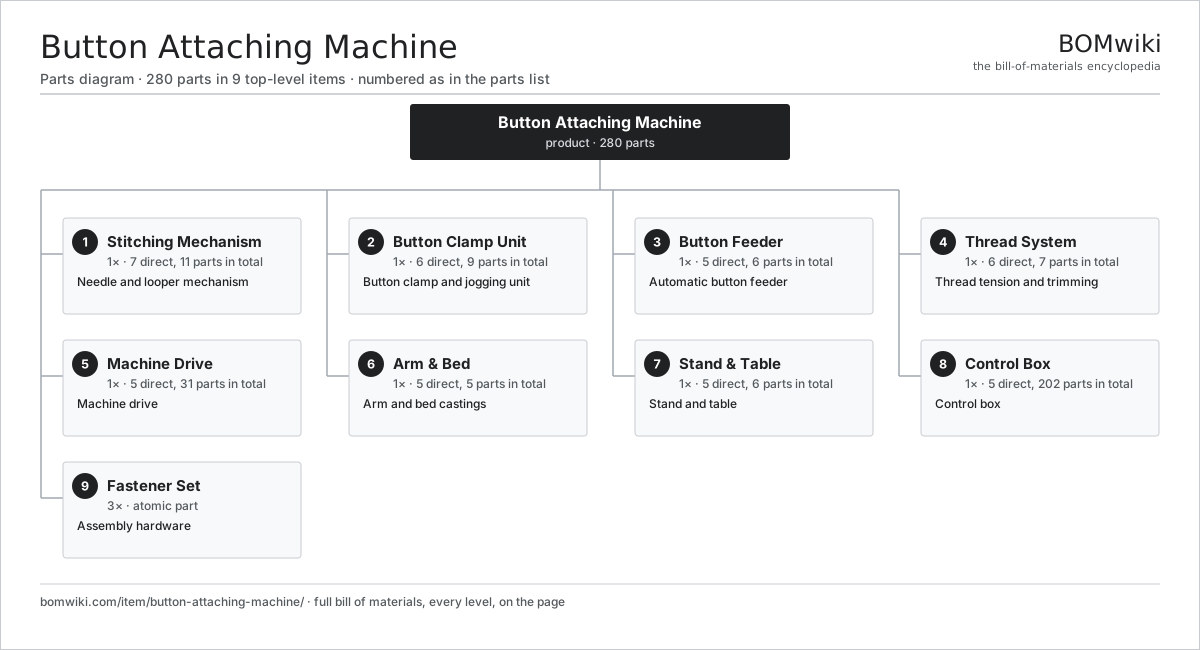
| # | Part | Qty | What it does |
|---|---|---|---|
| 1 | Stitching Mechanism 7 parts | 1× | Needle and looper mechanism |
| 2 | Button Clamp Unit 6 parts | 1× | Button clamp and jogging unit |
| 3 | Button Feeder 5 parts | 1× | Automatic button feeder |
| 4 | Thread System 6 parts | 1× | Thread tension and trimming |
| 5 | Machine Drive 5 parts | 1× | Machine drive |
| 6 | Arm & Bed 5 parts | 1× | Arm and bed castings |
| 7 | Stand & Table 5 parts | 1× | Stand and table |
| 8 | Control Box 5 parts | 1× | Control box |
| 9 | Fastener Set | 3× | Assembly hardware |
3D model
No 3D model yet. Have a CAD file of this? Add a 3D model. STL renders right on this page; STEP, FreeCAD, and OpenSCAD sources are welcome too (openly licensed, like all 3D models on BOMwiki).
Build & assembly graph
expand / collapse · shared sub-assemblies converge · links to related products · est. labourTap an assembly to expand/collapse · tap a part to open it · use “Open page” for any node · drag to pan, scroll to zoom.
Bill of materials for Button Attaching Machine
9 top-level lines · 62 rows shown · 280 parts total · indented to 3 levels| # | Item / sub-assembly | Part no. | Qty/assy | Ext. qty | Parts | Type |
|---|---|---|---|---|---|---|
| 1 | Stitching Mechanism 7 parts | button-attaching-machine-stitching | 1× | 1 | 11 | assembly |
| 1.1 | Needle Bar | button-attaching-machine-needle-bar | 1× | 1 | · | part |
| 1.2 | Needle | button-attaching-machine-needle | 1× | 1 | · | part |
| 1.3 | Looper | button-attaching-machine-looper | 1× | 1 | · | part |
| 1.4 | Looper Cam | button-attaching-machine-looper-cam | 1× | 1 | · | part |
| 1.5 | Needle Crank | button-attaching-machine-needle-crank | 1× | 1 | · | part |
| 1.6 | Ball Bearing | ball-bearing | 4× | 4 | · | part |
| 1.7 | Oil Seal | oil-seal | 2× | 2 | · | part |
| 2 | Button Clamp Unit 6 parts | button-attaching-machine-clamp-unit | 1× | 1 | 9 | assembly |
| 2.1 | Clamp Jaw | button-attaching-machine-clamp-jaw | 2× | 2 | · | part |
| 2.2 | Clamp Lifter | button-attaching-machine-clamp-lifter | 1× | 1 | · | part |
| 2.3 | X Jogging Cam | button-attaching-machine-jog-cam-x | 1× | 1 | · | part |
| 2.4 | Y Jogging Cam | button-attaching-machine-jog-cam-y | 1× | 1 | · | part |
| 2.5 | Feed Plate | button-attaching-machine-feed-plate | 1× | 1 | · | part |
| 2.6 | Coil Spring | coil-spring | 3× | 3 | · | part |
| 3 | Button Feeder 5 parts | button-attaching-machine-feeder | 1× | 1 | 6 | assembly |
| 3.1 | Feeder Bowl | button-attaching-machine-feeder-bowl | 1× | 1 | · | part |
| 3.2 | Bowl Electromagnet | button-attaching-machine-feeder-coil | 2× | 2 | · | part |
| 3.3 | Orienting Chute | button-attaching-machine-chute | 1× | 1 | · | part |
| 3.4 | Placer Finger | button-attaching-machine-placer | 1× | 1 | · | part |
| 3.5 | Button Sensor | button-attaching-machine-button-sensor | 1× | 1 | · | part |
| 4 | Thread System 6 parts | button-attaching-machine-thread-system | 1× | 1 | 7 | assembly |
| 4.1 | Tension Unit | button-attaching-machine-tension-unit | 1× | 1 | · | part |
| 4.2 | Take-Up Lever | button-attaching-machine-takeup-lever | 1× | 1 | · | part |
| 4.3 | Thread Trimmer | button-attaching-machine-trimmer | 1× | 1 | · | part |
| 4.4 | Thread Wiper | button-attaching-machine-wiper | 1× | 1 | · | part |
| 4.5 | Thread Stand | button-attaching-machine-thread-stand | 1× | 1 | · | part |
| 4.6 | Coil Spring | coil-spring | 2× | 2 | · | part |
| 5 | Machine Drive 5 parts | button-attaching-machine-drive | 1× | 1 | 31 | assembly |
| 5.1 | Servo Motor 4 parts | servo-motor | 1× | 1 | 24 | assembly |
| 5.1.1 | Stator Assembly 3 parts + deeper › | stator-assembly | 1× | 1 | 3 | assembly |
| 5.1.2 | Rotor Assembly 4 parts + deeper › | rotor-assembly | 1× | 1 | 19 | assembly |
| 5.1.3 | Encoder | encoder | 1× | 1 | · | part |
| 5.1.4 | Motor Housing | motor-housing | 1× | 1 | · | part |
| 5.2 | Main Shaft | button-attaching-machine-main-shaft | 1× | 1 | · | part |
| 5.3 | Handwheel | button-attaching-machine-handwheel | 1× | 1 | · | part |
| 5.4 | Encoder | encoder | 1× | 1 | · | part |
| 5.5 | Ball Bearing | ball-bearing | 4× | 4 | · | part |
| 6 | Arm & Bed 5 parts | button-attaching-machine-body | 1× | 1 | 5 | assembly |
| 6.1 | Arm Casting | button-attaching-machine-arm-casting | 1× | 1 | · | part |
| 6.2 | Bed Casting | button-attaching-machine-bed-casting | 1× | 1 | · | part |
| 6.3 | Face Plate | button-attaching-machine-face-plate | 1× | 1 | · | part |
| 6.4 | O-Ring Set | oring-set | 1× | 1 | · | part |
| 6.5 | Fastener Set | fastener-set | 1× | 1 | · | part |
| 7 | Stand & Table 5 parts | button-attaching-machine-stand | 1× | 1 | 6 | assembly |
| 7.1 | Table Top | button-attaching-machine-table-top | 1× | 1 | · | part |
| 7.2 | Leg Set | button-attaching-machine-legs | 1× | 1 | · | part |
| 7.3 | Foot Pedal | button-attaching-machine-pedal | 2× | 2 | · | part |
| 7.4 | Knee Lifter | button-attaching-machine-knee-lifter | 1× | 1 | · | part |
| 7.5 | Fastener Set | fastener-set | 1× | 1 | · | part |
| 8 | Control Box 5 parts | button-attaching-machine-control | 1× | 1 | 202 | assembly |
| 8.1 | Control Board 5 parts | button-attaching-machine-control-board | 1× | 1 | 196 | assembly |
| 8.1.1 | Bare PCB | pcb-bare | 1× | 1 | · | part |
| 8.1.2 | Microcontroller | mcu | 1× | 1 | · | part |
| 8.1.3 | Power MOSFET | mosfet | 6× | 6 | · | part |
| 8.1.4 | SMD Passive (R/C/L) | smd-passives | 180× | 180 | · | part |
| 8.1.5 | Connector | connector | 8× | 8 | · | part |
| 8.2 | LCD Panel | lcd-panel | 1× | 1 | · | part |
| 8.3 | Power Supply | power-supply | 1× | 1 | · | part |
| 8.4 | Relay | relay | 2× | 2 | · | part |
| 8.5 | Wire Bundle | wire-bundle | 2× | 2 | · | part |
| 9 | Fastener Set | fastener-set | 3× | 3 | · | part |
Something wrong in this list? Report a problem with this BOM.
Related products
same domain, ranked by shared parts Automatic Fabric Cutting Machine
1,695 parts · shares 6 with this page
Computerized Flat Knitting Machine
6,577 parts · shares 5 with this page
Automatic Fabric Cutting Machine
1,695 parts · shares 6 with this page
Computerized Flat Knitting Machine
6,577 parts · shares 5 with this page
 Industrial Quilting Machine
1,090 parts · shares 6 with this page
Jigger Dyeing Machine
276 parts · shares 6 with this page
FDY Filament Spinning Line
679 parts · shares 5 with this page
Air-Jet Spinning Machine
689 parts · shares 5 with this page
Industrial Quilting Machine
1,090 parts · shares 6 with this page
Jigger Dyeing Machine
276 parts · shares 6 with this page
FDY Filament Spinning Line
679 parts · shares 5 with this page
Air-Jet Spinning Machine
689 parts · shares 5 with this page
Sourcing: possible vendors
Browse the supplier directory → Prices, MOQ, and lead times are algorithmic estimates, not quotes, and not claims about these companies. Company mappings are curated by keyword; est. price band $10k–$1M. How estimates work| Vendor | HQ | Specialty | MOQ | Lead time |
|---|---|---|---|---|
|
🇨🇭Rieter
rieter.com ↗
|
Winterthur, CH | Spinning machinery | 10 units | 14–24 wks |
| truetzschler.com ↗ | Mönchengladbach, DE | Textile machinery | 10 units | 14–24 wks |
|
🇧🇪Picanol
picanol.be ↗
|
Ypres, BE | Weaving machines | 10 units | 14–24 wks |
| karlmayer.com ↗ | Obertshausen, DE | Warp knitting machines | 10 units | 14–24 wks |
|
🇨🇭Saurer
saurer.com ↗
|
Arbon, CH | Spinning & embroidery | 10 units | 14–24 wks |
794-word article