DOCSIS Cable Modem
ProductOverview
A cable modem terminates a hybrid fiber-coax (HFC) broadband connection inside the subscriber's home. The cable operator's plant carries data as RF carriers on the same coaxial cable that historically carried analog television: fiber runs from the headend to a neighborhood node, and the last few hundred meters to each home are coax shared among dozens of subscribers. The modem's job is to pick its assigned channels out of more than a gigahertz of downstream spectrum, demodulate them, and present the result as ordinary Ethernet, while transmitting upstream traffic in precisely timed bursts that interleave with every other modem on the same segment.
The signal path starts at the RF Tuner Front End, where a diplexer splits the spectrum and a full-band capture tuner digitizes everything above 108 MHz at once. The DOCSIS Mainboard carries the DOCSIS SoC that does the demodulation, MAC processing, and encryption, and the Ethernet Interface interface hands decoded packets to the subscriber's router over a 2.5GBASE-T port. The Power Section section regulates a 12 V adapter down to the half-dozen rails the silicon needs, the Indicator Board shows lock and registration status on the front panel, and the Enclosure stands the whole assembly on edge so convection cools the always-on SoC without a fan.
How it works
Downstream, DOCSIS 3.1 replaces the older single-carrier QAM channels with OFDM blocks up to 192 MHz wide, each built from thousands of narrow subcarriers modulated at up to 4096-QAM. Rather than tuning individual 6 MHz channels with separate tuners, the Full-Band Capture Tuner samples the entire downstream band with one wideband ADC and lets the DOCSIS SoC channelize digitally. This full-band capture approach means the modem can bond two OFDM blocks plus 32 legacy SC-QAM channels simultaneously, reaching aggregate rates around 5 Gbit/s, and it also lets the SoC run a full-spectrum analyzer for plant diagnostics, operators query modems remotely to find ingress and tilt problems in the coax.
Upstream is harder than downstream because the band from 5 to 85 MHz is shared by every modem on the node and is where noise funnels in from every household's wiring. The modem never transmits freely: the cable modem termination system (CMTS) at the headend grants each modem specific time-frequency slots, and the Upstream Amplifier bursts OFDMA frames into exactly those slots at a power level the CMTS continuously trims, anywhere from +17 to +65 dBmV depending on cable loss. Ranging, the startup process where the CMTS measures each modem's round-trip delay and power, is what lets thousands of bursts from different homes arrive at the headend aligned to within a fraction of a symbol.
Registration follows a fixed sequence visible on the Indicator Board: the modem scans for a downstream OFDM channel, locks, receives upstream channel descriptors, ranges, gets an IP address via DHCP, downloads its configuration file from the operator's TFTP server, and registers. The configuration file sets the service tier, speed caps live at the headend and in this file, not in the hardware. Traffic is encrypted between modem and CMTS with BPI+ using AES-128, and firmware images must carry the operator's signature before the Firmware Flash will accept them, since the modem is operator-managed equipment even when the subscriber owns it.
Construction
The RF front end is the part of the board built to survive the outside world. The F-Connector connects to a drop cable that is bonded to the house ground, and the Surge Arrestor clamps the kilovolt-scale transients that lightning induces on aerial coax. The Diplexer is a passive LC filter pair whose crossover at 85/108 MHz keeps the modem's own upstream bursts, which can be a billion times stronger than the weakest downstream subcarrier, out of its receiver.
Digitally, the DOCSIS SoC is a single chip integrating the OFDM PHY, the DOCSIS MAC with its scheduling and concatenation logic, hardware AES, and an ARM core running Linux for management. It dissipates 5–8 W continuously, which the SoC Heatsink and the chimney-style vents in the Rear Shell handle without a fan; modems are specified for 0–40 °C ambient in still air. The DDR Memory buffers packets during upstream grant waits, and the LAN side exits through the Ethernet PHY and Ethernet Magnetics, which provide the 1.5 kV isolation that Ethernet requires between buildings' ground domains.
A plain modem like this contains no router, Wi-Fi, or NAT, it is a transparent bridge between the coax and one Ethernet port, which is why it pairs with a separate router. Gateway variants add those functions on the same SoC family, but operators and standards bodies still certify the modem core separately through CableLabs DOCSIS qualification.
DOCSIS Cable Modem parts and their functions
6 top-level parts · 442 parts in total · full bill of materials below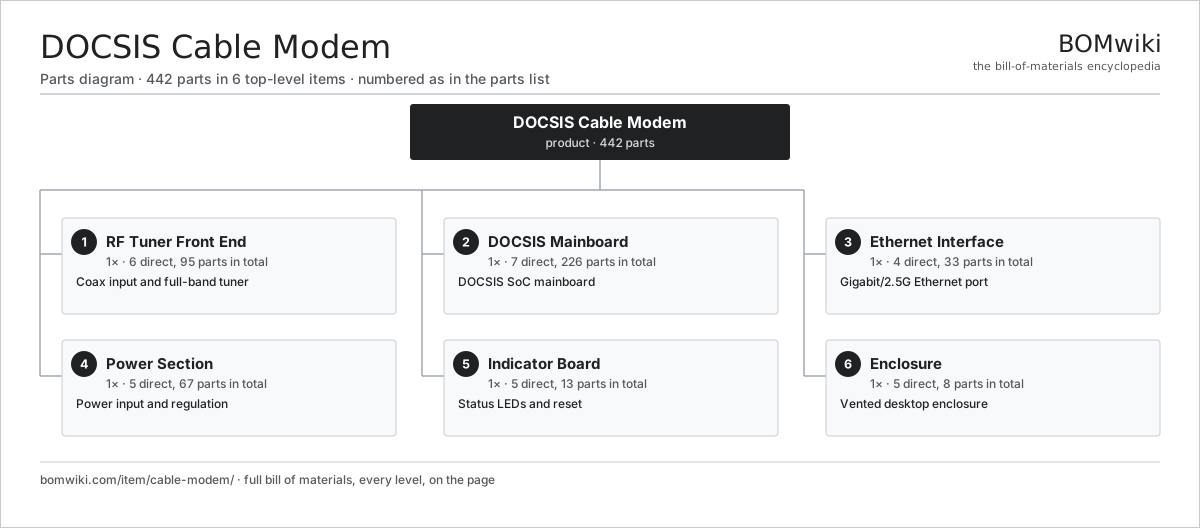
| # | Part | Qty | What it does |
|---|---|---|---|
| 1 | RF Tuner Front End 6 parts | 1× | Coax input and full-band tuner |
| 2 | DOCSIS Mainboard 7 parts | 1× | DOCSIS SoC mainboard |
| 3 | Ethernet Interface 4 parts | 1× | Gigabit/2.5G Ethernet port |
| 4 | Power Section 5 parts | 1× | Power input and regulation |
| 5 | Indicator Board 5 parts | 1× | Status LEDs and reset |
| 6 | Enclosure 5 parts | 1× | Vented desktop enclosure |
3D model
No 3D model yet. Have a CAD file of this? Add a 3D model. STL renders right on this page; STEP, FreeCAD, and OpenSCAD sources are welcome too (openly licensed, like all 3D models on BOMwiki).
Build & assembly graph
expand / collapse · shared sub-assemblies converge · links to related products · est. labourTap an assembly to expand/collapse · tap a part to open it · use “Open page” for any node · drag to pan, scroll to zoom.
Bill of materials for DOCSIS Cable Modem
6 top-level lines · 38 rows shown · 442 parts total · indented to 3 levels| # | Item / sub-assembly | Part no. | Qty/assy | Ext. qty | Parts | Type |
|---|---|---|---|---|---|---|
| 1 | RF Tuner Front End 6 parts | cable-modem-rf-frontend | 1× | 1 | 95 | assembly |
| 1.1 | F-Connector | cable-modem-f-connector | 1× | 1 | · | part |
| 1.2 | Diplexer | cable-modem-diplexer | 1× | 1 | · | part |
| 1.3 | Full-Band Capture Tuner | cable-modem-fbc-tuner | 1× | 1 | · | part |
| 1.4 | Upstream Amplifier | cable-modem-upstream-amp | 1× | 1 | · | part |
| 1.5 | Surge Arrestor | cable-modem-surge-arrestor | 1× | 1 | · | part |
| 1.6 | SMD Passive (R/C/L) | smd-passives | 90× | 90 | · | part |
| 2 | DOCSIS Mainboard 7 parts | cable-modem-mainboard | 1× | 1 | 226 | assembly |
| 2.1 | Bare PCB | pcb-bare | 1× | 1 | · | part |
| 2.2 | DOCSIS SoC | cable-modem-docsis-soc | 1× | 1 | · | part |
| 2.3 | DDR Memory | cable-modem-ddr | 1× | 1 | · | part |
| 2.4 | Firmware Flash | cable-modem-flash | 1× | 1 | · | part |
| 2.5 | Crystal Oscillator | cable-modem-xtal | 1× | 1 | · | part |
| 2.6 | SoC Heatsink | cable-modem-heatsink | 1× | 1 | · | part |
| 2.7 | SMD Passive (R/C/L) | smd-passives | 220× | 220 | · | part |
| 3 | Ethernet Interface 4 parts | cable-modem-ethernet | 1× | 1 | 33 | assembly |
| 3.1 | Ethernet PHY | cable-modem-eth-phy | 1× | 1 | · | part |
| 3.2 | RJ45 Jack | cable-modem-rj45 | 1× | 1 | · | part |
| 3.3 | Ethernet Magnetics | cable-modem-magnetics | 1× | 1 | · | part |
| 3.4 | SMD Passive (R/C/L) | smd-passives | 30× | 30 | · | part |
| 4 | Power Section 5 parts | cable-modem-power | 1× | 1 | 67 | assembly |
| 4.1 | Power Supply | power-supply | 1× | 1 | · | part |
| 4.2 | DC Input Jack | cable-modem-dc-jack | 1× | 1 | · | part |
| 4.3 | Buck Regulators | cable-modem-buck-regulators | 4× | 4 | · | part |
| 4.4 | Thermal Fuse | thermal-fuse | 1× | 1 | · | part |
| 4.5 | SMD Passive (R/C/L) | smd-passives | 60× | 60 | · | part |
| 5 | Indicator Board 5 parts | cable-modem-indicator-board | 1× | 1 | 13 | assembly |
| 5.1 | Bare PCB | pcb-bare | 1× | 1 | · | part |
| 5.2 | Status LED | cable-modem-led-array | 5× | 5 | · | part |
| 5.3 | Light Pipe | cable-modem-light-pipe | 5× | 5 | · | part |
| 5.4 | Reset Switch | cable-modem-reset-switch | 1× | 1 | · | part |
| 5.5 | Connector | connector | 1× | 1 | · | part |
| 6 | Enclosure 5 parts | cable-modem-enclosure | 1× | 1 | 8 | assembly |
| 6.1 | Front Shell | cable-modem-front-shell | 1× | 1 | · | part |
| 6.2 | Rear Shell | cable-modem-rear-shell | 1× | 1 | · | part |
| 6.3 | Base Stand | cable-modem-base-stand | 1× | 1 | · | part |
| 6.4 | Rubber Foot | cable-modem-feet | 4× | 4 | · | part |
| 6.5 | Fastener Set | fastener-set | 1× | 1 | · | part |
Something wrong in this list? Report a problem with this BOM.
Related products
same domain, ranked by shared parts Microwave Backhaul Radio
369 parts · shares 2 with this page
Microwave Backhaul Radio
369 parts · shares 2 with this page
 Fiber ONT (Optical Network Terminal)
327 parts · shares 1 with this page
Fiber ONT (Optical Network Terminal)
327 parts · shares 1 with this page
 Network Tap
262 parts · shares 1 with this page
Network Tap
262 parts · shares 1 with this page
 5G Base Station
436 parts · shares 1 with this page
5G CPE Router
407 parts · shares 1 with this page
5G Base Station
436 parts · shares 1 with this page
5G CPE Router
407 parts · shares 1 with this page
 Carrier Core Router
1,039 parts · shares 1 with this page
Carrier Core Router
1,039 parts · shares 1 with this page
Sourcing: possible vendors
Browse the supplier directory → Prices, MOQ, and lead times are algorithmic estimates, not quotes, and not claims about these companies. Company mappings are curated by keyword; est. price band $30–$50k. How estimates work| Vendor | HQ | Specialty | MOQ | Lead time |
|---|---|---|---|---|
|
🇺🇸Cisco
cisco.com ↗
|
San Jose, US | Networking | 500 units | 8–14 wks |
|
🇺🇸Juniper
juniper.net ↗
|
Sunnyvale, US | Networking | 500 units | 8–14 wks |
| arista.com ↗ | Santa Clara, US | Networking | 500 units | 8–14 wks |
|
🇫🇮Nokia
nokia.com ↗
|
Espoo, FI | Telecom equipment | 500 units | 8–14 wks |
|
🇨🇳Huawei
huawei.com ↗
|
Shenzhen, CN | Networking & telecom | 500 units | 8–14 wks |
834-word article