Calender Machine
ProductOverview
Calendering is a final finishing step for plastic sheets, transforming rough extruded film or sheet into smooth, gloss-finished, precision-thickness product. The Roll Stack Assembly consists of 3, 4, or even 5 heated cylindrical rolls arranged vertically. The plastic sheet is fed between the top two rolls (the nip), compressed to a precise gap, and progressively smoothed as it passes through each subsequent nip. The process flattens surface roughness, densifies the material, and can impart texture or gloss patterns. Rubber and PVC sheet, plastic film, and specialty material finishing all use calenders.
The basic 3-roll calender is the most common: a plastic sheet passes between the top and center rolls, then between the center and bottom rolls. The 4-roll and 5-roll machines add more nips and finer control. Industrial calenders are massive machines, with nip pressures exceeding 200 tons per roll and heated rolls that weigh several tons each.
Roll stack and nips
The Roll Stack Assembly is the core: three or more precision-ground steel rolls, each 200–400 mm in diameter and 500–3000 mm long. Each roll is supported on Roll Bearing tapered roller bearings at both ends; the Roll Shaft carries the load and transmits torque. Every roll has an internal Chilled Roll Core, a water-cooled tube of copper or brass, that cools the roll and stabilizes its surface temperature during operation.
The gap between rolls (the nip) is typically 0.1–5 mm depending on the target sheet thickness. Plastic is fed into the nip and emerges compressed and burnished. As it advances to the next nip, it is compressed and further refined.
Nip pressure and adjustment
The Nip Adjustment System uses hydraulic Nip Cylinder to control the gap. Nip pressure is maintained by a Pressure Valve typically at 100–150 bar nominal. Because the nip consumes enormous force (a 3-meter-wide nip at 200 bar can exceed 600 tons), the Machine Frame must be a massive fabricated-steel structure with heavy Tie-Down Bolt anchor bolts.
Closed-loop thickness control is essential for high-precision sheet. A Thickness Sensor (infrared laser or mechanical gauge) measures the emerging sheet thickness in real time. The Thickness Controller compares it to the target and adjusts the nip opening via a Nip Cylinder to maintain thickness within ±0.01–0.05 mm.
Heating and cooling
The Heating System circulates hot oil (60–140 °C) through each Roll Barrel via Oil Supply Lines with rotary unions on the roll shafts. A Oil Heater maintains temperature, and the Temperature Controller PID-regulates each roll independently. Hot rolls are necessary because plastics (especially PVC and rubber) soften and flow under compression only when heated.
Simultaneously, the Cooling System circulates chilled water (5–25 °C) through the Chilled Roll Core inside each roll. This two-stream approach, heating the outer surface while cooling the core, allows the machine to densify and burnish the outer surface while preventing the roll itself from overheating and expanding, which would destroy thickness control.
Roll drive and synchronization
The Drive Train rotates all rolls at synchronized speed (the same RPM). A Drive Motor (15–75 kW) drives a Gearbox that feeds a Drive Shaft connected to each roll via Synchronization Gear Set sets or pulleys. If rolls get out of sync, the sheet will wrinkle or buckle at one edge. Line speed is typically 1–10 m/min depending on material viscosity and desired surface finish.
Winding and collection
The calendered sheet exits the stack and is collected on a Winding & Collection Station. A powered Take-Up Roll Stand winds the hot sheet at controlled tension; a Dancer Roller maintains constant tension despite variations in roll diameter as it winds up. A Edge Guide uses photoelectric sensors to keep the sheet centered and prevent lateral drift.
Process control
The Control & Monitoring is central to machine operation. The PLC Module receives inputs from Temperature Sensor thermocouples on each roll surface, a Thickness Sensor at the outlet, and a Pressure Transducer on the nip pressure line. The controller adjusts heating (via oil circulator), cooling (via chiller setpoint), nip pressure (via hydraulic solenoid proportional valve), and motor speed (via VFD) to maintain the target sheet thickness, surface finish, and gloss.
The Operator Panel displays roll temperatures, nip pressure, measured thickness, production count, and any alarms. Operators can reprogram the machine for different materials and thicknesses by entering new setpoints.
Machine variants and applications
A 3-roll calender is typical for rubber sheet and light plastic film. A 4-roll machine adds a lower pressure nip for softer materials and finer finish. A 5-roll or more creates a pillow effect, with an upper soft nip (lower pressure) followed by a sharp nip, producing a very fine, gloss finish. Specialty designs add texture rollers with engraved patterns, allowing the machine to imprint patterns onto the sheet surface in a single pass.
Calender Machine parts and their functions
8 top-level parts · 49 parts in total · full bill of materials below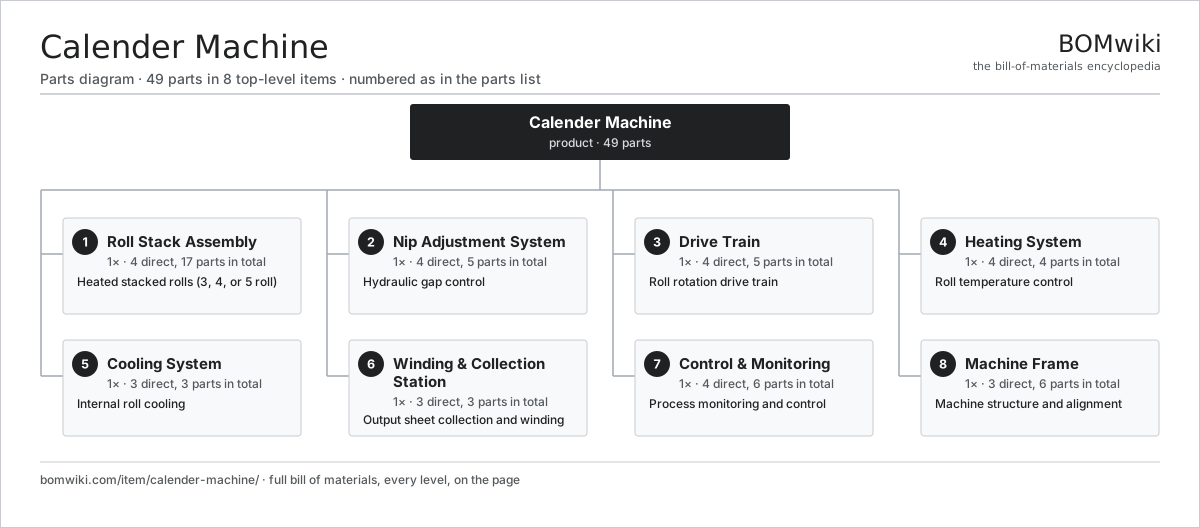
| # | Part | Qty | What it does |
|---|---|---|---|
| 1 | Roll Stack Assembly 4 parts | 1× | Heated stacked rolls (3, 4, or 5 roll) |
| 2 | Nip Adjustment System 4 parts | 1× | Hydraulic gap control |
| 3 | Drive Train 4 parts | 1× | Roll rotation drive train |
| 4 | Heating System 4 parts | 1× | Roll temperature control |
| 5 | Cooling System 3 parts | 1× | Internal roll cooling |
| 6 | Winding & Collection Station 3 parts | 1× | Output sheet collection and winding |
| 7 | Control & Monitoring 4 parts | 1× | Process monitoring and control |
| 8 | Machine Frame 3 parts | 1× | Machine structure and alignment |
3D model
No 3D model yet. Have a CAD file of this? Add a 3D model. STL renders right on this page; STEP, FreeCAD, and OpenSCAD sources are welcome too (openly licensed, like all 3D models on BOMwiki).
Build & assembly graph
expand / collapse · shared sub-assemblies converge · links to related products · est. labourTap an assembly to expand/collapse · tap a part to open it · use “Open page” for any node · drag to pan, scroll to zoom.
Bill of materials for Calender Machine
8 top-level lines · 37 rows shown · 49 parts total · indented to 3 levels| # | Item / sub-assembly | Part no. | Qty/assy | Ext. qty | Parts | Type |
|---|---|---|---|---|---|---|
| 1 | Roll Stack Assembly 4 parts | calender-machine-roll-stack | 1× | 1 | 17 | assembly |
| 1.1 | Roll Barrel | calender-machine-roll | 3× | 3 | · | part |
| 1.2 | Roll Bearing | calender-machine-roll-bearing | 8× | 8 | · | part |
| 1.3 | Roll Shaft | calender-machine-roll-shaft | 3× | 3 | · | part |
| 1.4 | Chilled Roll Core | calender-machine-chilled-core | 3× | 3 | · | part |
| 2 | Nip Adjustment System 4 parts | calender-machine-nip-adjustment | 1× | 1 | 5 | assembly |
| 2.1 | Nip Cylinder | calender-machine-hydraulic-cylinder | 2× | 2 | · | part |
| 2.2 | Pressure Valve | calender-machine-pressure-valve | 1× | 1 | · | part |
| 2.3 | Thickness Sensor | calender-machine-thickness-sensor | 1× | 1 | · | part |
| 2.4 | Thickness Controller | calender-machine-feedback-controller | 1× | 1 | · | part |
| 3 | Drive Train 4 parts | calender-machine-roll-drive | 1× | 1 | 5 | assembly |
| 3.1 | Drive Motor | calender-machine-motor | 1× | 1 | · | part |
| 3.2 | Gearbox | calender-machine-gearbox | 1× | 1 | · | part |
| 3.3 | Drive Shaft | calender-machine-drive-shaft | 2× | 2 | · | part |
| 3.4 | Synchronization Gear Set | calender-machine-synchronization-gear | 1× | 1 | · | part |
| 4 | Heating System 4 parts | calender-machine-heating-system | 1× | 1 | 4 | assembly |
| 4.1 | Oil Heater | calender-machine-oil-heater | 1× | 1 | · | part |
| 4.2 | Circulation Pump | calender-machine-circulating-pump | 1× | 1 | · | part |
| 4.3 | Oil Supply Lines | calender-machine-oil-lines | 1× | 1 | · | part |
| 4.4 | Temperature Controller | calender-machine-temperature-controller | 1× | 1 | · | part |
| 5 | Cooling System 3 parts | calender-machine-cooling-system | 1× | 1 | 3 | assembly |
| 5.1 | Water Chiller | calender-machine-chiller | 1× | 1 | · | part |
| 5.2 | Cooling Pump | calender-machine-cooling-pump | 1× | 1 | · | part |
| 5.3 | Water Supply Lines | calender-machine-water-lines | 1× | 1 | · | part |
| 6 | Winding & Collection Station 3 parts | calender-machine-winding-station | 1× | 1 | 3 | assembly |
| 6.1 | Take-Up Roll Stand | calender-machine-unwind-roll | 1× | 1 | · | part |
| 6.2 | Dancer Roller | calender-machine-dancer-roller | 1× | 1 | · | part |
| 6.3 | Edge Guide | calender-machine-edge-guide | 1× | 1 | · | part |
| 7 | Control & Monitoring 4 parts | calender-machine-control-system | 1× | 1 | 6 | assembly |
| 7.1 | PLC Module | calender-machine-plc | 1× | 1 | · | part |
| 7.2 | Operator Panel | calender-machine-operator-panel | 1× | 1 | · | part |
| 7.3 | Temperature Sensor | calender-machine-temperature-sensor | 3× | 3 | · | part |
| 7.4 | Pressure Transducer | calender-machine-pressure-transducer | 1× | 1 | · | part |
| 8 | Machine Frame 3 parts | calender-machine-frame | 1× | 1 | 6 | assembly |
| 8.1 | Base Frame | calender-machine-baseframe | 1× | 1 | · | part |
| 8.2 | Tie-Down Bolt | calender-machine-tie-bolt | 4× | 4 | · | part |
| 8.3 | Fastener Set | fastener-set | 1× | 1 | · | part |
Something wrong in this list? Report a problem with this BOM.
Sourcing: possible vendors
Browse the supplier directory → Prices, MOQ, and lead times are algorithmic estimates, not quotes, and not claims about these companies. Company mappings are curated by keyword; est. price band $5k–$2M. How estimates work| Vendor | HQ | Specialty | MOQ | Lead time |
|---|---|---|---|---|
| atlascopco.com ↗ | Stockholm, SE | Compressors & industrial | 10 units | 12–20 wks |
|
🇦🇹Andritz
andritz.com ↗
|
Graz, AT | Process plants & machinery | 10 units | 12–20 wks |
| buhlergroup.com ↗ | Uzwil, CH | Food & materials processing | 10 units | 12–20 wks |
| gea.com ↗ | Düsseldorf, DE | Process technology | 10 units | 12–20 wks |
| mhi.com ↗ | Tokyo, JP | Heavy machinery | 10 units | 12–20 wks |
872-word article