Canned Motor Pump
ProductOverview
A canned motor pump is a centrifugal pump and its electric motor built into one hermetically sealed pressure vessel. The motor rotor spins inside the pumped liquid, and the only barrier between fluid and the energized stator windings is the Stator Can, a welded corrosion-resistant liner usually less than half a millimetre thick. Because the shaft never penetrates the pressure boundary, there is no mechanical seal, no gland, and no possible seal leak. The design dates to the 1950s and remains the standard answer when the pumped fluid is toxic, flammable, carcinogenic, or simply too expensive to lose: liquid chlorine, hydrofluoric acid, liquefied gases, heat-transfer oils, and refrigerants are typical services. The sealless alternatives are this design and the magnetic-drive pump; the canned motor wins where secondary containment and compactness matter most.
How it works
Hydraulically the machine is a conventional single-stage centrifugal pump. The Closed Impeller draws liquid into its eye and slings it outward into the Volute Casing, converting velocity into pressure. A pair of Wear Ring surfaces controls internal recirculation, exactly as in a sealed pump.
The difference is everything behind the impeller. The Pump Shaft is a single rigid piece carrying both the impeller and the motor rotor, and it never leaves the wetted cavity. The squirrel-cage Rotor Assembly is sheathed in its own welded Rotor Can, closed at each end by a Rotor End Cap, so the laminations and cage bars never touch the process fluid. The stationary side mirrors this: the laminated core and three-phase Copper Winding sets of the Stator Assembly sit dry behind the stator can, clamped by the Stator Band. The rotating magnetic field crosses both cans with an efficiency penalty of roughly 5–15% from eddy-current losses in the metal liners, the main cost of hermetic construction.
A deliberate slipstream of the pumped liquid does double duty as coolant and lubricant. Flow tapped from the discharge passes through the Circulation Filter, is metered by the Orifice Plug at typically 2–5% of rated flow, sweeps heat out of the rotor gap, feeds the Carbon Journal Bearing films, and returns through the Circulation Tube. On some configurations a small Auxiliary Impeller on the rear shaft end drives this circuit independently of main flow. The circulation path is chosen to match the fluid: reverse circulation for liquids near their boiling point, external cooling jackets for hot-oil duty above 350 °C.
Bearings and wear monitoring
The shaft rides in two carbon-graphite sleeve bearings held in stainless Bearing Holder carriers, with hardened Journal Sleeve journals and Thrust Disc faces taking residual axial load. These bearings run on a liquid film of the process fluid itself, which means dry running destroys them in seconds, the single dominant failure mode of the type. Manufacturers therefore build in condition monitoring as standard: the Bearing Wear Monitor reads rotor axial and radial position inductively through the can, displaying bearing wear on a front gauge without any disassembly, while Hall Sensor elements track rotor position and embedded Winding Thermostat elements trip the starter on winding over-temperature. API 685 requires this style of instrumentation for refinery service.
Containment and safety
The pressure boundary is double. The primary barrier is the stator can; behind it the Backup Containment Shell is a fully pressure-rated housing, so a can breach is contained rather than released. Electrical leads exit through the glass-to-metal sealed Hermetic Terminal Plate, keeping even the Terminal Enclosure side gas-tight, a canned motor pump with a failed can still does not leak to atmosphere. The rear of the machine is closed by the Rear Casing and bolted End Cover with its End Cover Gasket, giving service access to the rear bearing.
This architecture removes the coupling, the seal support system, the bearing frame, and the baseplate alignment work of a conventional pump set. The pump is shorter, runs at 55–65 dB(A) because there is no fan, and mounts in any orientation. Against these advantages stand the lower wire-to-water efficiency, the need for clean or filtered liquid at the bearings, and repair that returns to specialist shops rather than the plant workshop.
Applications
Chemical plants use canned motor pumps for chlorine, phosgene, ethylene oxide, and acid transfer; refineries for light hydrocarbons under API 685; refrigeration plants for ammonia and CO₂ circulation; and nuclear stations use very large canned motor reactor coolant pumps where zero leakage is mandatory. Sizes run from fractional-kilowatt chemical metering duties to multi-megawatt reactor circulators, all sharing the same principle: put the rotor in the liquid and weld the world shut around it.
Canned Motor Pump parts and their functions
8 top-level parts · 74 parts in total · full bill of materials below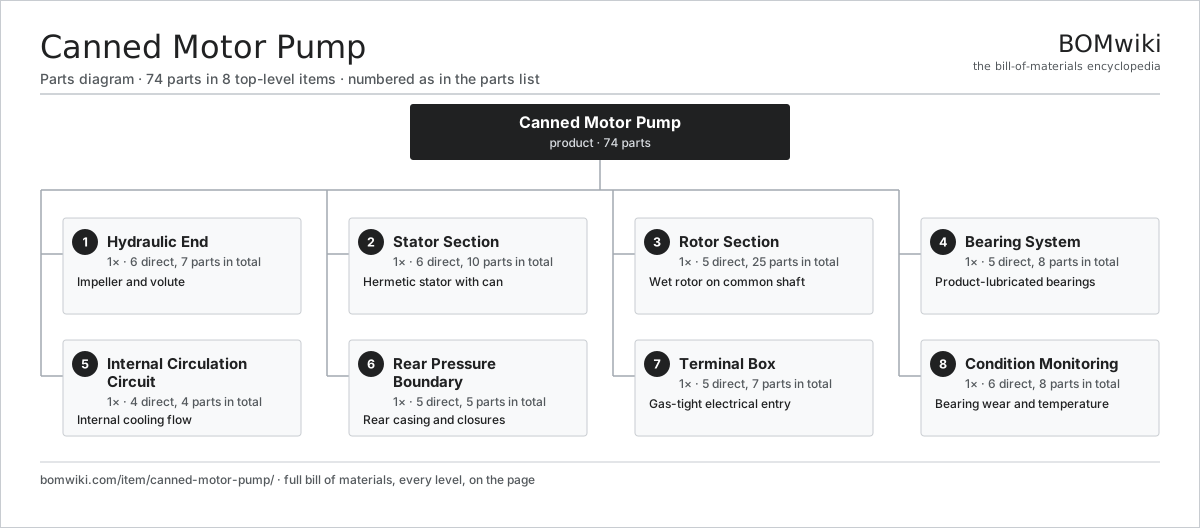
| # | Part | Qty | What it does |
|---|---|---|---|
| 1 | Hydraulic End 6 parts | 1× | Impeller and volute |
| 2 | Stator Section 6 parts | 1× | Hermetic stator with can |
| 3 | Rotor Section 5 parts | 1× | Wet rotor on common shaft |
| 4 | Bearing System 5 parts | 1× | Product-lubricated bearings |
| 5 | Internal Circulation Circuit 4 parts | 1× | Internal cooling flow |
| 6 | Rear Pressure Boundary 5 parts | 1× | Rear casing and closures |
| 7 | Terminal Box 5 parts | 1× | Gas-tight electrical entry |
| 8 | Condition Monitoring 6 parts | 1× | Bearing wear and temperature |
3D model
No 3D model yet. Have a CAD file of this? Add a 3D model. STL renders right on this page; STEP, FreeCAD, and OpenSCAD sources are welcome too (openly licensed, like all 3D models on BOMwiki).
Build & assembly graph
expand / collapse · shared sub-assemblies converge · links to related products · est. labourTap an assembly to expand/collapse · tap a part to open it · use “Open page” for any node · drag to pan, scroll to zoom.
Bill of materials for Canned Motor Pump
8 top-level lines · 57 rows shown · 74 parts total · indented to 3 levels| # | Item / sub-assembly | Part no. | Qty/assy | Ext. qty | Parts | Type |
|---|---|---|---|---|---|---|
| 1 | Hydraulic End 6 parts | canned-motor-pump-hydraulic-end | 1× | 1 | 7 | assembly |
| 1.1 | Volute Casing | canned-motor-pump-volute-casing | 1× | 1 | · | part |
| 1.2 | Closed Impeller | canned-motor-pump-impeller | 1× | 1 | · | part |
| 1.3 | Wear Ring | canned-motor-pump-wear-ring | 2× | 2 | · | part |
| 1.4 | Impeller Nut | canned-motor-pump-impeller-nut | 1× | 1 | · | part |
| 1.5 | Casing Gasket | canned-motor-pump-casing-gasket | 1× | 1 | · | part |
| 1.6 | Fastener Set | fastener-set | 1× | 1 | · | part |
| 2 | Stator Section 6 parts | canned-motor-pump-stator-section | 1× | 1 | 10 | assembly |
| 2.1 | Stator Can | canned-motor-pump-stator-can | 1× | 1 | · | part |
| 2.2 | Stator Assembly 3 parts | stator-assembly | 1× | 1 | 3 | assembly |
| 2.2.1 | Stator Core (laminations) | stator-core | 1× | 1 | · | part |
| 2.2.2 | Copper Winding | copper-winding | 1× | 1 | · | part |
| 2.2.3 | Slot Insulation | stator-insulation | 1× | 1 | · | part |
| 2.3 | Copper Winding | copper-winding | 3× | 3 | · | part |
| 2.4 | Stator Band | canned-motor-pump-stator-band | 1× | 1 | · | part |
| 2.5 | Backup Containment Shell | canned-motor-pump-backup-shell | 1× | 1 | · | part |
| 2.6 | Wire Bundle | wire-bundle | 1× | 1 | · | part |
| 3 | Rotor Section 5 parts | canned-motor-pump-rotor-section | 1× | 1 | 25 | assembly |
| 3.1 | Rotor Can | canned-motor-pump-rotor-can | 1× | 1 | · | part |
| 3.2 | Rotor Assembly 4 parts | rotor-assembly | 1× | 1 | 19 | assembly |
| 3.2.1 | Rotor Shaft | rotor-shaft | 1× | 1 | · | part |
| 3.2.2 | Rotor Core | rotor-core | 1× | 1 | · | part |
| 3.2.3 | Neodymium Magnet | neodymium-magnet | 16× | 16 | · | part |
| 3.2.4 | Ball Bearing | ball-bearing | 1× | 1 | · | part |
| 3.3 | Pump Shaft | canned-motor-pump-shaft | 1× | 1 | · | part |
| 3.4 | Journal Sleeve | canned-motor-pump-shaft-sleeve | 2× | 2 | · | part |
| 3.5 | Rotor End Cap | canned-motor-pump-rotor-end-cap | 2× | 2 | · | part |
| 4 | Bearing System 5 parts | canned-motor-pump-bearing-system | 1× | 1 | 8 | assembly |
| 4.1 | Carbon Journal Bearing | canned-motor-pump-journal-bearing | 2× | 2 | · | part |
| 4.2 | Thrust Disc | canned-motor-pump-thrust-disc | 2× | 2 | · | part |
| 4.3 | Bearing Holder | canned-motor-pump-bearing-holder | 2× | 2 | · | part |
| 4.4 | O-Ring Set | oring-set | 1× | 1 | · | part |
| 4.5 | Fastener Set | fastener-set | 1× | 1 | · | part |
| 5 | Internal Circulation Circuit 4 parts | canned-motor-pump-circulation-circuit | 1× | 1 | 4 | assembly |
| 5.1 | Circulation Tube | canned-motor-pump-circulation-tube | 1× | 1 | · | part |
| 5.2 | Orifice Plug | canned-motor-pump-orifice-plug | 1× | 1 | · | part |
| 5.3 | Circulation Filter | canned-motor-pump-internal-filter | 1× | 1 | · | part |
| 5.4 | Auxiliary Impeller | canned-motor-pump-auxiliary-impeller | 1× | 1 | · | part |
| 6 | Rear Pressure Boundary 5 parts | canned-motor-pump-pressure-boundary | 1× | 1 | 5 | assembly |
| 6.1 | Rear Casing | canned-motor-pump-rear-casing | 1× | 1 | · | part |
| 6.2 | End Cover | canned-motor-pump-end-cover | 1× | 1 | · | part |
| 6.3 | End Cover Gasket | canned-motor-pump-cover-gasket | 1× | 1 | · | part |
| 6.4 | O-Ring Set | oring-set | 1× | 1 | · | part |
| 6.5 | Fastener Set | fastener-set | 1× | 1 | · | part |
| 7 | Terminal Box 5 parts | canned-motor-pump-terminal-box | 1× | 1 | 7 | assembly |
| 7.1 | Hermetic Terminal Plate | canned-motor-pump-terminal-plate | 1× | 1 | · | part |
| 7.2 | Terminal Enclosure | canned-motor-pump-terminal-enclosure | 1× | 1 | · | part |
| 7.3 | Connector | connector | 3× | 3 | · | part |
| 7.4 | Wire Bundle | wire-bundle | 1× | 1 | · | part |
| 7.5 | O-Ring Set | oring-set | 1× | 1 | · | part |
| 8 | Condition Monitoring 6 parts | canned-motor-pump-monitoring | 1× | 1 | 8 | assembly |
| 8.1 | Bearing Wear Monitor | canned-motor-pump-bearing-monitor | 1× | 1 | · | part |
| 8.2 | Winding Thermostat | canned-motor-pump-thermostat | 2× | 2 | · | part |
| 8.3 | Hall Sensor | hall-sensor | 2× | 2 | · | part |
| 8.4 | Bare PCB | pcb-bare | 1× | 1 | · | part |
| 8.5 | SMD Passive (R/C/L) | smd-passives | 1× | 1 | · | part |
| 8.6 | Connector | connector | 1× | 1 | · | part |
Something wrong in this list? Report a problem with this BOM.
Related products
same domain, ranked by shared parts Irrigation Pump Station
1,881 parts · shares 4 with this page
Mine Dewatering Pump
259 parts · shares 4 with this page
Irrigation Pump Station
1,881 parts · shares 4 with this page
Mine Dewatering Pump
259 parts · shares 4 with this page
 Sluice Gate
123 parts · shares 4 with this page
Sluice Gate
123 parts · shares 4 with this page
 Butterfly Valve
152 parts · shares 3 with this page
Butterfly Valve
152 parts · shares 3 with this page
 Control Valve
46 parts · shares 3 with this page
Hydraulic Test Bench
77 parts · shares 3 with this page
Control Valve
46 parts · shares 3 with this page
Hydraulic Test Bench
77 parts · shares 3 with this page
Sourcing: possible vendors
Browse the supplier directory → Prices, MOQ, and lead times are algorithmic estimates, not quotes, and not claims about these companies. Company mappings are curated by keyword; est. price band $50–$50k. How estimates work| Vendor | HQ | Specialty | MOQ | Lead time |
|---|---|---|---|---|
|
🇩🇰Grundfos
grundfos.com ↗
|
Bjerringbro, DK | Pumps | 200 units | 6–12 wks |
|
🇺🇸Xylem
xylem.com ↗
|
Washington, US | Water technology | 200 units | 6–12 wks |
| flowserve.com ↗ | Irving, US | Pumps & valves | 200 units | 6–12 wks |
|
🇩🇪KSB
ksb.com ↗
|
Frankenthal, DE | Pumps & valves | 200 units | 6–12 wks |
| parker.com ↗ | Cleveland, US | Motion & fluid control | 200 units | 6–12 wks |
839-word article