Carbon Fiber Prosthetic Foot
ProductOverview
Carbon fiber prosthetic feet represent the most advanced passive lower-limb prostheses, replacing the simple wooden or polyester-resin feet of earlier decades with engineered composite structures that store and release energy during the gait cycle. The key innovation is the Carbon Keel Spring: a curved carbon-fiber-reinforced epoxy leaf spring that flexes during loading response (foot strike), storing elastic energy, then rebounds during push-off, releasing that energy to propel the user forward. This energy return reduces metabolic cost of walking by 8–12% compared to conventional prostheses and enables more natural, symmetric gait at higher speeds, including light jogging.
The defining characteristic of energy-return feet is Spring-like behavior: when the user's weight loads the foot at initial contact, the Carbon Keel Spring bends smoothly, absorbing energy. Then, as weight transfers to the back leg during push-off, the keel rebounds like a spring, actively assisting forward propulsion. This mimics the natural behavior of the human calf muscle and Achilles tendon, which store and release elastic energy during each step.
Materials and Composite Structure
The Carbon Fiber Plies are the heart of the foot. These are continuous carbon-fiber tows, typically in 3K, 6K, or 12K filament count, woven in near-unidirectional or quasi-isotropic patterns and bonded together with Epoxy Resin System (epoxy resin). The fiber orientation is critical: the keel is designed with fibers running primarily along the foot's lengthwise axis (anterior-posterior), so that the composite bends with high compliance in the vertical direction but resists torsional and lateral loads. A typical keel laminate comprises 8–12 plies of carbon fabric, each ply 0.1–0.2 mm thick, producing a total keel thickness of 1–2 mm.
The Epoxy Resin System must possess high elongation-to-break (typically 4–6% strain) to prevent catastrophic brittle failure if the keel accidentally overflexes or impacts a hard surface. If the resin were too stiff (low elongation), the keel would snap rather than bend, stranding the user. Epoxy formulations are tuned to cure to a glassy state at room temperature while maintaining some ductility: a good prosthetic foot keel can survive 1–1.5× maximum expected deflection before permanent deformation.
Keel Design and Deflection Characteristics
The Carbon Keel Spring is laid-up as a prepreg (pre-impregnated fiber-resin) in a Keel Mold Assembly with a gentle S-curve or rocker profile, typically 2–5 cm of initial plantarflexion (toe-down) at rest. When the user applies body weight (500–1200 N standing), the keel deflects downward by 1–4 mm, storing elastic strain energy. The deflection is approximately linear (Hooke's law) in the normal walking load range, with stiffness around 18–24 N/mm depending on user weight. Heavier users need stiffer keels; lighter users benefit from more compliant feet that capture energy more efficiently.
The key functional metric is energy return percentage: the ratio of energy released during push-off to energy absorbed at loading response. Modern carbon feet achieve 85–95% return, meaning that in a 100-step walk at 1.2 m/s, the elastic rebound saves the user 8–12% of the metabolic work of normal walking. Over a full day of 5000–8000 steps, this saving corresponds to 20–30 kJ (roughly the energy content of 5–7 kilocalories), reducing fatigue and enabling longer walking distances.
Heel Absorption and Compliance
The Heel Wedge and Shock Absorber is distinct from the main keel: it handles the sharp initial impact of foot strike, which can produce 1–2 g peak vertical acceleration. A stiff heel would transmit this shock directly to the socket and residual limb, causing discomfort and tissue damage. Instead, the Heel Cushion Material (polyurethane or PORON viscoelastic material) compresses 3–8 mm under 1.5× body weight, converting the impact energy into heat through viscous damping. The Heel Backing Shell provides structural backup, preventing the foam from bottoming out on the keel.
The Heel Wedge Geometry (5–15° posterior slope) is tuned to match the user's natural ankle plantarflexion angle. If the wedge is too steep, it simulates excessive plantarflexion and causes hip/knee compensation; if too shallow, it simulates excessive dorsiflexion and creates a "stubbing" feel. Prosthetists select wedge angle during fitting by observing the user's gait and adjusting alignment until the knee flexion curve matches normal biomechanics.
Forefoot Structure and Toe Break
The Forefoot Structure forms the rigid midbody of the foot from heel to metatarsal heads, maintaining the arch and transferring midstance load to the keel. At the metatarsal phalangeal (MTP) line, the foot must accommodate the Toe Break Joint, a hinge or flexible zone permitting 50–70° dorsiflexion (toe-up). This mimics the MTP joint in the human foot, which allows the toe to "roll over" during late swing and early stance, lifting the foot to clear the ground and achieving a natural toe-off at the end of stance phase.
The toe-break joint is critical for comfortable walking on inclines and stairs. Without sufficient toe-break compliance, users cannot flex their toes over obstacles, limiting functional mobility. Conversely, excessive toe-break compliance reduces propulsive efficiency because some muscle force is wasted bending the foot rather than moving the body forward.
Cosmetic Design and Personalization
The Cosmetic Foot Cover and Toe Shell encases the entire structural foot, presenting a humanoid appearance matching the user's skin tone and, in some cases, fine anatomical detail. The Silicone Foot Skin is either liquid silicone rubber (LSR) or soft thermoplastic polyurethane, compression-molded over the underlying structure. The Articulated Toe Caps replicates individual toes with flexible interphalangeal creases, allowing the toe to bend if the wearer walks barefoot or in minimal footwear.
Professional foot artists add Cosmetic Detailing and detailing, painted nail beds, cuticles, veins, and freckles, to achieve a custom, realistic appearance. This cosmetic work is typically hand-performed by a prosthetist or cosmetic specialist and is ordered as an add-on feature by users who prefer less noticeable prostheses or who engage in swimming or barefoot activities.
Performance Across Activities
Energy-return feet excel in level-ground walking and light jogging (6–8 km/h). The metabolic benefit is greatest at fast walking speeds (1.5–1.8 m/s); at slower speeds (0.5–0.7 m/s), the energy return fraction is lower because the keel does not flex as much. On stairs and slopes, the compliance and controlled deflection of the keel reduce joint pain in the sound-side knee and hip, a major complaint of conventional prosthesis users.
The Pylon Ankle Adaptor enables quick-change foot swaps: a user can wear an energy-return foot for walking and switch to a waterproof prosthetic foot for swimming without major adjustment. The ISO 5895 interface standardizes the mounting, so any ISO-compatible foot fits any ISO-compatible pylon.
Durability and Maintenance
The carbon-fiber keel has a designed lifespan of 3–5 years under normal use (8000–12000 steps/day). The primary failure modes are fatigue cracking in the resin matrix (at keel-to-heel junction, after 500,000+ cycles) and delamination (fiber-resin separation) due to impact or heel strike at extreme angles. Modern composite design reduces these risks through local reinforcement and optimized ply orientation.
The Heel Cushion Material compresses and hardens over years of use, reducing impact absorption and increasing socket pressure. Foam replacement (re-gluing new foam into the heel shell) is a routine maintenance procedure every 2–3 years. The Silicone Foot Skin is durable but can crack if the foot strikes sharp objects; localized repair via silicone patching is possible, but full cosmetic resurfacing may be needed after major impacts.
Comparison to Other Foot Types
Passive mechanical feet (simple rigid or SACH feet) offer lower cost (~1–2 k dollars) but no energy return and higher metabolic cost. Microprocessor-powered prosthetic ankles (such as the BiOM PowerFoot) add active motor-driven push-off but require daily charging and cost 3–5× more. Carbon energy-return feet occupy the sweet spot: 30–50% cost of motorized feet, 85–95% of active push-off energy, and zero maintenance compared to powered systems. For most active users who walk >8000 steps/day and want natural gait mechanics, carbon energy-return feet are the gold standard.
Carbon Fiber Prosthetic Foot parts and their functions
5 top-level parts · 14 parts in total · full bill of materials below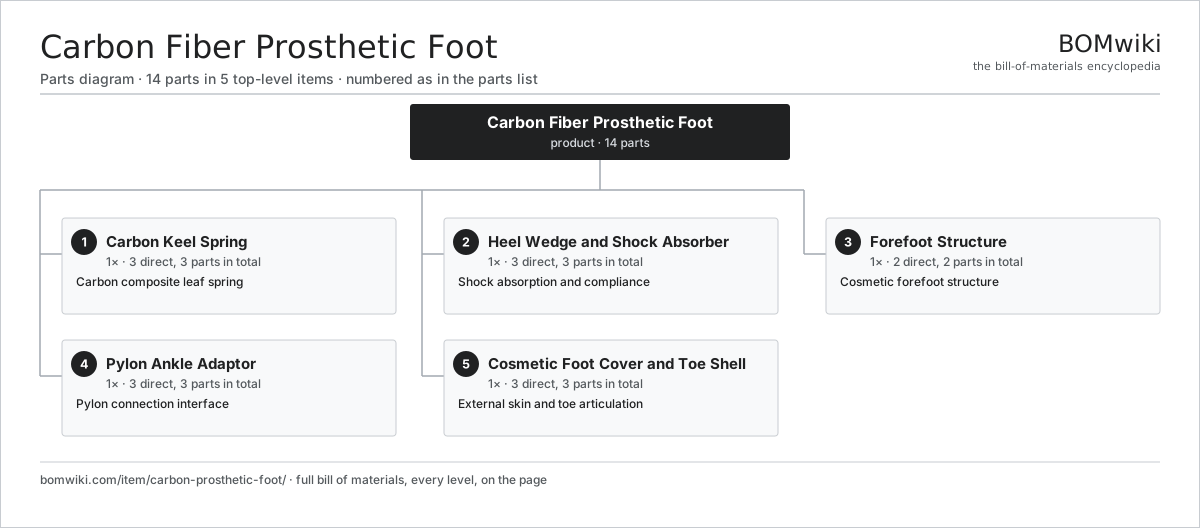
| # | Part | Qty | What it does |
|---|---|---|---|
| 1 | Carbon Keel Spring 3 parts | 1× | Carbon composite leaf spring |
| 2 | Heel Wedge and Shock Absorber 3 parts | 1× | Shock absorption and compliance |
| 3 | Forefoot Structure 2 parts | 1× | Cosmetic forefoot structure |
| 4 | Pylon Ankle Adaptor 3 parts | 1× | Pylon connection interface |
| 5 | Cosmetic Foot Cover and Toe Shell 3 parts | 1× | External skin and toe articulation |
3D model
No 3D model yet. Have a CAD file of this? Add a 3D model. STL renders right on this page; STEP, FreeCAD, and OpenSCAD sources are welcome too (openly licensed, like all 3D models on BOMwiki).
Build & assembly graph
expand / collapse · shared sub-assemblies converge · links to related products · est. labourTap an assembly to expand/collapse · tap a part to open it · use “Open page” for any node · drag to pan, scroll to zoom.
Bill of materials for Carbon Fiber Prosthetic Foot
5 top-level lines · 19 rows shown · 14 parts total · indented to 3 levels| # | Item / sub-assembly | Part no. | Qty/assy | Ext. qty | Parts | Type |
|---|---|---|---|---|---|---|
| 1 | Carbon Keel Spring 3 parts | carbon-prosthetic-foot-keel-assembly | 1× | 1 | 3 | assembly |
| 1.1 | Carbon Fiber Plies | carbon-prosthetic-foot-carbon-layers | 1× | 1 | · | part |
| 1.2 | Epoxy Resin System | carbon-prosthetic-foot-resin-matrix | 1× | 1 | · | part |
| 1.3 | Keel Mold Assembly | carbon-prosthetic-foot-curvature-mold | 1× | 1 | · | part |
| 2 | Heel Wedge and Shock Absorber 3 parts | carbon-prosthetic-foot-heel-unit | 1× | 1 | 3 | assembly |
| 2.1 | Heel Cushion Material | carbon-prosthetic-foot-heel-foam | 1× | 1 | · | part |
| 2.2 | Heel Backing Shell | carbon-prosthetic-foot-heel-shell | 1× | 1 | · | part |
| 2.3 | Heel Wedge Geometry | carbon-prosthetic-foot-heel-wedge-angle | 1× | 1 | · | part |
| 3 | Forefoot Structure 2 parts | carbon-prosthetic-foot-foot-shell | 1× | 1 | 2 | assembly |
| 3.1 | Forefoot Shell Blank | carbon-prosthetic-foot-forefoot-blank | 1× | 1 | · | part |
| 3.2 | Toe Break Joint | carbon-prosthetic-foot-toe-break-joint | 1× | 1 | · | part |
| 4 | Pylon Ankle Adaptor 3 parts | carbon-prosthetic-foot-ankle-adaptor | 1× | 1 | 3 | assembly |
| 4.1 | Ankle Block Connector | carbon-prosthetic-foot-adaptor-block | 1× | 1 | · | part |
| 4.2 | ISO Standard Mount Plate | carbon-prosthetic-foot-iso-adapter-plate | 1× | 1 | · | part |
| 4.3 | Fastener Set | fastener-set | 1× | 1 | · | part |
| 5 | Cosmetic Foot Cover and Toe Shell 3 parts | carbon-prosthetic-foot-cosmetic-cover | 1× | 1 | 3 | assembly |
| 5.1 | Silicone Foot Skin | carbon-prosthetic-foot-silicone-skin | 1× | 1 | · | part |
| 5.2 | Articulated Toe Caps | carbon-prosthetic-foot-toe-cap-assembly | 1× | 1 | · | part |
| 5.3 | Cosmetic Detailing | carbon-prosthetic-foot-cosmetic-seams | 1× | 1 | · | part |
Something wrong in this list? Report a problem with this BOM.
Sourcing: possible vendors
Browse the supplier directory → Prices, MOQ, and lead times are algorithmic estimates, not quotes, and not claims about these companies. Company mappings are curated by keyword; est. price band $500–$3M. How estimates work| Vendor | HQ | Specialty | MOQ | Lead time |
|---|---|---|---|---|
| gehealthcare.com ↗ | Chicago, US | Medical imaging & devices | 100 units | 12–20 wks |
| siemens-healthineers.com ↗ | Erlangen, DE | Medical systems | 100 units | 12–20 wks |
|
🇳🇱Philips
philips.com ↗
|
Amsterdam, NL | Health technology | 100 units | 12–20 wks |
| medtronic.com ↗ | Minneapolis, US | Medical devices | 100 units | 12–20 wks |
|
🇨🇳Mindray
mindray.com ↗
|
Shenzhen, CN | Medical devices | 100 units | 12–20 wks |
1,422-word article