Carbonation System
ProductOverview
Carbonation systems are specialized subsystems within beverage lines, responsible for dissolving precise quantities of CO2 into water, juice, or syrup-based drinks to achieve the desired carbonation level (typically 3.5–4.5 volumes of CO2 for soft drinks and sparkling water). The process involves three core steps: deaeration (removing dissolved oxygen and air that would inhibit CO2 uptake), CO2 injection (metering gas into the product under controlled pressure), and cooling (chilling the product to enhance gas solubility and shelf-life).
Integrated carbonation modules are placed upstream of the filler in high-speed lines, receiving product from concentrate mix tanks or syrup proportioning stations and delivering cold, fully carbonated product directly to the bottle-fill heads. Precise CO2 control is critical: under-carbonation results in flat-tasting product, while over-carbonation causes excessive foam and bottle pressure spikes.
How it works
Deaeration Stage
Incoming product enters a vacuum-assisted deaeration chamber where solenoid inlet valve opens under PLC control. A rotary vane or screw vacuum pump cycles the chamber to 0.3–0.5 bar absolute pressure, causing dissolved air and oxygen to flash-evaporate. A water-cooled condenser recovers product vapors and returns liquid to minimize product loss. Deaeration takes 30–90 seconds per batch and is critical for carbonation accuracy: residual air bubbles prevent CO2 from dissolving completely, reducing final carbonation levels.
After deaeration is complete, the pressurized CO2 mixing tank fills from the deaerator, and the next product batch enters the deaerator chamber independently, allowing continuous operation in-line with a lag buffer.
CO2 Injection and Metering
The mixing tank receives deaerated product and pressurized CO2 gas simultaneously. A proportional solenoid valve meters CO2 flow under closed-loop PLC control. A sonic orifice creates acoustic choking, ensuring that the metering rate is constant regardless of tank pressure changes (5–10 bar range). The PLC compares actual CO2 concentration (measured by an in-tank dissolved-gas meter) against the setpoint (e.g., 4.0 volumes) and adjusts the solenoid valve duty cycle to add more or less CO2 until equilibrium is reached.
The mixing tank includes a low-speed agitator paddle (10–50 rpm) that promotes gentle, bubble-free mixing, avoiding vortex formation and foam.
Dwell and Equilibration
Product resides in the mixing tank for 20–60 seconds, allowing CO2 molecules to diffuse throughout the liquid and reach saturation. Temperature and pressure conditions during dwell significantly influence carbonation efficiency: colder product absorbs more CO2 at a given pressure (Henry's Law). The tank relief valve (8–10 bar) protects the system from overpressure if CO2 injection continues unchecked.
Cooling Stage
As product leaves the mixing tank, it passes through a plate heat exchanger cooled by a recirculating glycol-water loop. Chilled glycol at 0–2 °C cools carbonated product to 1–4 °C, a target setpoint for both taste perception and microbial stability. A VFD-driven pump modulates cooler flow based on real-time product temperature feedback from an RTD sensor, maintaining setpoint within ±1 °C.
Instrumentation and Feedback Loop
Pressure transmitters on the CO2 supply and tank outlet ensure the injection stage is operating at the correct pressures. A dissolved-CO2 meter (isentropic or gas-exchange type) measures actual carbonation levels in real time, outputting 4–20 mA to the PLC. The controller adjusts the CO2 metering solenoid to track the setpoint, accounting for product flow rate variations and temperature drift.
Integration with Fillers
The carbonation module discharges directly into the filler inlet, typically via a metering pump synchronized to the filler speed. Servo feedback from the filler line-rate encoder ensures the carbonation pump speed matches incoming bottle demand, preventing build-up or starvation at the filler inlet.
Typical Applications
Soft drinks (cola, lemonade, flavored water): 3.5–4.2 volumes CO2. Sparkling water: 3.7–4.5 volumes. Beer: 2.5–3.0 volumes (lower due to malt character and foam stability requirements). Wine coolers and alcopops: 2.0–3.0 volumes.
Deaeration Methods
Vacuum deaeration is preferred for maximum gas removal (80–99% efficiency). Flash-evaporation deaerators (less common in modern lines) rely on product pressure drop in a nozzle to create rapid boiling and gas separation. Ultrasonic deaerators use sonic energy but are less effective for industrial volumes.
Pressure and Solubility
CO2 solubility in water follows Henry's Law: at 4 °C and 1 bar, water dissolves 3.5 g CO2 per liter (1.8 volumes). To achieve 4.0 volumes at 4 °C, the tank must maintain approximately 4 bar CO2 pressure above the liquid surface. Temperature changes of ±5 °C can cause 10–15% swings in carbonation level if pressure is not actively controlled.
Maintenance and Sanitation
All wetted surfaces are stainless steel 304/316L, food-grade gaskets (FKM, EPDM), and quick-disconnect couplings for line changeover. The tank, pump, and cooler are designed for CIP: all product lines can be flushed and sterilized with caustic and acid without disassembly. Proportional solenoid valves are soaked in hot water or light detergent and checked for spool stiction monthly. Dissolved-CO2 sensors require annual recalibration to maintain ±0.1 volume accuracy.
Carbonation System parts and their functions
8 top-level parts · 29 parts in total · full bill of materials below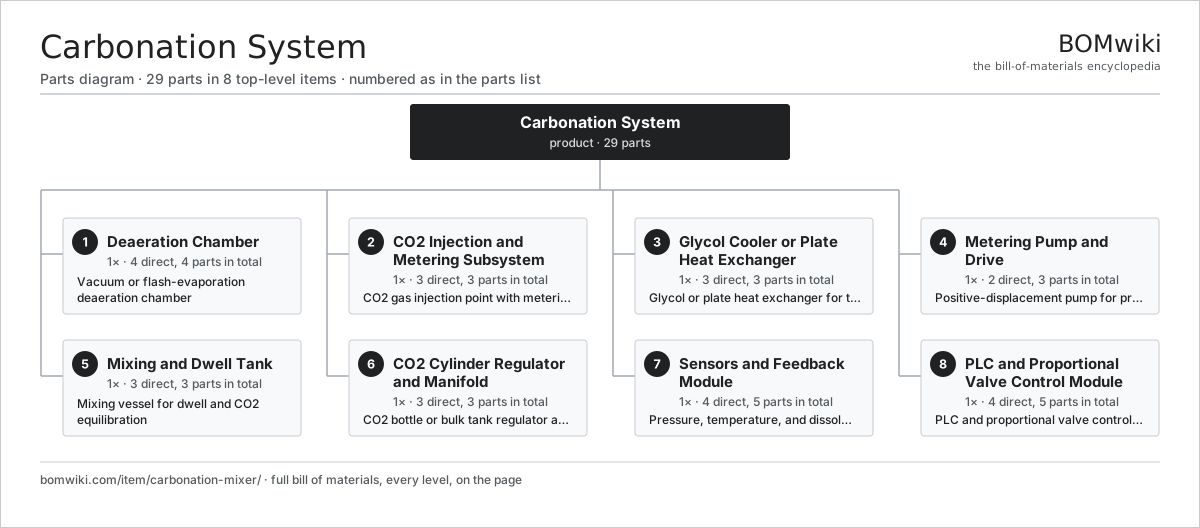
| # | Part | Qty | What it does |
|---|---|---|---|
| 1 | Deaeration Chamber 4 parts | 1× | Vacuum or flash-evaporation deaeration chamber |
| 2 | CO2 Injection and Metering Subsystem 3 parts | 1× | CO2 gas injection point with metering and mixing |
| 3 | Glycol Cooler or Plate Heat Exchanger 3 parts | 1× | Glycol or plate heat exchanger for temperature control |
| 4 | Metering Pump and Drive 2 parts | 1× | Positive-displacement pump for precise flow control |
| 5 | Mixing and Dwell Tank 3 parts | 1× | Mixing vessel for dwell and CO2 equilibration |
| 6 | CO2 Cylinder Regulator and Manifold 3 parts | 1× | CO2 bottle or bulk tank regulator and solenoid |
| 7 | Sensors and Feedback Module 4 parts | 1× | Pressure, temperature, and dissolved-CO2 sensors |
| 8 | PLC and Proportional Valve Control Module 4 parts | 1× | PLC and proportional valve controllers |
3D model
No 3D model yet. Have a CAD file of this? Add a 3D model. STL renders right on this page; STEP, FreeCAD, and OpenSCAD sources are welcome too (openly licensed, like all 3D models on BOMwiki).
Build & assembly graph
expand / collapse · shared sub-assemblies converge · links to related products · est. labourTap an assembly to expand/collapse · tap a part to open it · use “Open page” for any node · drag to pan, scroll to zoom.
Bill of materials for Carbonation System
8 top-level lines · 38 rows shown · 29 parts total · indented to 3 levels| # | Item / sub-assembly | Part no. | Qty/assy | Ext. qty | Parts | Type |
|---|---|---|---|---|---|---|
| 1 | Deaeration Chamber 4 parts | carbonation-mixer-deaerator | 1× | 1 | 4 | assembly |
| 1.1 | Vacuum Deaeration Tank | carbonation-mixer-deaer-vessel | 1× | 1 | · | part |
| 1.2 | Vacuum Pump Assembly 1 parts | carbonation-mixer-deaer-vacuum-pump | 1× | 1 | 1 | assembly |
| 1.2.1 | Vacuum Pump Motor | carbonation-mixer-vacuum-motor | 1× | 1 | · | part |
| 1.3 | Condenser and Vapor Recovery | carbonation-mixer-deaer-condenser | 1× | 1 | · | part |
| 1.4 | Pressure Sensor | pressure-sensor | 1× | 1 | · | part |
| 2 | CO2 Injection and Metering Subsystem 3 parts | carbonation-mixer-co2-injection | 1× | 1 | 3 | assembly |
| 2.1 | CO2 Proportioning Solenoid Valve | carbonation-mixer-gas-solenoid | 1× | 1 | · | part |
| 2.2 | Sonic Orifice Restriction | carbonation-mixer-sonic-orifice | 1× | 1 | · | part |
| 2.3 | Pressure Sensor | pressure-sensor | 1× | 1 | · | part |
| 3 | Glycol Cooler or Plate Heat Exchanger 3 parts | carbonation-mixer-cooler | 1× | 1 | 3 | assembly |
| 3.1 | Plate Heat Exchanger | carbonation-mixer-cooler-plate | 1× | 1 | · | part |
| 3.2 | Glycol Recirculation Pump 1 parts | carbonation-mixer-cooler-pump | 1× | 1 | 1 | assembly |
| 3.2.1 | Cooler Pump Motor | carbonation-mixer-cooler-pump-motor | 1× | 1 | · | part |
| 3.3 | Temperature Sensor | temperature-sensor | 1× | 1 | · | part |
| 4 | Metering Pump and Drive 2 parts | carbonation-mixer-pump | 1× | 1 | 3 | assembly |
| 4.1 | Carbonation Pump Servo Motor | carbonation-mixer-pump-drive | 1× | 1 | · | part |
| 4.2 | Ball Bearing | ball-bearing | 2× | 2 | · | part |
| 5 | Mixing and Dwell Tank 3 parts | carbonation-mixer-tank | 1× | 1 | 3 | assembly |
| 5.1 | Pressurized Mixing Tank | carbonation-mixer-tank-vessel | 1× | 1 | · | part |
| 5.2 | Low-Speed Mixer Motor and Impeller 1 parts | carbonation-mixer-tank-agitator | 1× | 1 | 1 | assembly |
| 5.2.1 | Tank Agitator Motor | carbonation-mixer-mixer-motor | 1× | 1 | · | part |
| 5.3 | Pressure Relief Valve | carbonation-mixer-tank-relief | 1× | 1 | · | part |
| 6 | CO2 Cylinder Regulator and Manifold 3 parts | carbonation-mixer-gas-supply | 1× | 1 | 3 | assembly |
| 6.1 | CO2 Dual-Stage Regulator | carbonation-mixer-regulator | 1× | 1 | · | part |
| 6.2 | CO2 Isolation Solenoid Valve | carbonation-mixer-isolation-solenoid | 1× | 1 | · | part |
| 6.3 | One-Way Check Valve | carbonation-mixer-check-valve | 1× | 1 | · | part |
| 7 | Sensors and Feedback Module 4 parts | carbonation-mixer-instrumentation | 1× | 1 | 5 | assembly |
| 7.1 | Pressure Transmitter | carbonation-mixer-pressure-tx | 2× | 2 | · | part |
| 7.2 | RTD Temperature Sensor | carbonation-mixer-temperature-probe | 1× | 1 | · | part |
| 7.3 | Dissolved CO2 Meter 1 parts | carbonation-mixer-co2-meter | 1× | 1 | 1 | assembly |
| 7.3.1 | CO2 Measurement Cell | carbonation-mixer-co2-cell | 1× | 1 | · | part |
| 7.4 | Bare PCB | pcb-bare | 1× | 1 | · | part |
| 8 | PLC and Proportional Valve Control Module 4 parts | carbonation-mixer-servo-drives | 1× | 1 | 5 | assembly |
| 8.1 | Carbonation Control PLC | carbonation-mixer-plc | 1× | 1 | · | part |
| 8.2 | Proportional Amplifier | carbonation-mixer-prop-amp | 2× | 2 | · | part |
| 8.3 | VFD Cooling Controller | carbonation-mixer-cooling-amp | 1× | 1 | · | part |
| 8.4 | Touch Digitizer | touch-digitizer | 1× | 1 | · | part |
Something wrong in this list? Report a problem with this BOM.
Related products
same domain, ranked by shared parts Drum Drying Machine
634 parts · shares 4 with this page
Drum Drying Machine
634 parts · shares 4 with this page
 Fluid Bed Dryer
550 parts · shares 4 with this page
Fluid Bed Dryer
550 parts · shares 4 with this page
 Industrial Freeze Dryer
816 parts · shares 4 with this page
Spray Drying Tower
1,040 parts · shares 4 with this page
Industrial Freeze Dryer
816 parts · shares 4 with this page
Spray Drying Tower
1,040 parts · shares 4 with this page
 Vacuum Belt Dryer
951 parts · shares 4 with this page
Bottle Rinser
36 parts · shares 3 with this page
Vacuum Belt Dryer
951 parts · shares 4 with this page
Bottle Rinser
36 parts · shares 3 with this page
Sourcing: possible vendors
Browse the supplier directory → Prices, MOQ, and lead times are algorithmic estimates, not quotes, and not claims about these companies. Company mappings are curated by keyword; est. price band $1k–$500k. How estimates work| Vendor | HQ | Specialty | MOQ | Lead time |
|---|---|---|---|---|
| gea.com ↗ | Düsseldorf, DE | Process technology | 20 units | 12–20 wks |
| buhlergroup.com ↗ | Uzwil, CH | Food & materials processing | 20 units | 12–20 wks |
| tetrapak.com ↗ | Pully, CH | Food packaging & processing | 20 units | 12–20 wks |
| jbtc.com ↗ | Chicago, US | Food processing equipment | 20 units | 12–20 wks |
| alfalaval.com ↗ | Lund, SE | Heat transfer & separation | 20 units | 12–20 wks |
849-word article