Beverage Carbonator
ProductOverview
A carbonator dissolves carbon dioxide into water or finished beverage and holds it dissolved until the moment of dispense or filling. The same principle scales from the shoebox unit under a fast-food soda fountain to the saturator skid feeding a 60,000 L/h bottling line: chill the water, pressurize it with CO2, give the gas surface area and time to dissolve, and never let pressure or temperature stray from the curve that keeps it in solution.
The governing physics is Henry's law, dissolved CO2 is proportional to the partial pressure of CO2 above the liquid, and its strong temperature dependence: water at 2 °C holds roughly twice the CO2 of water at 20 °C at the same pressure. Every design decision in the machine serves those two facts. A cola is carbonated to roughly 7.5–8 g/L (about 4 volumes), sparkling water typically 6–8 g/L, and a lightly sparkling beverage 3–4 g/L.
How it works
Mains water first passes the Inlet Strainer and enters the Carbonator Pump. The Rotary Vane Pump Head is a positive-displacement head that lifts the water to 8–12 bar, well above the tank's 3–6 bar headspace, so it can be sprayed in against pressure; its Pump Bypass Valve recirculates flow when the outlet deadheads. The Pump Motor cycles on demand from the level system, often thousands of starts per week in a busy outlet.
Inside the Carbonation Tank, the Water Spray Nozzle atomizes the incoming water through the CO2-filled headspace. Droplets present enormous surface area, so most of the dissolution happens during that fall; the remainder occurs at the liquid surface while the water sits under pressure. Production machines add an inline CO2 Injector, a venturi or sintered sparger in the CO2 Injection System, that shears gas into sub-millimetre bubbles in the flowing stream, with the CO2 Flow Meter closing the loop on grams-per-litre dosing. Gas arrives from cylinders or a bulk tank through the CO2 Pressure Regulator, the CO2 Inline Filter, and the CO2 Solenoid Valve.
Cold water is non-negotiable. The Chilled Water System holds the water at 1–4 °C, usually via an ice bank: the Refrigerant Compressor freezes a reserve of ice on the Evaporator / Ice Bank coil during quiet periods, and the Bath Agitator Motor stirs the bath so peak dispense draws melt the ice instead of overloading the refrigeration. The Radiator condenser and its Blower Motor fan reject the heat. Warm carbonated water not only holds less gas, it foams violently at the dispense valve, which is the classic symptom of a failed ice bank.
Level control keeps the system stable. Three Conductive Level Probe electrodes feed the Level Control Board, which starts the pump at low level and stops it at high, maintaining a roughly constant headspace volume so tank pressure (and therefore carbonation) stays put. The Dry-Run Cutout locks the pump out on supply failure because a vane head run dry destroys itself in minutes. The Control Panel supervise the rest: holding the pressure–temperature pair that corresponds to the target CO2 level, and alarming on gas-out or low water.
Deaeration
Bottling-plant carbonators add a step the fountain unit skips: removing the air already dissolved in the water. Oxygen and nitrogen occupy "Henry's law capacity" that should belong to CO2, cause gushing at the filler, and oxidize flavors. In the Water Deaeration Stage stage, inlet water is sprayed through the Column Spray Head into the Stripping Column held at 0.1–0.3 bar absolute by the Deaeration Vacuum Pump; thin films of water release their dissolved air, which leaves through the Air Vent Valve. Good systems get residual oxygen below 0.5 ppm before a single gram of CO2 is spent.
Safety
Two hazards shape the regulations around carbonators. The first is pressure: the Pressure Shell is a certified pressure vessel and the Safety Relief Valve is its last line, set just above working pressure. The second is backflow. If carbonated water siphons backward into copper plumbing it dissolves copper and has caused documented poisonings at soda fountains, hence the dual Double Check Valve required by EN 13951 and NSF 18, and the rule that no copper may sit between carbonator and dispense point. CO2 itself asphyxiates: cellar installations pair the machine with gas monitors because a leaked cylinder can displace the air in a closed room.
Beverage Carbonator parts and their functions
8 top-level parts · 95 parts in total · full bill of materials below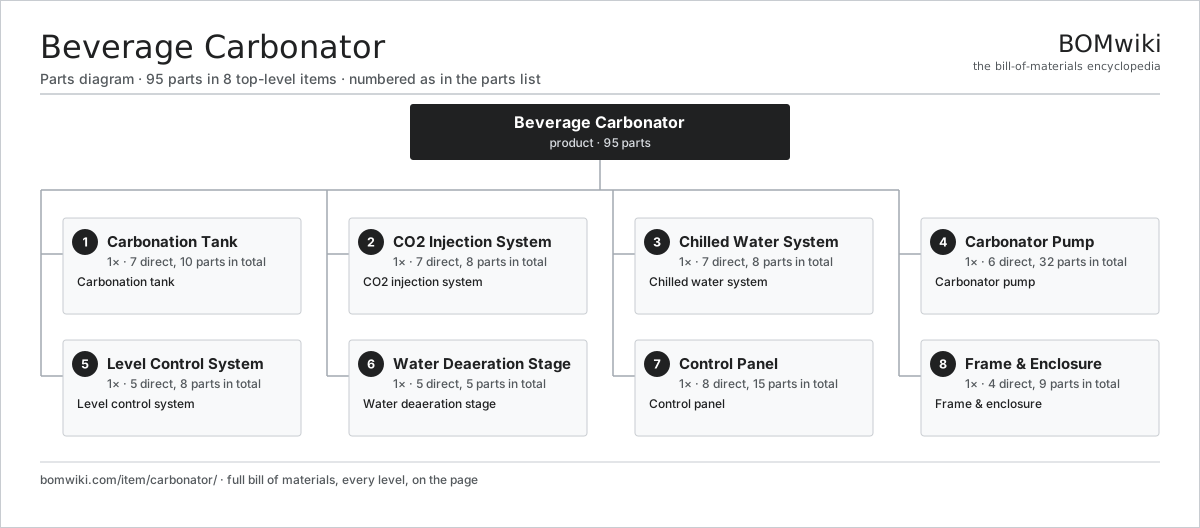
| # | Part | Qty | What it does |
|---|---|---|---|
| 1 | Carbonation Tank 7 parts | 1× | Carbonation tank |
| 2 | CO2 Injection System 7 parts | 1× | CO2 injection system |
| 3 | Chilled Water System 7 parts | 1× | Chilled water system |
| 4 | Carbonator Pump 6 parts | 1× | Carbonator pump |
| 5 | Level Control System 5 parts | 1× | Level control system |
| 6 | Water Deaeration Stage 5 parts | 1× | Water deaeration stage |
| 7 | Control Panel 8 parts | 1× | Control panel |
| 8 | Frame & Enclosure 4 parts | 1× | Frame & enclosure |
3D model
No 3D model yet. Have a CAD file of this? Add a 3D model. STL renders right on this page; STEP, FreeCAD, and OpenSCAD sources are welcome too (openly licensed, like all 3D models on BOMwiki).
Build & assembly graph
expand / collapse · shared sub-assemblies converge · links to related products · est. labourTap an assembly to expand/collapse · tap a part to open it · use “Open page” for any node · drag to pan, scroll to zoom.
Bill of materials for Beverage Carbonator
8 top-level lines · 62 rows shown · 95 parts total · indented to 3 levels| # | Item / sub-assembly | Part no. | Qty/assy | Ext. qty | Parts | Type |
|---|---|---|---|---|---|---|
| 1 | Carbonation Tank 7 parts | carbonator-tank | 1× | 1 | 10 | assembly |
| 1.1 | Pressure Shell | carbonator-tank-shell | 1× | 1 | · | part |
| 1.2 | Safety Relief Valve | carbonator-relief-valve | 1× | 1 | · | part |
| 1.3 | Water Spray Nozzle | carbonator-spray-nozzle | 1× | 1 | · | part |
| 1.4 | Level Sight Glass | carbonator-sight-glass | 1× | 1 | · | part |
| 1.5 | Process Port | carbonator-tank-port | 4× | 4 | · | part |
| 1.6 | O-Ring Set | oring-set | 1× | 1 | · | part |
| 1.7 | Pressure Sensor | pressure-sensor | 1× | 1 | · | part |
| 2 | CO2 Injection System 7 parts | carbonator-co2-system | 1× | 1 | 8 | assembly |
| 2.1 | CO2 Pressure Regulator | carbonator-co2-regulator | 1× | 1 | · | part |
| 2.2 | CO2 Injector | carbonator-injector | 1× | 1 | · | part |
| 2.3 | CO2 Solenoid Valve | carbonator-co2-solenoid | 1× | 1 | · | part |
| 2.4 | Double Check Valve | carbonator-check-valve | 2× | 2 | · | part |
| 2.5 | CO2 Inline Filter | carbonator-co2-filter | 1× | 1 | · | part |
| 2.6 | CO2 Flow Meter | carbonator-flowmeter | 1× | 1 | · | part |
| 2.7 | Pressure Sensor | pressure-sensor | 1× | 1 | · | part |
| 3 | Chilled Water System 7 parts | carbonator-chiller | 1× | 1 | 8 | assembly |
| 3.1 | Refrigerant Compressor | carbonator-compressor | 1× | 1 | · | part |
| 3.2 | Evaporator / Ice Bank | carbonator-evaporator | 1× | 1 | · | part |
| 3.3 | Radiator | radiator | 1× | 1 | · | part |
| 3.4 | Expansion Valve | carbonator-expansion-valve | 1× | 1 | · | part |
| 3.5 | Bath Agitator Motor | carbonator-agitator-motor | 1× | 1 | · | part |
| 3.6 | Temperature Probe | carbonator-temp-probe | 2× | 2 | · | part |
| 3.7 | Blower Motor | blower-motor | 1× | 1 | · | part |
| 4 | Carbonator Pump 6 parts | carbonator-pump-assy | 1× | 1 | 32 | assembly |
| 4.1 | Rotary Vane Pump Head | carbonator-vane-pump | 1× | 1 | · | part |
| 4.2 | Pump Motor 5 parts | carbonator-pump-motor | 1× | 1 | 26 | assembly |
| 4.2.1 | Stator Assembly 3 parts + deeper › | stator-assembly | 1× | 1 | 3 | assembly |
| 4.2.2 | Rotor Assembly 4 parts + deeper › | rotor-assembly | 1× | 1 | 19 | assembly |
| 4.2.3 | Copper Winding | copper-winding | 1× | 1 | · | part |
| 4.2.4 | Motor Housing | motor-housing | 1× | 1 | · | part |
| 4.2.5 | Ball Bearing | ball-bearing | 2× | 2 | · | part |
| 4.3 | Pump Bypass Valve | carbonator-bypass-valve | 1× | 1 | · | part |
| 4.4 | Inlet Strainer | carbonator-strainer | 1× | 1 | · | part |
| 4.5 | Oil Seal | oil-seal | 1× | 1 | · | part |
| 4.6 | Connector | connector | 2× | 2 | · | part |
| 5 | Level Control System 5 parts | carbonator-level-control | 1× | 1 | 8 | assembly |
| 5.1 | Conductive Level Probe | carbonator-level-probe | 3× | 3 | · | part |
| 5.2 | Level Control Board | carbonator-level-board | 1× | 1 | · | part |
| 5.3 | Relay | relay | 2× | 2 | · | part |
| 5.4 | Dry-Run Cutout | carbonator-low-water-cutout | 1× | 1 | · | part |
| 5.5 | Wire Bundle | wire-bundle | 1× | 1 | · | part |
| 6 | Water Deaeration Stage 5 parts | carbonator-deaeration | 1× | 1 | 5 | assembly |
| 6.1 | Deaeration Vacuum Pump | carbonator-vacuum-pump | 1× | 1 | · | part |
| 6.2 | Stripping Column | carbonator-deaeration-column | 1× | 1 | · | part |
| 6.3 | Column Spray Head | carbonator-spray-head | 1× | 1 | · | part |
| 6.4 | Air Vent Valve | carbonator-vent-valve | 1× | 1 | · | part |
| 6.5 | Pressure Sensor | pressure-sensor | 1× | 1 | · | part |
| 7 | Control Panel 8 parts | carbonator-controls | 1× | 1 | 15 | assembly |
| 7.1 | Microcontroller | mcu | 1× | 1 | · | part |
| 7.2 | LCD Panel | lcd-panel | 1× | 1 | · | part |
| 7.3 | Bare PCB | pcb-bare | 1× | 1 | · | part |
| 7.4 | SMD Passive (R/C/L) | smd-passives | 1× | 1 | · | part |
| 7.5 | Relay | relay | 3× | 3 | · | part |
| 7.6 | Connector | connector | 6× | 6 | · | part |
| 7.7 | Power Supply | power-supply | 1× | 1 | · | part |
| 7.8 | Thermal Fuse | thermal-fuse | 1× | 1 | · | part |
| 8 | Frame & Enclosure 4 parts | carbonator-frame | 1× | 1 | 9 | assembly |
| 8.1 | Base Chassis | carbonator-chassis | 1× | 1 | · | part |
| 8.2 | Sheet Metal Panel | sheet-panel | 3× | 3 | · | part |
| 8.3 | Levelling Foot | carbonator-foot | 4× | 4 | · | part |
| 8.4 | Fastener Set | fastener-set | 1× | 1 | · | part |
Something wrong in this list? Report a problem with this BOM.
Related products
same domain, ranked by shared parts Industrial Smokehouse
267 parts · shares 20 with this page
Industrial Smokehouse
267 parts · shares 20 with this page
 Chocolate Enrober
470 parts · shares 19 with this page
Spiral Freezer
179 parts · shares 19 with this page
Chocolate Enrober
470 parts · shares 19 with this page
Spiral Freezer
179 parts · shares 19 with this page
 Chocolate Tempering Machine
141 parts · shares 18 with this page
Confectionery Depositor
699 parts · shares 18 with this page
Commercial Bread Slicer
187 parts · shares 17 with this page
Chocolate Tempering Machine
141 parts · shares 18 with this page
Confectionery Depositor
699 parts · shares 18 with this page
Commercial Bread Slicer
187 parts · shares 17 with this page
Sourcing: possible vendors
Browse the supplier directory → Prices, MOQ, and lead times are algorithmic estimates, not quotes, and not claims about these companies. Company mappings are curated by keyword; est. price band $1k–$500k. How estimates work| Vendor | HQ | Specialty | MOQ | Lead time |
|---|---|---|---|---|
| gea.com ↗ | Düsseldorf, DE | Process technology | 20 units | 12–20 wks |
| buhlergroup.com ↗ | Uzwil, CH | Food & materials processing | 20 units | 12–20 wks |
| tetrapak.com ↗ | Pully, CH | Food packaging & processing | 20 units | 12–20 wks |
| jbtc.com ↗ | Chicago, US | Food processing equipment | 20 units | 12–20 wks |
| alfalaval.com ↗ | Lund, SE | Heat transfer & separation | 20 units | 12–20 wks |
742-word article