Cash Deposit Machine
ProductOverview
A cash deposit machine is a self-service banking convenience that extends deposit hours without staffing. Unlike a night depository (which merely collects envelopes for morning processing), a cash deposit machine actively validates banknotes and checks, processes them into an escrow safe, and immediately issues a receipt confirming the deposit amount. For a customer, this is faster and less intimidating than handing a bag to a teller: insert envelope, machine counts, machine validates, machine prints receipt, done. For the bank, this reduces teller workload (fewer simple deposits to process) and provides a objective audit trail (no teller miscounts or disputes). Retail chains, office supply stores, and large corporate offices often install these to allow employees to make deposits during lunch or after hours.
The machine's core innovation is automation of the validation step. A simple night depository trusts the customer (customer seals an envelope, bank counts it in the morning). A cash deposit machine does not trust the customer: it opens the envelope, inspects each banknote optically and magnetically, counts them, scans any checks for MICR codes and imagery, and only then accepts the deposit. If a note is counterfeit, the machine rejects it into a locked bin. If a check's MICR line is unreadable (damaged or altered), the machine flags it for manual review. The bank has objective evidence: images of every note and check, sensor readings, a transaction log.
Deposit Process & Validation
A customer enters the bank lobby during evening hours (the machine is available 24/7) and approaches the Customer Interface Touchscreen. The screen shows "Deposit Account Number" with a numeric keypad. The customer enters their account number. The Master Controller & Logic Board looks it up in the bank's core system (via Ethernet): "Account 5847-123 | Smith, J. | Checking | Current Balance: $2,345.67". The screen displays "Confirm: $2,345.67 | Checking | Smith, John | Press OK to continue." The customer confirms. The machine prompts "Insert deposit envelope." The customer places an envelope (pre-provided by the bank or their own, marked with account number and amount) into the Bill Acceptor Feeder's hopper opening. The machine displays "Counting... Please wait." The Feed Wheel starts, fed by the hopper's Straightener Rollers, which separate and align individual notes. The Banknote Authentication Sensor Head fires: for each note, the CMOS Image Sensor captures full-color images (front and back), the Uv Led illuminates security features, the Mg Coil reads magnetic signatures, and the Ir Detector measures reflectance. All sensor data streams to the Master Controller & Logic Board, which runs a multi-modal neural network (trained on thousands of genuine and counterfeit notes). The network outputs a verdict in ~50 ms per note: "Accept: $100 bill, series 2017, denomination verified" or "Reject: Counterfeit – MG signature mismatch". Accepted notes fall into a gravity-fed Deposit Chute that feeds directly into the Time-Locked Escrow Safe. Rejected notes are diverted by a pneumatic or solenoid gate into the Reject & Exception Bin, a locked bin.
After all banknotes are processed, the customer is asked "Insert any checks?" (if the deposit includes checks, which are optional). They insert a stack of checks into a separate slot, and the Check MICR & Image Scanner reads the MICR line of each check (routing number, account number, check number) using an inductive coil Micr Reader. The Check Camera captures full-color images of front and back (for later verification and fraud detection). The Master Controller & Logic Board performs basic checks: Is the routing number valid (matches a known U.S. bank)? Is the account number numeric? Are the images readable (no folds, tears, or illegible ink)? Valid checks fall into the Deposit Chute alongside banknotes. Questionable checks (unreadable MICR, mismatched routing number, image defects) are diverted to the reject bin for manual handling.
Once all items have been processed, the Customer Interface Touchscreen displays a summary: "Total deposited: $5,000 (30 × $100 + 15 × $33 + 50 checks). 2 notes rejected. Your receipt will print below." The Thermal Receipt Printer produces a thermal receipt: ''' DEPOSIT RECEIPT Bank Name: [Bank] Time: 2024-03-15 18:47:23 Account: 5847-123 (John Smith)
Accepted: $100 bills: 30 × $3,000 $10 bills: 20 × $200 Checks: 50 × $1,555 TOTAL ACCEPTED: $4,755 Rejected: Unfit banknotes: 2 Unreadable checks: 0
Deposit Reference: #87654321 Processing Status: Pending (bank reconciliation) Next step: Bank will confirm within 24 hours Thank you! '''
The customer takes the receipt. All accepted items are now in the Time-Locked Escrow Safe, locked until the next morning when the bank manager opens it with a key and the Time Delay Lock permits access.
Escrow & Time-Locking
The Time-Locked Escrow Safe is the machine's vault core. It is a TL-15 burglary-resistant safe, meaning it can resist professional drilling, prying, and explosives for 15 minutes. The safe's door is fitted with dual Solenoid Bolts (redundant for safety) and a Time Delay Lock. The time-lock is a motorized solenoid controlled by a quartz clock embedded in the Master Controller & Logic Board. A typical bank might set the lock to "unlock 7 AM–6 PM Monday–Friday, 9 AM–2 PM Saturday, locked all Sunday." At 6:01 PM on Friday, the time-lock mechanism (a motor-driven cam) physically retracts the solenoid bolts, securing the safe. No matter what credentials or override keys are presented, the door cannot open until 7:00 AM Monday. This design makes it impossible for a single employee (teller, manager) to open the safe unilaterally outside business hours. Even if a manager's key is stolen or a manager is coerced at gunpoint to open the machine, the time-lock prevents access. The delay forces a potential thief to wait until business hours, by which time other staff or security can intervene.
Deposits are logged on a per-transaction basis. Each time the Deposit Chute routes an accepted note into the safe, a counter in the Master Controller & Logic Board increments. The final tally is stored on the SSD: "2024-03-15 18:47 | Account 5847-123 | Deposit: 50 items | $4,755 accepted, $200 rejected | Reference #87654321 | Status: Escrow". This log is synced in real-time to the bank's core system via Ethernet. So the bank's accounting records already show the deposit tentatively posted (pending morning verification). This reduces reconciliation time.
Morning Processing & Reconciliation
The next morning at 7 AM, the bank manager opens the machine using the Time-Locked Escrow Safe's dual Solenoid Bolts (unlocked by the time-lock) and a mechanical key. The manager counts the contents: 50 banknotes totaling $4,755 and 50 checks. She compares this to the Master Controller & Logic Board's log: "Escrow safe deposited: 50 items, $4,755." A perfect match. She manually verifies a spot-check sample (count 10 random notes, inspect each for physical defects or fading, a safety check that the machine's sensors were accurate). All pass. The manager removes the contents, bundles them, and processes them through the bank's standard deposit pipeline: checks are sent to the check processing center, banknotes are counted and either reused or sent to the Federal Reserve if unfit. The reference numbers logged by the machine are entered into the bank's core system, officially clearing the "Escrow" status to "Completed."
If the manager finds a discrepancy (e.g., escrow log says 50 notes but she counts 45), she can query the Master Controller & Logic Board's SD card: timestamp, images of every note, sensor readings. Did the machine jam and drop a note? Did a note slip through a gap in the chute? The images provide forensic evidence. This accountability is valuable not just for reconciliation, but also for customer disputes: if a customer later claims "I deposited 60 notes but your receipt says 50," the bank can show the images and prove the customer was mistaken.
Counterfeit & Fraud Detection
The Banknote Authentication Sensor Head uses four independent sensors to detect counterfeits:
- Image analysis (optical camera): Pattern matching and OCR verify denomination text, portraits, and security microprinting.
- UV fluorescence (365 nm light): Genuine currency shows characteristic fluorescent patterns in security threads. Counterfeits often show weak or absent fluorescence.
- Magnetic signature (inductive coil): Metallic security features and magnetic inks produce a unique impedance signature per denomination. Counterfeits or chemically altered notes show deviations.
- Infrared reflectance (850 nm light): Ink composition is formulated for specific IR reflectance. Counterfeits made with incorrect ink show anomalous reflectance.
A note passes all four checks only if ALL sensors agree. If even one sensor dissents (e.g., "IR reflectance anomaly" or "magnetic signature mismatch"), the note is rejected. This multi-modal fusion approach reduces false positives (rejecting good notes) to <0.1% while maintaining 99.97% detection of counterfeits.
Network & Audit Integration
The Master Controller & Logic Board connects to the bank's core system via Gigabit Ethernet. Real-time data exchange occurs: the machine queries the customer's account balance (to prevent fraud like deposits into closed accounts), reports each accepted/rejected transaction, and uploads image data (note and check images) to the bank's cloud storage for archival. If a check deposited via the machine later bounces or is flagged as fraudulent, the bank can instantly retrieve the image captured by the machine, useful for dispute resolution.
The audit log stored on the Master Controller & Logic Board's SSD is write-protected: the control board logs data sequentially, and once written, logs cannot be deleted or overwritten (only appended). This satisfies regulatory requirements (OCC, FDIC) for immutable audit trails. Logs are retained for 5+ years and are available for regulatory examination.
Maintenance & Troubleshooting
The Bill Acceptor Feeder's Feed Wheel wears with heavy use. At 1200 notes/min, the machine can process 72,000 notes per 8-hour day. After 6–12 months (100,000–500,000 notes), the rubber coating of the feed wheel degrades, and the machine may start double-feeding (processing two notes as one). The feed wheel is replaced as a service kit (~$100, 30-minute job). The Separator Plate (the mechanical pick or air-gap device) may need cleaning or adjustment if double-feeds occur. The Banknote Authentication Sensor Head's lens surfaces (LED and camera) should be cleaned weekly with optical-grade wipes to prevent dust buildup (improves image quality). The Thermal Head in the receipt printer accumulates thermal residue and should be cleaned monthly with isopropyl alcohol. The Time-Locked Escrow Safe's hinges and lock mechanisms should be inspected annually; lubrication (light machine oil) keeps them smooth. The Time Delay Lock's battery (which backs up the clock during power outages) should be tested annually and replaced every 2–3 years.
Cash Deposit Machine parts and their functions
8 top-level parts · 64 parts in total · full bill of materials below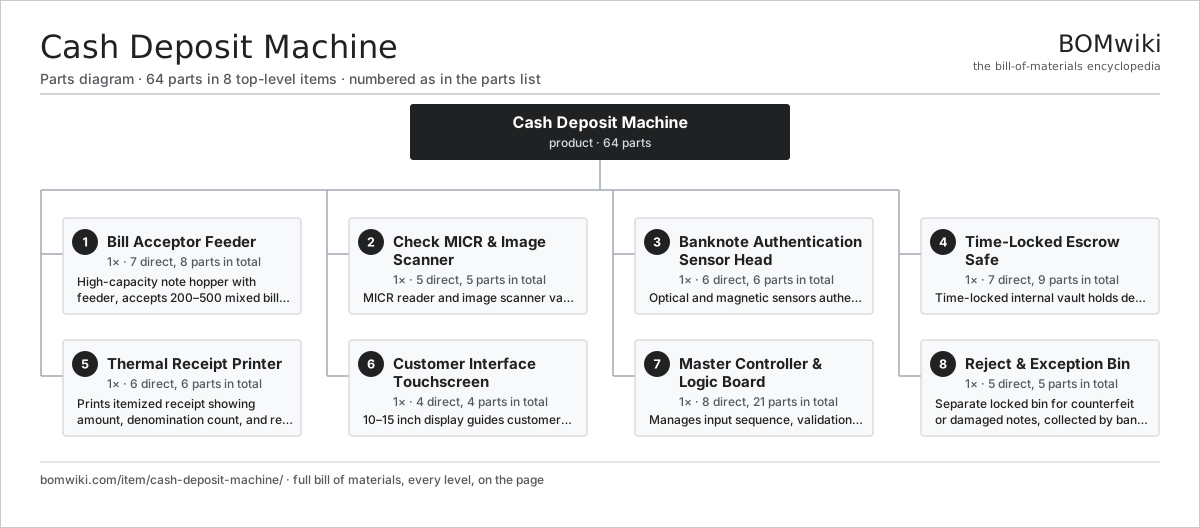
| # | Part | Qty | What it does |
|---|---|---|---|
| 1 | Bill Acceptor Feeder 7 parts | 1× | High-capacity note hopper with feeder, accepts 200–500 mixed bills per batch |
| 2 | Check MICR & Image Scanner 5 parts | 1× | MICR reader and image scanner validate check barcodes and route checks separately from cash |
| 3 | Banknote Authentication Sensor Head 6 parts | 1× | Optical and magnetic sensors authenticate each banknote before acceptance |
| 4 | Time-Locked Escrow Safe 7 parts | 1× | Time-locked internal vault holds deposits overnight, opened by bank staff only during daytime |
| 5 | Thermal Receipt Printer 6 parts | 1× | Prints itemized receipt showing amount, denomination count, and reference number |
| 6 | Customer Interface Touchscreen 4 parts | 1× | 10–15 inch display guides customer through deposit process step-by-step |
| 7 | Master Controller & Logic Board 8 parts | 1× | Manages input sequence, validation, escrow logic, audit logging, bank network sync |
| 8 | Reject & Exception Bin 5 parts | 1× | Separate locked bin for counterfeit or damaged notes, collected by bank staff |
3D model
No 3D model yet. Have a CAD file of this? Add a 3D model. STL renders right on this page; STEP, FreeCAD, and OpenSCAD sources are welcome too (openly licensed, like all 3D models on BOMwiki).
Build & assembly graph
expand / collapse · shared sub-assemblies converge · links to related products · est. labourTap an assembly to expand/collapse · tap a part to open it · use “Open page” for any node · drag to pan, scroll to zoom.
Bill of materials for Cash Deposit Machine
8 top-level lines · 56 rows shown · 64 parts total · indented to 3 levels| # | Item / sub-assembly | Part no. | Qty/assy | Ext. qty | Parts | Type |
|---|---|---|---|---|---|---|
| 1 | Bill Acceptor Feeder 7 parts | cash-deposit-machine-bill-acceptor | 1× | 1 | 8 | assembly |
| 1.1 | Hopper Bucket | cash-deposit-machine-hopper-bucket | 1× | 1 | · | part |
| 1.2 | Feed Wheel | cash-deposit-machine-feed-wheel | 1× | 1 | · | part |
| 1.3 | Separator Plate | cash-deposit-machine-separator-plate | 1× | 1 | · | part |
| 1.4 | Straightener Roller | cash-deposit-machine-straightener-roller | 2× | 2 | · | part |
| 1.5 | Feed Motor | cash-deposit-machine-feed-motor | 1× | 1 | · | part |
| 1.6 | Encoder | encoder | 1× | 1 | · | part |
| 1.7 | Fastener Set | fastener-set | 1× | 1 | · | part |
| 2 | Check MICR & Image Scanner 5 parts | cash-deposit-machine-check-scanner | 1× | 1 | 5 | assembly |
| 2.1 | Micr Reader | cash-deposit-machine-micr-reader | 1× | 1 | · | part |
| 2.2 | Check Camera | cash-deposit-machine-check-camera | 1× | 1 | · | part |
| 2.3 | Check Lighting | cash-deposit-machine-check-lighting | 1× | 1 | · | part |
| 2.4 | Bare PCB | pcb-bare | 1× | 1 | · | part |
| 2.5 | Connector | connector | 1× | 1 | · | part |
| 3 | Banknote Authentication Sensor Head 6 parts | cash-deposit-machine-validator-head | 1× | 1 | 6 | assembly |
| 3.1 | CMOS Image Sensor | image-sensor | 1× | 1 | · | part |
| 3.2 | Uv Led | cash-deposit-machine-uv-led | 1× | 1 | · | part |
| 3.3 | Mg Coil | cash-deposit-machine-mg-coil | 1× | 1 | · | part |
| 3.4 | Ir Detector | cash-deposit-machine-ir-detector | 1× | 1 | · | part |
| 3.5 | Bare PCB | pcb-bare | 1× | 1 | · | part |
| 3.6 | Connector | connector | 1× | 1 | · | part |
| 4 | Time-Locked Escrow Safe 7 parts | cash-deposit-machine-escrow-safe | 1× | 1 | 9 | assembly |
| 4.1 | Safe Body | cash-deposit-machine-safe-body | 1× | 1 | · | part |
| 4.2 | Safe Door | cash-deposit-machine-safe-door | 1× | 1 | · | part |
| 4.3 | Time Delay Lock | cash-deposit-machine-time-delay-lock | 1× | 1 | · | part |
| 4.4 | Solenoid Bolts | cash-deposit-machine-solenoid-bolts | 2× | 2 | · | part |
| 4.5 | Deposit Chute | cash-deposit-machine-deposit-chute | 1× | 1 | · | part |
| 4.6 | Tamper Switch | cash-deposit-machine-tamper-switch | 2× | 2 | · | part |
| 4.7 | Fastener Set | fastener-set | 1× | 1 | · | part |
| 5 | Thermal Receipt Printer 6 parts | cash-deposit-machine-receipt-printer | 1× | 1 | 6 | assembly |
| 5.1 | Thermal Head | cash-deposit-machine-thermal-head | 1× | 1 | · | part |
| 5.2 | Paper Roll | cash-deposit-machine-paper-roll | 1× | 1 | · | part |
| 5.3 | Paper Motor | cash-deposit-machine-paper-motor | 1× | 1 | · | part |
| 5.4 | Cutter Blade | cash-deposit-machine-cutter-blade | 1× | 1 | · | part |
| 5.5 | Paper Sensor | cash-deposit-machine-paper-sensor | 1× | 1 | · | part |
| 5.6 | Connector | connector | 1× | 1 | · | part |
| 6 | Customer Interface Touchscreen 4 parts | cash-deposit-machine-touchscreen | 1× | 1 | 4 | assembly |
| 6.1 | Lcd Panel | cash-deposit-machine-lcd-panel | 1× | 1 | · | part |
| 6.2 | Touch Digitizer | cash-deposit-machine-touch-digitizer | 1× | 1 | · | part |
| 6.3 | Lcd Controller | cash-deposit-machine-lcd-controller | 1× | 1 | · | part |
| 6.4 | Connector | connector | 1× | 1 | · | part |
| 7 | Master Controller & Logic Board 8 parts | cash-deposit-machine-control-board | 1× | 1 | 21 | assembly |
| 7.1 | Microcontroller | mcu | 1× | 1 | · | part |
| 7.2 | Bare PCB | pcb-bare | 2× | 2 | · | part |
| 7.3 | SMD Passive (R/C/L) | smd-passives | 1× | 1 | · | part |
| 7.4 | Power MOSFET | mosfet | 6× | 6 | · | part |
| 7.5 | Relay | relay | 3× | 3 | · | part |
| 7.6 | Rtc Module | safe-deposit-system-rtc-module | 1× | 1 | · | part |
| 7.7 | Connector | connector | 6× | 6 | · | part |
| 7.8 | Power Supply | power-supply | 1× | 1 | · | part |
| 8 | Reject & Exception Bin 5 parts | cash-deposit-machine-reject-safe | 1× | 1 | 5 | assembly |
| 8.1 | Reject Bin Body | cash-deposit-machine-reject-bin-body | 1× | 1 | · | part |
| 8.2 | Reject Bin Lock | cash-deposit-machine-reject-bin-lock | 1× | 1 | · | part |
| 8.3 | Reject Chute | cash-deposit-machine-reject-chute | 1× | 1 | · | part |
| 8.4 | Reject Counter Sensor | cash-deposit-machine-reject-counter-sensor | 1× | 1 | · | part |
| 8.5 | Fastener Set | fastener-set | 1× | 1 | · | part |
Something wrong in this list? Report a problem with this BOM.
Related products
same domain, ranked by shared parts Safe Deposit Box System
5,374 parts · shares 5 with this page
Drive-Through Teller Unit
178 parts · shares 5 with this page
Queue Ticket Dispenser
307 parts · shares 5 with this page
Safe Deposit Box System
5,374 parts · shares 5 with this page
Drive-Through Teller Unit
178 parts · shares 5 with this page
Queue Ticket Dispenser
307 parts · shares 5 with this page
Sourcing: possible vendors
Browse the supplier directory → Prices, MOQ, and lead times are algorithmic estimates, not quotes, and not claims about these companies. Company mappings are curated by keyword; est. price band $50–$15k. How estimates work| Vendor | HQ | Specialty | MOQ | Lead time |
|---|---|---|---|---|
|
🇯🇵Canon
canon.com ↗
|
Tokyo, JP | Imaging & optics | 500 units | 8–12 wks |
|
🇯🇵Ricoh
ricoh.com ↗
|
Tokyo, JP | Office imaging | 500 units | 8–12 wks |
|
🇺🇸Xerox
xerox.com ↗
|
Norwalk, US | Printers & copiers | 500 units | 8–12 wks |
|
🇯🇵Epson
epson.com ↗
|
Suwa, JP | Printers & projectors | 500 units | 8–12 wks |
|
🇯🇵Brother
brother.com ↗
|
Nagoya, JP | Printers & sewing | 500 units | 8–12 wks |
1,862-word article