POS Cash Drawer
ProductOverview
The POS (point-of-sale) cash drawer is an electromechanical money box designed to integrate seamlessly with a retail register or terminal. When a sale is completed, the POS system sends a pulse command to the drawer, which energizes a solenoid latch, releasing the till tray to slide outward on smooth ball-bearing rails. The cashier deposits payment, closes the drawer, and the mechanical spring resets the latch to the locked position. A position sensor confirms closure and relocks to the POS system, maintaining an accurate record of cash transactions.
Cash drawers are found in nearly every retail environment: grocery stores, restaurants, pharmacies, and ticketing windows. Beyond the obvious security benefit, the drawer's integration with the POS provides a tamper-evident audit trail, ensures accountability, and eliminates the need for a separate cash box or register bell.
How it works
Solenoid Actuation: When a customer transaction is completed and tendered, the POS terminal sends a control signal (typically a 12 V or 24 V pulse lasting 100–300 milliseconds) to the control electronics module. This pulse energizes the solenoid coil, which pulls a steel bolt out of its locked position in the enclosure.
Drawer Extension: With the bolt withdrawn, the till tray is no longer mechanically constrained. A spring-assisted mechanism or the natural inertia of the electromagnet pulse allows the tray to begin sliding outward on the ball-bearing rails. The smooth, low-friction bearings ensure that even light finger pressure extends the tray fully, and the drawer typically opens 10–14 inches.
Open Confirmation: A microswitch mounted in the latch frame closes when the drawer reaches its fully-open position, and this sensor signal is transmitted back to the POS system, logging the drawer opening event and timestamp for audit purposes.
Manual Closure and Re-locking: The cashier deposits cash into the appropriate bill compartment or coin cup, then manually pushes the drawer closed. As it retracts, the return spring resets the solenoid plunger, allowing the steel bolt to engage the locking slot again. Once fully closed, the bolt snaps into place, and the sensor sends a "closed and locked" signal back to the POS, completing the transaction cycle.
Multi-Statement Verification: Advanced POS systems can query the cash drawer's control board at any time to confirm lock status, allowing the system to refuse new transactions if the drawer is ajar or if a fault is detected. This prevents unauthorized opening and provides real-time inventory control.
Tray Organization
The till tray is removable for end-of-shift cash reconciliation. Tray designs typically feature:
- A large bill slot for flat paper currency
- Four or five coin cups for pennies, nickels, dimes, and quarters (in the U.S. context)
- A separate check or receipt slot
- A security cover (on some models) to prevent bills from spilling if the drawer is opened at an angle
High-volume retail environments sometimes use a dual-tray design: a primary tray for the shift and a secondary tray that is emptied periodically without disrupting sales.
Interface and Integration
Legacy Serial Interface: Older cash drawers communicated via RS-232 serial or parallel (Centronics) ports connected to a register or terminal. A typical command was an RJ-12 jack pin assignment with ground, 12 V power, and signal pins.
Modern USB and Proprietary: Contemporary systems often use USB directly or proprietary RJ-12 connectors with encrypted handshake protocols to improve security and reduce pinout confusion.
Daisy-Chaining: Some hospitality or quick-service environments use multiple cash drawers on a single terminal. Drawers support daisy-chaining via a second RJ-12 port, allowing a cascade of open commands to address each drawer in sequence.
Security Considerations
A typical cash drawer setup provides:
- Hardware Lock: Only the solenoid can open the drawer, and the key is in the POS system.
- Audit Trail: Every open/close event is timestamped and logged by the POS.
- Employee Accountability: Each register operator is associated with a login and thus with a drawer session.
- Tamper Evident: Forced prying or drilling typically breaks the latch spring or solenoid, disabling automatic locking and raising an alarm on the POS.
Security does not rely on the cash drawer alone. Retail environments implement multi-layer controls: camera surveillance, till reconciliation routines, exception reports (large cash removals), and regular audit audits.
Maintenance and Longevity
The ball-bearing rails are the most frequently serviced components. Over years of repeated opening and closing, bearings may accumulate dust or wear, leading to stiffness. Cleaning and light lubrication with machine oil or silicone spray restore smooth motion. The solenoid is electromagnetically rated for millions of cycles and rarely fails unless subjected to power spikes or moisture. The microswitch is the second most wear-prone part and is typically field-replaceable.
A well-maintained cash drawer can operate reliably for 5–10 years in retail environments with 1000+ open/close cycles per day.
Regional and Legacy Variations
Cash drawers vary by region:
- North American: Typically 18–20 inches wide, 4-compartment coin tray, bill slot for mixed denominations.
- European: Often narrower (16 inches), with 5-compartment coin trays to accommodate Euro denominations and 1- and 2-Euro coins.
- Japanese/Asian: Compact designs, 14–16 inches, with smaller bill compartments reflecting smaller currency sizes.
Many businesses have standardized on a particular brand and form factor, and replacement drawers can often be sourced as drop-in replacements from the same manufacturer.
POS Cash Drawer parts and their functions
6 top-level parts · 31 parts in total · full bill of materials below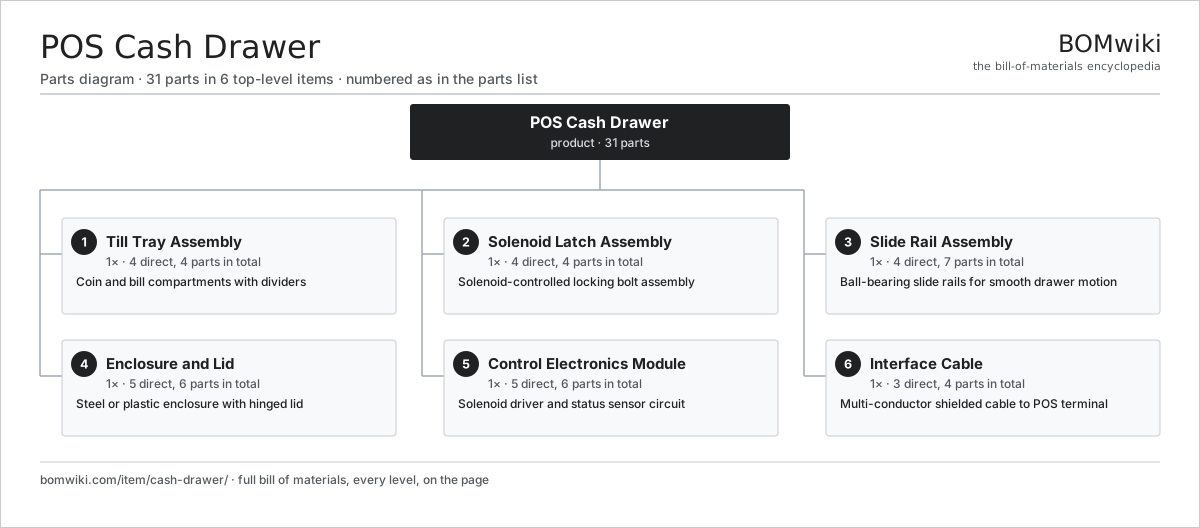
| # | Part | Qty | What it does |
|---|---|---|---|
| 1 | Till Tray Assembly 4 parts | 1× | Coin and bill compartments with dividers |
| 2 | Solenoid Latch Assembly 4 parts | 1× | Solenoid-controlled locking bolt assembly |
| 3 | Slide Rail Assembly 4 parts | 1× | Ball-bearing slide rails for smooth drawer motion |
| 4 | Enclosure and Lid 5 parts | 1× | Steel or plastic enclosure with hinged lid |
| 5 | Control Electronics Module 5 parts | 1× | Solenoid driver and status sensor circuit |
| 6 | Interface Cable 3 parts | 1× | Multi-conductor shielded cable to POS terminal |
3D model
No 3D model yet. Have a CAD file of this? Add a 3D model. STL renders right on this page; STEP, FreeCAD, and OpenSCAD sources are welcome too (openly licensed, like all 3D models on BOMwiki).
Build & assembly graph
expand / collapse · shared sub-assemblies converge · links to related products · est. labourTap an assembly to expand/collapse · tap a part to open it · use “Open page” for any node · drag to pan, scroll to zoom.
Bill of materials for POS Cash Drawer
6 top-level lines · 31 rows shown · 31 parts total · indented to 3 levels| # | Item / sub-assembly | Part no. | Qty/assy | Ext. qty | Parts | Type |
|---|---|---|---|---|---|---|
| 1 | Till Tray Assembly 4 parts | cash-drawer-till-tray | 1× | 1 | 4 | assembly |
| 1.1 | Bill Slot Assembly | cash-drawer-bill-compartment | 1× | 1 | · | part |
| 1.2 | Coin Dispenser Cups | cash-drawer-coin-cups | 1× | 1 | · | part |
| 1.3 | Cash Security Cover | cash-drawer-security-shield | 1× | 1 | · | part |
| 1.4 | Fastener Set | fastener-set | 1× | 1 | · | part |
| 2 | Solenoid Latch Assembly 4 parts | cash-drawer-latch-mechanism | 1× | 1 | 4 | assembly |
| 2.1 | Solenoid Lock Bolt | cash-drawer-solenoid-latch | 1× | 1 | · | part |
| 2.2 | Latch Return Spring | cash-drawer-latch-spring | 1× | 1 | · | part |
| 2.3 | Drawer Open Sensor | cash-drawer-position-sensor | 1× | 1 | · | part |
| 2.4 | Fastener Set | fastener-set | 1× | 1 | · | part |
| 3 | Slide Rail Assembly 4 parts | cash-drawer-roller-guides | 1× | 1 | 7 | assembly |
| 3.1 | Ball Bearing | ball-bearing | 4× | 4 | · | part |
| 3.2 | Linear Guide Rail | cash-drawer-rail-track | 1× | 1 | · | part |
| 3.3 | Bearing Carriage Block | cash-drawer-roller-carriage | 1× | 1 | · | part |
| 3.4 | Fastener Set | fastener-set | 1× | 1 | · | part |
| 4 | Enclosure and Lid 5 parts | cash-drawer-case | 1× | 1 | 6 | assembly |
| 4.1 | Cabinet Shell | cash-drawer-base-enclosure | 1× | 1 | · | part |
| 4.2 | Hinged Security Lid | cash-drawer-hinged-lid | 1× | 1 | · | part |
| 4.3 | Installation Bracket | cash-drawer-mounting-bracket | 1× | 1 | · | part |
| 4.4 | O-Ring Set | oring-set | 1× | 1 | · | part |
| 4.5 | Fastener Set | fastener-set | 2× | 2 | · | part |
| 5 | Control Electronics Module 5 parts | cash-drawer-interface-board | 1× | 1 | 6 | assembly |
| 5.1 | Bare PCB | pcb-bare | 1× | 1 | · | part |
| 5.2 | Relay | relay | 1× | 1 | · | part |
| 5.3 | Power Supply | power-supply | 1× | 1 | · | part |
| 5.4 | Connector | connector | 2× | 2 | · | part |
| 5.5 | Fastener Set | fastener-set | 1× | 1 | · | part |
| 6 | Interface Cable 3 parts | cash-drawer-cable-assembly | 1× | 1 | 4 | assembly |
| 6.1 | Wire Bundle | wire-bundle | 1× | 1 | · | part |
| 6.2 | Connector | connector | 2× | 2 | · | part |
| 6.3 | Fastener Set | fastener-set | 1× | 1 | · | part |
Something wrong in this list? Report a problem with this BOM.
Related products
same domain, ranked by shared parts Electric Typewriter
47 parts · shares 4 with this page
Electric Typewriter
47 parts · shares 4 with this page
 Pneumatic Tube Station
201 parts · shares 4 with this page
Pneumatic Tube Station
201 parts · shares 4 with this page
 Guillotine Paper Cutter
261 parts · shares 3 with this page
Produce Misting System
137 parts · shares 3 with this page
Postal Scale
35 parts · shares 2 with this page
Guillotine Paper Cutter
261 parts · shares 3 with this page
Produce Misting System
137 parts · shares 3 with this page
Postal Scale
35 parts · shares 2 with this page
 Motorized Projector Screen
52 parts · shares 1 with this page
Motorized Projector Screen
52 parts · shares 1 with this page
Sourcing: possible vendors
Browse the supplier directory → Prices, MOQ, and lead times are algorithmic estimates, not quotes, and not claims about these companies. Company mappings are curated by keyword; est. price band $50–$15k. How estimates work| Vendor | HQ | Specialty | MOQ | Lead time |
|---|---|---|---|---|
|
🇯🇵Canon
canon.com ↗
|
Tokyo, JP | Imaging & optics | 500 units | 8–12 wks |
|
🇯🇵Ricoh
ricoh.com ↗
|
Tokyo, JP | Office imaging | 500 units | 8–12 wks |
|
🇺🇸Xerox
xerox.com ↗
|
Norwalk, US | Printers & copiers | 500 units | 8–12 wks |
|
🇯🇵Epson
epson.com ↗
|
Suwa, JP | Printers & projectors | 500 units | 8–12 wks |
|
🇯🇵Brother
brother.com ↗
|
Nagoya, JP | Printers & sewing | 500 units | 8–12 wks |
995-word article