Catalytic Converter
ProductOverview
A catalytic converter is an emissions control device that chemically transforms harmful tailpipe pollutants (unburned hydrocarbons, carbon monoxide, and nitrogen oxides) into benign compounds (carbon dioxide, water, and nitrogen) using solid-state catalysis. Modern gasoline vehicles emit 90–99% fewer regulated pollutants than 1970s vehicles, largely due to catalytic converters. A typical car's catalytic converter processes 80,000–100,000 liters of exhaust gas daily (at highway cruise), continuously oxidizing and reducing pollutants at high temperatures (300–600°C) without being consumed.
The converter is a precision stainless steel can containing a porous ceramic honeycomb monolith coated with a thin layer of precious metals (platinum, palladium, rhodium) dispersed on an aluminum oxide support. Exhaust gas flows through the monolith's thousands of small channels, allowing pollutant molecules to diffuse through the ceramic walls and react with the catalyst surface.
How It Works
Hot exhaust gas (500–600°C) from the engine enters the catalytic converter at the Inlet Diffuser Cone, a conical diffuser that spreads high-velocity jets evenly across the Ceramic Monolith Substrate inlet face to ensure uniform flow distribution.
The monolith is a ceramic block (cordierite or alumina) with a honeycomb structure: thousands of parallel small square or hexagonal channels running the length of the monolith (75–150 mm). Channel walls are just 0.1–0.2 mm thick, creating enormous internal surface area, a single liter of monolith may have 100–350 m² of surface.
The Catalytic Washcoat is a thin (10–50 micron) porous coating of aluminum oxide (Al₂O₃) and precious metals applied to the monolith channel walls. Platinum (Pt), palladium (Pd), and rhodium (Rh) are the active catalyst species. Typical loading: 0.5–2 g of Pt and Pd per liter of core, and 0.02–0.2 g of Rh.
As exhaust gas flows through the monolith channels at 2–10 m/s, pollutant molecules (CO, unburned CₙHₓ, NOx) diffuse through the porous washcoat and contact the precious metal surface. Three parallel reactions occur:
Oxidation (HC and CO to CO₂ and H₂O): Hydrocarbon + O₂ → CO₂ + H₂O (over Pt or Pd catalyst) CO + 0.5 O₂ → CO₂ (over Pt catalyst)
Reduction (NOx to N₂): NO + 0.5 H₂ → 0.5 N₂ + 0.5 H₂O (over Rh catalyst, requires reductant)
The oxygen-storage function (cerium oxide promoter): When exhaust is rich (insufficient O₂), cerium oxide (CeO₂) in the washcoat absorbs oxygen from NO, generating N₂ and storing oxygen. When exhaust turns lean (excess O₂), CeO₂ releases stored oxygen, oxidizing CO and HC.
This dual oxidation-reduction mechanism is enabled by the engine control unit (ECU) carefully oscillating the fuel-air ratio around stoichiometric (λ = 1) at 1–10 Hz. By keeping the mixture near stoichiometric, the converter always has both reductants (for NOx) and oxidants (for CO/HC) present, maximizing conversion efficiency.
Once gas passes through the monolith, reduced pollutant concentrations emerge at the Outlet Collection Cone, a convergent outlet that collects flow and directs it toward the muffler, reducing backpressure.
Catalyst Light-Off and Thermal Cycling
The precious metal catalysts are slow to activate when cold. "Light-off" temperature is the exhaust temperature at which conversion efficiency reaches 50%. Typical light-off:
- CO: 200–250°C
- HC: 300–350°C
- NOx: 200–300°C (under reducing conditions)
A cold-started engine produces 10–20 times higher emissions during the first 30–60 seconds (light-off phase) than during warm operation. Modern vehicles use electrical heater elements in the exhaust manifold or upstream of the catalytic converter, reducing cold-start emissions by 20–30%.
Thermal cycling is brutal: the converter may swing from 50°C (cold soak after overnight parking) to 800°C (loaded acceleration) in seconds. The ceramic monolith has low thermal conductivity and expands/contracts differently than the stainless steel shell, creating stress. Modern monoliths use low-thermal-expansion materials (cordierite, specifically engineered to ~5×10⁻⁶ m/m·K) to minimize thermal shock.
Oxygen Sensor Feedback
Two Oxygen Sensor Ports (upstream and downstream O2 sensor ports) allow the ECU to monitor catalytic efficiency in real time. The upstream sensor (before catalyst) measures exhaust composition. The downstream sensor (after catalyst) measures residual oxygen. If conversion is working, the downstream sensor signals should show reduced oxygen and pollutant content relative to upstream.
If the converter degrades (clogging, catalyst poisoning, internal monolith fracture), the downstream sensor signal becomes identical to the upstream signal, triggering an emissions fault code and "Check Engine" light.
Failure Modes and Poisoning
Thermal damage: Severe overheating (from running rich, oil burning, or continuous high-load operation) can melt the ceramic monolith, causing structural collapse and blockage.
Catalyst poisoning: Phosphorus (from engine oil additives), sulfur (from fuel), lead (from contaminated fuel), and silicone (from leaking coolant or sealants) bond to the precious metal surface, blocking active sites. Once poisoned, the catalyst is permanently damaged.
Monolith fracture: Thermal shock or physical impact can crack the ceramic honeycomb, causing pieces to dislodge into the exhaust system downstream. A fractured converter loses structural integrity and flow distribution.
Clogging: Carbon deposits, soot (from cold starting or incomplete combustion), or mechanical debris (valve material, piston fragments) accumulate in channels, increasing backpressure and restricting flow. Heavy clogging reduces engine power (backpressure >50 kPa) and triggers a fault code.
Corrosion: 409L stainless steel can corrode from salt spray (in coastal regions) or sulfuric acid formation (from sulfur in fuel and water vapor in exhaust at cold idle). Aluminized 409L resists corrosion better.
Monitoring and Onboard Diagnostics
Modern vehicles perform on-board diagnostics (OBD) comparing upstream and downstream O2 sensor response. A slow downstream sensor signal (indicating poor conversion) triggers a "Catalyst System Efficiency Below Threshold" code (P0420). This forces the vehicle into limp-home mode (reduced power, higher emissions) and requires replacement.
Some OBD systems monitor catalytic temperature, detecting excessive heat (combustion occurring inside the converter due to unburned fuel from engine misfires or rich running) and flagging overtemp faults.
Regulations and Historical Context
Catalytic converters became mandatory in the United States in 1974 (mid-year models). Three-way converters (simultaneous reduction of NOx and oxidation of HC/CO) appeared in 1981 with closed-loop feedback control. Euro standards (implemented 1992 in Europe, 2000+ globally) progressively tightened NOx, HC, and particulate limits, driving catalytic converter efficiency and complexity higher.
Modern gasoline vehicles emit 5–20 mg/km of NOx and 10–50 mg/km HC+NOx (Euro 6d); 1970s vehicles emitted 1000–2000 mg/km. Catalytic converters are responsible for ~80% of this improvement.
Diesel catalytic converters differ: they use lean NOx reduction (LNR) catalysts with urea (AdBlue) injection or passive NOx adsorbers (PNA), since diesel exhaust is typically very lean (excess O₂) and cannot achieve stoichiometric oscillation.
Precious Metal Cost and Recycling
Platinum group metals (Pt, Pd, Rh) are extremely expensive: ~$60/g for Pt, $20/g for Pd, $150/g for Rh (prices fluctuate). A single catalytic converter contains $500–$2000 in precious metals, making converters theft targets and spurring recycling industries that recover 95%+ of precious metals from spent converters.
Scrap value has driven converter theft; thieves steal catalytic converters from parked vehicles in seconds using a battery-powered saw, reselling the recycled metals. Protective shields and replacement catalytic converter theft devices (such as cages) have become common anti-theft measures.
Catalytic Converter parts and their functions
8 top-level parts · 17 parts in total · full bill of materials below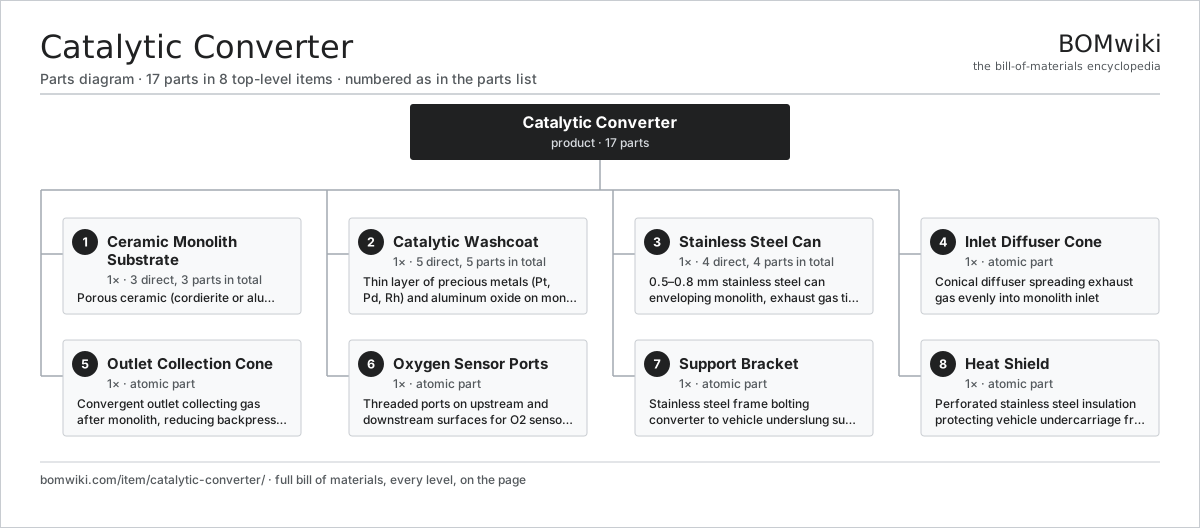
| # | Part | Qty | What it does |
|---|---|---|---|
| 1 | Ceramic Monolith Substrate 3 parts | 1× | Porous ceramic (cordierite or alumina) honeycomb substrate supporting catalyst |
| 2 | Catalytic Washcoat 5 parts | 1× | Thin layer of precious metals (Pt, Pd, Rh) and aluminum oxide on monolith surface |
| 3 | Stainless Steel Can 4 parts | 1× | 0.5–0.8 mm stainless steel can enveloping monolith, exhaust gas tight |
| 4 | Inlet Diffuser Cone | 1× | Conical diffuser spreading exhaust gas evenly into monolith inlet |
| 5 | Outlet Collection Cone | 1× | Convergent outlet collecting gas after monolith, reducing backpressure |
| 6 | Oxygen Sensor Ports | 1× | Threaded ports on upstream and downstream surfaces for O2 sensors |
| 7 | Support Bracket | 1× | Stainless steel frame bolting converter to vehicle underslung support |
| 8 | Heat Shield | 1× | Perforated stainless steel insulation protecting vehicle undercarriage from radiant heat |
3D model
No 3D model yet. Have a CAD file of this? Add a 3D model. STL renders right on this page; STEP, FreeCAD, and OpenSCAD sources are welcome too (openly licensed, like all 3D models on BOMwiki).
Build & assembly graph
expand / collapse · shared sub-assemblies converge · links to related products · est. labourTap an assembly to expand/collapse · tap a part to open it · use “Open page” for any node · drag to pan, scroll to zoom.
Bill of materials for Catalytic Converter
8 top-level lines · 20 rows shown · 17 parts total · indented to 3 levels| # | Item / sub-assembly | Part no. | Qty/assy | Ext. qty | Parts | Type |
|---|---|---|---|---|---|---|
| 1 | Ceramic Monolith Substrate 3 parts | catalytic-converter-monolith | 1× | 1 | 3 | assembly |
| 1.1 | Monolith Ceramic Block | catalytic-converter-monolith-body | 1× | 1 | · | part |
| 1.2 | Honeycomb Cell Array | catalytic-converter-cell-structure | 1× | 1 | · | part |
| 1.3 | Ceramic Porosity | catalytic-converter-porosity | 1× | 1 | · | part |
| 2 | Catalytic Washcoat 5 parts | catalytic-converter-washcoat | 1× | 1 | 5 | assembly |
| 2.1 | Platinum Catalyst | catalytic-converter-precious-metal-platinum | 1× | 1 | · | part |
| 2.2 | Palladium Catalyst | catalytic-converter-precious-metal-palladium | 1× | 1 | · | part |
| 2.3 | Rhodium Catalyst | catalytic-converter-precious-metal-rhodium | 1× | 1 | · | part |
| 2.4 | Alumina Support | catalytic-converter-aluminum-oxide | 1× | 1 | · | part |
| 2.5 | Cerium Oxide Promoter | catalytic-converter-cerium-oxide | 1× | 1 | · | part |
| 3 | Stainless Steel Can 4 parts | catalytic-converter-stainless-shell | 1× | 1 | 4 | assembly |
| 3.1 | Stainless Can Body | catalytic-converter-shell-body | 1× | 1 | · | part |
| 3.2 | Inlet Mounting Flange | catalytic-converter-inlet-flange | 1× | 1 | · | part |
| 3.3 | Outlet Mounting Flange | catalytic-converter-outlet-flange | 1× | 1 | · | part |
| 3.4 | Shell Seam Welds | catalytic-converter-shell-weld | 1× | 1 | · | part |
| 4 | Inlet Diffuser Cone | catalytic-converter-inlet-cone | 1× | 1 | · | part |
| 5 | Outlet Collection Cone | catalytic-converter-outlet-cone | 1× | 1 | · | part |
| 6 | Oxygen Sensor Ports | catalytic-converter-oxygen-sensor-bungs | 1× | 1 | · | part |
| 7 | Support Bracket | catalytic-converter-mounting-bracket | 1× | 1 | · | part |
| 8 | Heat Shield | catalytic-converter-heat-shield | 1× | 1 | · | part |
Something wrong in this list? Report a problem with this BOM.
Sourcing: possible vendors
Browse the supplier directory → Prices, MOQ, and lead times are algorithmic estimates, not quotes, and not claims about these companies. Company mappings are curated by keyword; est. price band $8k–$90k. How estimates work| Vendor | HQ | Specialty | MOQ | Lead time |
|---|---|---|---|---|
|
🇯🇵Toyota
global.toyota ↗
|
Toyota City, JP | Automaker | made to order | 16–28 wks |
| volkswagen-group.com ↗ | Wolfsburg, DE | Automaker | made to order | 16–28 wks |
| gm.com ↗ | Detroit, US | Automaker | made to order | 16–28 wks |
| hyundai.com ↗ | Seoul, KR | Automaker | made to order | 16–28 wks |
|
🇨🇳BYD
byd.com ↗
|
Shenzhen, CN | EV & battery manufacturer | made to order | 16–28 wks |
1,214-word article