Catch Sorting Conveyor
ProductOverview
A catch sorting conveyor is a motorized processing table used on commercial fishing vessels to grade, wash, and sort fresh fish immediately after haul. The machine consists of a stainless steel or rubber-faced conveyor belt (60–100 cm wide, 4–6 m long) driven by a 3–5 hp electric motor through a gearbox. The belt surface speed is adjustable (0.2–1.5 m/s) to match fish throughput and processing flow.
Key features include a pair of Grading Roller Assembly (adjustable 50 mm diameter, variable spacing) positioned on the belt surface that divide fish by length, smaller fish drop through to a lower chute, larger ones ride over. A Wash Pump (20–50 L/min) circulates seawater or fresh water via Spray Nozzle (conical fog pattern) to rinse slime, scales, and blood from the catch. A Drain System below the belt collects wash water and debris, directing it overboard via a Drain Valve.
The system is mounted on a structural Frame Structure integrated with the vessel's hold superstructure or deck processing area. Crew stand on both sides of the conveyor, manually extracting fish at various points along the belt path or allowing sorted product to discharge into collection bins. Belt speed is controlled via a variable-frequency drive (VFD) inverter or simple gearbox ratio selection.
How It Works
Fish input: Fresh catch from a Power Block haul or net discharge is poured or scooped onto the conveyor belt inlet. Crew or conveyor hopper guides fish onto the moving belt at adjustable flow rate (typically 100–500 kg per minute, depending on vessel operations).
Wash phase: As fish move along the belt, Spray Nozzle delivers seawater or fresh-water fog onto the fish surface. The water rinses away slime, blood, scales, and viscera, improving fish appearance and marketability. Crew may use hand-held soft brushes to lightly scrub large fish (tuna) to improve surface quality.
Grading phase: Fish pass over the Grading Roller Assembly, two parallel, adjustable-gap rollers (typically 100–120 mm spacing for tuna sorting). Small or deformed fish drop through the gap below the belt, falling into a separate lower chute. Large premium fish ride over the top and continue along the belt to the discharge end.
Discharge and collection: At the belt discharge end, crew remove fish by hand and place them into collection bins or trays (segregated by grade). Alternatively, the belt discharge may route directly into a larger collection tank or cooler for immediate ice-packing.
Drain and recovery: Water and debris fall through the perforated grate below the conveyor into the Drain System sump. Periodically (or automatically via timer), the Drain Valve opens, and the accumulated liquid (containing blood, scales, and dissolved proteins) drains overboard.
Speed modulation: The operator can adjust belt surface speed (0.2–1.5 m/s) via the gearbox ratio or VFD frequency control. Slower speeds (0.5 m/s) allow more thorough washing and crew pick-off time; faster speeds (1.2 m/s) maximize throughput when processing peak catch volumes.
Typical Fishing Vessel Integration
Purse-seine tuna vessel: A 50 m vessel with twin power blocks (see Power Block) may land 20–50 tonnes per haul. The catch-sorting conveyor processes 5–15 tonnes/hour, allowing 2–4 hour processing window post-haul. Crew of 4–5 stand beside the conveyor, segregating by size and quality (premium grade, medium, damaged, reject). Premium tuna (grade 1, whole-body integrity, good coloration) are ice-packed and flash-frozen for sashimi export ($15–$30/kg wholesale); medium grade fish go to canning processing.
Longline trawler: A bottom-trawl vessel hauling a mixed demersal catch (cod, halibut, haddock, pollock) may use the conveyor to segregate by species and size. Undersized fish (below market minimum) are rejected overboard per regulations; market-sized fish are binned by species and packed on ice.
Seine-net pelagic vessel: Sardine, anchovy, or mackerel catches (1000+ kg per haul) are processed rapidly through the conveyor at maximum speed (1.5 m/s), with minimal grading (simply rinsed and discharged into chilled hold tanks). High throughput is prioritized over quality segregation.
Design Variants
Single-stage conveyor: Small vessels use a simple flat belt with no grading rollers, relying entirely on manual crew sorting. This is slower but less capital-intensive.
Multi-stage cascading: Large factory-ships use 2–3 cascading conveyors in series, with grading at each stage, progressively segregating catch by size and quality into 5–6 bins.
Automatic segregation (advanced): AI-vision systems mounted above the belt can identify fish species, size, and quality, directing air-jet puffs to push desired grades into different discharge chutes. These systems are expensive (>$100,000) and are found only on premium industrial vessels.
Filleting integration: Some land-based or shore-based processing facilities integrate filleting machinery immediately after the grading conveyor, automating the entire fresh-fish-to-fillet process on a single line.
Maintenance and Operational Considerations
Belt tracking: The conveyor belt must track straight along the center line of the drive and tail rollers. Misalignment causes edge wear and fish spillage. Weekly visual inspection and monthly tension adjustment (via tensioner idler) prevent this issue.
Water quality: Seawater used for wash phase must be clean and cold (0–5°C). In warm climate ports, vessel operators may use refrigerated fresh water instead. Salt spray buildup on the frame is controlled by weekly fresh-water rinse.
Blade sharpness: Any cutting blades (if integrated into conveyor for automated filleting) must be razor-sharp. Dull blades crush rather than cut fish, leading to poor presentation and rapid spoilage.
Motor thermal load: Continuous operation (1–3 hours per processing session) at full capacity may heat the 3–5 hp motor above safe limits. Most protocols include 10–15 minute rest breaks between haul cycles to allow motor cooling.
Grading roller adjustment: The spacing and pressure of Grading Roller Assembly must be precisely tuned to the target fish size. Operators typically carry shim plates or turn adjustable bolts to fine-tune the gap for the day's expected catch.
Regulatory Considerations
Size compliance: Many fisheries enforce minimum market size limits; juvenile fish must be rejected (returned to sea). The grading conveyor is often the enforcement point, undersized fish are physically separated and discarded. Vessel observers or electronic monitoring cameras verify compliance at the grading stage.
Discard impact: Rejected undersized fish are typically dead or dying at this point (crushed, bruised from net haul, or asphyxiated). Some jurisdictions mandate live-release chutes for sensitive species (e.g., juvenile halibut), leading to specialized conveyor designs with gentler handling.
Labeling and traceability: Modern conveyors include RFID or barcode scanners to tag fish bins with catch date, location, and quota block. This data is transmitted to shore authorities for real-time stock monitoring.
Environmental and Economic Impact
Efficient fish processing (washing, grading, immediate icing) extends product shelf-life by 50–100% vs. crude hold stowage. This improves market value (+5–15% price) and reduces spoilage waste. For pelagic species destined for fishmeal (low value, $300–500/tonne), the slight quality improvement is less economically significant than for high-value species (tuna, halibut, $5000–30,000/tonne) where processing quality directly impacts export revenue.
Environmental benefit: graded discard streams (undersized or damaged fish) can be diverted to fishmeal plants rather than dumped, reducing bycatch waste.
Safety Hazards
Pinch points: The conveyor belt and grading rollers create pinch hazards. Guard rails and warning signs mark the working area. Crew are trained to keep hands clear during operation.
Entanglement: Long hair or loose clothing can be caught in moving belt sections. Crew wear tight-fitting attire and secured headwear.
Electrical hazard: The 3-phase motor and VFD inverter are high-voltage (400 VAC). Only qualified electricians service electrical components.
Slip hazard: The deck around the conveyor becomes wet and slippery. Crew wear non-skid boots; the deck is hosed down and swabbed after each processing session.
Catch Sorting Conveyor parts and their functions
8 top-level parts · 95 parts in total · full bill of materials below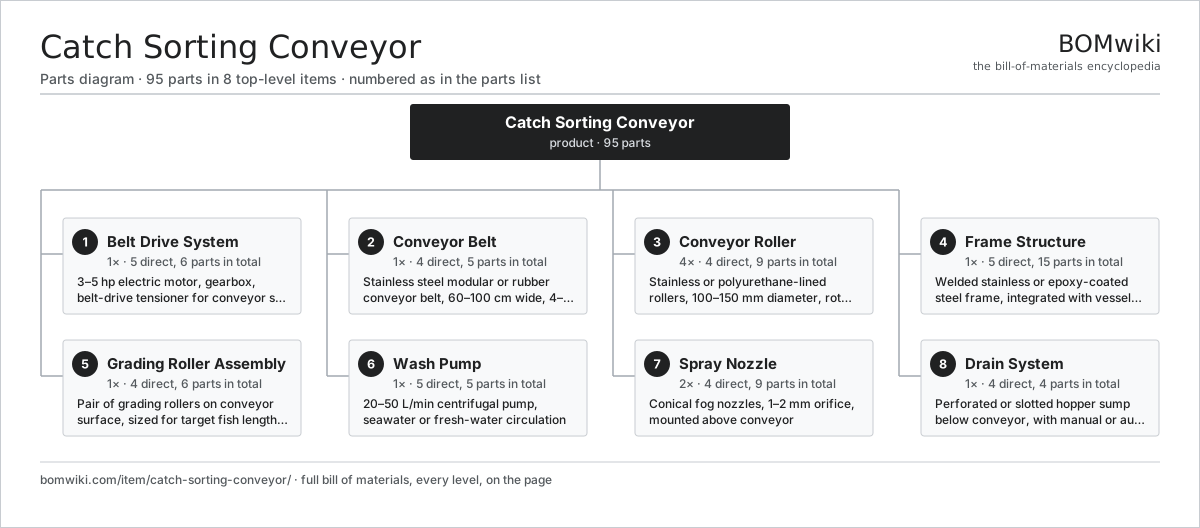
| # | Part | Qty | What it does |
|---|---|---|---|
| 1 | Belt Drive System 5 parts | 1× | 3–5 hp electric motor, gearbox, belt-drive tensioner for conveyor speed control |
| 2 | Conveyor Belt 4 parts | 1× | Stainless steel modular or rubber conveyor belt, 60–100 cm wide, 4–6 m long |
| 3 | Conveyor Roller 4 parts | 4× | Stainless or polyurethane-lined rollers, 100–150 mm diameter, rotating shafts |
| 4 | Frame Structure 5 parts | 1× | Welded stainless or epoxy-coated steel frame, integrated with vessel hold or standalone module |
| 5 | Grading Roller Assembly 4 parts | 1× | Pair of grading rollers on conveyor surface, sized for target fish length, pressure-adjustable |
| 6 | Wash Pump 5 parts | 1× | 20–50 L/min centrifugal pump, seawater or fresh-water circulation |
| 7 | Spray Nozzle 4 parts | 2× | Conical fog nozzles, 1–2 mm orifice, mounted above conveyor |
| 8 | Drain System 4 parts | 1× | Perforated or slotted hopper sump below conveyor, with manual or automatic valve |
3D model
No 3D model yet. Have a CAD file of this? Add a 3D model. STL renders right on this page; STEP, FreeCAD, and OpenSCAD sources are welcome too (openly licensed, like all 3D models on BOMwiki).
Build & assembly graph
expand / collapse · shared sub-assemblies converge · links to related products · est. labourTap an assembly to expand/collapse · tap a part to open it · use “Open page” for any node · drag to pan, scroll to zoom.
Bill of materials for Catch Sorting Conveyor
8 top-level lines · 43 rows shown · 95 parts total · indented to 3 levels| # | Item / sub-assembly | Part no. | Qty/assy | Ext. qty | Parts | Type |
|---|---|---|---|---|---|---|
| 1 | Belt Drive System 5 parts | catch-sorting-conveyor-belt-drive | 1× | 1 | 6 | assembly |
| 1.1 | Drive Motor | catch-sorting-conveyor-motor | 1× | 1 | · | part |
| 1.2 | Gearbox | catch-sorting-conveyor-gearbox | 1× | 1 | · | part |
| 1.3 | Drive Belt | catch-sorting-conveyor-drive-belt | 1× | 1 | · | part |
| 1.4 | Belt Pulley | catch-sorting-conveyor-belt-pulley | 2× | 2 | · | part |
| 1.5 | Belt Tensioner | catch-sorting-conveyor-belt-tensioner | 1× | 1 | · | part |
| 2 | Conveyor Belt 4 parts | catch-sorting-conveyor-belt | 1× | 1 | 5 | assembly |
| 2.1 | Belt Segment | catch-sorting-conveyor-belt-segment | 1× | 1 | · | part |
| 2.2 | Head Sprocket | catch-sorting-conveyor-head-sprocket | 1× | 1 | · | part |
| 2.3 | Tail Sprocket | catch-sorting-conveyor-tail-sprocket | 1× | 1 | · | part |
| 2.4 | Belt Edge Rail | catch-sorting-conveyor-belt-edge-rail | 2× | 2 | · | part |
| 3 | Conveyor Roller 4 parts | catch-sorting-conveyor-roller | 4× | 4 | 9 | assembly |
| 3.1 | Roller Barrel | catch-sorting-conveyor-roller-barrel | 2× | 8 | · | part |
| 3.2 | Roller Shaft | catch-sorting-conveyor-roller-shaft | 2× | 8 | · | part |
| 3.3 | Ball Bearing | ball-bearing | 4× | 16 | · | part |
| 3.4 | Fastener Set | fastener-set | 1× | 4 | · | part |
| 4 | Frame Structure 5 parts | catch-sorting-conveyor-frame | 1× | 1 | 15 | assembly |
| 4.1 | Frame Beam | catch-sorting-conveyor-frame-beam | 4× | 4 | · | part |
| 4.2 | Frame Base Plate | catch-sorting-conveyor-frame-plate | 2× | 2 | · | part |
| 4.3 | Bearing Seat | catch-sorting-conveyor-bearing-seat | 4× | 4 | · | part |
| 4.4 | Vibration Damper | catch-sorting-conveyor-vibration-damper | 4× | 4 | · | part |
| 4.5 | Fastener Set | fastener-set | 1× | 1 | · | part |
| 5 | Grading Roller Assembly 4 parts | catch-sorting-conveyor-grading-rollers | 1× | 1 | 6 | assembly |
| 5.1 | Grading Roller Pair | catch-sorting-conveyor-grading-roller-pair | 1× | 1 | · | part |
| 5.2 | Grading Mounting Block | catch-sorting-conveyor-grading-mounting-block | 1× | 1 | · | part |
| 5.3 | Grading Adjustable Bolt | catch-sorting-conveyor-grading-adjustable-bolt | 2× | 2 | · | part |
| 5.4 | Grading Bearing | catch-sorting-conveyor-grading-bearing | 2× | 2 | · | part |
| 6 | Wash Pump 5 parts | catch-sorting-conveyor-wash-pump | 1× | 1 | 5 | assembly |
| 6.1 | Pump Motor | catch-sorting-conveyor-pump-motor | 1× | 1 | · | part |
| 6.2 | Pump Impeller | catch-sorting-conveyor-pump-impeller | 1× | 1 | · | part |
| 6.3 | Pump Casing | catch-sorting-conveyor-pump-casing | 1× | 1 | · | part |
| 6.4 | Pump Strainer | catch-sorting-conveyor-pump-strainer | 1× | 1 | · | part |
| 6.5 | Pump Check Valve | catch-sorting-conveyor-pump-check-valve | 1× | 1 | · | part |
| 7 | Spray Nozzle 4 parts | catch-sorting-conveyor-spray-nozzle | 2× | 2 | 9 | assembly |
| 7.1 | Nozzle Cone | catch-sorting-conveyor-nozzle-cone | 2× | 4 | · | part |
| 7.2 | Nozzle Bracket | catch-sorting-conveyor-nozzle-bracket | 2× | 4 | · | part |
| 7.3 | Nozzle Hose | catch-sorting-conveyor-nozzle-hose | 1× | 2 | · | part |
| 7.4 | Nozzle Hose Clamp | catch-sorting-conveyor-nozzle-hose-clamp | 4× | 8 | · | part |
| 8 | Drain System 4 parts | catch-sorting-conveyor-drain-system | 1× | 1 | 4 | assembly |
| 8.1 | Drain Sump | catch-sorting-conveyor-drain-sump | 1× | 1 | · | part |
| 8.2 | Drain Grate | catch-sorting-conveyor-drain-grate | 1× | 1 | · | part |
| 8.3 | Drain Valve | catch-sorting-conveyor-drain-valve | 1× | 1 | · | part |
| 8.4 | Drain Hose | catch-sorting-conveyor-drain-hose | 1× | 1 | · | part |
Something wrong in this list? Report a problem with this BOM.
Sourcing: possible vendors
Browse the supplier directory → Prices, MOQ, and lead times are algorithmic estimates, not quotes, and not claims about these companies. Company mappings are curated by keyword; est. price band $2k–$500M. How estimates work| Vendor | HQ | Specialty | MOQ | Lead time |
|---|---|---|---|---|
| hd.com ↗ | Ulsan, KR | Shipbuilder | made to order | 52–104 wks |
| fincantieri.com ↗ | Trieste, IT | Shipbuilder | made to order | 52–104 wks |
| damen.com ↗ | Gorinchem, NL | Shipbuilder | made to order | 52–104 wks |
| brunswick.com ↗ | Mettawa, US | Marine & boats | made to order | 52–104 wks |
|
🇨🇳CSSC
cssc.net.cn ↗
|
Shanghai, CN | Shipbuilding conglomerate | made to order | 52–104 wks |
1,350-word article