CD Duplicator Tower
ProductOverview
A CD duplicator tower is an automated optical media duplication system that produces multiple CD or DVD copies from a single master image. The tower stacks four to eight optical burner drives (CD/DVD writers) vertically or horizontally, controlled by a Controller Board (Main Logic) that synchronizes reads from a Master Optical Drive (CD/DVD Reader) with simultaneous writes across all Slave Burner Drive (CD/DVD Writer)s.
Unlike older one-at-a-time standalone burners, a tower can produce 16–32 CDs per hour by burning multiple copies in parallel. The master image is cached on a Hard Drive (Master Image Storage) so that the master optical disc can be read once (or multiple times for large runs) and then the image is replayed to each burner, eliminating per-disc read delays.
How it works
The operator loads a blank CD-R into the tower's media drawer for each burner slot and inserts the master CD into the master drive. The Main CPU controller firmware initiates the duplication sequence: the Master Optical Drive (CD/DVD Reader) begins spinning and reading the master CD via a Laser Diode (Read) (a low-power semiconductor laser operating at 650 nm, the red wavelength).
The Laser Diode (Read) reads pit patterns on the CD (the data is encoded as a series of pits and lands, or flat surfaces, on the disc surface). A Optical Assembly assembly focuses the laser onto the pit layer, and the reflected light is sensed by a photodiode; changes in reflectivity as pits pass under the beam produce an RF (radio frequency) signal that is amplified by a RF Preamplifier.
This RF signal passes through error correction and decoding stages in the Controller Board (Main Logic), converting the pit pattern back into binary data (the original audio, video, or software). The DMA Controller transfers this data at high speed to the Buffer RAM (256 MB–1 GB of SDRAM), which acts as a buffer. Once a complete image or chunk is buffered, the Main CPU simultaneously writes this data to all four (or eight) Slave Burner Drive (CD/DVD Writer)s.
Each Slave Burner Drive (CD/DVD Writer) is a standard CD/DVD writer. The Laser Diode (Write) is a much more powerful laser than the master drive's (100–400 mW vs. < 5 mW), capable of melting the polycarbonate dye layer on a CD-R blank. As the blank media rotates under the focused laser beam, the laser is modulated on and off by the Laser Driver IC to create pits and lands that encode the data. The Optical Assembly include an AO (acousto-optic) modulator that adjusts laser power in real-time to optimize write quality.
All burner drives are synchronized to the same speed (typically 16×–24× for CDs, meaning the physical data rate is 16–24 times the normal playback rate of 1.4 MB/s). The SATA Controller IC manages the SATA links to each drive, ensuring data distribution is even and no burner waits for buffered data.
Once all burners have written their discs (typically 2–5 minutes per CD, or 8–15 minutes per DVD), the controller signals that the burn is complete, and the operator ejects all finished discs and inserts new blanks for the next batch.
Master image caching
The Hard Drive (Master Image Storage) stores a local copy of the master image. This allows:
- Faster throughput: The master CD is read once (or a few times for very large runs), then the cached image on the HDD is fed to all burners.
- Reduced wear: Repeated access to the master CD (which is an original, irreplaceable disc) is minimized.
- Batch processing: Multiple batches of blanks can be burned from the same cached image without re-inserting the master.
Media types and compatibility
Modern towers support multiple media formats:
- CD-R (CD-Recordable): Write-once, read many times; dye layer becomes pits when heated by the laser.
- CD-RW (CD-ReWritable): Reusable; uses phase-change material that can be reset.
- DVD-R / DVD+R: Single-layer DVDs, larger capacity (4.7 GB vs. 700 MB for CDs).
- DVD-RW / DVD+RW: Rewritable DVDs.
The Laser Diode (Write) wavelength is the same for CD-R and early DVDs (650 nm), but power levels and modulation frequencies differ. Modern burners can auto-detect the media type and adjust laser power and timing accordingly.
Error correction and quality
CD and DVD data includes Reed-Solomon error correction codes that allow recovery of corrupted bits. The Controller Board (Main Logic) implements error correction during both reading (from the master) and writing (to the blanks), ensuring high fidelity even if the optical paths are slightly misaligned or the blank media has minor defects.
Quality metrics include:
- BLER (Block Error Rate): Errors per second; good CDs have BLER < 10.
- Jitter: Timing variations in the pit edges; high jitter causes data corruption and playback glitches.
- Reflectivity: The ratio of light reflected from the pit surface vs. the land surface; too low and the laser cannot read clearly.
Professional duplicators measure these metrics on sample CDs from each batch, using a LCD Display to alert operators to quality drift.
Thermal considerations
The Laser Diode (Write) generates significant heat, especially when running at high power for extended burns. The Cooling Fan circulates air through the tower to prevent heat buildup. Poor cooling can cause the laser wavelength to drift, reducing write quality, or thermal shutdowns that interrupt burns. Larger towers (with 6–8 burners) often include temperature sensors and PWM fan speed control to maintain stable operating temperature.
Legacy and modern evolution
CD/DVD duplication towers were the industry standard from the late 1990s through the 2010s, producing everything from music CDs and software distributions to DVDs of films and educational content. As streaming and cloud distribution displaced physical media, demand for duplication towers declined. However, they remain in use for:
- Archival: Organizations burning critical data to optical media for long-term storage.
- Niche music and video: Independent artists and regional distributors selling physical copies.
- Legacy compatibility: Some industries (medical, legal, financial) still rely on optical media for compliance and archives.
Modern towers are often retrofitted with USB or Ethernet interfaces, allowing them to receive images from networked sources rather than requiring physical master CDs.
CD Duplicator Tower parts and their functions
6 top-level parts · 53 parts in total · full bill of materials below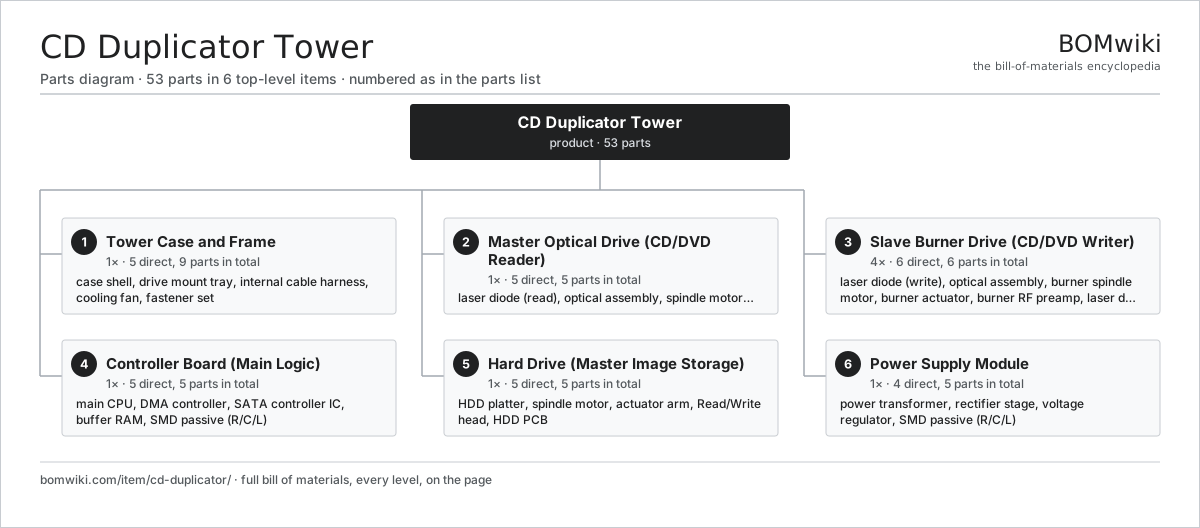
| # | Part | Qty | What it does |
|---|---|---|---|
| 1 | Tower Case and Frame 5 parts | 1× | Stacked or carousel-style housing holding up to 4–8 optical drives with cable management and cooling. |
| 2 | Master Optical Drive (CD/DVD Reader) 5 parts | 1× | High-speed CD or DVD reader extracting master data stream to be distributed to all slave burner drives. |
| 3 | Slave Burner Drive (CD/DVD Writer) 6 parts | 4× | High-speed write-capable optical drive receiving data stream from master and burning CD-R or DVD±R media. |
| 4 | Controller Board (Main Logic) 5 parts | 1× | Microcontroller or FPGA orchestrating master read, burst buffering, and synchronized burning across all slave drives. |
| 5 | Hard Drive (Master Image Storage) 5 parts | 1× | 2.5" or 3.5" SATA hard drive storing the master CD/DVD image for repeated burns without re-reading the master optical media. |
| 6 | Power Supply Module 4 parts | 1× | AC/DC converter supplying +12 V and +5 V rails to master drive, 4 burner drives, hard drive, and controller board. |
3D model
No 3D model yet. Have a CAD file of this? Add a 3D model. STL renders right on this page; STEP, FreeCAD, and OpenSCAD sources are welcome too (openly licensed, like all 3D models on BOMwiki).
Build & assembly graph
expand / collapse · shared sub-assemblies converge · links to related products · est. labourTap an assembly to expand/collapse · tap a part to open it · use “Open page” for any node · drag to pan, scroll to zoom.
Bill of materials for CD Duplicator Tower
6 top-level lines · 36 rows shown · 53 parts total · indented to 3 levels| # | Item / sub-assembly | Part no. | Qty/assy | Ext. qty | Parts | Type |
|---|---|---|---|---|---|---|
| 1 | Tower Case and Frame 5 parts | cd-duplicator-tower-case | 1× | 1 | 9 | assembly |
| 1.1 | Case Shell | cd-duplicator-case-shell | 1× | 1 | · | part |
| 1.2 | Drive Mount Tray | cd-duplicator-drive-tray | 5× | 5 | · | part |
| 1.3 | Internal Cable Harness | cd-duplicator-cable-harness | 1× | 1 | · | part |
| 1.4 | Cooling Fan | cd-duplicator-cooling-fan | 1× | 1 | · | part |
| 1.5 | Fastener Set | fastener-set | 1× | 1 | · | part |
| 2 | Master Optical Drive (CD/DVD Reader) 5 parts | cd-duplicator-master-drive | 1× | 1 | 5 | assembly |
| 2.1 | Laser Diode (Read) | cd-duplicator-master-laser | 1× | 1 | · | part |
| 2.2 | Optical Assembly | cd-duplicator-master-optics | 1× | 1 | · | part |
| 2.3 | Spindle Motor | cd-duplicator-master-spindle-motor | 1× | 1 | · | part |
| 2.4 | Focus/Tracking Actuator | cd-duplicator-master-actuator | 1× | 1 | · | part |
| 2.5 | RF Preamplifier | cd-duplicator-master-preamp | 1× | 1 | · | part |
| 3 | Slave Burner Drive (CD/DVD Writer) 6 parts | cd-duplicator-burner-drive | 4× | 4 | 6 | assembly |
| 3.1 | Laser Diode (Write) | cd-duplicator-burner-laser | 1× | 4 | · | part |
| 3.2 | Optical Assembly | cd-duplicator-burner-optics | 1× | 4 | · | part |
| 3.3 | Burner Spindle Motor | cd-duplicator-burner-spindle-motor | 1× | 4 | · | part |
| 3.4 | Burner Actuator | cd-duplicator-burner-actuator | 1× | 4 | · | part |
| 3.5 | Burner RF Preamp | cd-duplicator-burner-preamp | 1× | 4 | · | part |
| 3.6 | Laser Driver IC | cd-duplicator-burner-laser-driver | 1× | 4 | · | part |
| 4 | Controller Board (Main Logic) 5 parts | cd-duplicator-controller-board | 1× | 1 | 5 | assembly |
| 4.1 | Main CPU | cd-duplicator-main-cpu | 1× | 1 | · | part |
| 4.2 | DMA Controller | cd-duplicator-dma-engine | 1× | 1 | · | part |
| 4.3 | SATA Controller IC | cd-duplicator-sata-controller | 1× | 1 | · | part |
| 4.4 | Buffer RAM | cd-duplicator-buffer-memory | 1× | 1 | · | part |
| 4.5 | SMD Passive (R/C/L) | smd-passives | 1× | 1 | · | part |
| 5 | Hard Drive (Master Image Storage) 5 parts | cd-duplicator-hard-drive | 1× | 1 | 5 | assembly |
| 5.1 | HDD Platter | cd-duplicator-hdd-platter | 1× | 1 | · | part |
| 5.2 | Spindle Motor | cd-duplicator-hdd-spindle | 1× | 1 | · | part |
| 5.3 | Actuator Arm | cd-duplicator-hdd-actuator | 1× | 1 | · | part |
| 5.4 | Read/Write Head | cd-duplicator-hdd-head | 1× | 1 | · | part |
| 5.5 | HDD PCB | cd-duplicator-hdd-pcb | 1× | 1 | · | part |
| 6 | Power Supply Module 4 parts | cd-duplicator-power-supply | 1× | 1 | 5 | assembly |
| 6.1 | Power Transformer | cd-duplicator-transformer | 1× | 1 | · | part |
| 6.2 | Rectifier Stage | cd-duplicator-rectifier | 1× | 1 | 1 | assembly |
| 6.3 | Voltage Regulator | cd-duplicator-regulator | 2× | 2 | · | part |
| 6.4 | SMD Passive (R/C/L) | smd-passives | 1× | 1 | · | part |
Something wrong in this list? Report a problem with this BOM.
Sourcing: possible vendors
Browse the supplier directory → Prices, MOQ, and lead times are algorithmic estimates, not quotes, and not claims about these companies. Company mappings are curated by keyword; est. price band $50–$3k. How estimates work| Vendor | HQ | Specialty | MOQ | Lead time |
|---|---|---|---|---|
|
🇯🇵Sony
sony.com ↗
|
Tokyo, JP | Consumer electronics | 1,000 units | 8–12 wks |
| samsung.com ↗ | Suwon, KR | Electronics & displays | 1,000 units | 8–12 wks |
|
🇺🇸Harman
harman.com ↗
|
Stamford, US | Audio (JBL, AKG) | 1,000 units | 8–12 wks |
|
🇺🇸Bose
bose.com ↗
|
Framingham, US | Audio | 1,000 units | 8–12 wks |
| yamaha.com ↗ | Hamamatsu, JP | Audio & instruments | 1,000 units | 8–12 wks |
1,060-word article