Cello
ProductOverview
A cello is a large bowed string instrument played seated, resting on the floor on a spike, with a tonal range that covers the cello-and-bass register of an orchestra. Drawing a bow across a string sets it vibrating, but a bare string moves almost no air. The instrument's job is to take that small vibration and turn it into sound, which it does by feeding the string's energy into a hollow wooden box tuned to radiate it. Every part of the cello exists either to hold the strings under tension or to carry their vibration into that box.
The resonating box is the Body, built from a carved spruce Spruce Top Plate and a maple Maple Back Plate joined by bent Maple Ribs. The Neck Assembly carries the Ebony Fingerboard and the pegbox. Four Cello Strings run from the Tuning Pegs over the Bridge to the Tailpiece Assembly, and the whole instrument stands on the Endpin Assembly.
How it works
The strings are stretched between the Tuning Pegs in the pegbox and the Tailpiece Assembly at the bottom, passing over the Bridge which holds them clear of the body. A player sets coarse pitch by turning the friction pegs and makes fine adjustments with the tailpiece fine tuners; notes are then chosen by pressing a string against the unfretted ebony Ebony Fingerboard, shortening its vibrating length. Because there are no frets, exact pitch depends entirely on finger placement.
When the bow is drawn across a string, its rosined hair grips and releases the string hundreds of times a second, sustaining the vibration. That motion passes into the Bridge, whose feet rock the spruce top. Two parts inside the body shape what happens next: the Bass Bar glued under the top's bass foot spreads and stiffens the plate so low notes radiate evenly, and the Sound Post, a spruce dowel wedged between top and back just under the treble foot, couples the two plates so they move together and pump air through the f-holes. The Body thus acts as a tuned loudspeaker for the strings. The Endpin Assembly anchors the cello at a fixed playing height, transferring almost none of the sound to the floor so the energy stays in the box.
Cello parts and their functions
8 top-level parts · 54 parts in total · full bill of materials below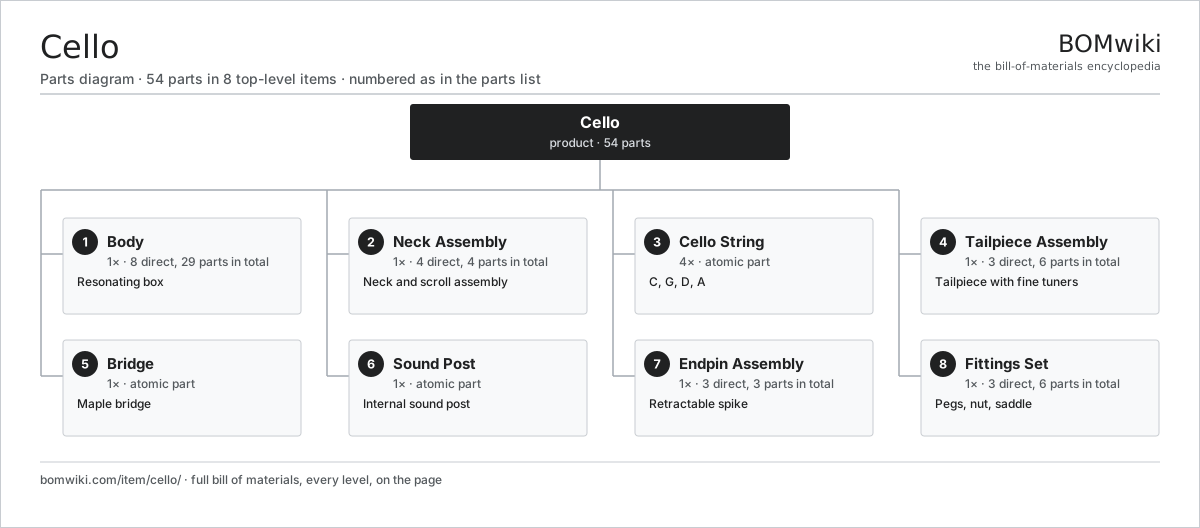
| # | Part | Qty | What it does |
|---|---|---|---|
| 1 | Body 8 parts | 1× | Resonating box |
| 2 | Neck Assembly 4 parts | 1× | Neck and scroll assembly |
| 3 | Cello String | 4× | C, G, D, A |
| 4 | Tailpiece Assembly 3 parts | 1× | Tailpiece with fine tuners |
| 5 | Bridge | 1× | Maple bridge |
| 6 | Sound Post | 1× | Internal sound post |
| 7 | Endpin Assembly 3 parts | 1× | Retractable spike |
| 8 | Fittings Set 3 parts | 1× | Pegs, nut, saddle |
3D model
No 3D model yet. Have a CAD file of this? Add a 3D model. STL renders right on this page; STEP, FreeCAD, and OpenSCAD sources are welcome too (openly licensed, like all 3D models on BOMwiki).
Build & assembly graph
expand / collapse · shared sub-assemblies converge · links to related products · est. labourTap an assembly to expand/collapse · tap a part to open it · use “Open page” for any node · drag to pan, scroll to zoom.
Bill of materials for Cello
8 top-level lines · 29 rows shown · 54 parts total · indented to 3 levels| # | Item / sub-assembly | Part no. | Qty/assy | Ext. qty | Parts | Type |
|---|---|---|---|---|---|---|
| 1 | Body 8 parts | cello-body | 1× | 1 | 29 | assembly |
| 1.1 | Spruce Top Plate | cello-top-plate | 1× | 1 | · | part |
| 1.2 | Maple Back Plate | cello-back-plate | 1× | 1 | · | part |
| 1.3 | Maple Rib | cello-rib | 6× | 6 | · | part |
| 1.4 | Corner / End Block | cello-block | 6× | 6 | · | part |
| 1.5 | Rib Lining | cello-lining | 12× | 12 | · | part |
| 1.6 | Bass Bar | cello-bass-bar | 1× | 1 | · | part |
| 1.7 | Purfling | cello-purfling | 1× | 1 | · | part |
| 1.8 | Varnish Finish | cello-varnish | 1× | 1 | · | part |
| 2 | Neck Assembly 4 parts | cello-neck | 1× | 1 | 4 | assembly |
| 2.1 | Maple Neck Blank | cello-neck-blank | 1× | 1 | · | part |
| 2.2 | Scroll | cello-scroll | 1× | 1 | · | part |
| 2.3 | Pegbox | cello-pegbox | 1× | 1 | · | part |
| 2.4 | Ebony Fingerboard | cello-fingerboard | 1× | 1 | · | part |
| 3 | Cello String | cello-string | 4× | 4 | · | part |
| 4 | Tailpiece Assembly 3 parts | cello-tailpiece-assembly | 1× | 1 | 6 | assembly |
| 4.1 | Tailpiece | cello-tailpiece | 1× | 1 | · | part |
| 4.2 | Fine Tuner | cello-fine-tuner | 4× | 4 | · | part |
| 4.3 | Tailgut | cello-tailgut | 1× | 1 | · | part |
| 5 | Bridge | cello-bridge | 1× | 1 | · | part |
| 6 | Sound Post | cello-sound-post | 1× | 1 | · | part |
| 7 | Endpin Assembly 3 parts | cello-endpin-assembly | 1× | 1 | 3 | assembly |
| 7.1 | Endpin Rod | cello-endpin-rod | 1× | 1 | · | part |
| 7.2 | Endpin Socket | cello-endpin-socket | 1× | 1 | · | part |
| 7.3 | Locking Collar | cello-endpin-collar | 1× | 1 | · | part |
| 8 | Fittings Set 3 parts | cello-fittings | 1× | 1 | 6 | assembly |
| 8.1 | Tuning Peg | cello-peg | 4× | 4 | · | part |
| 8.2 | Nut | cello-nut | 1× | 1 | · | part |
| 8.3 | Saddle | cello-saddle | 1× | 1 | · | part |
Something wrong in this list? Report a problem with this BOM.
Sourcing: possible vendors
Browse the supplier directory → Prices, MOQ, and lead times are algorithmic estimates, not quotes, and not claims about these companies. Company mappings are curated by keyword; est. price band $50–$5k. How estimates work| Vendor | HQ | Specialty | MOQ | Lead time |
|---|---|---|---|---|
| yamaha.com ↗ | Hamamatsu, JP | Audio & instruments | 200 units | 8–14 wks |
|
🇺🇸Fender
fender.com ↗
|
Los Angeles, US | Guitars & amps | 200 units | 8–14 wks |
|
🇺🇸Gibson
gibson.com ↗
|
Nashville, US | Guitars | 200 units | 8–14 wks |
|
🇯🇵Roland
roland.com ↗
|
Hamamatsu, JP | Electronic instruments | 200 units | 8–14 wks |
| steinway.com ↗ | New York, US | Pianos | 200 units | 8–14 wks |
393-word article