Center Pivot Irrigation System
ProductOverview
A center pivot irrigation system is a motorized sprinkler boom that rotates around a fixed central point, watering a circular field with minimal labor. The system consists of a Pivot Point Assembly at the field center (a stationary bearing and water swivel), a center-pivot-main-line conveying water up the rotating boom, multiple Boom Span Sections forming the boom structure (40–100+ m long), and 3–4 wheeled Drive Tower Units that advance the boom around the pivot in a slow rotation. At the pivot point, a Well Pump Station draws water from a well and pressurizes it; a Control Panel & Motor Control regulates pump speed and boom rotation rate via timers and soil-moisture sensors.
Center pivots dominate large-scale agriculture in water-abundant regions (Americas, Australia, parts of Asia). A single operator can manage 500+ hectares by programming different irrigation schedules for different pivots. The circular field shape is inflexible, but the system's reliability and water-use efficiency have made it the standard technology for row crops, corn, wheat, and potatoes on large farms.
Pivot point and water supply
The Pivot Point Assembly is the mechanical heart. A massive Center Tower, typically a 3–5 m vertical I-beam, is anchored to a concrete pad or well house at the field center. Atop this tower sits a Pivot Bearing, a large thrust bearing or slew ring rated for 50+ tonnes (the weight of the rotating boom plus water).
Water is supplied from the Well Pump Station, a submersible or centrifugal pump drawing from a well. The Centrifugal Pump is rated 50–300 L/s depending on field size and crop water demand. A Pump Motor (5–50 kW) drives the pump; modern systems use a Variable Frequency Drive (variable frequency drive) that varies motor speed based on Flow Sensor Input feedback and Pressure Regulator setpoint.
The discharge from the pump enters a Water Swivel Joint, a rotating joint that seals the connection as the boom rotates. The swivel is filled with bearing grease and a pressure-balancing chamber; water flows through the center passage without leakage. Beyond the swivel, a center-pivot-main-line (75–150 mm diameter steel or aluminum pipe) runs up the Pivot Point Assembly and out through the rotating boom to the Sprinkler & Nozzle Array.
Boom structure and spans
The boom is assembled from 4–10 Boom Span Sections, each 40–60 m long and weighing 2–5 tonnes. Each Boom Span Section is a welded truss consisting of two Span Longerons (typically 200 × 100 mm I-beams or 150 × 150 mm tube longerons) connected by Lateral Brace cross-bracing (50 × 50 mm tube). This truss structure provides bending strength while minimizing weight and wind loading.
Internally, a Water Supply Pipe (75–100 mm diameter) runs the length of each span, carrying pressurized water. The pipe connects span-to-span via flexible hose couplings, allowing for thermal expansion and minor misalignment as the boom rotates and flexes under its own weight and water column.
Support bearings are critical. Span Bearings are mounted at each tower and at intermediate points (every 15–20 m) along the boom. These bearings prevent sagging and ensure uniform nozzle height above the field. Old systems used rolling wheels on cables; modern systems use pillow-block or flange-mounted ball bearings.
Drive towers
Three to four Drive Tower Units, spaced 20–30 m apart along the boom, provide the motive force. Each tower is an independently mobile unit, typically 2–3 m tall, mounted on a Tower Frame (welded box tube) with two Drive Wheels (pneumatic tires, 600–900 mm diameter). Inside the frame is a Tower Drive Motor (0.5–2 kW electric or hydraulic motor) with integral gearbox (reduction 50:1 to 100:1), spinning a Pinion Drive Gear (25–50 tooth pinion).
The boom itself carries a large ring gear (100–400 teeth) running parallel to the main boom axis. As each tower's pinion rotates, it engages the ring gear and advances the boom. All towers must rotate in synchronism; older systems used a shared shaft or cable; modern systems use individual tower motors driven by the Control Panel & Motor Control logic, which cuts power to one motor if it falls behind (a safety mechanism preventing boom binding).
Typical boom rotation speed is 0.5–2.0 degrees per hour, completing a full 360° circle in 18–48 hours. The speed is set so that the Sprinkler & Nozzle Array applies the desired water depth (e.g., 25 mm) per revolution.
Sprinkler and nozzle distribution
The Sprinkler & Nozzle Array consists of 20–50 individual Spray Nozzles spaced 2–4 m apart along the boom, mounted via Nozzle Brackets. Each nozzle is a simple brass or polymer spray nozzle (full-cone pattern, 4–6 m throw radius at typical pressure). Nozzles are sized smaller near the pivot (lower radius, less water needed) and larger farther out (higher radius, more water needed), ensuring uniform application across the circular field.
The application rate (depth per revolution) is set by nozzle size and boom rotation speed. A farmer irrigating corn might apply 25 mm per cycle: if the boom rotates once per 2 days, that is 12.5 mm/day, matching typical crop evapotranspiration in summer. The Control Panel & Motor Control can vary boom speed via the tower motor power, allowing the farmer to increase or decrease application rate without changing nozzles.
For row crops (beans, potatoes, lettuce), some operators replace sprinklers with a Drip Irrigation Tubing (16 mm drip tubing with emitters), reducing water loss to evaporation and runoff. Drip conversion requires more maintenance but is more water-efficient.
End gun coverage
Circular pivots inherently leave uncovered corner zones. To address this, many systems include a End Gun & Booster, a secondary high-pressure nozzle and pump assembly mounted at the boom end. The End Gun Pump (1–3 kW booster) creates additional pressure, driving the End Gun Nozzle (20–50 mm bore) to throw water 15–30 m, covering the outer corner zones as the boom rotates. The Activation Solenoid is pulsed on and off by a timer or soil-moisture controller, running the end gun only when needed (typically 1–2 hours per 24-hour cycle).
Control system and automation
The Control Panel & Motor Control is mounted on the Center Tower or in an adjacent shelter. It houses a Main Contactor (3-phase contactor switching pump motor power), a Variable Frequency Drive (variable frequency drive modulating pump speed), and logic controllers sequencing the system.
Simple systems are timer-based: the farmer sets a start time and application depth (in mm); the panel rotates the boom one degree, waits for the nozzles to wet the field to a fixed depth (sensed via time), then advances another degree. Complex systems use Flow Sensor Inputs and Pressure Regulators: if soil moisture rises, the panel slows the pump motor via the VFD, reducing application rate without stopping rotation.
Modern systems accept soil-moisture wireless data from field sensors or integrated water-balance models; the controller automatically schedules irrigation. Some systems are networked to cloud platforms, allowing remote monitoring and adjustment via smartphone.
Water application uniformity
The key performance metric is Christiansen Uniformity (CU), the statistical measure of how uniformly water is applied across the field. A CU of 75% means that the driest quarter of the field receives 75% of the average application. Good pivot design achieves 75–85% CU; poor nozzle distribution or worn bearings can drop it to 60%, wasting water on over-irrigated zones and under-irrigating others.
Factors affecting uniformity include nozzle size variation, wind (especially for sprinkler pivots), boom sag, and soil infiltration variability.
Maintenance and lifecycle
The Tower Bearings, Span Bearings, and Pivot Bearing are the primary wear items. Annual greasing is mandatory; bearing replacement is typically 1000-hour maintenance. The Spray Nozzles clog over time from sediment or algae; they are cleaned or replaced every season. The Pivot Bearing, the most expensive component (USD 5,000–15,000), is replaced every 15–25 years.
Corrosion is a concern in coastal or high-humidity areas. Most modern pivots use galvanized or epoxy-coated steel; aluminum booms are lighter and rust-resistant but more expensive. Annual inspection of all bolted connections is recommended, as vibration and fatigue can loosen fasteners.
Electrical faults (contactor failure, VFD malfunction) are common in wet climates. Sealed, NEMA 4X enclosures and surge protection devices are essential. Backup diesel generators are sometimes installed for critical irrigation seasons.
A well-maintained pivot can operate 15–25 years. Older systems from the 1980s–1990s are still common but increasingly replaced with high-efficiency low-pressure systems or drip irrigation where water scarcity drives adoption.
Center Pivot Irrigation System parts and their functions
8 top-level parts · 127 parts in total · full bill of materials below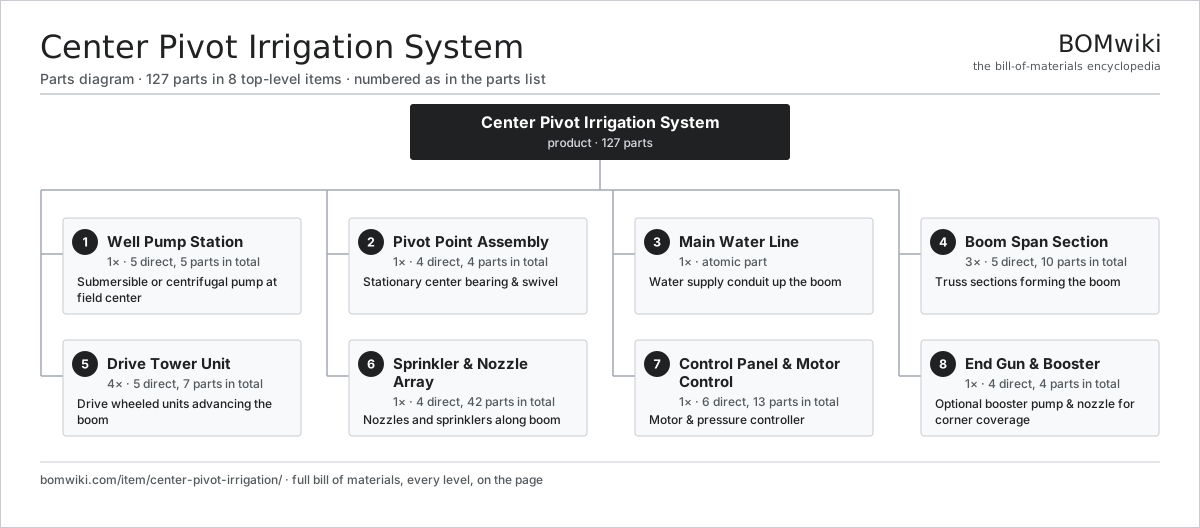
| # | Part | Qty | What it does |
|---|---|---|---|
| 1 | Well Pump Station 5 parts | 1× | Submersible or centrifugal pump at field center |
| 2 | Pivot Point Assembly 4 parts | 1× | Stationary center bearing & swivel |
| 3 | Main Water Line | 1× | Water supply conduit up the boom |
| 4 | Boom Span Section 5 parts | 3× | Truss sections forming the boom |
| 5 | Drive Tower Unit 5 parts | 4× | Drive wheeled units advancing the boom |
| 6 | Sprinkler & Nozzle Array 4 parts | 1× | Nozzles and sprinklers along boom |
| 7 | Control Panel & Motor Control 6 parts | 1× | Motor & pressure controller |
| 8 | End Gun & Booster 4 parts | 1× | Optional booster pump & nozzle for corner coverage |
3D model
No 3D model yet. Have a CAD file of this? Add a 3D model. STL renders right on this page; STEP, FreeCAD, and OpenSCAD sources are welcome too (openly licensed, like all 3D models on BOMwiki).
Build & assembly graph
expand / collapse · shared sub-assemblies converge · links to related products · est. labourTap an assembly to expand/collapse · tap a part to open it · use “Open page” for any node · drag to pan, scroll to zoom.
Bill of materials for Center Pivot Irrigation System
8 top-level lines · 41 rows shown · 127 parts total · indented to 3 levels| # | Item / sub-assembly | Part no. | Qty/assy | Ext. qty | Parts | Type |
|---|---|---|---|---|---|---|
| 1 | Well Pump Station 5 parts | center-pivot-well-pump | 1× | 1 | 5 | assembly |
| 1.1 | Centrifugal Pump | center-pivot-pump-unit | 1× | 1 | · | part |
| 1.2 | Pump Motor | center-pivot-pump-motor | 1× | 1 | · | part |
| 1.3 | Discharge Pipe | center-pivot-pump-discharge-line | 1× | 1 | · | part |
| 1.4 | Flow Meter | center-pivot-flow-meter | 1× | 1 | · | part |
| 1.5 | Pressure Gauge | center-pivot-pressure-gauge | 1× | 1 | · | part |
| 2 | Pivot Point Assembly 4 parts | center-pivot-pivot-point | 1× | 1 | 4 | assembly |
| 2.1 | Center Tower | center-pivot-center-tower | 1× | 1 | · | part |
| 2.2 | Pivot Bearing | center-pivot-pivot-bearing | 1× | 1 | · | part |
| 2.3 | Water Swivel Joint | center-pivot-water-swivel | 1× | 1 | · | part |
| 2.4 | Electrical Slip Ring | center-pivot-electrical-slip-ring | 1× | 1 | · | part |
| 3 | Main Water Line | center-pivot-irrigation-main-line | 1× | 1 | · | part |
| 4 | Boom Span Section 5 parts | center-pivot-span | 3× | 3 | 10 | assembly |
| 4.1 | Span Longeron | center-pivot-span-beam | 2× | 6 | · | part |
| 4.2 | Lateral Brace | center-pivot-span-lateral-truss | 4× | 12 | · | part |
| 4.3 | Water Supply Pipe | center-pivot-span-pipe | 1× | 3 | · | part |
| 4.4 | Span Bearing | center-pivot-span-bearing | 2× | 6 | · | part |
| 4.5 | Fastener Set | fastener-set | 1× | 3 | · | part |
| 5 | Drive Tower Unit 5 parts | center-pivot-tower | 4× | 4 | 7 | assembly |
| 5.1 | Tower Frame | center-pivot-tower-frame | 1× | 4 | · | part |
| 5.2 | Tower Drive Motor | center-pivot-tower-motor | 1× | 4 | · | part |
| 5.3 | Drive Wheel | center-pivot-tower-wheel | 2× | 8 | · | part |
| 5.4 | Pinion Drive Gear | center-pivot-tower-drive-gear | 1× | 4 | · | part |
| 5.5 | Tower Bearing | center-pivot-tower-bearing | 2× | 8 | · | part |
| 6 | Sprinkler & Nozzle Array 4 parts | center-pivot-sprinkler-array | 1× | 1 | 42 | assembly |
| 6.1 | Nozzle Bracket | center-pivot-sprinkler-bracket | 20× | 20 | · | part |
| 6.2 | Spray Nozzle | center-pivot-sprinkler-nozzle | 20× | 20 | · | part |
| 6.3 | Drip Irrigation Tubing | center-pivot-drip-line | 1× | 1 | · | part |
| 6.4 | Nozzle Adaptor | center-pivot-nozzle-adaptor | 1× | 1 | · | part |
| 7 | Control Panel & Motor Control 6 parts | center-pivot-control-panel | 1× | 1 | 13 | assembly |
| 7.1 | Main Contactor | center-pivot-main-contactor | 1× | 1 | · | part |
| 7.2 | Variable Frequency Drive | center-pivot-vfd | 1× | 1 | · | part |
| 7.3 | Motor Soft-Starter | center-pivot-motor-starter | 1× | 1 | · | part |
| 7.4 | Flow Sensor Input | center-pivot-flow-sensor | 1× | 1 | · | part |
| 7.5 | Pressure Regulator | center-pivot-pressure-controller | 1× | 1 | · | part |
| 7.6 | Connector | connector | 8× | 8 | · | part |
| 8 | End Gun & Booster 4 parts | center-pivot-end-gun | 1× | 1 | 4 | assembly |
| 8.1 | End Gun Pump | center-pivot-end-gun-pump | 1× | 1 | · | part |
| 8.2 | End Gun Nozzle | center-pivot-end-gun-nozzle | 1× | 1 | · | part |
| 8.3 | End Gun Motor | center-pivot-end-gun-motor | 1× | 1 | · | part |
| 8.4 | Activation Solenoid | center-pivot-end-gun-solenoid | 1× | 1 | · | part |
Something wrong in this list? Report a problem with this BOM.
Sourcing: possible vendors
Browse the supplier directory → Prices, MOQ, and lead times are algorithmic estimates, not quotes, and not claims about these companies. Company mappings are curated by keyword; est. price band $5k–$800k. How estimates work| Vendor | HQ | Specialty | MOQ | Lead time |
|---|---|---|---|---|
| deere.com ↗ | Moline, US | Agriculture & turf | made to order | 14–24 wks |
| cnh.com ↗ | Basildon, GB | Agriculture (Case IH, New Holland) | made to order | 14–24 wks |
|
🇺🇸AGCO
agcocorp.com ↗
|
Duluth, US | Agriculture (Fendt, Massey Ferguson) | made to order | 14–24 wks |
|
🇩🇪Claas
claas.com ↗
|
Harsewinkel, DE | Harvesters & tractors | made to order | 14–24 wks |
|
🇯🇵Kubota
kubota.com ↗
|
Osaka, JP | Compact tractors & equipment | made to order | 14–24 wks |
1,530-word article