Ceramic Kiln
ProductOverview
A ceramic kiln is an industrial furnace designed to fire ceramic pieces, clay wares, porcelain, refractories, tiles, and decorative objects, at temperatures between 1000 and 1300 °C. At these temperatures, clay minerals undergo irreversible chemical transformations, forming new crystalline phases that give fired ceramics their hardness, durability, and water resistance.
Ceramic kilns vary widely in size, heating method, and design. Small studio kilns (5–50 cubic feet) serve individual potters and educational institutions. Industrial batch kilns (2–10 cubic meters) serve manufacturing shops producing thousands of pieces monthly. Continuous tunnel kilns, using conveyor transport through a static heat zone, dominate large-scale production. This document describes a mid-sized batch kiln typical of tableware, tile, and architectural ceramic manufacturing.
How It Works
Finished clay pieces (greenware or bisqueware) are carefully arranged on the kiln shelves, stacked via Shelving Furniture including Kiln Shelf, Shelf Post, and Kiln Stilt to maximize space while preventing physical contact between pieces. The batch is loaded onto the Loading Cart and wheeled into the Refractory Chamber.
The operator closes and seals the Kiln Door, verifies all instruments, and initiates the firing program on the Temperature Controller. The control sequence depends on the ware type:
For stoneware and earthenware, a typical program includes:
- Slow ramp (50–100 °C/hour) to 300 °C, allowing surface moisture to evaporate.
- Continued ramp to 1000 °C over 12–18 hours. At 500–600 °C, organic matter burns out (bisque fire). At 600–800 °C, the clay begins to shrink and harden (sintering begins).
- Final ramp to peak temperature (1200–1300 °C) over 2–4 hours.
- Hold at peak for 1–4 hours, allowing glaze maturation and chemical equilibration.
- Cool naturally over 12–72 hours, slow enough to minimize thermal shock cracking.
The Burner System or Electric Heating Element supply heat continuously. In a gas-fired kiln, the Main Burner, burning natural gas or oil, is ignited by the Pilot Burner. The Proportional Valve modulates fuel flow based on the Temperature Controller PLC's proportional output. The Air Blower provides combustion air, and hot exhaust gases exit through the Ventilation System, specifically the Chimney Stack and Damper Control.
In an electric kiln, individual Electric Heating Element are energized via heavy-duty Power Contactor relays. The elements are distributed around the chamber to ensure uniform temperature. Because electric kilns produce no combustion gases, they offer more precise temperature control and cleaner atmospheres, but require substantially more electrical infrastructure (three-phase 50+ amp supply).
The Pyrometer continuously monitors internal temperature via non-contact infrared measurement, and the Thermocouple Bundle records an internal temperature profile for quality assurance. These readings are logged to the PLC's memory for post-firing analysis.
Cooling and Unloading
Once the firing cycle is complete, the kiln is allowed to cool passively. Forced cooling via the Exhaust Fan or Forced Air Inlet can reduce cool-down time from 48 hours to 12–24 hours, but risks thermal shock cracking if done too aggressively. The Damper Control is adjusted to balance heat loss and internal circulation.
When the kiln has cooled to room temperature (checked with a handheld probe), the door is opened and the batch is unloaded. Pieces are inspected for color development (indicating proper firing temperature), glaze maturity, warping, and defects. Most refiring losses (2–5% of volume) are due to warping or glaze-firing defects rather than material failure.
Refractory and Maintenance
The Refractory Chamber interior is lined with Brick Lining, either dense firebrick (3000+ firings) or high-alumina brick (5000+ firings). Over time, repeated heating-cooling cycles cause brick surface spalling and erosion. After 500–2000 cycles (depending on brick quality and peak temperature), the interior lining requires patching or replacement. The Fiber Insulation outer layer must be inspected annually for signs of settling or deterioration.
Atmosphere Control
Oxidation, reduction, and neutral atmosphere firing produce different ceramic colors and glazes. In oxidation firing (normal), air is supplied abundantly. In reduction firing, the burner is run rich, consuming oxygen in the chamber and forcing combustion of carbon monoxide, which extracts oxygen from metal oxides in glazes, changing colors (copper oxide → copper, iron oxide → dark iron). The Damper Control and Air Blower are manually adjusted or programmed to achieve the desired atmosphere throughout the cycle.
Emissions and Environmental Compliance
Modern kilns often include the Exhaust Scrubber to capture particulate dust and comply with local air quality regulations. The scrubber may use wet collection (water spray + settling) or dry filtration (pleated cartridges). Solid waste (kiln furniture, broken refractories) is typically collected separately for disposal or recycling.
Ceramic Kiln parts and their functions
8 top-level parts · 146 parts in total · full bill of materials below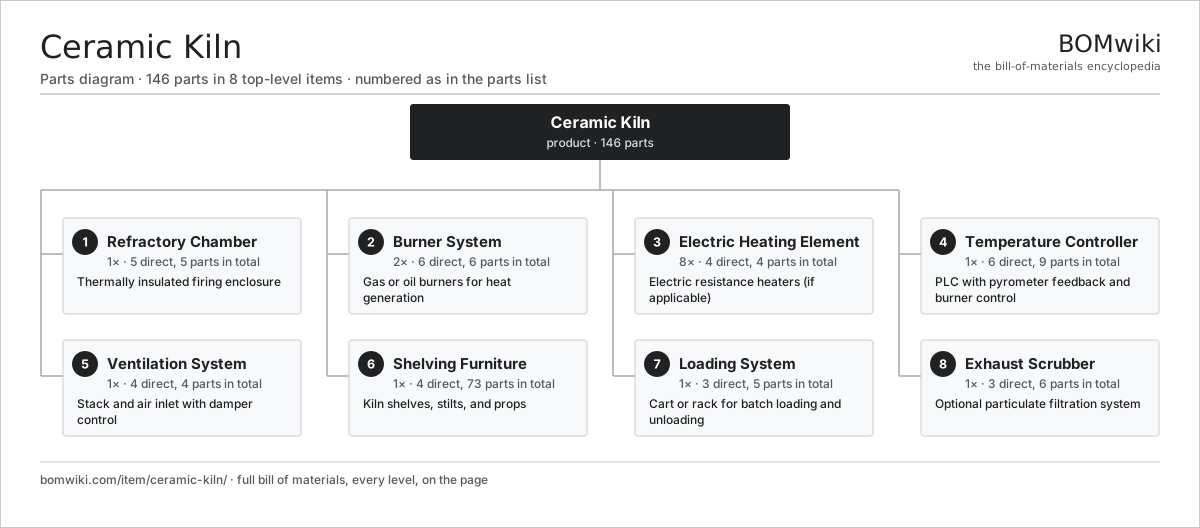
| # | Part | Qty | What it does |
|---|---|---|---|
| 1 | Refractory Chamber 5 parts | 1× | Thermally insulated firing enclosure |
| 2 | Burner System 6 parts | 2× | Gas or oil burners for heat generation |
| 3 | Electric Heating Element 4 parts | 8× | Electric resistance heaters (if applicable) |
| 4 | Temperature Controller 6 parts | 1× | PLC with pyrometer feedback and burner control |
| 5 | Ventilation System 4 parts | 1× | Stack and air inlet with damper control |
| 6 | Shelving Furniture 4 parts | 1× | Kiln shelves, stilts, and props |
| 7 | Loading System 3 parts | 1× | Cart or rack for batch loading and unloading |
| 8 | Exhaust Scrubber 3 parts | 1× | Optional particulate filtration system |
3D model
No 3D model yet. Have a CAD file of this? Add a 3D model. STL renders right on this page; STEP, FreeCAD, and OpenSCAD sources are welcome too (openly licensed, like all 3D models on BOMwiki).
Build & assembly graph
expand / collapse · shared sub-assemblies converge · links to related products · est. labourTap an assembly to expand/collapse · tap a part to open it · use “Open page” for any node · drag to pan, scroll to zoom.
Bill of materials for Ceramic Kiln
8 top-level lines · 43 rows shown · 146 parts total · indented to 3 levels| # | Item / sub-assembly | Part no. | Qty/assy | Ext. qty | Parts | Type |
|---|---|---|---|---|---|---|
| 1 | Refractory Chamber 5 parts | ceramic-kiln-refractory-chamber | 1× | 1 | 5 | assembly |
| 1.1 | Brick Lining | ceramic-kiln-brick-lining | 1× | 1 | · | part |
| 1.2 | Fiber Insulation | ceramic-kiln-fiber-insulation | 1× | 1 | · | part |
| 1.3 | Chamber Shell | ceramic-kiln-chamber-shell | 1× | 1 | · | part |
| 1.4 | Arch Support | ceramic-kiln-arch-support | 1× | 1 | · | part |
| 1.5 | Floor Support | ceramic-kiln-floor-supports | 1× | 1 | · | part |
| 2 | Burner System 6 parts | ceramic-kiln-burner-system | 2× | 2 | 6 | assembly |
| 2.1 | Main Burner | ceramic-kiln-main-burner | 1× | 2 | · | part |
| 2.2 | Pilot Burner | ceramic-kiln-pilot-burner | 1× | 2 | · | part |
| 2.3 | Fuel Valve | ceramic-kiln-fuel-valve-solenoid | 1× | 2 | · | part |
| 2.4 | Proportional Valve | ceramic-kiln-proportional-fuel-valve | 1× | 2 | · | part |
| 2.5 | Air Blower | ceramic-kiln-air-blower | 1× | 2 | · | part |
| 2.6 | Ignition Electrode | ceramic-kiln-ignition-electrode | 1× | 2 | · | part |
| 3 | Electric Heating Element 4 parts | ceramic-kiln-electric-heating-elements | 8× | 8 | 4 | assembly |
| 3.1 | Element Wire | ceramic-kiln-element-wire | 1× | 8 | · | part |
| 3.2 | Element Connector | ceramic-kiln-element-connector | 1× | 8 | · | part |
| 3.3 | Power Contactor | ceramic-kiln-power-contactor | 1× | 8 | · | part |
| 3.4 | Element Support | ceramic-kiln-element-support-frame | 1× | 8 | · | part |
| 4 | Temperature Controller 6 parts | ceramic-kiln-temperature-controller | 1× | 1 | 9 | assembly |
| 4.1 | Microcontroller | mcu | 1× | 1 | · | part |
| 4.2 | Pyrometer | ceramic-kiln-pyrometer | 1× | 1 | · | part |
| 4.3 | Thermocouple Bundle | ceramic-kiln-thermocouple-bundle | 1× | 1 | · | part |
| 4.4 | LCD Panel | lcd-panel | 1× | 1 | · | part |
| 4.5 | Relay | relay | 4× | 4 | · | part |
| 4.6 | Power Supply | power-supply | 1× | 1 | · | part |
| 5 | Ventilation System 4 parts | ceramic-kiln-ventilation-system | 1× | 1 | 4 | assembly |
| 5.1 | Chimney Stack | ceramic-kiln-chimney-stack | 1× | 1 | · | part |
| 5.2 | Damper Control | ceramic-kiln-damper-control | 1× | 1 | · | part |
| 5.3 | Forced Air Inlet | ceramic-kiln-forced-air-inlet | 1× | 1 | · | part |
| 5.4 | Exhaust Fan | ceramic-kiln-exhaust-fan | 1× | 1 | · | part |
| 6 | Shelving Furniture 4 parts | ceramic-kiln-shelving-furniture | 1× | 1 | 73 | assembly |
| 6.1 | Kiln Shelf | ceramic-kiln-shelf | 12× | 12 | · | part |
| 6.2 | Shelf Post | ceramic-kiln-shelf-post | 24× | 24 | · | part |
| 6.3 | Kiln Stilt | ceramic-kiln-stilts | 36× | 36 | · | part |
| 6.4 | Shelf Separator | ceramic-kiln-shelf-separator | 1× | 1 | · | part |
| 7 | Loading System 3 parts | ceramic-kiln-loading-system | 1× | 1 | 5 | assembly |
| 7.1 | Loading Cart | ceramic-kiln-loading-cart | 1× | 1 | · | part |
| 7.2 | Kiln Door | ceramic-kiln-hinge-door | 1× | 1 | · | part |
| 7.3 | Peephole Plug | ceramic-kiln-peephole-plug | 3× | 3 | · | part |
| 8 | Exhaust Scrubber 3 parts | ceramic-kiln-exhaust-scrubber | 1× | 1 | 6 | assembly |
| 8.1 | Scrubber Chamber | ceramic-kiln-scrubber-chamber | 1× | 1 | · | part |
| 8.2 | Scrubber Pump | ceramic-kiln-scrubber-pump | 1× | 1 | · | part |
| 8.3 | Filter Cartridge | ceramic-kiln-filter-cartridge | 4× | 4 | · | part |
Something wrong in this list? Report a problem with this BOM.
Related products
same domain, ranked by shared parts All-Electric Injection Molding Machine
851 parts · shares 3 with this page
Automated Paint Spray Line
2,003 parts · shares 3 with this page
Binder Jetting Printer
112 parts · shares 3 with this page
Blown Film Extrusion Line
436 parts · shares 3 with this page
Cast Film Extrusion Line
406 parts · shares 3 with this page
All-Electric Injection Molding Machine
851 parts · shares 3 with this page
Automated Paint Spray Line
2,003 parts · shares 3 with this page
Binder Jetting Printer
112 parts · shares 3 with this page
Blown Film Extrusion Line
436 parts · shares 3 with this page
Cast Film Extrusion Line
406 parts · shares 3 with this page
Sourcing: possible vendors
Browse the supplier directory → Prices, MOQ, and lead times are algorithmic estimates, not quotes, and not claims about these companies. Company mappings are curated by keyword; est. price band $5k–$2M. How estimates work| Vendor | HQ | Specialty | MOQ | Lead time |
|---|---|---|---|---|
| atlascopco.com ↗ | Stockholm, SE | Compressors & industrial | 10 units | 12–20 wks |
|
🇦🇹Andritz
andritz.com ↗
|
Graz, AT | Process plants & machinery | 10 units | 12–20 wks |
| buhlergroup.com ↗ | Uzwil, CH | Food & materials processing | 10 units | 12–20 wks |
| gea.com ↗ | Düsseldorf, DE | Process technology | 10 units | 12–20 wks |
| mhi.com ↗ | Tokyo, JP | Heavy machinery | 10 units | 12–20 wks |
823-word article