Electric Chain Hoist
ProductOverview
An electric chain hoist lifts and lowers loads on an alloy-steel link chain driven by an electric motor through a reduction gearbox. It is the standard light-to-medium lifting machine of workshops, assembly lines and entertainment rigging: compact, self-contained, and capable of duty cycles that a manual hoist cannot sustain. Capacities run from 125 kg bench units to 5-tonne double-fall machines, with the 500 kg to 2 t class by far the most common.
The machine is built around a die-cast aluminium Hoist Body and Covers that aligns three elements on a single axis: the Brake Motor Assembly, the Reduction Gearbox, and the Chain Drive Assembly. The load hangs from the Bottom Hook Block; the hoist itself hangs from the Suspension Assembly, either a top hook on a beam clamp or a rigid lug bolted to a push or electric trolley. The slack side of the chain falls into the Chain Container so it cannot foul the load.
How it works
Pressing a button on the Pendant Control Station energises one of the two reversing contactors in the Electrical Panel. The contactor connects the 3-phase supply to the motor in the chosen phase sequence, and simultaneously the Brake Rectifier feeds DC to the Brake Release Coil. The coil pulls the Armature Plate back against its springs, freeing the Friction Disc, and the motor turns.
Motor speed, typically 1,400 rpm on 50 Hz, passes through two helical Helical Gear Pair stages, a total reduction of roughly 25:1 to 60:1, onto the Output Shaft. The shaft carries the Lift Wheel (Load Sheave), a hardened wheel with five machined pockets. Alternate chain links seat flat in the pockets while the links between them stand vertically in a circumferential groove, so the wheel drives the chain positively, with no reliance on friction. The Chain Guide funnels the chain into the pockets and the Chain Stripper peels it off the exit side. A 5-pocket wheel turning at 25 rpm with 6 mm chain yields a hook speed of about 4 m/min.
When the button is released, both contactor and brake coil drop out. Six Coil Spring elements clamp the friction disc within about 100 ms, holding the load statically. Because the brake is spring-applied and electrically released, any power failure stops and holds the load, the fail-safe arrangement required by EN 14492-2 and ASME B30.16.
Protection devices
Three independent devices guard the machine. The Friction Slip Clutch is a preset friction clutch inside the gear train; if the operator attempts to lift more than roughly 125–160% of rated load, or drives the hook into the end stops, the clutch slips and the chain stops moving while the motor continues to turn. Critically, the clutch sits upstream of the brake path in modern designs, so the brake can still hold a load even with the clutch slipping.
Geared or lever-type Hook Travel Limit Switch units cut the control circuit at the highest and lowest hook positions before the Chain End Stop is struck. A Thermal Fuse or thermistor embedded in the stator winding trips the control circuit if winding temperature exceeds the class F limit, which matters because hoist duty (FEM 2m, 40% ED, up to 240 starts per hour) is dominated by starting current heating.
Control is at extra-low voltage: the Control Transformer supplies 24 or 48 V to the pendant, so a damaged Pendant Cable cannot expose the operator to line voltage. The cable carries an internal strain wire so the conductors bear no mechanical load.
Load path components
The Load Chain is case-hardened Grade 80 (or DAT/T grade) alloy chain, manufactured to EN 818-7 with calibrated pitch so it meshes accurately with the lift wheel pockets. Working stress gives a minimum safety factor of 4 against breaking load; wear is checked by gauging 11-link sections, with 2% elongation the discard limit. The Forged Bottom Hook and Top Suspension Hook are drop-forged from quenched-and-tempered alloy steel and are designed to yield by slowly opening, a visible warning, rather than fracturing. The bottom hook swivels on a thrust Ball Bearing inside the Hook Block Housing so a twisted sling cannot wind up the chain, and a Hook Safety Latch closes the throat.
Two-fall versions reeve the chain over an idler sheave in the hook block and anchor the dead end at the Chain End Stop, doubling capacity and halving speed.
Variants
Two-speed hoists use a pole-changing (Dahlander) motor for a 4:1 speed ratio, typically 8/2 m/min; inverter-driven hoists give stepless control and soft reversal. Entertainment-industry chain hoists (D8+, BGV-C1) run inverted, body climbs the chain, with doubled brake systems. Low-headroom and articulated-trolley versions trade lift height for clearance under the beam. Food and galvanising-plant variants substitute stainless chain and IP66 enclosures.
Electric Chain Hoist parts and their functions
9 top-level parts · 83 parts in total · full bill of materials below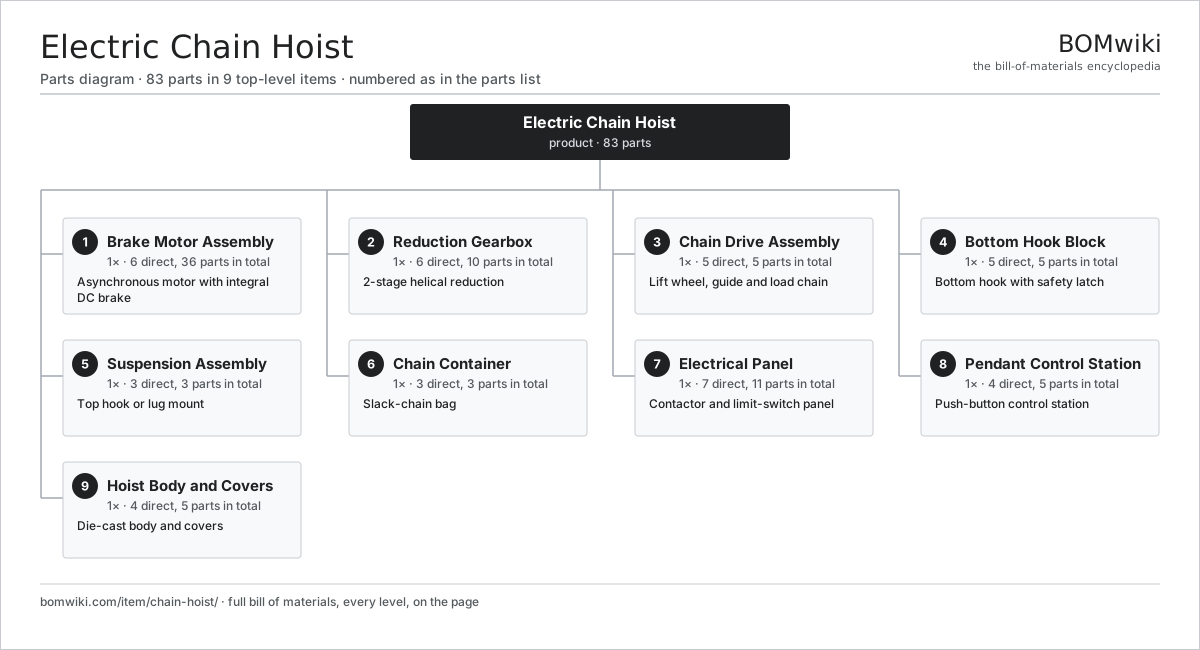
| # | Part | Qty | What it does |
|---|---|---|---|
| 1 | Brake Motor Assembly 6 parts | 1× | Asynchronous motor with integral DC brake |
| 2 | Reduction Gearbox 6 parts | 1× | 2-stage helical reduction |
| 3 | Chain Drive Assembly 5 parts | 1× | Lift wheel, guide and load chain |
| 4 | Bottom Hook Block 5 parts | 1× | Bottom hook with safety latch |
| 5 | Suspension Assembly 3 parts | 1× | Top hook or lug mount |
| 6 | Chain Container 3 parts | 1× | Slack-chain bag |
| 7 | Electrical Panel 7 parts | 1× | Contactor and limit-switch panel |
| 8 | Pendant Control Station 4 parts | 1× | Push-button control station |
| 9 | Hoist Body and Covers 4 parts | 1× | Die-cast body and covers |
3D model
No 3D model yet. Have a CAD file of this? Add a 3D model. STL renders right on this page; STEP, FreeCAD, and OpenSCAD sources are welcome too (openly licensed, like all 3D models on BOMwiki).
Build & assembly graph
expand / collapse · shared sub-assemblies converge · links to related products · est. labourTap an assembly to expand/collapse · tap a part to open it · use “Open page” for any node · drag to pan, scroll to zoom.
Bill of materials for Electric Chain Hoist
9 top-level lines · 64 rows shown · 83 parts total · indented to 3 levels| # | Item / sub-assembly | Part no. | Qty/assy | Ext. qty | Parts | Type |
|---|---|---|---|---|---|---|
| 1 | Brake Motor Assembly 6 parts | chain-hoist-brake-motor | 1× | 1 | 36 | assembly |
| 1.1 | Stator Assembly 3 parts | stator-assembly | 1× | 1 | 3 | assembly |
| 1.1.1 | Stator Core (laminations) | stator-core | 1× | 1 | · | part |
| 1.1.2 | Copper Winding | copper-winding | 1× | 1 | · | part |
| 1.1.3 | Slot Insulation | stator-insulation | 1× | 1 | · | part |
| 1.2 | Rotor Assembly 4 parts | rotor-assembly | 1× | 1 | 19 | assembly |
| 1.2.1 | Rotor Shaft | rotor-shaft | 1× | 1 | · | part |
| 1.2.2 | Rotor Core | rotor-core | 1× | 1 | · | part |
| 1.2.3 | Neodymium Magnet | neodymium-magnet | 16× | 16 | · | part |
| 1.2.4 | Ball Bearing | ball-bearing | 1× | 1 | · | part |
| 1.3 | Ball Bearing | ball-bearing | 2× | 2 | · | part |
| 1.4 | DC Disc Brake 5 parts | chain-hoist-brake-unit | 1× | 1 | 10 | assembly |
| 1.4.1 | Brake Release Coil | chain-hoist-brake-coil | 1× | 1 | · | part |
| 1.4.2 | Friction Disc | chain-hoist-friction-disc | 1× | 1 | · | part |
| 1.4.3 | Armature Plate | chain-hoist-armature-plate | 1× | 1 | · | part |
| 1.4.4 | Coil Spring | coil-spring | 6× | 6 | · | part |
| 1.4.5 | Brake Rectifier | chain-hoist-rectifier | 1× | 1 | · | part |
| 1.5 | Motor Cooling Fan | chain-hoist-cooling-fan | 1× | 1 | · | part |
| 1.6 | Motor Housing | motor-housing | 1× | 1 | · | part |
| 2 | Reduction Gearbox 6 parts | chain-hoist-gearbox | 1× | 1 | 10 | assembly |
| 2.1 | Helical Gear Pair | gear-pair | 2× | 2 | · | part |
| 2.2 | Output Shaft | chain-hoist-output-shaft | 1× | 1 | · | part |
| 2.3 | Ball Bearing | ball-bearing | 3× | 3 | · | part |
| 2.4 | Oil Seal | oil-seal | 2× | 2 | · | part |
| 2.5 | Gearbox Housing | gearbox-housing | 1× | 1 | · | part |
| 2.6 | Friction Slip Clutch | chain-hoist-slip-clutch | 1× | 1 | · | part |
| 3 | Chain Drive Assembly 5 parts | chain-hoist-chain-drive | 1× | 1 | 5 | assembly |
| 3.1 | Lift Wheel (Load Sheave) | chain-hoist-lift-wheel | 1× | 1 | · | part |
| 3.2 | Chain Guide | chain-hoist-chain-guide | 1× | 1 | · | part |
| 3.3 | Load Chain | chain-hoist-load-chain | 1× | 1 | · | part |
| 3.4 | Chain End Stop | chain-hoist-chain-stop | 1× | 1 | · | part |
| 3.5 | Chain Stripper | chain-hoist-stripper | 1× | 1 | · | part |
| 4 | Bottom Hook Block 5 parts | chain-hoist-hook-block | 1× | 1 | 5 | assembly |
| 4.1 | Forged Bottom Hook | chain-hoist-bottom-hook | 1× | 1 | · | part |
| 4.2 | Hook Safety Latch | chain-hoist-safety-latch | 1× | 1 | · | part |
| 4.3 | Ball Bearing | ball-bearing | 1× | 1 | · | part |
| 4.4 | Hook Block Housing | chain-hoist-hook-housing | 1× | 1 | · | part |
| 4.5 | Fastener Set | fastener-set | 1× | 1 | · | part |
| 5 | Suspension Assembly 3 parts | chain-hoist-suspension | 1× | 1 | 3 | assembly |
| 5.1 | Top Suspension Hook | chain-hoist-top-hook | 1× | 1 | · | part |
| 5.2 | Suspension Lug | chain-hoist-suspension-lug | 1× | 1 | · | part |
| 5.3 | Fastener Set | fastener-set | 1× | 1 | · | part |
| 6 | Chain Container 3 parts | chain-hoist-chain-container | 1× | 1 | 3 | assembly |
| 6.1 | Chain Bag | chain-hoist-chain-bag | 1× | 1 | · | part |
| 6.2 | Bag Bracket | chain-hoist-bag-bracket | 1× | 1 | · | part |
| 6.3 | Fastener Set | fastener-set | 1× | 1 | · | part |
| 7 | Electrical Panel 7 parts | chain-hoist-electrical-panel | 1× | 1 | 11 | assembly |
| 7.1 | Relay | relay | 2× | 2 | · | part |
| 7.2 | Control Transformer | chain-hoist-control-transformer | 1× | 1 | · | part |
| 7.3 | Hook Travel Limit Switch | chain-hoist-limit-switch | 2× | 2 | · | part |
| 7.4 | Bare PCB | pcb-bare | 1× | 1 | · | part |
| 7.5 | Wire Bundle | wire-bundle | 1× | 1 | · | part |
| 7.6 | Connector | connector | 3× | 3 | · | part |
| 7.7 | Thermal Fuse | thermal-fuse | 1× | 1 | · | part |
| 8 | Pendant Control Station 4 parts | chain-hoist-pendant | 1× | 1 | 5 | assembly |
| 8.1 | Pendant Housing | chain-hoist-pendant-housing | 1× | 1 | · | part |
| 8.2 | Direction Pushbutton | chain-hoist-pushbutton | 2× | 2 | · | part |
| 8.3 | Emergency Stop Button | chain-hoist-estop | 1× | 1 | · | part |
| 8.4 | Pendant Cable | chain-hoist-pendant-cable | 1× | 1 | · | part |
| 9 | Hoist Body and Covers 4 parts | chain-hoist-housing | 1× | 1 | 5 | assembly |
| 9.1 | Main Body Casting | chain-hoist-main-body | 1× | 1 | · | part |
| 9.2 | End Cover | chain-hoist-end-cover | 2× | 2 | · | part |
| 9.3 | O-Ring Set | oring-set | 1× | 1 | · | part |
| 9.4 | Fastener Set | fastener-set | 1× | 1 | · | part |
Something wrong in this list? Report a problem with this BOM.
Used in 1 assembly
Related products
same domain, ranked by shared parts Articulated Forklift
2,417 parts · shares 3 with this page
Articulated Forklift
2,417 parts · shares 3 with this page
 Container Handler
552 parts · shares 3 with this page
Container Handler
552 parts · shares 3 with this page
 Container Spreader
559 parts · shares 3 with this page
Open-Mouth Sack Filler
214 parts · shares 3 with this page
Pop-Up Wheel Sorter
705 parts · shares 3 with this page
Container Spreader
559 parts · shares 3 with this page
Open-Mouth Sack Filler
214 parts · shares 3 with this page
Pop-Up Wheel Sorter
705 parts · shares 3 with this page
Sourcing: possible vendors
Browse the supplier directory → Prices, MOQ, and lead times are algorithmic estimates, not quotes, and not claims about these companies. Company mappings are curated by keyword; est. price band $2k–$300k. How estimates work| Vendor | HQ | Specialty | MOQ | Lead time |
|---|---|---|---|---|
| toyota-industries.com ↗ | Kariya, JP | Forklifts & logistics | 20 units | 10–16 wks |
| kiongroup.com ↗ | Frankfurt, DE | Forklifts (Linde, STILL) | 20 units | 10–16 wks |
| jungheinrich.com ↗ | Hamburg, DE | Warehouse trucks | 20 units | 10–16 wks |
| crown.com ↗ | New Bremen, US | Forklifts | 20 units | 10–16 wks |
|
🇨🇳Hangcha
hcforklift.com ↗
|
Hangzhou, CN | Forklifts & material handling | 20 units | 10–16 wks |
856-word article