Bill Change Machine
ProductOverview
A bill change machine, also called a currency change machine or coin exchange kiosk, is an automated financial device that accepts paper currency and dispenses its equivalent value in coins. The user inserts a bill (typically USD $1 to $20), the machine validates the bill against counterfeiting and damage, calculates the appropriate coin mix by denomination, and dispenses the exact amount. These machines are ubiquitous in laundromats, parking facilities, arcades, casinos, and public transit stations where coins are required for operation.
The core value is convenience and speed. A laundromat operator can keep one Bill Change Machine rather than staffing a cashier; users get coins on demand without human interaction. The machine is a trust multiplier: a person who does not trust a human cashier will trust a machine to count coins correctly.
How it works
The user inserts a bill into the Bill Validator Module, which accepts it edge-first into a precision plastic Bill Feed Aperture. The throat is exactly 0.25 inches wide, forcing single-bill feed to prevent jamming. A small Bill Feed Stepper (NEMA 14 stepper motor) advances the bill at 1–2 inches per second through a sensor stack.
The Bill Image Sensor, typically a grayscale camera, captures the bill face. The microcontroller in the Control Microcontroller Board compares key features: portrait position, denomination markers (text and color bands), and anti-counterfeiting patterns. Simultaneously, an Infrared LED Assembly and matched phototransistor measure bill thickness and reflectance. An Magnetic Security Sensor, an inductive coil, detects the magnetic signature of the security thread embedded in all modern US bills.
If all three sensors agree on the denomination, the bill is accepted and the Control Microcontroller Board proceeds to change calculation. If sensors disagree or detect damage or forgery, the bill is returned to the user via a reverse stepper command. Typical validation latency is 2–5 milliseconds.
Once validated, the microcontroller calculates the coin mix. For example, a $1 bill becomes four quarters, or ten dimes, or twenty nickels, depending on hopper inventory. The algorithm prioritizes quarters because they are the most useful currency for laundromats and slot machines. The microcontroller then issues step pulses to the five stepper motors, one per denomination.
Each stepper drives a flexible helical auger inside a gravity-fed hopper. The auger rotates at ~10 RPM, and each quarter-turn drops one coin from the hopper into the Coin Selection Chute, a multi-lane aluminum channel that routes all coins toward the customer-facing output tray.
As coins pass the Coin Verification Sensor, an infrared optical gate counts each piece and reports back to the microcontroller. The microcontroller cross-checks the count against the expected number and stops stepper motion once the count is correct. This feedback loop ensures accuracy even if an auger slips or a coin jams.
The entire transaction from bill insertion to coin dispensing typically takes 4–8 seconds. The user collects coins from the stainless steel tray at the machine front. Any coins not dispensed to the user, overflow or rejected coins, fall into the Secure Coin Vault, a lockable Vault Storage Box inside the cabinet that holds ~10 kg of mixed coins.
Control and Inventory Management
The Control Microcontroller Board is the machine brain. A 32-bit ARM Cortex-M4 microcontroller runs the entire sequence: bill validation, denomination recognition, coin accounting, stepper sequencing, and hopper inventory tracking.
Inventory tracking is critical. The microcontroller stores a running tally of coins dispensed and accepted in non-volatile Non-Volatile Memory (I2C EEPROM). Each night or weekly, an operator connects a simple diagnostic interface (USB or Ethernet) and downloads transaction history and current hopper levels. This tells the operator which denominators are low, how much coin was dispensed, and whether any errors occurred (e.g., jammed augers, optical sensor faults).
Some machines add a small LCD or LED status display and manual buttons to allow the operator to refill hoppers or troubleshoot on-site. Others are silent and report only to back-end accounting software via a network connection.
The Cabinet Back is hinged or removable, allowing the operator to access all five hoppers and refill them with bulk coin. Refilling is straightforward: unlock the cabinet, lift each hopper's gravity-fed top, pour coins in, and close. The microcontroller will eventually auto-detect that a hopper is full and cease dispensing from it until levels drop.
Power and Reliability
The machine requires 120 V AC mains power and draws 2–3 amps at peak (when multiple steppers run simultaneously). An internal Power Supply steps voltage down to 24 V DC, which powers the Stepper Motor Driver IC quad driver IC and all stepper motors. The Microcontroller and sensor circuits run at 5 V via a secondary regulator.
Stepper motors are chosen for reliability and cost-effectiveness. They require no encoder feedback; the microcontroller simply knows that N step pulses = N coin drops, assuming the auger does not slip. In practice, auger slip is rare because augers are flexible plastic and compress gently against the hopper gravity, providing natural friction coupling.
The Bill Image Sensor and Magnetic Security Sensor are the most wear-prone components. Over many years, the magnetic sensor coil can develop drift as capacitors in the read circuit age. Sensors can also become contaminated by bill dust or debris. Maintenance intervals are typically 12–24 months; sensors are cheap (< USD 20 per unit) and replaceable by field technicians in under 30 minutes.
Variants and Market
Change machines are sold in two configurations: standalone units (cabinet + all mechanics) and embedded versions (used as sub-modules in larger vending platforms, like laundromat card dispensers or self-service parking kiosks).
Standalone units are compact, 24×36×18 inches, and weigh 200–280 pounds loaded. They cost USD 3,000–5,000 new and are typically financed by laundromat operators through leasing companies. Revenue model: the operator or location owner owns the machine and keeps all coin revenue, or they lease it and pay 10–20% of revenue to the leasing operator.
High-end variants add features like credit-card acceptance (a card reader inserted by the user funds a digital wallet inside the machine, which then dispenses coins), or multi-currency support (US, Canadian, Australian coins all mixed in one cabinet). Budget variants omit the vault and the optical sensor (using only magnetic validation) to reduce cost to USD 1,500–2,500.
The bill validator is the single highest-reliability component. Top manufacturers (e.g., Cashcode, JCM) sell validator modules to machine manufacturers, who integrate them into change machines. A Cashcode or JCM validator costs USD 400–600 and is field-replaceable by swapping a single 24-pin connector.
See also
- Bill Validator Module for currency recognition specifics
- Coin Hopper Array for coin storage and indexing
- Control Microcontroller Board for microcontroller logic and transaction sequencing
Bill Change Machine parts and their functions
7 top-level parts · 40 parts in total · full bill of materials below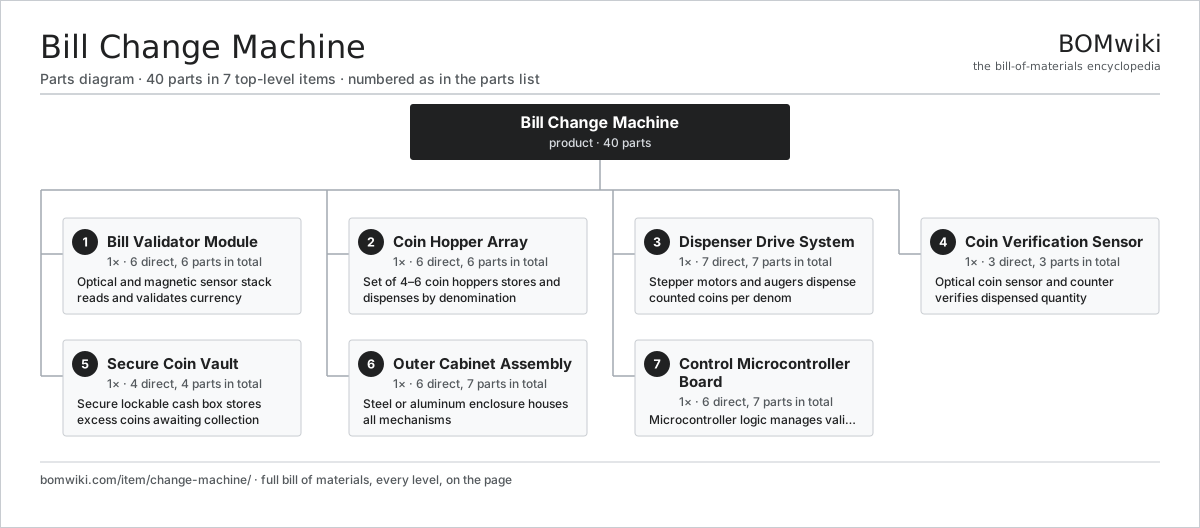
| # | Part | Qty | What it does |
|---|---|---|---|
| 1 | Bill Validator Module 6 parts | 1× | Optical and magnetic sensor stack reads and validates currency |
| 2 | Coin Hopper Array 6 parts | 1× | Set of 4–6 coin hoppers stores and dispenses by denomination |
| 3 | Dispenser Drive System 7 parts | 1× | Stepper motors and augers dispense counted coins per denom |
| 4 | Coin Verification Sensor 3 parts | 1× | Optical coin sensor and counter verifies dispensed quantity |
| 5 | Secure Coin Vault 4 parts | 1× | Secure lockable cash box stores excess coins awaiting collection |
| 6 | Outer Cabinet Assembly 6 parts | 1× | Steel or aluminum enclosure houses all mechanisms |
| 7 | Control Microcontroller Board 6 parts | 1× | Microcontroller logic manages validation, counting, dispensing |
3D model
No 3D model yet. Have a CAD file of this? Add a 3D model. STL renders right on this page; STEP, FreeCAD, and OpenSCAD sources are welcome too (openly licensed, like all 3D models on BOMwiki).
Build & assembly graph
expand / collapse · shared sub-assemblies converge · links to related products · est. labourTap an assembly to expand/collapse · tap a part to open it · use “Open page” for any node · drag to pan, scroll to zoom.
Bill of materials for Bill Change Machine
7 top-level lines · 45 rows shown · 40 parts total · indented to 3 levels| # | Item / sub-assembly | Part no. | Qty/assy | Ext. qty | Parts | Type |
|---|---|---|---|---|---|---|
| 1 | Bill Validator Module 6 parts | change-machine-bill-validator | 1× | 1 | 6 | assembly |
| 1.1 | Bill Feed Aperture | change-machine-bill-throat | 1× | 1 | · | part |
| 1.2 | Infrared LED Assembly | change-machine-ir-led | 1× | 1 | · | part |
| 1.3 | Magnetic Security Sensor | change-machine-mag-sensor | 1× | 1 | · | part |
| 1.4 | Bill Image Sensor | change-machine-optical-sensor | 1× | 1 | · | part |
| 1.5 | Bill Feed Stepper | change-machine-stepper-feeder | 1× | 1 | · | part |
| 1.6 | Bare PCB | pcb-bare | 1× | 1 | · | part |
| 2 | Coin Hopper Array 6 parts | change-machine-hopper-array | 1× | 1 | 6 | assembly |
| 2.1 | Penny Hopper | change-machine-hopper-penny | 1× | 1 | · | part |
| 2.2 | Nickel Hopper | change-machine-hopper-nickel | 1× | 1 | · | part |
| 2.3 | Dime Hopper | change-machine-hopper-dime | 1× | 1 | · | part |
| 2.4 | Quarter Hopper | change-machine-hopper-quarter | 1× | 1 | · | part |
| 2.5 | Dollar Coin Hopper | change-machine-hopper-dollar | 1× | 1 | · | part |
| 2.6 | Fastener Set | fastener-set | 1× | 1 | · | part |
| 3 | Dispenser Drive System 7 parts | change-machine-dispenser-mechanism | 1× | 1 | 7 | assembly |
| 3.1 | Stepper Motor Penny | change-machine-stepper-motor-penny | 1× | 1 | · | part |
| 3.2 | Stepper Motor Nickel | change-machine-stepper-motor-nickel | 1× | 1 | · | part |
| 3.3 | Stepper Motor Dime | change-machine-stepper-motor-dime | 1× | 1 | · | part |
| 3.4 | Stepper Motor Quarter | change-machine-stepper-motor-quarter | 1× | 1 | · | part |
| 3.5 | Penny Auger | change-machine-auger-penny | 1× | 1 | · | part |
| 3.6 | Quarter Auger | change-machine-auger-quarter | 1× | 1 | · | part |
| 3.7 | Coin Selection Chute | change-machine-selection-chute | 1× | 1 | · | part |
| 4 | Coin Verification Sensor 3 parts | change-machine-coin-counter | 1× | 1 | 3 | assembly |
| 4.1 | Ir Gate | change-machine-ir-gate | 1× | 1 | · | part |
| 4.2 | Pulse Counter | change-machine-pulse-counter | 1× | 1 | · | part |
| 4.3 | Bare PCB | pcb-bare | 1× | 1 | · | part |
| 5 | Secure Coin Vault 4 parts | change-machine-vault | 1× | 1 | 4 | assembly |
| 5.1 | Vault Storage Box | change-machine-vault-box | 1× | 1 | · | part |
| 5.2 | Tumbler Lock | change-machine-vault-lock | 1× | 1 | · | part |
| 5.3 | Overflow Chute | change-machine-vault-chute | 1× | 1 | · | part |
| 5.4 | Fastener Set | fastener-set | 1× | 1 | · | part |
| 6 | Outer Cabinet Assembly 6 parts | change-machine-cabinet | 1× | 1 | 7 | assembly |
| 6.1 | Cabinet Frame | change-machine-cabinet-frame | 1× | 1 | · | part |
| 6.2 | Cabinet Sides | change-machine-cabinet-sides | 2× | 2 | · | part |
| 6.3 | Cabinet Front | change-machine-cabinet-front | 1× | 1 | · | part |
| 6.4 | Cabinet Back | change-machine-cabinet-back | 1× | 1 | · | part |
| 6.5 | Coin Tray | change-machine-coin-tray | 1× | 1 | · | part |
| 6.6 | Fastener Set | fastener-set | 1× | 1 | · | part |
| 7 | Control Microcontroller Board 6 parts | change-machine-controller | 1× | 1 | 7 | assembly |
| 7.1 | Microcontroller | mcu | 1× | 1 | · | part |
| 7.2 | Stepper Motor Driver IC | change-machine-stepper-driver | 1× | 1 | · | part |
| 7.3 | SMD Passive (R/C/L) | smd-passives | 1× | 1 | · | part |
| 7.4 | Power Supply | power-supply | 1× | 1 | · | part |
| 7.5 | Non-Volatile Memory | change-machine-eeprom | 1× | 1 | · | part |
| 7.6 | Connector | connector | 2× | 2 | · | part |
Something wrong in this list? Report a problem with this BOM.
Sourcing: possible vendors
Browse the supplier directory → Prices, MOQ, and lead times are algorithmic estimates, not quotes, and not claims about these companies. Company mappings are curated by keyword; est. price band $1k–$30k. How estimates work| Vendor | HQ | Specialty | MOQ | Lead time |
|---|---|---|---|---|
| cranems.com ↗ | Williston, US | Vending machines | 50 units | 10–16 wks |
|
🇪🇸Azkoyen
azkoyen.com ↗
|
Peralta, ES | Vending & payment | 50 units | 10–16 wks |
| fujielectric.com ↗ | Tokyo, JP | Vending & power electronics | 50 units | 10–16 wks |
| sanden-rs.com ↗ | Isesaki, JP | Vending & retail systems | 50 units | 10–16 wks |
| tcnvend.com ↗ | Changsha, CN | Vending machines | 50 units | 10–16 wks |
1,183-word article