Inline Checkweigher
ProductOverview
An inline checkweigher weighs every single package leaving a production line, not a sample, all of them, while they move at full line speed, and physically removes any that are out of tolerance. It is usually the last instrument before the case packer, doing three jobs at once: consumer protection (no underweight packs reach shelves), legal compliance with average-weight regulations, and process feedback (a drifting filler shows up in the trend display minutes before it would show up in giveaway cost).
Mechanically the machine is three short conveyors in a row, the Infeed Conveyor, the Weigh Belt, and the Outfeed Conveyor with its Rejector, on a common stainless Base Frame.
Dynamic weighing
The weigh belt is itself the scale: belt, Belt Motor, and Belt Rollers all sit on a stiff Weigh Platform carried by a single Load Cell. Modern machines use electromagnetic force restoration (EMFR) cells rather than strain gauges: a servo loop holds the platform at a null position and the coil current needed to do so is the weight measurement. EMFR gives microgram-class resolution and, critically, settles fast enough to weigh in motion.
The problem dynamic weighing solves is time. A 200 mm pack crossing a 350 mm belt at 60 m/min is on the scale for barely 150 ms, and for only part of that is it fully aboard. The Entry Photocell opens the measurement window, the Signal Processor samples the cell at several kilohertz, and digital filtering strips out belt vibration, motor ripple, and building floor noise to extract a stable plateau value before the Exit Photocell closes the window. Filter design is where checkweighers differ most; the same load cell that delivers ±0.05 g statically might achieve ±0.2 g (3σ) dynamically on a good floor and ±0.5 g next to a stamping press. The Vibration Dampers under the platform and a windscreen Sheet Metal Panel around the belt exist because air currents and floor vibration are genuine error sources at this resolution.
Accuracy also depends on presentation. The infeed belt runs slightly faster than the upstream line, so each pack accelerates away from its neighbour at the Gapping Roller speed step, only one package may ever be on the weigh belt at a time. The Side Guides square packs up so they do not cross the belt diagonally, which lengthens effective transit and clips the measurement window.
Classification and rejection
Each weight is classified into zones around the target: typically TU2/TU1 (reject), OK band, and overweight. The zone limits follow the applicable average-weight law, in the EU, packs below tolerable negative error TU1 are limited to 2.5 % of the batch and nothing may fall below TU2 (twice TU1); e-marked prepackages require a verified instrument, which is why the weighing chain is built to OIML R51 class and sealed after calibration.
When a pack fails, the controller does not fire the rejector immediately, it tracks the pack's position via the Encoder and fires the Reject Valve exactly when the pack reaches the Pusher Plate. The Pusher Cylinder strokes in under 100 ms, sweeping the pack into the lockable Reject Bin; light packs under about 100 g are blown off by the Air Blast Nozzle instead. The Reject Confirmation Sensor then verifies the pack actually left the line, a commanded-but-unconfirmed reject is a line-stop event in food and pharma HACCP plans, because it means a known-bad pack continued downstream. The locked bin is the other audit point: rejected product must not be quietly returned to the line.
Process feedback
Because every pack is weighed, the machine is also a 100 %-sampling SPC station. The LCD Panel shows running mean, standard deviation, and giveaway against target; trend outputs through the I/O Board can close the loop to the filler, nudging the fill setpoint as the mean drifts. On a line filling 200 g packs at 150 packs/min, pulling mean overfill from 2 g down to 0.5 g saves about 65 kg of product per shift, which is typically the economic argument that buys the machine.
Checkweighers are commonly combined in one frame with a metal detector or X-ray inspector ahead of the weigh belt, sharing the rejector and controls. Routine verification is simple by design: a certified test weight placed on the running belt must classify correctly, and most plants run that check at every shift change.
Inline Checkweigher parts and their functions
7 top-level parts · 75 parts in total · full bill of materials below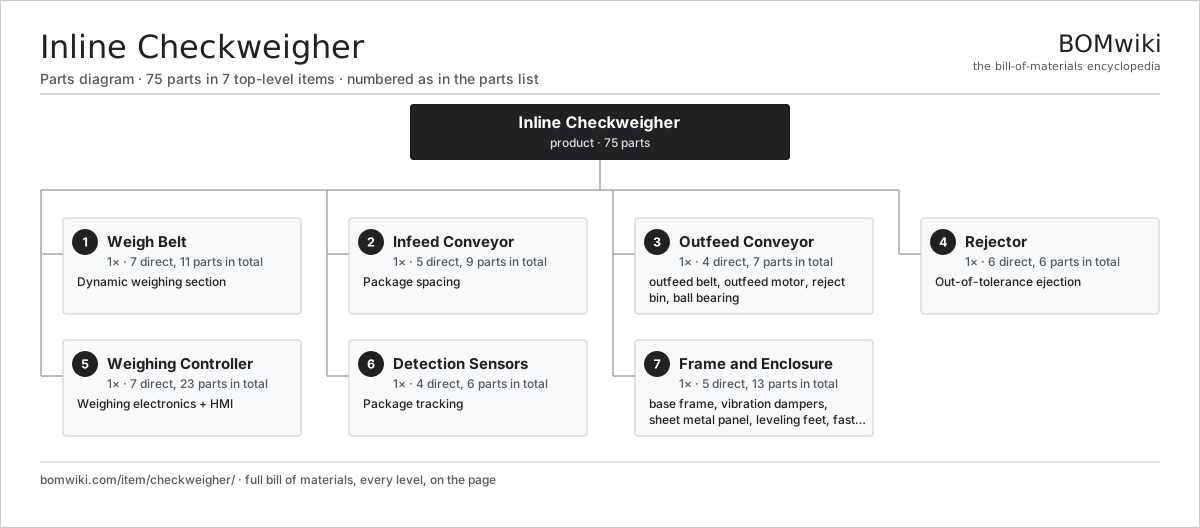
| # | Part | Qty | What it does |
|---|---|---|---|
| 1 | Weigh Belt 7 parts | 1× | Dynamic weighing section |
| 2 | Infeed Conveyor 5 parts | 1× | Package spacing |
| 3 | Outfeed Conveyor 4 parts | 1× | Belt that carries weighed packages past the rejector and back to the production line. |
| 4 | Rejector 6 parts | 1× | Out-of-tolerance ejection |
| 5 | Weighing Controller 7 parts | 1× | Weighing electronics + HMI |
| 6 | Detection Sensors 4 parts | 1× | Package tracking |
| 7 | Frame and Enclosure 5 parts | 1× | Stainless washdown frame that isolates the weigh cell from floor and line vibration. |
3D model
No 3D model yet. Have a CAD file of this? Add a 3D model. STL renders right on this page; STEP, FreeCAD, and OpenSCAD sources are welcome too (openly licensed, like all 3D models on BOMwiki).
Build & assembly graph
expand / collapse · shared sub-assemblies converge · links to related products · est. labourTap an assembly to expand/collapse · tap a part to open it · use “Open page” for any node · drag to pan, scroll to zoom.
Bill of materials for Inline Checkweigher
7 top-level lines · 53 rows shown · 75 parts total · indented to 3 levels| # | Item / sub-assembly | Part no. | Qty/assy | Ext. qty | Parts | Type |
|---|---|---|---|---|---|---|
| 1 | Weigh Belt 7 parts | checkweigher-weigh-belt | 1× | 1 | 11 | assembly |
| 1.1 | Load Cell | checkweigher-load-cell | 1× | 1 | · | part |
| 1.2 | Weigh Platform | checkweigher-weigh-platform | 1× | 1 | · | part |
| 1.3 | Weigh Belt Band | checkweigher-weigh-belt-band | 1× | 1 | · | part |
| 1.4 | Belt Motor | checkweigher-belt-motor | 1× | 1 | · | part |
| 1.5 | Belt Rollers | checkweigher-belt-rollers | 2× | 2 | · | part |
| 1.6 | Belt Tension Adjuster | checkweigher-tension-adjuster | 1× | 1 | · | part |
| 1.7 | Ball Bearing | ball-bearing | 4× | 4 | · | part |
| 2 | Infeed Conveyor 5 parts | checkweigher-infeed-conveyor | 1× | 1 | 9 | assembly |
| 2.1 | Infeed Belt | checkweigher-infeed-belt | 1× | 1 | · | part |
| 2.2 | Infeed Motor | checkweigher-infeed-motor | 1× | 1 | · | part |
| 2.3 | Gapping Roller | checkweigher-gapping-roller | 1× | 1 | · | part |
| 2.4 | Side Guides | checkweigher-side-guides | 2× | 2 | · | part |
| 2.5 | Ball Bearing | ball-bearing | 4× | 4 | · | part |
| 3 | Outfeed Conveyor 4 parts | checkweigher-outfeed-conveyor | 1× | 1 | 7 | assembly |
| 3.1 | Outfeed Belt | checkweigher-outfeed-belt | 1× | 1 | · | part |
| 3.2 | Outfeed Motor | checkweigher-outfeed-motor | 1× | 1 | · | part |
| 3.3 | Reject Bin | checkweigher-reject-bin | 1× | 1 | · | part |
| 3.4 | Ball Bearing | ball-bearing | 4× | 4 | · | part |
| 4 | Rejector 6 parts | checkweigher-rejector | 1× | 1 | 6 | assembly |
| 4.1 | Pusher Cylinder | checkweigher-pusher-cylinder | 1× | 1 | · | part |
| 4.2 | Pusher Plate | checkweigher-pusher-plate | 1× | 1 | · | part |
| 4.3 | Air Blast Nozzle | checkweigher-air-nozzle | 1× | 1 | · | part |
| 4.4 | Reject Valve | checkweigher-reject-valve | 1× | 1 | · | part |
| 4.5 | Reject Confirmation Sensor | checkweigher-reject-confirm-sensor | 1× | 1 | · | part |
| 4.6 | Pressure Sensor | pressure-sensor | 1× | 1 | · | part |
| 5 | Weighing Controller 7 parts | checkweigher-controller | 1× | 1 | 23 | assembly |
| 5.1 | Signal Processor 4 parts | checkweigher-signal-processor | 1× | 1 | 7 | assembly |
| 5.1.1 | Bare PCB | pcb-bare | 1× | 1 | · | part |
| 5.1.2 | Compute SoC Module | soc-module | 1× | 1 | · | part |
| 5.1.3 | SMD Passive (R/C/L) | smd-passives | 1× | 1 | · | part |
| 5.1.4 | Connector | connector | 4× | 4 | · | part |
| 5.2 | LCD Panel | lcd-panel | 1× | 1 | · | part |
| 5.3 | Touch Digitizer | touch-digitizer | 1× | 1 | · | part |
| 5.4 | Power Supply | power-supply | 1× | 1 | · | part |
| 5.5 | Relay | relay | 3× | 3 | · | part |
| 5.6 | I/O Board 4 parts | checkweigher-io-board | 1× | 1 | 9 | assembly |
| 5.6.1 | Bare PCB | pcb-bare | 1× | 1 | · | part |
| 5.6.2 | Microcontroller | mcu | 1× | 1 | · | part |
| 5.6.3 | SMD Passive (R/C/L) | smd-passives | 1× | 1 | · | part |
| 5.6.4 | Connector | connector | 6× | 6 | · | part |
| 5.7 | Wire Bundle | wire-bundle | 1× | 1 | · | part |
| 6 | Detection Sensors 4 parts | checkweigher-detection-sensors | 1× | 1 | 6 | assembly |
| 6.1 | Entry Photocell | checkweigher-entry-photocell | 1× | 1 | · | part |
| 6.2 | Exit Photocell | checkweigher-exit-photocell | 1× | 1 | · | part |
| 6.3 | Encoder | encoder | 1× | 1 | · | part |
| 6.4 | Connector | connector | 3× | 3 | · | part |
| 7 | Frame and Enclosure 5 parts | checkweigher-frame | 1× | 1 | 13 | assembly |
| 7.1 | Base Frame | checkweigher-base-frame | 1× | 1 | · | part |
| 7.2 | Vibration Dampers | checkweigher-vibration-dampers | 4× | 4 | · | part |
| 7.3 | Sheet Metal Panel | sheet-panel | 3× | 3 | · | part |
| 7.4 | Leveling Feet | checkweigher-leveling-feet | 4× | 4 | · | part |
| 7.5 | Fastener Set | fastener-set | 1× | 1 | · | part |
Something wrong in this list? Report a problem with this BOM.
Related products
same domain, ranked by shared parts Cartoning Machine
280 parts · shares 3 with this page
Gantry Palletizer
236 parts · shares 3 with this page
Cartoning Machine
280 parts · shares 3 with this page
Gantry Palletizer
236 parts · shares 3 with this page
 Strapping Machine
218 parts · shares 3 with this page
VFFS Machine
237 parts · shares 3 with this page
Strapping Machine
218 parts · shares 3 with this page
VFFS Machine
237 parts · shares 3 with this page
 Packaging & Filling Line
1,443 parts · shares 2 with this page
Automatic Labeling Machine
104 parts · shares 2 with this page
Packaging & Filling Line
1,443 parts · shares 2 with this page
Automatic Labeling Machine
104 parts · shares 2 with this page
Sourcing: possible vendors
Browse the supplier directory → Prices, MOQ, and lead times are algorithmic estimates, not quotes, and not claims about these companies. Company mappings are curated by keyword; est. price band $10k–$3M. How estimates work| Vendor | HQ | Specialty | MOQ | Lead time |
|---|---|---|---|---|
| heidelberg.com ↗ | Heidelberg, DE | Printing presses | 10 units | 12–22 wks |
|
🇨🇭Bobst
bobst.com ↗
|
Lausanne, CH | Packaging machinery | 10 units | 12–22 wks |
| koenig-bauer.com ↗ | Würzburg, DE | Printing presses | 10 units | 12–22 wks |
| wuh-group.com ↗ | Lengerich, DE | Flexible packaging machines | 10 units | 12–22 wks |
| markandy.com ↗ | Chesterfield, US | Label presses | 10 units | 12–22 wks |
758-word article