Cheque Printer
ProductOverview
The cheque printer is a specialized, high-reliability document printer designed exclusively for printing bank cheques in the financial services industry. Unlike general-purpose office printers, a cheque printer incorporates two critical technologies:
MICR (Magnetic Ink Character Recognition): The account number and routing code printed at the bottom of a cheque are rendered in ferromagnetic ink containing iron oxide particles. This ink can be read by high-speed automated cheque-processing equipment in banks, allowing cheques to be cleared and funds distributed without manual data entry.
Security and Audit: The cheque printer maintains precise control over which cheques are printed, when, and by whom, supporting regulatory requirements for fraud prevention and financial audit trails.
The dedicated cheque printer has been the backbone of paper-based banking for 50+ years, and despite electronic payment growth, remains in use in corporate finance departments, law firms, and financial institutions worldwide.
How it works
MICR Ink Chemistry: The MICR ribbon is impregnated with a special ferromagnetic ink containing finely-divided iron oxide particles suspended in an oil-based carrier. This ink has a unique property: when printed on paper, the iron oxide particles are magnetically attractive and can be reliably read by MICR reader equipment operating at 5–10 MHz.
The ink differs from regular printer ink in several ways:
- Magnetic Property: Iron oxide gives the ink a measurable magnetic susceptibility. MICR readers detect the presence and absence of ink by changes in magnetic flux.
- Particle Size and Distribution: Particles are carefully controlled (typically 1–10 microns) to ensure consistent permeability and detectability.
- Carrier Viscosity: The oil-based carrier is formulated to flow smoothly from the ribbon onto paper during impact but dry quickly to prevent smudging.
Wire-Dot Matrix Print Head: The MICR print head operates on the same principle as early impact matrix printers:
- A column of 9–24 fine steel wires (typically 0.5 mm diameter) are arranged vertically.
- Each wire is coupled to a solenoid (electromagnet).
- To print a character, the controller energizes selected solenoids in a precise sequence, pulling their wires forward to strike the MICR ribbon.
- The ribbon is backed by the platen, so each wire impact deposits a dot of MICR ink on the cheque.
- Multiple passes (vertical advances) build up the character dot-by-dot.
For example, to print the digit "5", the controller might energize wires 1, 2, 3, 5, and 9 in the first vertical pass, then advance the ribbon and cheque, energize a different set of wires, and repeat. The result is a recognizable digit formed by dots.
Cheque Feed and Transport: The feed mechanism uses a pickup roller to separate and pull individual cheques from the input stack, feeding them through transport rollers to the print head. A stepper motor advances cheques line-by-line in precise increments, ensuring that the account number is printed in the correct position (bottom, 5/8 inch from the edge, as per banking standards).
Ribbon Advance: After each character is printed, the ribbon motor advances the MICR ribbon by a small amount to position fresh ink. Some ribbets support multiple strikes per ribbon area (multi-strike ribbons, used 2–3 times); others are single-strike and discarded after full depletion.
Post-Print Ejection: Completed cheques are automatically ejected into the output tray, ready for distribution or mailing.
MICR Specification and Banking Standards
The MICR specification is rigidly defined by the American Bankers Association (ABA) and adopted internationally:
- Font: A unique, chunky mono-space font (E-13B) designed to be readable by both humans and machines.
- Position: The routing number and account number are printed on a line 5/8 inch from the bottom of the cheque.
- Size: Characters are 0.104 inches tall.
- Ink Color: Pure black or dark brown (visually), but always ferromagnetic (the magnetic property is essential).
- Magnetic Properties: The ink must have a magnetic permeability sufficient for detection at 5–10 MHz with at least a 3:1 signal-to-noise ratio.
Non-compliance with MICR standards results in:
- Cheques are rejected by bank clearing equipment and returned to the issuer unpaid.
- Significant operational friction: customers must rewrite cheques or re-pay via electronic transfer.
- Regulatory penalties in some jurisdictions.
Security Features
Cheque printers incorporate several security measures:
- Controlled Dispensing: Blank cheques are stored in a locked cabinet; the printer only feeds cheques when explicitly commanded, preventing unauthorized printing of additional cheques.
- Audit Logging: Every cheque number printed, the date, time, and user are logged to an internal audit trail, supporting regulatory and forensic investigation if needed.
- Ink Cartridge Identification: Some advanced models use cartridges that must be authenticated (via a chip or barcode) before printing is allowed, preventing use of non-approved, potentially counterfeit MICR inks.
- Positioning Control: The platen and print head positions are precisely calibrated, preventing offset or smudged printing that could render cheques unreadable or appear fraudulent.
Maintenance and Longevity
The MICR print head is the most wear-intensive component:
- Wire Life: 10–50 million strikes (depending on duty cycle, ink quality, and platen hardness). At 100 cheques per hour, 24/7 operation, a head might last 4–20 years.
- Platen Wear: The platen gradually hardens and may develop a glaze, reducing ink transfer. Platen life is typically 5–10 million impressions. Replacement involves removing end caps, sliding out the platen shaft, and installing a new platen, a 15-minute field service task.
- Ribbon Cartridge: Discarded when ink is depleted; no field maintenance needed. Cartridges are relatively inexpensive ($20–50).
Periodic maintenance includes:
- Cleaning the print head of dried ink or debris using cotton swabs and solvent.
- Inspecting feed rollers for worn edges or slippage; cleaning with dry cloth or replacing if worn.
- Checking cheque path for jams and ensuring guides are clean.
Cheque Processing Workflow
In a typical corporate finance workflow:
- The accounts payable team prepares a list of cheques to print (payee, amount, account number, date).
- Blank pre-printed cheques (stock cheques with company logo, but no account or amount information) are loaded into the input tray.
- The accounting software (QuickBooks, NetSuite, etc.) sends cheque data to the printer controller via serial or parallel port.
- The feeder pulls cheques one by one.
- The print head prints the amount, date, and routing/account information in MICR ink.
- Completed cheques fall into the output tray, are optionally signed, and mailed or hand-delivered.
- The printer logs each cheque to an audit file (cheque number, date, amount, payee) for reconciliation and fraud detection.
Market and Legacy Context
The cheque printer market peaked in the 1990s–2000s as a high-volume, high-security document printer. However, electronic payment systems (ACH, wire transfer, credit cards, mobile payment) have dramatically reduced cheque usage in North America and Europe.
In 2024, cheques remain important in:
- Australia, Canada, UK: Still widely used for business-to-business payments and rent payments.
- Developing Nations: Where electronic infrastructure is less mature.
- Legal and Government: Court-ordered payments, government benefits, and certain regulatory requirements still demand cheques.
As a result, dedicated cheque printers are now niche products, manufactured primarily by:
- Deluxe: Specializes in cheque printing (software and hardware).
- S.P. Richards and other distributors: Refurbish and resell used cheque printers.
A new cheque printer costs $2,000–5,000. Used models in good condition can be found for $500–1,500. The secondary market remains active because the cost of specialized hardware is low compared to the value of in-house cheque printing (avoiding outsourcing to cheque vendors).
Future and Digital Alternatives
Some organizations have migrated to digital alternatives:
- Mobile Deposit: Customers photograph cheques for deposit; no physical cheque handling needed.
- Wire Transfer and ACH: Electronic fund movement eliminates cheque printing.
- Virtual Cheques: PDF files with MICR rendering, signed digitally and archived rather than printed.
However, until electronic payment systems achieve full penetration in all markets and industries, the dedicated cheque printer remains a valuable tool for organizations that issue cheques in volume.
Cheque Printer parts and their functions
7 top-level parts · 38 parts in total · full bill of materials below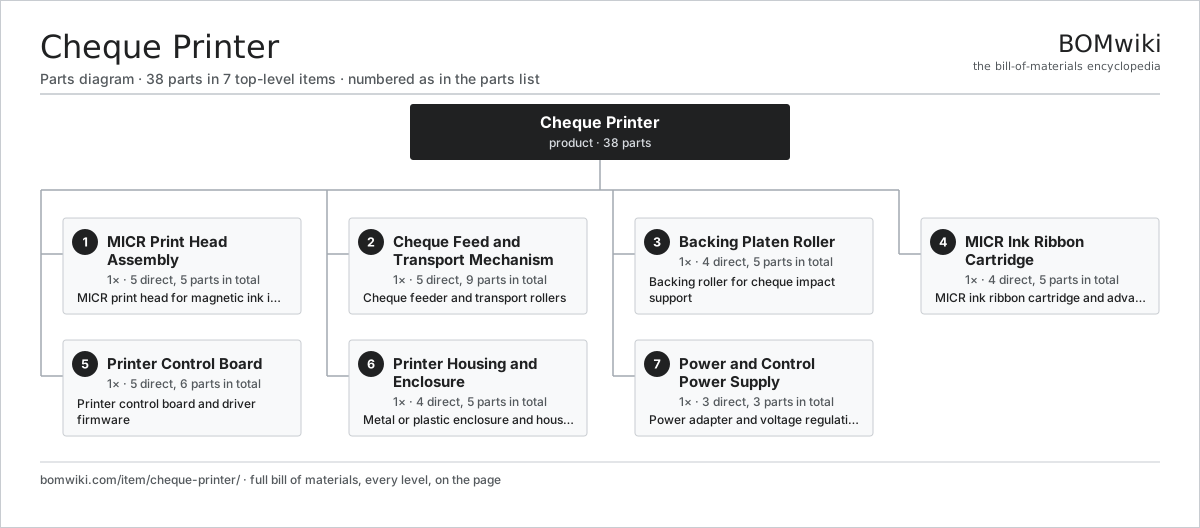
| # | Part | Qty | What it does |
|---|---|---|---|
| 1 | MICR Print Head Assembly 5 parts | 1× | MICR print head for magnetic ink impression |
| 2 | Cheque Feed and Transport Mechanism 5 parts | 1× | Cheque feeder and transport rollers |
| 3 | Backing Platen Roller 4 parts | 1× | Backing roller for cheque impact support |
| 4 | MICR Ink Ribbon Cartridge 4 parts | 1× | MICR ink ribbon cartridge and advance |
| 5 | Printer Control Board 5 parts | 1× | Printer control board and driver firmware |
| 6 | Printer Housing and Enclosure 4 parts | 1× | Metal or plastic enclosure and housing |
| 7 | Power and Control Power Supply 3 parts | 1× | Power adapter and voltage regulation |
3D model
No 3D model yet. Have a CAD file of this? Add a 3D model. STL renders right on this page; STEP, FreeCAD, and OpenSCAD sources are welcome too (openly licensed, like all 3D models on BOMwiki).
Build & assembly graph
expand / collapse · shared sub-assemblies converge · links to related products · est. labourTap an assembly to expand/collapse · tap a part to open it · use “Open page” for any node · drag to pan, scroll to zoom.
Bill of materials for Cheque Printer
7 top-level lines · 37 rows shown · 38 parts total · indented to 3 levels| # | Item / sub-assembly | Part no. | Qty/assy | Ext. qty | Parts | Type |
|---|---|---|---|---|---|---|
| 1 | MICR Print Head Assembly 5 parts | cheque-printer-micr-head | 1× | 1 | 5 | assembly |
| 1.1 | Print Wire Matrix | cheque-printer-print-wire-matrix | 1× | 1 | · | part |
| 1.2 | Solenoid Driver Array | cheque-printer-solenoid-array | 1× | 1 | · | part |
| 1.3 | Print Head Return Spring | cheque-printer-head-spring | 1× | 1 | · | part |
| 1.4 | Print Head Mount Bracket | cheque-printer-head-mounting | 1× | 1 | · | part |
| 1.5 | Fastener Set | fastener-set | 1× | 1 | · | part |
| 2 | Cheque Feed and Transport Mechanism 5 parts | cheque-printer-feed-system | 1× | 1 | 9 | assembly |
| 2.1 | Feed System Motor | cheque-printer-feed-motor | 1× | 1 | · | part |
| 2.2 | Pickup Roller | cheque-printer-pickup-roller | 1× | 1 | · | part |
| 2.3 | Transport Roller Pair | cheque-printer-feed-rollers | 2× | 2 | · | part |
| 2.4 | Ball Bearing | ball-bearing | 4× | 4 | · | part |
| 2.5 | Fastener Set | fastener-set | 1× | 1 | · | part |
| 3 | Backing Platen Roller 4 parts | cheque-printer-platen | 1× | 1 | 5 | assembly |
| 3.1 | Platen Core Shaft | cheque-printer-platen-core | 1× | 1 | · | part |
| 3.2 | Impact Absorber Coating | cheque-printer-platen-covering | 1× | 1 | · | part |
| 3.3 | Ball Bearing | ball-bearing | 2× | 2 | · | part |
| 3.4 | Fastener Set | fastener-set | 1× | 1 | · | part |
| 4 | MICR Ink Ribbon Cartridge 4 parts | cheque-printer-ribbon-system | 1× | 1 | 5 | assembly |
| 4.1 | Ribbon Supply Spool | cheque-printer-ribbon-spool | 2× | 2 | · | part |
| 4.2 | Ribbon Advance Motor | cheque-printer-ribbon-motor | 1× | 1 | · | part |
| 4.3 | Ribbon Tension Control | cheque-printer-ribbon-tension | 1× | 1 | · | part |
| 4.4 | Fastener Set | fastener-set | 1× | 1 | · | part |
| 5 | Printer Control Board 5 parts | cheque-printer-controller | 1× | 1 | 6 | assembly |
| 5.1 | Microcontroller | mcu | 1× | 1 | · | part |
| 5.2 | Bare PCB | pcb-bare | 1× | 1 | · | part |
| 5.3 | Solenoid Driver Stage | cheque-printer-solenoid-driver | 1× | 1 | · | part |
| 5.4 | Connector | connector | 2× | 2 | · | part |
| 5.5 | Fastener Set | fastener-set | 1× | 1 | · | part |
| 6 | Printer Housing and Enclosure 4 parts | cheque-printer-case | 1× | 1 | 5 | assembly |
| 6.1 | Enclosure Shell | cheque-printer-case-body | 1× | 1 | · | part |
| 6.2 | Cheque Input Hopper | cheque-printer-input-tray | 1× | 1 | · | part |
| 6.3 | Printed Cheque Output Tray | cheque-printer-output-tray | 1× | 1 | · | part |
| 6.4 | Fastener Set | fastener-set | 2× | 2 | · | part |
| 7 | Power and Control Power Supply 3 parts | cheque-printer-power-supply | 1× | 1 | 3 | assembly |
| 7.1 | Power Supply | power-supply | 1× | 1 | · | part |
| 7.2 | Connector | connector | 1× | 1 | · | part |
| 7.3 | Fastener Set | fastener-set | 1× | 1 | · | part |
Something wrong in this list? Report a problem with this BOM.
Related products
same domain, ranked by shared parts Cash Deposit Machine
64 parts · shares 2 with this page
Check Scanner
83 parts · shares 2 with this page
Coin Counting Kiosk
63 parts · shares 2 with this page
Coin Sorter / Counter
95 parts · shares 2 with this page
Cash Deposit Machine
64 parts · shares 2 with this page
Check Scanner
83 parts · shares 2 with this page
Coin Counting Kiosk
63 parts · shares 2 with this page
Coin Sorter / Counter
95 parts · shares 2 with this page
Sourcing: possible vendors
Browse the supplier directory → Prices, MOQ, and lead times are algorithmic estimates, not quotes, and not claims about these companies. Company mappings are curated by keyword; est. price band $50–$15k. How estimates work| Vendor | HQ | Specialty | MOQ | Lead time |
|---|---|---|---|---|
|
🇯🇵Canon
canon.com ↗
|
Tokyo, JP | Imaging & optics | 500 units | 8–12 wks |
|
🇯🇵Ricoh
ricoh.com ↗
|
Tokyo, JP | Office imaging | 500 units | 8–12 wks |
|
🇺🇸Xerox
xerox.com ↗
|
Norwalk, US | Printers & copiers | 500 units | 8–12 wks |
|
🇯🇵Epson
epson.com ↗
|
Suwa, JP | Printers & projectors | 500 units | 8–12 wks |
|
🇯🇵Brother
brother.com ↗
|
Nagoya, JP | Printers & sewing | 500 units | 8–12 wks |
1,405-word article