Chess Clock
ProductOverview
A chess clock is two timers in one box, interlocked so that exactly one runs at any moment. After moving, a player presses their side of the clock; that press stops their own countdown and starts the opponent's. The device predates electronics, mechanical versions with two spring-driven movements and a see-saw bar appeared in the 1880s, but the modern tournament standard is digital, because rules like the Fischer increment cannot be implemented with gears.
The clock divides into the Dual Display Assembly the players read, the Rocker Mechanism they strike, the Control Board that does the counting, the Settings Interface for programming, and the Housing and Power System system.
The rocker
The visible signature of a chess clock is the Rocker Bar, a rigid lever spanning the case on a central Rocker Pivot. Its two ends are mechanically complementary: pressing the raised end drops it and raises the other, so the bar itself displays whose clock is running from across the room. Under each end a Plunger rides on a Coil Spring and actuates a snap-action Microswitch rated for over a million cycles, a blitz game alone can involve a hundred presses per side, delivered as slaps on the wide End Caps. The detent at the pivot makes each state positive; a half-pressed bar is not a legal state the electronics can see.
In the mechanical ancestors the same bar tilted a pair of balance-wheel movements so that one balance was physically arrested while the other ran. The digital version keeps the bar purely as a switch actuator, both for the familiar motion and because FIDE rules require the player to press the clock with the same hand that moved the piece.
Timing electronics
The Control Board is built around an Microcontroller clocked by a Timing Crystal at 32,768 Hz, the standard watch frequency, divided in firmware to drive two independent down-counters. Accuracy around ±20 ppm means well under half a second of drift across a six-hour classical session. Each counter maps through a Zebra Strip to its own LCD Panel behind a Display Bezel, showing hours, minutes, and seconds, switching to tenths below one minute. When a register hits zero the Flag Icon latches on, the segment is drawn as a small flag, after the pivoting flag that fell from the minute hand of analog clocks, and stays on so the arbiter can see which player lost on time even if the other flag falls later. The shared Move Counter increments on each completed pair of presses, which multi-period controls need ("40 moves in 90 minutes, then 30 minutes to finish").
The firmware implements the time-control algebra that made digital clocks mandatory. Fischer increment adds a fixed bonus (commonly 2–30 s) to a player's register at each press. Bronstein delay refunds up to the delay amount actually used, so the register never grows. Japanese byo-yomi, for go, gives repeating fixed periods after main time expires. All of these live in the Preset Store alongside user-programmable slots, selected through the Mode Buttons. A Pause Button freezes both registers for arbiter rulings, and the Sound Switch silences the Speaker, which otherwise beeps at time warnings.
Housing and power
The Upper Case and Lower Case form a low ABS wedge about 200 mm wide, angling both displays toward the players. Mass and the four Rubber Foot pads matter more than they look: the clock must not skate across the table under repeated blitz slaps, and FIDE regulations require the clock to sit on the side the arbiter designates, visible to both players.
Power is two AA cells in the Battery Holder behind a tool-free Battery Door. An LCD-based design draws so little, tens of microamps outside of beeps, that operating life exceeds 3,000 hours, and the firmware preserves both registers through a brief cell swap. The board connects to switches and displays through Connector headers and a short Wire Bundle, and the shells close with a standard Fastener Set. Tournament-approved models (DGT's line is the FIDE standard) add features such as automatic period changeover keyed to the move counter and a freeze rule that stops both clocks when one flag falls.
Chess Clock parts and their functions
6 top-level parts · 47 parts in total · full bill of materials below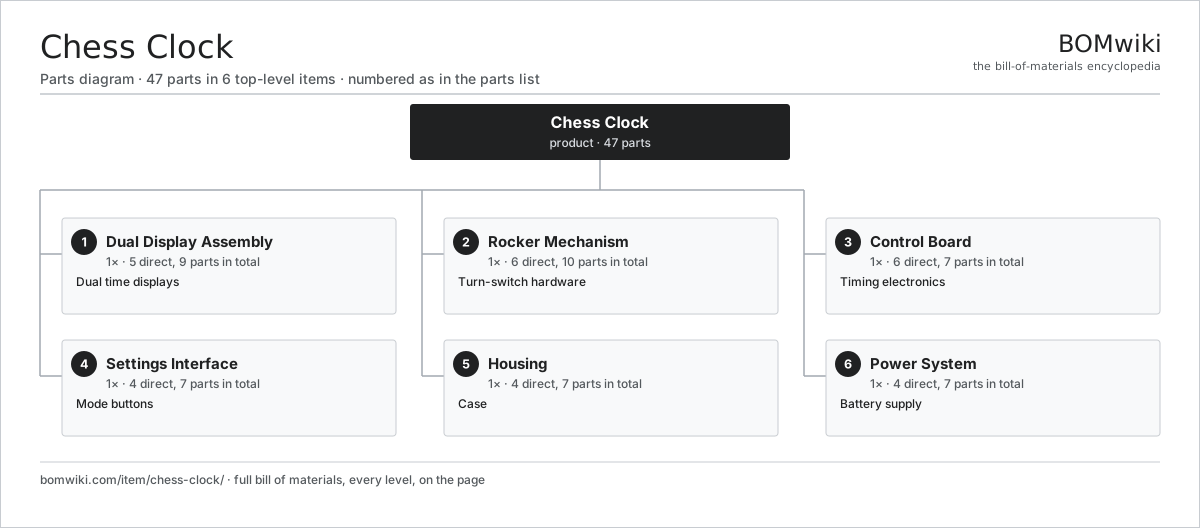
| # | Part | Qty | What it does |
|---|---|---|---|
| 1 | Dual Display Assembly 5 parts | 1× | Dual time displays |
| 2 | Rocker Mechanism 6 parts | 1× | Turn-switch hardware |
| 3 | Control Board 6 parts | 1× | Timing electronics |
| 4 | Settings Interface 4 parts | 1× | Mode buttons |
| 5 | Housing 4 parts | 1× | Case |
| 6 | Power System 4 parts | 1× | Battery supply |
3D model
No 3D model yet. Have a CAD file of this? Add a 3D model. STL renders right on this page; STEP, FreeCAD, and OpenSCAD sources are welcome too (openly licensed, like all 3D models on BOMwiki).
Build & assembly graph
expand / collapse · shared sub-assemblies converge · links to related products · est. labourTap an assembly to expand/collapse · tap a part to open it · use “Open page” for any node · drag to pan, scroll to zoom.
Bill of materials for Chess Clock
6 top-level lines · 35 rows shown · 47 parts total · indented to 3 levels| # | Item / sub-assembly | Part no. | Qty/assy | Ext. qty | Parts | Type |
|---|---|---|---|---|---|---|
| 1 | Dual Display Assembly 5 parts | chess-clock-display-assembly | 1× | 1 | 9 | assembly |
| 1.1 | LCD Panel | lcd-panel | 2× | 2 | · | part |
| 1.2 | Display Bezel | chess-clock-display-bezel | 2× | 2 | · | part |
| 1.3 | Zebra Strip | chess-clock-zebra-strip | 2× | 2 | · | part |
| 1.4 | Flag Icon | chess-clock-flag-icon | 2× | 2 | · | part |
| 1.5 | Move Counter | chess-clock-move-counter | 1× | 1 | · | part |
| 2 | Rocker Mechanism 6 parts | chess-clock-rocker-mechanism | 1× | 1 | 10 | assembly |
| 2.1 | Rocker Bar | chess-clock-rocker-bar | 1× | 1 | · | part |
| 2.2 | Rocker Pivot | chess-clock-rocker-pivot | 1× | 1 | · | part |
| 2.3 | Plunger | chess-clock-plunger | 2× | 2 | · | part |
| 2.4 | Microswitch | chess-clock-microswitch | 2× | 2 | · | part |
| 2.5 | Coil Spring | coil-spring | 2× | 2 | · | part |
| 2.6 | End Cap | chess-clock-end-cap | 2× | 2 | · | part |
| 3 | Control Board 6 parts | chess-clock-control-board | 1× | 1 | 7 | assembly |
| 3.1 | Bare PCB | pcb-bare | 1× | 1 | · | part |
| 3.2 | Microcontroller | mcu | 1× | 1 | · | part |
| 3.3 | Timing Crystal | chess-clock-crystal | 1× | 1 | · | part |
| 3.4 | SMD Passive (R/C/L) | smd-passives | 1× | 1 | · | part |
| 3.5 | Speaker | speaker | 1× | 1 | · | part |
| 3.6 | Connector | connector | 2× | 2 | · | part |
| 4 | Settings Interface 4 parts | chess-clock-settings-interface | 1× | 1 | 7 | assembly |
| 4.1 | Mode Button | chess-clock-mode-button | 4× | 4 | · | part |
| 4.2 | Pause Button | chess-clock-pause-button | 1× | 1 | · | part |
| 4.3 | Preset Store | chess-clock-preset-rom | 1× | 1 | · | part |
| 4.4 | Sound Switch | chess-clock-sound-switch | 1× | 1 | · | part |
| 5 | Housing 4 parts | chess-clock-housing | 1× | 1 | 7 | assembly |
| 5.1 | Upper Case | chess-clock-case-upper | 1× | 1 | · | part |
| 5.2 | Lower Case | chess-clock-case-lower | 1× | 1 | · | part |
| 5.3 | Rubber Foot | chess-clock-rubber-foot | 4× | 4 | · | part |
| 5.4 | Fastener Set | fastener-set | 1× | 1 | · | part |
| 6 | Power System 4 parts | chess-clock-power | 1× | 1 | 7 | assembly |
| 6.1 | Battery Holder | chess-clock-battery-holder | 1× | 1 | · | part |
| 6.2 | Battery Contact | chess-clock-battery-contact | 4× | 4 | · | part |
| 6.3 | Battery Door | chess-clock-battery-door | 1× | 1 | · | part |
| 6.4 | Wire Bundle | wire-bundle | 1× | 1 | · | part |
Something wrong in this list? Report a problem with this BOM.
Related products
same domain, ranked by shared parts Radio-Controlled Atomic Clock
130 parts · shares 6 with this page
GPS NTP Time Server
37 parts · shares 5 with this page
Radio-Controlled Atomic Clock
130 parts · shares 6 with this page
GPS NTP Time Server
37 parts · shares 5 with this page
 Watch Winder
39 parts · shares 5 with this page
Watch Winder
39 parts · shares 5 with this page
 Railway Station Clock
43 parts · shares 4 with this page
Railway Station Clock
43 parts · shares 4 with this page
 Carriage Clock
49 parts · shares 1 with this page
Carriage Clock
49 parts · shares 1 with this page
Sourcing: possible vendors
Browse the supplier directory → Prices, MOQ, and lead times are algorithmic estimates, not quotes, and not claims about these companies. Company mappings are curated by keyword; est. price band $20–$50k. How estimates work| Vendor | HQ | Specialty | MOQ | Lead time |
|---|---|---|---|---|
|
🇯🇵Seiko
seikowatches.com ↗
|
Tokyo, JP | Watches | 500 units | 8–14 wks |
|
🇯🇵Citizen
citizenwatch-global.com ↗
|
Tokyo, JP | Watches | 500 units | 8–14 wks |
|
🇯🇵Casio
casio.com ↗
|
Tokyo, JP | Watches & electronics | 500 units | 8–14 wks |
| swatchgroup.com ↗ | Biel, CH | Watches (Omega, Tissot) | 500 units | 8–14 wks |
| titancompany.in ↗ | Bengaluru, IN | Watches & timepieces | 500 units | 8–14 wks |
761-word article