Clarinet
ProductOverview
The clarinet is a single-reed woodwind with a cylindrical bore, most commonly pitched in B-flat. It assembles from five sections: the Mouthpiece Assembly, the short tuning Barrel, the Upper Joint Assembly and Lower Joint Assembly that carry the tone holes and keywork, and the flared Bell Assembly. Assembled length is about 660 mm and the bore runs 14.6–14.9 mm for most of that length.
Acoustically the clarinet is the orchestra's odd one out. Because the reed end is effectively closed and the bore is cylindrical, the air column behaves as a closed-open pipe: it sounds an octave lower than an open pipe of the same length, its spectrum in the low register is dominated by odd harmonics (the source of the hollow chalumeau timbre), and it overblows at the twelfth rather than the octave. That twelfth is why the clarinet needs more keywork than a flute or oboe: nineteen semitones, not twelve, must be filled between registers.
How it works
Sound generation happens at the Single Reed, a blade of Arundo donax cane clamped against the Mouthpiece table by the Ligature. The mouthpiece facing curves away from the reed, leaving a tip opening of roughly 1 mm. When the player blows, Bernoulli pressure and the acoustic pressure wave in the bore drive the reed toward the facing, narrowing the gap; the reed acts as a pressure-controlled valve, opening and closing 150 to 1900 times per second in lockstep with the standing wave it sustains. The player's embouchure damps the reed and fine- tunes pitch; reed stiffness is graded by strength numbers from about 2 to 5.
Pitch selection works by venting. Opening a tone hole shortens the effective air column; the clarinet has 24 holes, six covered directly by fingers through Ring Keys and the rest by padded keys. Each key cup carries a Key Pad of fish-skin bladder or leather that must seat airtight, and is returned by a blued-steel Needle Spring anchored in one of the Post Set pillars. Keys pivot on Key Axle rods, with Key Cork facings silencing contact and setting regulation clearances.
The Register Key under the left thumb opens a small vent about a third of the way down the bore. This disrupts the fundamental and lets the third harmonic take over, shifting the note up a twelfth into the clarion register. The same key doubles as the throat B-flat vent, a compromise inherited from the standard Boehm layout. The little fingers operate duplicated Pinky Lever Key clusters so awkward low-register sequences can be fingered on either hand, and the Bridge Key carries motion across the middle joint so upper-joint rings can close a lower-joint pad for the fork fingerings.
Construction
Professional bodies are turned from grenadilla (African blackwood, Dalbergia melanoxylon), an oily wood dense enough at ~1.2 g/cm³ to take precise tone holes and resist bore moisture; student instruments mold the Upper Joint Body and Lower Joint Body from ABS resin, which is dimensionally stable and immune to cracking. Joints mate through Tenon Cork sleeves, greased so they seal yet still slide for tuning. The Barrel, nominally 65–67 mm, is the main tuning element: pulling it out a millimeter flattens the instrument roughly 5 cents, and players swap barrels of different lengths for different halls and temperatures.
The Boehm system standard since the mid-19th century uses 17 keys and 6 rings in silver-plated nickel silver. The Throat Keys fill the break between registers, historically the clarinet's weakest notes. The Bell Body flare does little for most notes, which radiate from the first open tone hole, but it tunes and projects the two notes that use the full tube length, low E and middle B, and the Bell Ring guards the end grain against splits. The instrument hangs on the right thumb at the Thumb Rest; total weight is around 800 g.
Family and variants
The B-flat soprano is the standard orchestral and band instrument; the A clarinet, a semitone longer, shares the same mouthpiece and is preferred for sharp keys in orchestral writing. The family extends from the high E-flat sopranino through the alto, the bass clarinet an octave below the soprano, and contrabass instruments two octaves down. German and Austrian players use the Oehler key system, which keeps fingerings closer to the older Müller clarinet and pairs with a narrower bore and a different tonal ideal. The written range of the soprano runs from E3 to about C7, roughly four octaves, the widest of the standard woodwinds.
Clarinet parts and their functions
5 top-level parts · 67 parts in total · full bill of materials below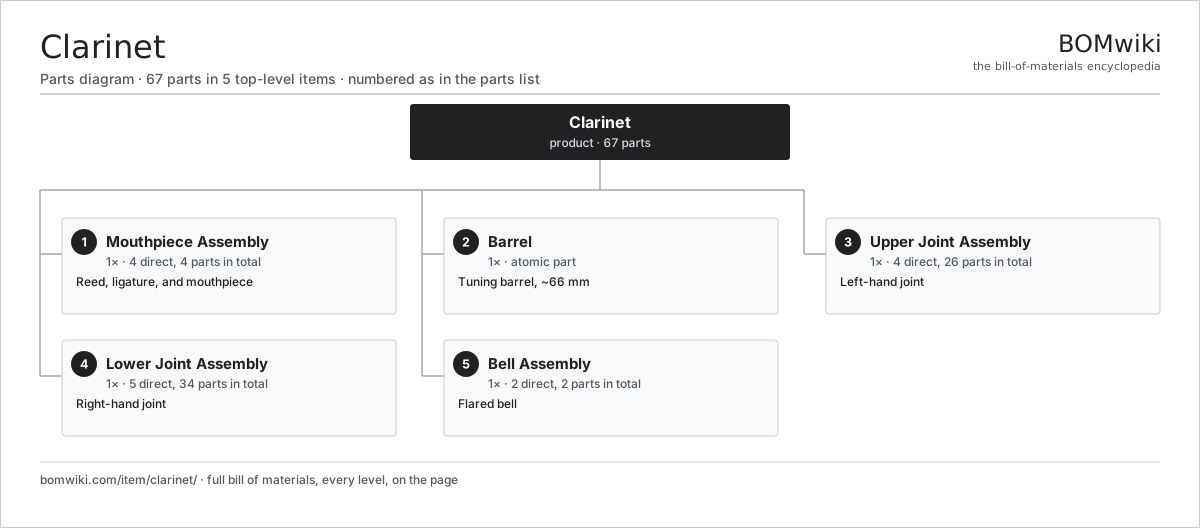
| # | Part | Qty | What it does |
|---|---|---|---|
| 1 | Mouthpiece Assembly 4 parts | 1× | Reed, ligature, and mouthpiece |
| 2 | Barrel | 1× | Tuning barrel, ~66 mm |
| 3 | Upper Joint Assembly 4 parts | 1× | Left-hand joint |
| 4 | Lower Joint Assembly 5 parts | 1× | Right-hand joint |
| 5 | Bell Assembly 2 parts | 1× | Flared bell |
3D model
No 3D model yet. Have a CAD file of this? Add a 3D model. STL renders right on this page; STEP, FreeCAD, and OpenSCAD sources are welcome too (openly licensed, like all 3D models on BOMwiki).
Build & assembly graph
expand / collapse · shared sub-assemblies converge · links to related products · est. labourTap an assembly to expand/collapse · tap a part to open it · use “Open page” for any node · drag to pan, scroll to zoom.
Bill of materials for Clarinet
5 top-level lines · 33 rows shown · 67 parts total · indented to 3 levels| # | Item / sub-assembly | Part no. | Qty/assy | Ext. qty | Parts | Type |
|---|---|---|---|---|---|---|
| 1 | Mouthpiece Assembly 4 parts | clarinet-mouthpiece-assembly | 1× | 1 | 4 | assembly |
| 1.1 | Mouthpiece | clarinet-mouthpiece | 1× | 1 | · | part |
| 1.2 | Single Reed | clarinet-reed | 1× | 1 | · | part |
| 1.3 | Ligature | clarinet-ligature | 1× | 1 | · | part |
| 1.4 | Mouthpiece Cap | clarinet-mouthpiece-cap | 1× | 1 | · | part |
| 2 | Barrel | clarinet-barrel | 1× | 1 | · | part |
| 3 | Upper Joint Assembly 4 parts | clarinet-upper-joint | 1× | 1 | 26 | assembly |
| 3.1 | Upper Joint Body | clarinet-upper-body | 1× | 1 | · | part |
| 3.2 | Tenon Cork | clarinet-tenon-cork | 2× | 2 | · | part |
| 3.3 | Post Set | clarinet-post-set | 1× | 1 | · | part |
| 3.4 | Upper Keywork 6 parts | clarinet-upper-keywork | 1× | 1 | 22 | assembly |
| 3.4.1 | Register Key | clarinet-register-key | 1× | 1 | · | part |
| 3.4.2 | Throat Key | clarinet-throat-key | 2× | 2 | · | part |
| 3.4.3 | Ring Key | clarinet-ring-key | 3× | 3 | · | part |
| 3.4.4 | Key Pad | clarinet-key-pad | 6× | 6 | · | part |
| 3.4.5 | Needle Spring | clarinet-needle-spring | 6× | 6 | · | part |
| 3.4.6 | Key Axle | clarinet-key-axle | 4× | 4 | · | part |
| 4 | Lower Joint Assembly 5 parts | clarinet-lower-joint | 1× | 1 | 34 | assembly |
| 4.1 | Lower Joint Body | clarinet-lower-body | 1× | 1 | · | part |
| 4.2 | Tenon Cork | clarinet-tenon-cork | 1× | 1 | · | part |
| 4.3 | Post Set | clarinet-post-set | 1× | 1 | · | part |
| 4.4 | Lower Keywork 7 parts | clarinet-lower-keywork | 1× | 1 | 30 | assembly |
| 4.4.1 | Ring Key | clarinet-ring-key | 3× | 3 | · | part |
| 4.4.2 | Pinky Lever Key | clarinet-pinky-lever | 6× | 6 | · | part |
| 4.4.3 | Bridge Key | clarinet-bridge-key | 1× | 1 | · | part |
| 4.4.4 | Key Pad | clarinet-key-pad | 7× | 7 | · | part |
| 4.4.5 | Needle Spring | clarinet-needle-spring | 7× | 7 | · | part |
| 4.4.6 | Key Axle | clarinet-key-axle | 5× | 5 | · | part |
| 4.4.7 | Key Cork | clarinet-key-cork | 1× | 1 | · | part |
| 4.5 | Thumb Rest | clarinet-thumb-rest | 1× | 1 | · | part |
| 5 | Bell Assembly 2 parts | clarinet-bell | 1× | 1 | 2 | assembly |
| 5.1 | Bell Body | clarinet-bell-body | 1× | 1 | · | part |
| 5.2 | Bell Ring | clarinet-bell-ring | 1× | 1 | · | part |
Something wrong in this list? Report a problem with this BOM.
Sourcing: possible vendors
Browse the supplier directory → Prices, MOQ, and lead times are algorithmic estimates, not quotes, and not claims about these companies. Company mappings are curated by keyword; est. price band $50–$5k. How estimates work| Vendor | HQ | Specialty | MOQ | Lead time |
|---|---|---|---|---|
| yamaha.com ↗ | Hamamatsu, JP | Audio & instruments | 200 units | 8–14 wks |
|
🇺🇸Fender
fender.com ↗
|
Los Angeles, US | Guitars & amps | 200 units | 8–14 wks |
|
🇺🇸Gibson
gibson.com ↗
|
Nashville, US | Guitars | 200 units | 8–14 wks |
|
🇯🇵Roland
roland.com ↗
|
Hamamatsu, JP | Electronic instruments | 200 units | 8–14 wks |
| steinway.com ↗ | New York, US | Pianos | 200 units | 8–14 wks |
790-word article