Clay Pugmill
ProductOverview
A clay pugmill (also called a pug mill or auger extruder) is an industrial machine that processes raw clay into a uniform, air-free paste suitable for forming into bricks, tiles, or hand-thrown pottery. The pugmill combines three essential functions: mixing heterogeneous clay chunks into a homogeneous mass, de-airing (removing gas bubbles that would cause defects when fired), and extrusion into a continuous log of clay paste.
Large brick and tile manufacturers operate dozens of pugmills simultaneously, feeding extruded clay into brick presses or forming machines. Smaller producers use pugmills to prepare wedged clay for hand-throwing or hand-building. The vacuum de-airing stage is critical: air voids in the clay would expand during kiln firing, causing the piece to bloat, crack, or explode.
How It Works
Raw clay, typically chunks or wedges from aged stockpiles, is loaded into the Hopper. The Hopper Vibrator prevents bridging (clay arching over itself without flowing), ensuring consistent feed. The Feed Gate is manually or pneumatically adjusted to control inlet flow rate.
Clay descends from the hopper into the Auger Barrel, where the Auger Screw flight begins to rotate at 20–100 rpm, driven by the Drive Motor through the Gearbox. The motor is typically 5–15 kW, providing continuous high-torque operation. The gearbox reduces motor speed by 30–100:1, delivering the auger shaft speed in the optimal range for clay mixing.
As the auger rotates, the clay is compressed against the barrel walls and the advancing screw flight. The mixture is worked, sheared, folded, and blended, removing air pockets and mixing the clay mass to uniform composition. This stage is called "plasticizing": rigid chunks gradually become plastic and cohesive.
Midway through the barrel, or in a separate chamber, the Vacuum De-Airing Chamber begins to evacuate air. The Vacuum Pump System, driven by the Pump Motor, generates partial vacuum (0.8–0.95 bar, approximately 80–95 kPa). The vacuum is applied through Vacuum Valve Set solenoids controlled by the machine's PLC. As vacuum is drawn, air bubbles in the clay expand and are sucked out through the vacuum port, leaving behind denser clay. This vacuum stage is essential: non-de-aired clay will exhibit defects in the kiln.
The de-aired, uniform clay paste is then forced forward by the continuing auger rotation toward the Extrusion Nozzle. The nozzle is a hardened steel die block defining the cross-sectional shape of the extrudate, circular (for extruding tubes), rectangular (for bricks or slabs), or custom shapes (for decorative tiles). The extrusion pressure builds up as clay fills the nozzle; typical extrusion pressures are 50–150 bar (5–15 MPa).
As clay emerges from the nozzle orifice in a continuous log, the Cutter activates. A Cutting Blade, driven by Cutter Cylinder pneumatic or hydraulic actuator, sweeps across the log at high speed, severing it at the location defined by Stop Block. The cut pieces, each now a "extrusion" or "column", fall onto a waiting conveyor or cart for transport to the forming machine (brick press, tile press, etc.) or to drying.
Vacuum De-Airing Details
The vacuum process is counter-intuitive to many: adding vacuum (lower pressure) actually removes air more effectively than compressed air would add it. As vacuum is applied, the gas bubbles expand to fill available space, creating pathways for smaller bubbles to coalesce and be pulled out. The Pressure Sensor on the Vacuum Receiver monitors vacuum level, and the PLC maintains it within the optimal range. Insufficient vacuum (<0.85 bar) fails to de-air thoroughly; excessive vacuum (approaching 1 atm of differential) risks clay consistency issues and wasting pump capacity.
Nozzle and Shaping
The Extrusion Nozzle is a replaceable die block, easily swapped to change output shape. A brick nozzle might be 300×100×100 mm rectangular. A tile nozzle might be 400×400×10 mm flat slab. Custom nozzles cost $500–$2000 each depending on complexity, but allow pugmills to produce a wide variety of products without major machine modification.
Temperature and Rheology
Clay viscosity is temperature-dependent. Cold clay is stiff and difficult to extrude; warm clay is more plastic and flows easily. Some pugmills include a heating jacket around the barrel, maintaining clay at 40–60 °C for optimal working properties. Temperature control is especially important when processing recycled clay, which may contain moisture variation.
Production Rates and Throughput
A small pugmill extrudes 10–20 kg/minute of clay paste; large industrial units achieve 100+ kg/minute. Throughput scales with auger speed (higher speed = more volume), but increases in speed must be accompanied by stronger motors and gearboxes, and more vacuum pump capacity to de-air the increased clay flow.
Maintenance and Wear
The auger screw and barrel are in constant contact with abrasive clay, so wear is inevitable. Hardened steel flights and barrels last 2–5 years under heavy use. The Barrel Seal prevents clay leakage around the rotating shaft; this dual-face mechanical seal must be inspected and replaced periodically. The vacuum pump requires a clean Vacuum Filter to avoid clogging; a blocked filter reduces de-airing effectiveness and increases pump power draw.
Environmental and Safety
Pugmill operation generates dust, particularly if dry clay is fed. Many installations include dust collection on the hopper inlet and discharges. The rotating auger is a pinch point and is enclosed by guards to prevent accidental contact. Emergency stop buttons are positioned around the machine. Excessive moisture release during de-airing can saturate the vacuum pump; liquid-ring pumps are more tolerant of moisture than rotary-vane units.
Clay Pugmill parts and their functions
8 top-level parts · 42 parts in total · full bill of materials below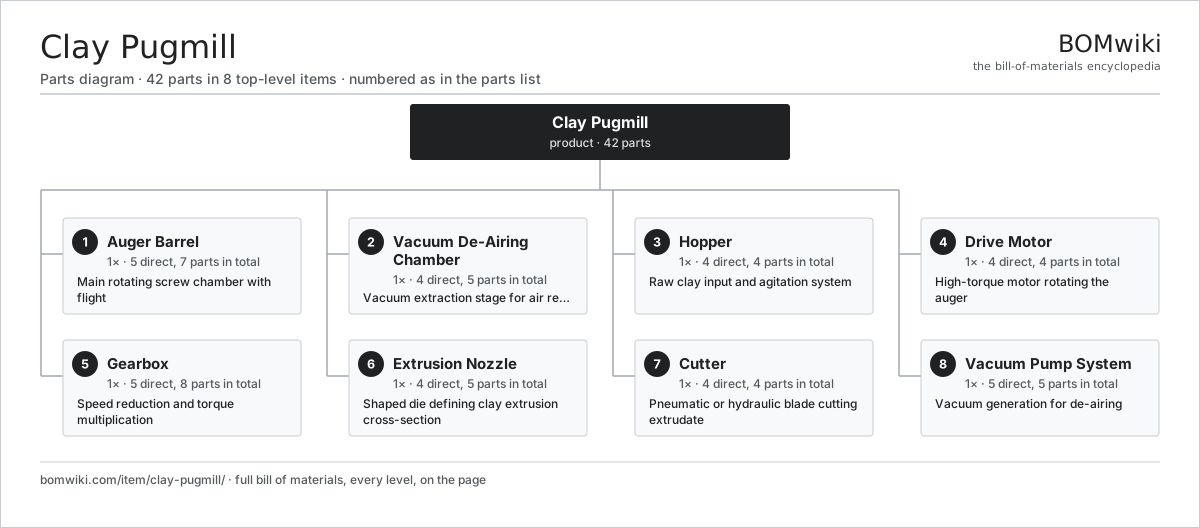
| # | Part | Qty | What it does |
|---|---|---|---|
| 1 | Auger Barrel 5 parts | 1× | Main rotating screw chamber with flight |
| 2 | Vacuum De-Airing Chamber 4 parts | 1× | Vacuum extraction stage for air removal |
| 3 | Hopper 4 parts | 1× | Raw clay input and agitation system |
| 4 | Drive Motor 4 parts | 1× | High-torque motor rotating the auger |
| 5 | Gearbox 5 parts | 1× | Speed reduction and torque multiplication |
| 6 | Extrusion Nozzle 4 parts | 1× | Shaped die defining clay extrusion cross-section |
| 7 | Cutter 4 parts | 1× | Pneumatic or hydraulic blade cutting extrudate |
| 8 | Vacuum Pump System 5 parts | 1× | Vacuum generation for de-airing |
3D model
No 3D model yet. Have a CAD file of this? Add a 3D model. STL renders right on this page; STEP, FreeCAD, and OpenSCAD sources are welcome too (openly licensed, like all 3D models on BOMwiki).
Build & assembly graph
expand / collapse · shared sub-assemblies converge · links to related products · est. labourTap an assembly to expand/collapse · tap a part to open it · use “Open page” for any node · drag to pan, scroll to zoom.
Bill of materials for Clay Pugmill
8 top-level lines · 43 rows shown · 42 parts total · indented to 3 levels| # | Item / sub-assembly | Part no. | Qty/assy | Ext. qty | Parts | Type |
|---|---|---|---|---|---|---|
| 1 | Auger Barrel 5 parts | clay-pugmill-auger-barrel | 1× | 1 | 7 | assembly |
| 1.1 | Barrel Body | clay-pugmill-barrel-body | 1× | 1 | · | part |
| 1.2 | Auger Screw | clay-pugmill-auger-screw | 1× | 1 | · | part |
| 1.3 | Barrel Bearing Set | clay-pugmill-barrel-bearing-set | 2× | 2 | · | part |
| 1.4 | Barrel Seal | clay-pugmill-barrel-seal | 2× | 2 | · | part |
| 1.5 | Flight Bolts | clay-pugmill-flight-bolts | 1× | 1 | · | part |
| 2 | Vacuum De-Airing Chamber 4 parts | clay-pugmill-vacuum-de-airing-chamber | 1× | 1 | 5 | assembly |
| 2.1 | De-Air Chamber Body | clay-pugmill-deair-chamber-body | 1× | 1 | · | part |
| 2.2 | Vacuum Valve Set | clay-pugmill-vacuum-valve-set | 2× | 2 | · | part |
| 2.3 | Pressure Sensor | pressure-sensor | 1× | 1 | · | part |
| 2.4 | Gate Valve | clay-pugmill-gate-valve | 1× | 1 | · | part |
| 3 | Hopper 4 parts | clay-pugmill-hopper | 1× | 1 | 4 | assembly |
| 3.1 | Hopper Bin | clay-pugmill-hopper-bin | 1× | 1 | · | part |
| 3.2 | Hopper Vibrator | clay-pugmill-hopper-vibrator | 1× | 1 | · | part |
| 3.3 | Feed Gate | clay-pugmill-feed-gate | 1× | 1 | · | part |
| 3.4 | Inlet Opening | clay-pugmill-inlet-opening | 1× | 1 | · | part |
| 4 | Drive Motor 4 parts | clay-pugmill-drive-motor | 1× | 1 | 4 | assembly |
| 4.1 | Three-Phase Motor | clay-pugmill-three-phase-motor | 1× | 1 | · | part |
| 4.2 | Motor Coupling | clay-pugmill-motor-coupling | 1× | 1 | · | part |
| 4.3 | Soft Starter | clay-pugmill-soft-starter | 1× | 1 | · | part |
| 4.4 | Power Supply | power-supply | 1× | 1 | · | part |
| 5 | Gearbox 5 parts | clay-pugmill-gearbox | 1× | 1 | 8 | assembly |
| 5.1 | Gearbox Input | clay-pugmill-gearbox-input-shaft | 1× | 1 | · | part |
| 5.2 | Gearbox Output | clay-pugmill-gearbox-output-shaft | 1× | 1 | · | part |
| 5.3 | Gear Set | clay-pugmill-gear-set | 1× | 1 | · | part |
| 5.4 | Internal Bearing | clay-pugmill-bearings-internal | 4× | 4 | · | part |
| 5.5 | Gear Oil | clay-pugmill-oil-level | 1× | 1 | · | part |
| 6 | Extrusion Nozzle 4 parts | clay-pugmill-extrusion-nozzle | 1× | 1 | 5 | assembly |
| 6.1 | Nozzle Body | clay-pugmill-nozzle-body | 1× | 1 | · | part |
| 6.2 | Nozzle Orifice | clay-pugmill-nozzle-orifice | 1× | 1 | · | part |
| 6.3 | Nozzle Locating Pin | clay-pugmill-nozzle-locating-pin | 2× | 2 | · | part |
| 6.4 | Nozzle Bolts | clay-pugmill-nozzle-bolts | 1× | 1 | · | part |
| 7 | Cutter 4 parts | clay-pugmill-cutter | 1× | 1 | 4 | assembly |
| 7.1 | Cutting Blade | clay-pugmill-cutting-blade | 1× | 1 | · | part |
| 7.2 | Cutter Cylinder | clay-pugmill-cutter-cylinder | 1× | 1 | · | part |
| 7.3 | Cutter Valve | clay-pugmill-cutter-valve | 1× | 1 | · | part |
| 7.4 | Stop Block | clay-pugmill-stop-block | 1× | 1 | · | part |
| 8 | Vacuum Pump System 5 parts | clay-pugmill-vacuum-pump-system | 1× | 1 | 5 | assembly |
| 8.1 | Vacuum Pump | clay-pugmill-vacuum-pump | 1× | 1 | · | part |
| 8.2 | Pump Motor | clay-pugmill-pump-motor | 1× | 1 | · | part |
| 8.3 | Vacuum Receiver | clay-pugmill-vacuum-receiver | 1× | 1 | · | part |
| 8.4 | Vacuum Filter | clay-pugmill-vacuum-filter | 1× | 1 | · | part |
| 8.5 | Pressure Sensor | pressure-sensor | 1× | 1 | · | part |
Something wrong in this list? Report a problem with this BOM.
Related products
same domain, ranked by shared parts Brush Making Machine
50 parts · shares 2 with this page
Brush Making Machine
50 parts · shares 2 with this page
Sourcing: possible vendors
Browse the supplier directory → Prices, MOQ, and lead times are algorithmic estimates, not quotes, and not claims about these companies. Company mappings are curated by keyword; est. price band $5k–$2M. How estimates work| Vendor | HQ | Specialty | MOQ | Lead time |
|---|---|---|---|---|
| atlascopco.com ↗ | Stockholm, SE | Compressors & industrial | 10 units | 12–20 wks |
|
🇦🇹Andritz
andritz.com ↗
|
Graz, AT | Process plants & machinery | 10 units | 12–20 wks |
| buhlergroup.com ↗ | Uzwil, CH | Food & materials processing | 10 units | 12–20 wks |
| gea.com ↗ | Düsseldorf, DE | Process technology | 10 units | 12–20 wks |
| mhi.com ↗ | Tokyo, JP | Heavy machinery | 10 units | 12–20 wks |
967-word article