Cochlear Implant System
ProductOverview
A cochlear implant is a surgically implanted neural prosthesis that directly stimulates the auditory nerve with electrical pulses, bypassing a damaged cochlea and restoring hearing sensation in people with profound bilateral sensorineural hearing loss. Unlike hearing aids, which amplify acoustic signals for residual hair cell function, cochlear implants are appropriate for users with little to no functional hearing and convert sound into electrical stimuli. Since FDA approval in 1985, they have restored functional hearing to over 750,000 users worldwide, making speech perception and environmental awareness possible in adults and enabling language acquisition in congenitally deaf children.
The system consists of two main parts: a surgically implanted Internal Receiver-Stimulator (embedded in bone behind the ear) and an external External Speech Processor (worn like a behind-the-ear hearing aid). The external processor captures sound via a Dual-Channel Microphone, analyzes speech frequencies and envelope, and wirelessly transmits encoded stimulation commands to the implant. The implant decodes these commands and delivers electrical pulses to the Cochlear Electrode Array (22–24 electrodes inserted into the cochlear spiral), which depolarizes auditory nerve fibers along the tonotopic axis (low frequencies at the basal end, high frequencies at the apex).
Anatomy of Hearing and the Cochlea
In normal hearing, acoustic waves travel through the ear canal and vibrate the tympanum, which drives the ossicular chain (malleus, incus, stapes). The stapes taps the oval window, creating fluid waves in the cochlear perilymph. These waves deflect the basilar membrane along its length, with low frequencies bending the apical (distal) membrane and high frequencies bending the basal (proximal) membrane. This frequency separation is called tonotopy. Deflection of the basilar membrane stimulates hair cells (outer and inner), which depolarize and release neurotransmitter onto afferent auditory nerve fibers, encoding both frequency (via which hair cells are active) and intensity (via firing rate and recruitment of additional fibers).
In profound sensorineural hearing loss, the hair cells are damaged or absent, but the auditory nerve remains intact. A cochlear implant restores hearing by electrically stimulating the auditory nerve directly, leveraging the remaining tonotopic organization: basal electrodes stimulate fibers encoding high frequencies; apical electrodes stimulate fibers encoding low frequencies. This allows the brain to reconstruct a frequency-based representation of sound, enabling speech and music perception.
Surgical Anatomy and Electrode Placement
The surgical insertion of a cochlear implant involves:
Mastoidectomy: Removal of mastoid bone behind the ear, creating a surgical bed for the Internal Receiver-Stimulator.
Cochleostomy: Creation of a small opening in the cochlear shell, typically in the round window niche.
Electrode array insertion: The surgeon introduces the Cochlear Electrode Array (24 electrodes on a silicone carrier) through the cochleostomy into the scala tympani (the lower compartment of the cochlea), advancing it 25–30 mm apically. The Surgical Insertion Guide (a stylet) protects electrode tips during insertion and is withdrawn once placement is complete.
Receiver implantation: The Internal Receiver-Stimulator is placed in the mastoid bed, with the Electrode Array Connector hermetically sealed through the titanium case and connected to the electrode array.
Wound closure: Skin flaps are sutured, with the external transmitter coil magnetically positioned over the internal Internal Inductive Coil.
This surgery is permanent; electrode arrays are designed for the lifetime of the user (20–40 years) with no planned replacement.
Internal Receiver-Stimulator Architecture
The Internal Receiver-Stimulator is a sophisticated miniaturized device, approximately 20×15 mm and 3 mm thick, encased in biocompatible Grade 5 titanium and surgically implanted in mastoid bone.
Inside the titanium Titanium Case:
Power harvesting coil (Internal Inductive Coil): A secondary inductive coil tuned to 2 MHz resonance, receiving wireless power from the external transmitter. Typical power transmission efficiency is 60–75% across the 1–3 mm scalp gap.
Receiver-stimulator ASIC (Receiver ASIC and Control Board): A custom silicon chip that:
- Rectifies the 2 MHz RF signal via Schottky diode and filter, extracting DC power.
- Demodulates the RF signal to extract baseband control bits using an envelope detector.
- Implements a multiplex stimulation driver controlling 24 independent current sources, each capable of delivering 5–50 μA biphasic pulses to electrode pairs.
- Sequences stimulation across electrodes (typically 20–22.5 kHz interleaved, to avoid crosstalk).
Hermetic feedthrough (Electrode Array Connector): A 22–24 pin connector passing electrode signals into the sealed titanium case with galvanic isolation and mechanical strain relief.
The entire implant consumes ~20–30 mW during active stimulation and has no internal battery; it operates entirely on wireless power, making this a true passive implant from the user's perspective.
External Processor Design and Audio Coding
The External Speech Processor is a wearable device similar to a hearing aid, worn behind the ear and magnetically coupled to the implanted Internal Inductive Coil.
Audio capture:
- Dual-Channel Microphone: Dual omnidirectional condenser mics capture sound in the 50 Hz–8 kHz range, with automatic gain control (AGC) compressing a 60 dB input range into a 20 dB stimulation dynamic range.
Signal processing (running on Digital Signal Processor (DSP)):
- Fast Fourier Transform (FFT): A 512–1024 point FFT is computed every 10 ms, decomposing audio into frequency bins.
- Frequency-to-electrode mapping (Frequency-to-Electrode Mapping): The FFT bins are grouped into 22–24 channels aligned with electrode positions. Low-frequency bins (<1 kHz) map to apical (lower frequency) electrodes; high frequencies (>8 kHz) map to basal (higher frequency) electrodes.
- Envelope extraction: Rather than transmitting fine temporal detail (which would require extremely high data rates), the processor extracts the envelope (amplitude modulation) of each frequency band. For example, the 1 kHz band envelope might be sampled at 250 Hz, capturing voice pitch and formant dynamics.
- Current steering (Multi-Electrode Pulse Sequencing): Each channel envelope is converted to a stimulation current (18–50 μA per electrode, delivered as biphasic pulses) and a stimulation rate (typically 800–3000 pulses/sec per electrode). The implant then delivers these currents via sequential multiplex, avoiding simultaneous activation of adjacent electrodes which would cause crosstalk.
Data transmission:
- The External Transmitter Coil is energized at 2 MHz, delivering power and data to the implant. The data is typically encoded as amplitude-shift keying (ASK) or frequency-shift keying (FSK) modulation onto the 2 MHz carrier. A typical data rate is 500 kbit/s to 1 Mbit/s, sufficient to update all 24 electrode stimulation currents every 10 ms.
Speech Coding and Auditory Perception
Different manufacturers (Cochlear, Advanced Bionics, MED-EL) implement different signal processing strategies, but all follow the principle of spectral-temporal encoding:
Advanced Combination Encoders (ACE) or similar strategies decompose speech into frequency bands aligned with electrodes, extracting amplitude envelope and rate information from each band.
Perception of speech: When an electrode stimulates its local auditory nerve population, the patient perceives a pitch corresponding to that electrode's characteristic frequency. The brain integrates activity across electrodes to perceive a sound with a spectral shape. For example, the vowel /a/ has energy concentrated in low frequencies and a high third formant; stimulation of apical (low-frequency) electrodes plus select basal electrodes reproduces this spectral shape.
Temporal resolution and pitch: Fine temporal structure (phase locking) is lost; the implant cannot convey individual voice harmonics above ~300 Hz. However, the envelope modulation of each frequency band is preserved, allowing the brain to extract syllable rate, voicing, and vowel identity.
Learning and plasticity: The first weeks after implant activation involve extensive auditory training. The brain gradually learns to associate stimulation patterns with sounds, a process called sensory adaptation. Most users require 2–3 months to achieve 50–80% speech recognition without visual cues (speechreading).
Wireless Power and Safety
The 2 MHz inductive coupling system must safely deliver sufficient power (20–30 mW) across the skin without excessive heating. Safety is ensured by:
Regulated power: The implant circuitry limits harvested power via a feedback control loop, preventing over-voltage and excessive current.
Temperature monitoring: The implant case remains below 38 °C (typically 36–37 °C during normal use) due to the high efficiency of the inductive link and the inherent heat dissipation of the electrode current (which flows through bodily tissues, providing distributed heating rather than concentrated heat in the implant).
Magnetic safety: The External Alignment Magnet (typically 8 mm diameter neodymium N45) holds the transmitter coil in place. If subjected to strong external magnetic fields (MRI, airport security), the magnet can shift, breaking the coil alignment and interrupting wireless power. Modern implants are MRI-conditional, meaning MRI is possible with specific safety precautions (magnet removal, head wrapping, low SAR settings).
Outcomes and Limitations
Modern cochlear implants provide:
- Open-set speech recognition: 80–95% of users achieve >70% word recognition in quiet without visual cues, comparable to normal hearing.
- Music and environmental sound: Modest perception of music (lacking pitch discrimination and harmonic richness); good perception of environmental sound (car engine, door slam, telephone ring).
- Bilateral implants: Users with bilateral implants can localize sound in the horizontal plane via interaural time difference cues (the difference in stimulation timing between ears).
Limitations:
- Frequency resolution: Limited to 22–24 spectral channels vs. 3000+ frequency bands in normal hearing.
- Pitch discrimination: Most users cannot distinguish musical pitches beyond ~300 Hz, making music listening less rich than normal hearing.
- Noise robustness: Speech perception degrades significantly in noise (60+ dB SNR); a normal-hearing listener maintains reasonable comprehension at 0 dB SNR.
- Electrode failure: Rare but possible; device replacement may be required if electrode impedance rises or current delivery fails.
Device Longevity and Maintenance
The implant itself is designed for 20–40 year lifespan with no planned replacement. The primary failure mode is electrode impedance drift (gradual rise in resistance) due to tissue encapsulation, but this is usually manageable by increasing stimulation current. The external processor, however, is replaced every 5–7 years as technology improves and battery durability degrades.
Modern processors often use rechargeable Li-ion batteries, allowing 20–40 hours of use per overnight charge. Disposable AA zinc-air batteries are also available, providing 1–2 weeks per battery.
Cochlear Implant System parts and their functions
6 top-level parts · 20 parts in total · full bill of materials below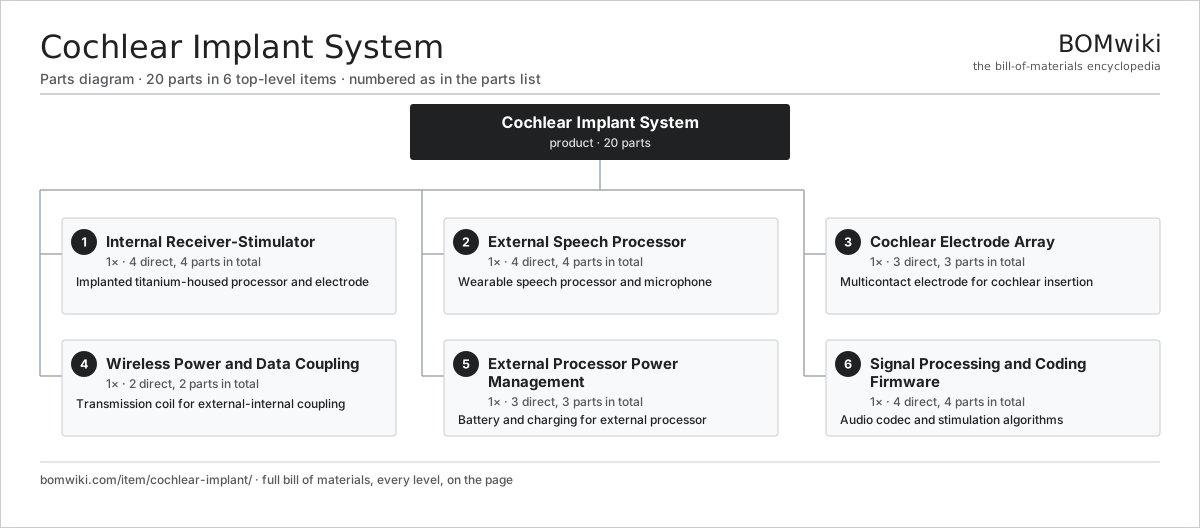
| # | Part | Qty | What it does |
|---|---|---|---|
| 1 | Internal Receiver-Stimulator 4 parts | 1× | Implanted titanium-housed processor and electrode |
| 2 | External Speech Processor 4 parts | 1× | Wearable speech processor and microphone |
| 3 | Cochlear Electrode Array 3 parts | 1× | Multicontact electrode for cochlear insertion |
| 4 | Wireless Power and Data Coupling 2 parts | 1× | Transmission coil for external-internal coupling |
| 5 | External Processor Power Management 3 parts | 1× | Battery and charging for external processor |
| 6 | Signal Processing and Coding Firmware 4 parts | 1× | Audio codec and stimulation algorithms |
3D model
No 3D model yet. Have a CAD file of this? Add a 3D model. STL renders right on this page; STEP, FreeCAD, and OpenSCAD sources are welcome too (openly licensed, like all 3D models on BOMwiki).
Build & assembly graph
expand / collapse · shared sub-assemblies converge · links to related products · est. labourTap an assembly to expand/collapse · tap a part to open it · use “Open page” for any node · drag to pan, scroll to zoom.
Bill of materials for Cochlear Implant System
6 top-level lines · 26 rows shown · 20 parts total · indented to 3 levels| # | Item / sub-assembly | Part no. | Qty/assy | Ext. qty | Parts | Type |
|---|---|---|---|---|---|---|
| 1 | Internal Receiver-Stimulator 4 parts | cochlear-implant-internal-receiver | 1× | 1 | 4 | assembly |
| 1.1 | Titanium Case | cochlear-implant-titanium-housing | 1× | 1 | · | part |
| 1.2 | Receiver ASIC and Control Board | cochlear-implant-receiver-pcb | 1× | 1 | · | part |
| 1.3 | Internal Inductive Coil | cochlear-implant-internal-coil | 1× | 1 | · | part |
| 1.4 | Electrode Array Connector | cochlear-implant-electrode-connector | 1× | 1 | · | part |
| 2 | External Speech Processor 4 parts | cochlear-implant-external-processor | 1× | 1 | 4 | assembly |
| 2.1 | Dual-Channel Microphone | cochlear-implant-processor-microphone | 1× | 1 | · | part |
| 2.2 | Digital Signal Processor (DSP) | cochlear-implant-processor-mcu | 1× | 1 | · | part |
| 2.3 | External Transmitter Coil | cochlear-implant-processor-transmitter-coil | 1× | 1 | · | part |
| 2.4 | Processor Battery Module | cochlear-implant-processor-battery-module | 1× | 1 | · | part |
| 3 | Cochlear Electrode Array 3 parts | cochlear-implant-electrode-array | 1× | 1 | 3 | assembly |
| 3.1 | Silicone Electrode Carrier | cochlear-implant-silicone-carrier | 1× | 1 | · | part |
| 3.2 | Platinum Electrode Contacts | cochlear-implant-platinum-contacts | 1× | 1 | · | part |
| 3.3 | Surgical Insertion Guide | cochlear-implant-insertion-guide | 1× | 1 | · | part |
| 4 | Wireless Power and Data Coupling 2 parts | cochlear-implant-magnet-coil | 1× | 1 | 2 | assembly |
| 4.1 | External Alignment Magnet | cochlear-implant-external-magnet | 1× | 1 | · | part |
| 4.2 | LC Resonance Capacitor | cochlear-implant-coupling-capacitor | 1× | 1 | · | part |
| 5 | External Processor Power Management 3 parts | cochlear-implant-power-system | 1× | 1 | 3 | assembly |
| 5.1 | Battery Cell | cochlear-implant-battery-cell | 1× | 1 | · | part |
| 5.2 | Charge Controller | cochlear-implant-charger-pcb | 1× | 1 | · | part |
| 5.3 | Boost Converter | cochlear-implant-boost-converter | 1× | 1 | · | part |
| 6 | Signal Processing and Coding Firmware 4 parts | cochlear-implant-signal-processing-firmware | 1× | 1 | 4 | assembly |
| 6.1 | Audio Front-End Signal Chain | cochlear-implant-audio-frontend | 1× | 1 | · | part |
| 6.2 | FFT Frequency Analyzer | cochlear-implant-fft-engine | 1× | 1 | · | part |
| 6.3 | Frequency-to-Electrode Mapping | cochlear-implant-channel-mapper | 1× | 1 | · | part |
| 6.4 | Multi-Electrode Pulse Sequencing | cochlear-implant-current-steering | 1× | 1 | · | part |
Something wrong in this list? Report a problem with this BOM.
Sourcing: possible vendors
Browse the supplier directory → Prices, MOQ, and lead times are algorithmic estimates, not quotes, and not claims about these companies. Company mappings are curated by keyword; est. price band $500–$3M. How estimates work| Vendor | HQ | Specialty | MOQ | Lead time |
|---|---|---|---|---|
| gehealthcare.com ↗ | Chicago, US | Medical imaging & devices | 100 units | 12–20 wks |
| siemens-healthineers.com ↗ | Erlangen, DE | Medical systems | 100 units | 12–20 wks |
|
🇳🇱Philips
philips.com ↗
|
Amsterdam, NL | Health technology | 100 units | 12–20 wks |
| medtronic.com ↗ | Minneapolis, US | Medical devices | 100 units | 12–20 wks |
|
🇨🇳Mindray
mindray.com ↗
|
Shenzhen, CN | Medical devices | 100 units | 12–20 wks |
1,676-word article