Coffee Roaster Product
Overview
The coffee roaster is a drum-type batch machine that develops green coffee into roasted beans through controlled application of heat over a 10–16 minute cycle. A perforated steel drum tumbles a 1 kg charge above a gas burner while a blower draws roast gases and loose chaff out of the chamber. The operator follows a temperature profile on a touchscreen controller, reading both bean-mass and exhaust-air probes to time the first crack and drop.
How it works
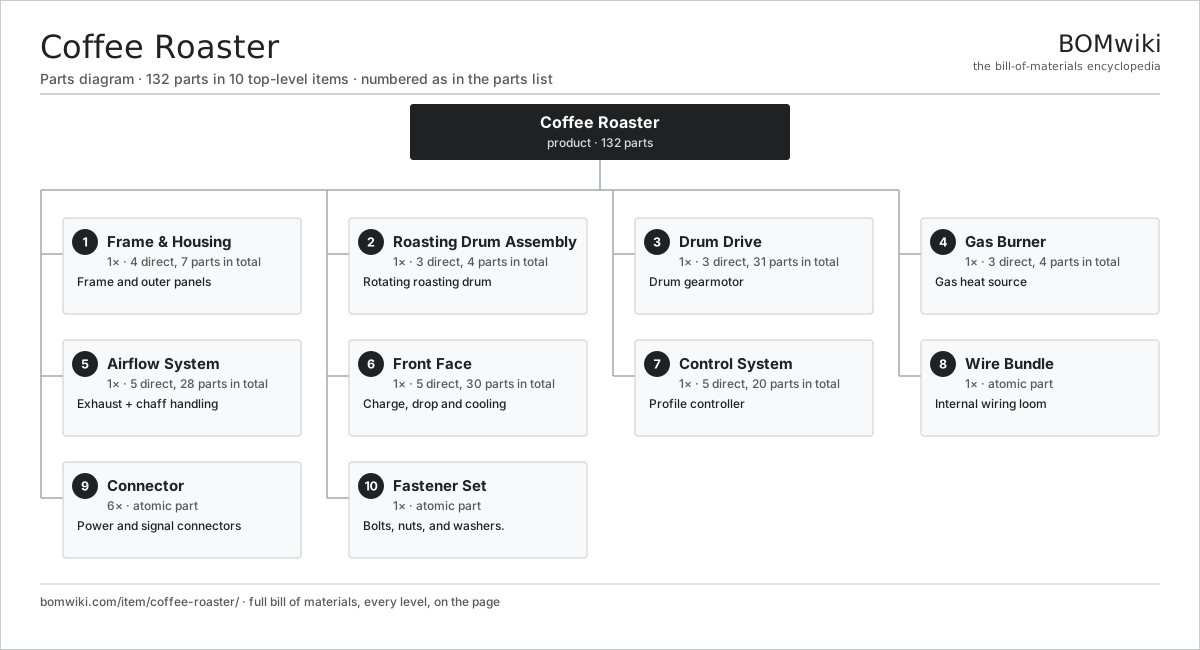
Heat reaches the beans by conduction from the drum wall and convection from burner gases. The Gas Burner fires beneath an insulated roast chamber held inside the Frame & Housing, while the Roasting Drum Assembly rotates at 50–70 rpm so that the perforated drum and internal flights lift and fold the bean bed for even color. Rotation is delivered by the Drum Drive gearmotor through a chain and sprocket.
As the roast progresses, the Airflow System system pulls heated gases through the drum perforations and into a cyclone that separates silverskin chaff before it reaches the exhaust. Airflow rate sets convective heat transfer and is a primary lever for shaping the roast curve.
The Front Face carries the charge hopper, the drop chute, and a stirred cooling tray. When the beans reach target development, the operator opens the drop door; beans fall onto the cooling tray where an agitator arm and a second blower quench them to room temperature in three to four minutes, halting roast reactions. The Control System logs bean temperature, rate of rise, and burner setting so a saved profile can be reproduced batch to batch.', },
'commercial-deep-fryer': { specs: [ ['Oil capacity', '23 L'], ['Production rate', '30–40 kg fries/hr'], ['Tank count', '1 vat, dual basket'], ['Heating', '3 immersion elements'], ['Rated power', '14 kW'], ['Temperature range', '40–195 °C'], ['Thermostat accuracy', '±1.5 °C'], ['Recovery time', '~2 min after load'], ['Cold-zone depth', '40 mm'], ['Electrical supply', '400 V, 3-phase'], ['Over-temp cutout', 'Manual-reset thermal fuse'], ['Filtration', 'Integrated pump + paper filter'], ['Basket capacity', '2 × 1.5 kg'], ], body: '## Overview
The commercial deep fryer cooks food by immersion in oil held at 150–190 °C. A 23-litre vat is heated by three electric immersion elements rated at 14 kW total, giving a recovery time of roughly two minutes after a cold load is dropped. Twin baskets allow staggered cooking, and an integrated filtration circuit extends oil life by removing crumbs and sediment between shifts.
Construction
The vat sits in the Cabinet & Housing, a stainless cabinet with a hinged front door and four legs that enclose the plumbing and electrical bay. Oil is held in the Fry Tank Assembly, a pressed stainless vat whose lower section forms a cold zone: a 40 mm-deep region below the elements where temperature stays under 90 °C so that fallen crumbs settle and carbonize slowly instead of fouling the oil.
The Heating System assembly carries three immersion elements and a manual-reset thermal fuse that cuts power if oil temperature exceeds the high limit, guarding against fire if oil level drops. The Temperature Control panel houses the operating thermostat, set between 40 and 195 °C with ±1.5 °C accuracy, plus a melt cycle that pulses the elements to thaw solid shortening without scorching.
During cooking the Fry Basket pair holds product clear of the cold zone. Between shifts the Oil Filtration System system drains the vat through a pump and paper filter, returning clarified oil to the tank. Three-phase mains enters through the Power Connection, which distributes 400 V to the elements through the high-limit and contactor chain.', },
'commercial-dishwasher': {
specs: [
['Type', 'Hood (pass-through) warewasher'],
['Throughput', 'Up to 60 racks/hr'],
['Cycle time', '60 / 90 / 120 s selectable'],
['Wash tank capacity', '30 L'],
['Wash temperature', '55–65 °C'],
['Rinse temperature', '82–90 °C'],
['Booster heater', '9 kW'],
['Tank heater', '6 kW'],
['Wash pump motor', '0.75 kW'],
['Rinse water use', '2.5 L/rack'],
['Electrical supply', '400 V, 3-phase'],
['Total connected load', '16 kW'],
['Rack size', '500 × 500 mm'],
],
body: '## Overview
The commercial dishwasher is a hood-type warewasher that cleans a 500 mm rack of dishes in a 60-, 90-, or 120-second cycle, reaching up to 60 racks per hour. A heated 30-litre tank recirculates detergent wash water, then a separate booster heats the final rinse to 82–90 °C for sanitation. Lowering the lift hood starts the cycle automatically.
How it works
The machine is built around the Cabinet & Frame, a welded stainless frame on adjustable feet. The Lift Hood is a counterbalanced lift door; raising it admits a rack and lowering it trips the cycle switch. Soiled water collects in the Wash Tank, whose sump holds a scrap strainer that traps food debris before it reaches the pump.
During the wash phase the Wash Recirculation Pump recirculates tank water at roughly 55–65 °C, driving the Spray Arm System of upper and lower rotating arms that blast detergent solution across the rack. The cycle then switches to the Rinse System, where a 9 kW booster heater delivers fresh water at 82–90 °C through dedicated rinse arms; a vacuum breaker prevents backflow into the supply. Rinse overflow replenishes the wash tank.
The Chemical Dispenser System meters detergent and rinse aid by peristaltic pump in proportion to fill volume. A Drain Pump empties the tank between change-outs, and the Control System sequences fill, wash, drain, and rinse from a touchscreen, interlocking the cycle to hood position and rinse temperature so that dishes leave only after the sanitizing rinse completes.', },
'commercial-dough-mixer': { specs: [ ['Bowl capacity', '20 L'], ['Flour capacity', '8 kg'], ['Dough capacity', '13 kg'], ['Mixing action', 'Planetary'], ['Speed settings', '3 (gear shift)'], ['Agitator speeds', '110 / 195 / 380 rpm'], ['Motor type', 'Single-phase induction'], ['Motor power', '0.75 kW (1 hp)'], ['Transmission', 'Oil-bath gearbox'], ['Bowl lift', 'Lever-actuated'], ['Electrical supply', '230 V, 50/60 Hz'], ['Timer range', '0–30 min'], ['Tool set', 'Hook, beater, whisk'], ], body: '## Overview
The commercial dough mixer is a planetary mixer sized for bakery and pizzeria use, taking a 20-litre bowl and up to 8 kg of flour or 13 kg of finished dough. A single-phase 0.75 kW induction motor drives an interchangeable hook, beater, or whisk through a three-speed oil-bath gearbox, giving agitator speeds from 110 to 380 rpm for kneading, creaming, and whipping.
Construction
The mixer is built on the Body & Frame, a cast-iron frame whose mass damps vibration and anchors the planetary head over the bowl. Drive comes from the Induction Motor, a single-phase induction unit, feeding the Transmission: an oil-bath gear train that both reduces motor speed and produces planetary motion, so the tool spins on its own axis while orbiting the bowl. A gear-shift lever selects three output speeds.
The Agitator Tool Set holds the three tools. The spiral hook develops gluten in stiff bread dough at low speed; the flat beater blends batters and creams fats; the wire whisk aerates eggs and cream at high speed. Tools mount on the planetary shaft with a bayonet pin.
The Bowl Assembly is a stainless bowl locked into a lever-actuated lift that raises it to the tool and lowers it for loading and removal. The Control Panel carries the speed selector, a 30-minute timer, and start/stop with a safety interlock that cuts the motor if the bowl guard is opened. Mains power enters through the Power Cord to the contactor and overload that protect the motor against stalling under a heavy dough load.', },
'conveyor-pizza-oven': { specs: [ ['Bake type', 'Air impingement, conveyor'], ['Belt width', '810 mm'], ['Belt material', 'Stainless wire mesh'], ['Bake time', '4–7 min (adjustable)'], ['Belt speed', 'Variable, 0.3–2.0 m/min'], ['Temperature range', '150–290 °C'], ['Heat source', 'Natural gas / LPG'], ['Burner output', '32 kW (110,000 BTU/hr)'], ['Throughput', 'Up to 60 × 12-inch pizzas/hr'], ['Blower motor', '0.55 kW'], ['Electrical supply', '230 V, single phase'], ['Insulation', 'Ceramic-fiber blanket'], ['Stackable', 'Up to 3 decks'], ], body: '## Overview
The conveyor pizza oven bakes by air impingement: a wire-mesh belt carries pizzas through an insulated tunnel where columns of high-velocity hot air strike the product from above and below. Bake time is set purely by belt speed, typically 4–7 minutes, so output is consistent regardless of operator skill. A 32 kW gas burner holds the tunnel at 150–290 °C, baking up to 60 twelve-inch pizzas per hour.
How it works
The bake tunnel is formed by the Insulated Cabinet, a ceramic-fiber-insulated stainless enclosure with end plates left open for product entry and exit. Pizzas ride the Conveyor Assembly, a stainless wire-mesh belt driven by a variable-speed gearmotor through sprockets; turning the speed control directly sets bake time.
Heat is produced by the Heating System section, where the gas burner fires into a heat exchanger so that combustion products stay separate from the food-contact air stream. The Air Impingement System is the defining feature: a blower pressurizes plenums above and below the belt, and perforated "finger" panels convert that pressure into jets that scrub the cool boundary layer off the dough, transferring heat far faster than a static deck. Finger placement tunes top-versus-bottom browning.
The Control System regulates burner gas valve to a setpoint thermocouple and sets belt speed independently. A Window & Access Door lets staff watch and reach product mid-bake, while the Exhaust & Flue flue carries combustion gases to the hood. Spent crumbs drop onto the Crumb Tray for cleaning.', },
'meat-grinder': {
specs: [
['Throughput', 'Up to 300 kg/hr'],
['Head size', '#22'],
['Motor type', 'Single-phase induction'],
['Motor power', '1.1 kW (1.5 hp)'],
['Auger speed', '200 rpm'],
['Transmission', 'Helical gear reduction'],
['Plate diameters', '4.5 / 8 mm supplied'],
['Knife', 'Reversible 4-wing'],
['Construction', 'Stainless body and head'],
['Electrical supply', '230 V, 50/60 Hz'],
['Duty', 'Continuous'],
['Reverse function', 'Yes'],
['Net weight', '45 kg'],
],
body: '## Overview
The commercial meat grinder reduces trimmed meat into mince at up to 300 kg per hour. A 1.1 kW induction motor drives a feed auger through a gear reduction, forcing meat past a rotating knife and a perforated plate. Plate hole size sets the grind: coarse 8 mm plates for sausage and chili, fine 4.5 mm plates for burger and pâté.
Construction
The machine stands on the Body & Housing, a stainless shell and base plate on rubber feet that house the drive and isolate vibration. Power comes from the Induction Motor, a single-phase induction unit rated for continuous duty, coupled to the Reduction Gearbox: a helical gear train that drops motor speed to roughly 200 rpm at the auger while multiplying torque to handle gristle and frozen edges without stalling.
The working section is the Grinding Head, the classic auger-knife-plate stack. Meat dropped into the throat is conveyed forward by the auger flights, which also compress it. At the head face a reversible four-wing knife rotates against a stationary plate; the scissor action between knife edges and plate holes shears the meat as it extrudes. A ring nut clamps the stack and sets knife-to-plate pressure, the key adjustment for clean cutting versus smearing.
The Control Box carries forward, reverse, and stop controls plus the motor overload; reverse clears jams by backing the auger out. Mains power enters through the Power Cord. The head, auger, knife, and plates all remove without tools for cleaning and to swap plate sizes between products.', },
'soft-serve-machine': { specs: [ ['Output type', 'Soft serve, gravity feed'], ['Flavors', '2 + twist'], ['Production rate', '18 L/hr'], ['Mix hopper capacity', '2 × 6 L'], ['Freezing cylinder', '2 × 1.2 L'], ['Serving temperature', '-6 to -4 °C'], ['Hopper hold temperature', '2–4 °C'], ['Refrigerant', 'R404A'], ['Compressor', '0.75 kW (1 hp)'], ['Beater motor', '2 × 0.37 kW'], ['Electrical supply', '230 V, 50/60 Hz'], ['Total connected load', '~2.2 kW'], ['Overrun', '30–40%'], ], body: '## Overview
The soft serve machine freezes liquid dairy mix into dispensed soft ice cream on demand. Two refrigerated hoppers hold mix at 2–4 °C; gravity feeds it into freezing cylinders where a rotating beater scrapes the chilled barrel wall, whipping air into the mix as it freezes to a serving temperature of -6 to -4 °C. The twin-cylinder layout gives two flavors plus a center twist, producing about 18 litres per hour.
How it works
The machine is housed in the Cabinet & Housing, a stainless body with a drip tray and removable service panels. Liquid mix is poured into the Mix Hopper, a refrigerated tank that keeps the reserve cold and food-safe until it is drawn down. Mix passes by gravity into the Freezing Cylinder, the heart of the machine: a refrigerant-jacketed barrel containing a motor-driven beater whose scraper blades shave freezing mix off the wall and fold air into it, building the 30–40% overrun that gives soft serve its texture.
Cooling is supplied by the Refrigeration System circuit, a sealed R404A system with compressor, condenser, and expansion valve feeding the cylinder jacket. The Dispensing Assembly assembly is a spring-loaded draw valve on the faceplate; pulling the handle opens the port and extrudes product through a star nozzle.
The Control System runs the freezing logic, holding product consistency by monitoring beater motor load — stiffer product draws more current — and cycling the compressor to maintain it. It also runs the hopper refrigeration and a heat-treat or standby cycle that keeps idle mix safe between rushes.', },
'vacuum-sealer': { specs: [ ['Type', 'Chamber vacuum sealer'], ['Chamber size', '300 × 350 × 130 mm'], ['Pump type', 'Oil rotary-vane'], ['Pump capacity', '8 m³/hr'], ['Final vacuum', '2 mbar (99.8%)'], ['Seal-bar length', '300 mm'], ['Seal type', 'Single impulse wire'], ['Cycle time', '20–40 s'], ['Pump motor', '0.37 kW'], ['Electrical supply', '230 V, 50/60 Hz'], ['Vacuum control', 'Sensor + adjustable setpoint'], ['Lid', 'Acrylic, hinged'], ['Cycles per hour', '~120'], ], body: '## Overview
The chamber vacuum sealer evacuates air from a pouch placed entirely inside a sealed chamber, then heat-seals it. Because the whole chamber is evacuated, pressure equalizes inside and outside the bag, so the machine handles liquids and marinades that an external suction sealer cannot. An oil rotary-vane pump pulls the chamber to 2 mbar — about 99.8% vacuum — in a 20–40 second cycle.
How it works
The machine is built around the Housing & Chamber, a stainless body containing a drawn chamber tub and a hinged acrylic lid that lets the operator watch the cycle. With a filled pouch laid across the seal bar and the lid closed, the Oil Rotary-Vane Vacuum Pump — an oil-lubricated rotary-vane unit rated at 8 m³/hr — draws air out of the sealed chamber.
Air moves through the Vacuum Plumbing, a hose-and-port network with a check valve that holds vacuum once the pump stops. The Vacuum Pressure Sensor measures chamber pressure against an adjustable setpoint, so operators can stop short of full vacuum for delicate or gas-flushed products. When the target is reached, the Seal Bar Assembly energizes its impulse wire, melting the pouch lip closed against a silicone counter-bar.
The Vent Solenoid Valve then vents the chamber back to atmosphere; the returning air presses tightly around the now-sealed pouch, completing the pack. The Control Board sequences vacuum, seal time, and vent, and times seal-wire current to bag thickness. Power and the pump motor are fed through the Power & Wiring.
Build & assembly graph
expand / collapse · shared sub-assemblies converge · links to related products · est. labourTap an assembly to expand/collapse · tap a part to open it · use “Open page” for any node · drag to pan, scroll to zoom.
Bill of materials
10 top-level lines · 63 rows shown · 132 parts total · indented to 3 levels| # | Item / sub-assembly | Part no. | Qty/assy | Ext. qty | Parts | Type |
|---|---|---|---|---|---|---|
| 1 | Frame & Housing 4 parts | coffee-roaster-chassis | 1× | 1 | 7 | assembly |
| 1.1 | Structural Frame | coffee-roaster-frame | 1× | 1 | — | part |
| 1.2 | Housing Panel | coffee-roaster-housing-panel | 4× | 4 | — | part |
| 1.3 | Roast Chamber | coffee-roaster-roast-chamber | 1× | 1 | — | part |
| 1.4 | Fastener Set | fastener-set | 1× | 1 | — | part |
| 2 | Roasting Drum Assembly 3 parts | coffee-roaster-drum-assembly | 1× | 1 | 4 | assembly |
| 2.1 | Perforated Drum | coffee-roaster-drum | 1× | 1 | — | part |
| 2.2 | Drum Shaft | coffee-roaster-drum-shaft | 1× | 1 | — | part |
| 2.3 | Ball Bearing | ball-bearing | 2× | 2 | — | part |
| 3 | Drum Drive 3 parts | coffee-roaster-drum-drive | 1× | 1 | 31 | assembly |
| 3.1 | Drum Drive Motor 4 parts | coffee-roaster-drive-motor | 1× | 1 | 25 | assembly |
| 3.1.1 | Stator Assembly 3 parts + deeper › | stator-assembly | 1× | 1 | 3 | assembly |
| 3.1.2 | Rotor Assembly 4 parts + deeper › | rotor-assembly | 1× | 1 | 19 | assembly |
| 3.1.3 | Motor Housing | motor-housing | 1× | 1 | — | part |
| 3.1.4 | Ball Bearing | ball-bearing | 2× | 2 | — | part |
| 3.2 | Drum Gearbox 4 parts | coffee-roaster-gearbox | 1× | 1 | 5 | assembly |
| 3.2.1 | Gearbox Housing | gearbox-housing | 1× | 1 | — | part |
| 3.2.2 | Helical Gear Pair | gear-pair | 1× | 1 | — | part |
| 3.2.3 | Ball Bearing | ball-bearing | 2× | 2 | — | part |
| 3.2.4 | O-Ring Set | oring-set | 1× | 1 | — | part |
| 3.3 | Drive Belt | drive-belt | 1× | 1 | — | part |
| 4 | Gas Burner 3 parts | coffee-roaster-burner | 1× | 1 | 4 | assembly |
| 4.1 | Burner Tube | coffee-roaster-burner-tube | 1× | 1 | — | part |
| 4.2 | Modulating Gas Valve 2 parts | coffee-roaster-gas-valve | 1× | 1 | 2 | assembly |
| 4.2.1 | Valve Body & Coil | coffee-roaster-valve-body | 1× | 1 | — | part |
| 4.2.2 | O-Ring Set | oring-set | 1× | 1 | — | part |
| 4.3 | Igniter & Flame Rod | coffee-roaster-igniter | 1× | 1 | — | part |
| 5 | Airflow System 5 parts | coffee-roaster-airflow | 1× | 1 | 28 | assembly |
| 5.1 | Blower Motor | blower-motor | 1× | 1 | — | part |
| 5.2 | Chaff Cyclone | coffee-roaster-cyclone | 1× | 1 | — | part |
| 5.3 | Chaff Collector | coffee-roaster-chaff-collector | 1× | 1 | — | part |
| 5.4 | Exhaust Ducting | coffee-roaster-ducting | 1× | 1 | — | part |
| 5.5 | Airflow Damper 4 parts | coffee-roaster-damper | 1× | 1 | 24 | assembly |
| 5.5.1 | Damper Vane | coffee-roaster-damper-vane | 1× | 1 | — | part |
| 5.5.2 | Stator Assembly 3 parts + deeper › | stator-assembly | 1× | 1 | 3 | assembly |
| 5.5.3 | Rotor Assembly 4 parts + deeper › | rotor-assembly | 1× | 1 | 19 | assembly |
| 5.5.4 | Helical Gear Pair | gear-pair | 1× | 1 | — | part |
| 6 | Front Face 5 parts | coffee-roaster-face | 1× | 1 | 30 | assembly |
| 6.1 | Front Plate | coffee-roaster-front-plate | 1× | 1 | — | part |
| 6.2 | Charge Hopper | coffee-roaster-charge-hopper | 1× | 1 | — | part |
| 6.3 | Sampling Trier | coffee-roaster-trier | 1× | 1 | — | part |
| 6.4 | Bean Drop Door | coffee-roaster-drop-door | 1× | 1 | — | part |
| 6.5 | Cooling Tray 4 parts | coffee-roaster-cooling-tray | 1× | 1 | 26 | assembly |
| 6.5.1 | Cooling Tray Pan | coffee-roaster-tray-pan | 1× | 1 | — | part |
| 6.5.2 | Stirring Arm | coffee-roaster-stirring-arm | 1× | 1 | — | part |
| 6.5.3 | Stirrer Gearmotor 3 parts + deeper › | coffee-roaster-stir-motor | 1× | 1 | 23 | assembly |
| 6.5.4 | Blower Motor | blower-motor | 1× | 1 | — | part |
| 7 | Control System 5 parts | coffee-roaster-control | 1× | 1 | 20 | assembly |
| 7.1 | Control Board 5 parts | coffee-roaster-control-board | 1× | 1 | 12 | assembly |
| 7.1.1 | Bare PCB | pcb-bare | 1× | 1 | — | part |
| 7.1.2 | Compute SoC Module | soc-module | 1× | 1 | — | part |
| 7.1.3 | Microcontroller | mcu | 1× | 1 | — | part |
| 7.1.4 | SMD Passive (R/C/L) | smd-passives | 1× | 1 | — | part |
| 7.1.5 | Connector | connector | 8× | 8 | — | part |
| 7.2 | Touchscreen 2 parts | coffee-roaster-touchscreen | 1× | 1 | 2 | assembly |
| 7.2.1 | LCD Panel | lcd-panel | 1× | 1 | — | part |
| 7.2.2 | Touch Digitizer | touch-digitizer | 1× | 1 | — | part |
| 7.3 | Bean Temperature Probe | coffee-roaster-bean-probe | 1× | 1 | — | part |
| 7.4 | Air Temperature Probe | coffee-roaster-air-probe | 1× | 1 | — | part |
| 7.5 | Relay | relay | 4× | 4 | — | part |
| 8 | Wire Bundle | wire-bundle | 1× | 1 | — | part |
| 9 | Connector | connector | 6× | 6 | — | part |
| 10 | Fastener Set | fastener-set | 1× | 1 | — | part |
Sourcing — likely vendors
Companies that make this · indicative price $1k–$500k · MOQ & lead are typical| Vendor | HQ | Specialty | MOQ | Lead time |
|---|---|---|---|---|
| gea.com ↗ | Düsseldorf, DE | Process technology | 20 units | 12–20 wks |
| buhlergroup.com ↗ | Uzwil, CH | Food & materials processing | 20 units | 12–20 wks |
| tetrapak.com ↗ | Pully, CH | Food packaging & processing | 20 units | 12–20 wks |
| jbtc.com ↗ | Chicago, US | Food processing equipment | 20 units | 12–20 wks |
| alfalaval.com ↗ | Lund, SE | Heat transfer & separation | 20 units | 12–20 wks |
2,671-word article