Coil Feed Line
ProductOverview
A coil feed line is an ancillary machine that automatically unwinds, straightens, and meters metal coil stock into a punch press or forming machine at precise incremental distances. The coil arrives as a tightly wound roll (coil set, permanent curvature from rolling), and the feed line removes this set through roller straightening. A programmable servo or pneumatic feeder then advances the straightened material by a precise distance for each press cycle, positioning the next blank under the punch array. The feed line integrates with the press via electrical or pneumatic signals, synchronizing advance with press cycles. Without a coil feeder, stamping operations require manual repositioning of the material between strokes or blank reloading, slow and error-prone. With a coil line, a single operator can supervise multiple presses, each with its own feeder line, achieving hundreds to thousands of stamped parts per shift with minimal manual work and excellent dimensional consistency.
Decoiler operation and tension control
The Decoiler Assembly is a motorized mandrel system. The Spindle Shaft has conical Coil Mandrel Cone mandrels at both ends. An operator loads the coil by sliding it onto the expanded cones, and the motor rotates the spindle slowly. Material unwinds from the outer diameter of the coil. A Driven Nip Roll (a powered rubber-faced nip roll) engages the unwound material and advances it toward the straightener.
The Tension Device (dancer arm or spring) is crucial: it prevents the coil from spinning too fast and creating slack, and it provides gentle tension to keep material taut. Excessive tension causes hardening and fatigue; insufficient tension causes wrinkles. Typical unwinding tension is 5–20 kg-f, monitored via a load cell in the dancer arm.
Straightening mechanism and coil set removal
The Straightening Unit consists of 5–7 hardened alloy steel rolls arranged vertically, alternating above and below the material path. As the material advances, it is bent upward by the first roll, then downward by the second, creating a sinusoidal deflection pattern. This cyclic bending induces plastic deformation opposite to the original coil set, removing it. The number of rolls and the diameter of each roll are optimized for material thickness and type. Thicker material (6 mm) requires larger rolls and more bending cycles; thin material (0.5 mm) uses smaller rolls.
Roll spacing (the gap between rolls) is critical: it's adjusted via Roll Adjustment Screw to accommodate material thickness. For 2 mm material, the gap might be 2.2–2.5 mm. Improper gap causes wrinkles or incomplete straightening. After passing through the roller stack, most coil set is removed, and the material is flat and ready for advancing.
Servo feeder positioning
The Servo Feeder Unit is the precision positioning element. The Feeder Arm are hardened steel clamps with elastomeric contact pads. A Feeder Cylinder (pneumatic or servo-hydraulic) advances the arms to grip the material, retracts slightly to release, and repeats. The distance advanced per cycle is programmable: a typical stamping job might advance 50 mm per stroke, then the press performs 6–8 operations on that 50 mm section before the feeder advances again.
Servo feeders use a ball-screw and stepper or servo motor instead of a pneumatic cylinder, allowing variable speed and stopping position. They offer ±0.2 mm repeatability compared to ±1.0 mm for pneumatic feeders. The Feeder Position Sensor detects when the advance is complete, and the control system signals the press to begin its cycle.
Synchronization and cycle timing
The Control System reads the press cycle signal (typically a 24 V contact closure or CNC output) and triggers the Feeder Cylinder to advance. The timing is:
- Press stroke begins; feeder retracts (arms release).
- Press descends and performs all operations.
- Press ascends and opens.
- Control system receives "cycle complete" signal.
- Feeder advances the material by the programmed distance.
- Loop repeats.
Typical cycle time is 3–5 seconds: 2 seconds for the press operations and 1–3 seconds for feed advance (depending on pneumatic vs servo and distance). Scrap advance (the distance the material moves forward after a part is punched free) must account for the width of the finished part plus a small bridge to the next blank. Progressive dies handle this internally; transfer presses and standalone press+feeder lines require manual calculation or CAM software to generate the scrap advance distance.
Straightness quality and material condition
Successful straightening depends on material properties and prior history:
- Virgin coil (never stamped): Clean, even curvature; straightens in one pass through the roller stack.
- Recoiled (from prior stamping and rerolling): Variable set direction; may require two passes or higher tension to fully remove.
- Work-hardened material (multiple re-strikes): May crack if bent too sharply; reduces roller gaps to gentler radius.
Material condition is monitored by feel and visual inspection: operators watch for wrinkles or edge wave (wavy edge from uneven stretching). If detected, the roller gaps are adjusted or material rewound and re-fed.
Scrap management
Scrap System systems catch punched slugs and trimmings. A Scrap Collection Tray sits beneath the press, collecting dross. For large-volume plants, a conveyor or chute directs scrap to a baling press or recycling bin. Scrap Ejector (vibrator or air-blow nozzle) clears accumulated chips that might jam the feeder.
Scrap advance distance is the distance from one blank outline to the next on the strip. For example, if a round blank is Ø20 mm and strip pitch is 25 mm, then 5 mm of material is scrap. This must be accounted for in the feeder advance distance: if two blanks per cycle are punched, the feeder advances 50 mm (25 + 25 mm).
Control interface and safety
The PLC Controller communicates with the press control via:
- Hard-wired contacts: Simple on-off signaling (press sends "cycle complete," feeder responds with advance pulse).
- CNC interface: Integrated PLC reads the press CNC output and synchronizes automatically.
Emergency stop (e-stop) must immediately:
- Cut power to the feeder motor and solenoid valve.
- Hold the material in place (pilot-operated check valve in the feeder cylinder).
- Stop the decoiler.
Safety guarding is required around the decoiler spindle (rotating mandrels) and the nip roll to prevent hand entrapment.
Maintenance and troubleshooting
Routine maintenance includes:
- Decoiler tension adjustment: Monitor dancer arm position; tighten if slack appears.
- Roller cleaning: Straightener rolls accumulate oil and metal dust; periodic cleaning with a cloth restores grip.
- Driven roll replacement: Rubber facing wears and hardens; typical replacement interval is 500–1000 operating hours.
- Feeder pad replacement: Contact pads wear; replaced when grip is lost.
Common issues:
- Wrinkled material: Straightener rollers misaligned or spacing incorrect. Adjust gaps and check for roll bending.
- Feed advance too short or too long: Check the solenoid valve timing or servo feeder calibration.
- Material slips in feeder: Worn grip pads; replace.
- Decoiler won't unwind smoothly: Coil cone not engaged fully; re-expand and re-load.
Integration with industry 4.0 and data logging
Modern coil lines integrate with the MES (manufacturing execution system) via Ethernet, logging:
- Feed advance distance and timing.
- Coil ID and material lot tracking.
- Scrap weight and yield.
- Feeder arm grip pressure (for wear prediction).
This data feeds process optimization and predictive maintenance algorithms.
Comparative advantages
A coil feed line increases throughput by 5–10× versus manual feeding, reduces scrap loss by 1–2 % (tighter tolerance on blank position), and eliminates operator fatigue from repetitive repositioning. Payback typically occurs within 2–3 years for shops running 20+ stamping shifts per week.
Coil Feed Line parts and their functions
6 top-level parts · 76 parts in total · full bill of materials below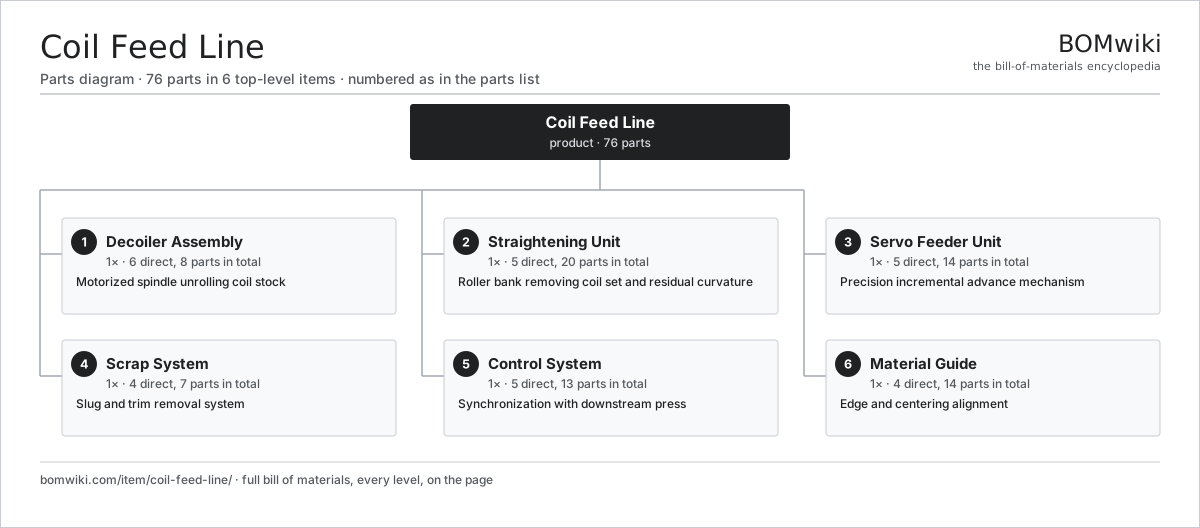
| # | Part | Qty | What it does |
|---|---|---|---|
| 1 | Decoiler Assembly 6 parts | 1× | Motorized spindle unrolling coil stock |
| 2 | Straightening Unit 5 parts | 1× | Roller bank removing coil set and residual curvature |
| 3 | Servo Feeder Unit 5 parts | 1× | Precision incremental advance mechanism |
| 4 | Scrap System 4 parts | 1× | Slug and trim removal system |
| 5 | Control System 5 parts | 1× | Synchronization with downstream press |
| 6 | Material Guide 4 parts | 1× | Edge and centering alignment |
3D model
No 3D model yet. Have a CAD file of this? Add a 3D model. STL renders right on this page; STEP, FreeCAD, and OpenSCAD sources are welcome too (openly licensed, like all 3D models on BOMwiki).
Build & assembly graph
expand / collapse · shared sub-assemblies converge · links to related products · est. labourTap an assembly to expand/collapse · tap a part to open it · use “Open page” for any node · drag to pan, scroll to zoom.
Bill of materials for Coil Feed Line
6 top-level lines · 35 rows shown · 76 parts total · indented to 3 levels| # | Item / sub-assembly | Part no. | Qty/assy | Ext. qty | Parts | Type |
|---|---|---|---|---|---|---|
| 1 | Decoiler Assembly 6 parts | coil-feed-line-decoiler | 1× | 1 | 8 | assembly |
| 1.1 | Spindle Shaft | coil-feed-line-spindle-shaft | 1× | 1 | · | part |
| 1.2 | Spindle Bearing | coil-feed-line-spindle-bearings | 2× | 2 | · | part |
| 1.3 | Decoiler Motor | coil-feed-line-shaft-motor | 1× | 1 | · | part |
| 1.4 | Coil Mandrel Cone | coil-feed-line-coil-cone | 2× | 2 | · | part |
| 1.5 | Driven Nip Roll | coil-feed-line-driven-roll | 1× | 1 | · | part |
| 1.6 | Tension Device | coil-feed-line-tension-control | 1× | 1 | · | part |
| 2 | Straightening Unit 5 parts | coil-feed-line-straightener | 1× | 1 | 20 | assembly |
| 2.1 | Straightener Roll | coil-feed-line-straightener-rolls | 5× | 5 | · | part |
| 2.2 | Roll Bearing | coil-feed-line-roll-bearings | 10× | 10 | · | part |
| 2.3 | Straightener Drive Motor | coil-feed-line-drive-motor | 1× | 1 | · | part |
| 2.4 | Roll Guide Frame | coil-feed-line-roll-guides | 2× | 2 | · | part |
| 2.5 | Roll Adjustment Screw | coil-feed-line-roll-adjustment-screws | 2× | 2 | · | part |
| 3 | Servo Feeder Unit 5 parts | coil-feed-line-servo-feeder | 1× | 1 | 14 | assembly |
| 3.1 | Feeder Arm | coil-feed-line-feeder-arms | 2× | 2 | · | part |
| 3.2 | Feeder Cylinder | coil-feed-line-feeder-cylinders | 2× | 2 | · | part |
| 3.3 | Feeder Position Sensor | coil-feed-line-feeder-position-sensor | 1× | 1 | · | part |
| 3.4 | Feeder Solenoid Valve | coil-feed-line-feeder-control-valve | 1× | 1 | · | part |
| 3.5 | Fastener Set | fastener-set | 8× | 8 | · | part |
| 4 | Scrap System 4 parts | coil-feed-line-scrap-collection | 1× | 1 | 7 | assembly |
| 4.1 | Scrap Collection Tray | coil-feed-line-scrap-tray | 1× | 1 | · | part |
| 4.2 | Scrap Chute | coil-feed-line-scrap-chute | 1× | 1 | · | part |
| 4.3 | Scrap Ejector | coil-feed-line-scrap-ejector | 1× | 1 | · | part |
| 4.4 | Fastener Set | fastener-set | 4× | 4 | · | part |
| 5 | Control System 5 parts | coil-feed-line-control-system | 1× | 1 | 13 | assembly |
| 5.1 | PLC Controller | coil-feed-line-plc-cpu | 1× | 1 | · | part |
| 5.2 | Operator HMI Panel | coil-feed-line-hmi-panel | 1× | 1 | · | part |
| 5.3 | Pressure Gauge | coil-feed-line-pressure-gauge | 1× | 1 | · | part |
| 5.4 | I/O Relay Module | coil-feed-line-io-relay-module | 2× | 2 | · | part |
| 5.5 | Connector | connector | 8× | 8 | · | part |
| 6 | Material Guide 4 parts | coil-feed-line-material-guide | 1× | 1 | 14 | assembly |
| 6.1 | Side Guide Roller | coil-feed-line-side-guides | 2× | 2 | · | part |
| 6.2 | Guide Support Frame | coil-feed-line-guide-supports | 2× | 2 | · | part |
| 6.3 | Guide Roller | coil-feed-line-guide-rollers | 4× | 4 | · | part |
| 6.4 | Fastener Set | fastener-set | 6× | 6 | · | part |
Something wrong in this list? Report a problem with this BOM.
Sourcing: possible vendors
Browse the supplier directory → Prices, MOQ, and lead times are algorithmic estimates, not quotes, and not claims about these companies. Company mappings are curated by keyword; est. price band $10k–$1M. How estimates work| Vendor | HQ | Specialty | MOQ | Lead time |
|---|---|---|---|---|
|
🇩🇪DMG MORI
dmgmori.com ↗
|
Bielefeld, DE | Machine tools | 5 units | 12–20 wks |
|
🇯🇵Mazak
mazak.com ↗
|
Oguchi, JP | Machine tools | 5 units | 12–20 wks |
| haascnc.com ↗ | Oxnard, US | CNC machine tools | 5 units | 12–20 wks |
|
🇯🇵Okuma
okuma.com ↗
|
Niwa, JP | Machine tools | 5 units | 12–20 wks |
|
🇩🇪Trumpf
trumpf.com ↗
|
Ditzingen, DE | Laser & sheet-metal machines | 5 units | 12–20 wks |
1,289-word article