Coin Pusher Machine
ProductOverview
A coin pusher is a simple mechanical-arcade game where players drop coins or tokens onto a moving pusher platform that oscillates back and forth, knocking coins down a tilted playing field. Coins tumble down the field, bouncing off side rails and other obstacles, eventually landing in collection chutes that either return coins to the player or direct them to the house. The game's appeal lies in the simple pleasure of watching coins pile and cascade, pure mechanical chaos with no skill or RNG, just physics and luck.
Mechanical Gameplay
The player inserts coins or tokens into a slot at the top of the Cabinet Enclosure. The control board credits them with 10–20 coins (or tokens) to drop. The player manually places one coin at a time onto the pusher blade, a 200mm-wide aluminum platform at the center of the Playfield Assembly.
The electric motor drives a rotating cam that converts circular motion into linear reciprocating motion. The pusher platform oscillates forward and backward at 2–4 cycles per second. Each forward stroke pushes the coin (and any coins already on the platform) downfield. The coin bounces off the tilted polycarbonate platform and back wall, tumbling and sliding until it falls into a collection chute.
There is no strategy, the outcome is purely mechanical. Identical coins dropped at identical positions may settle into different chutes depending on microvariations in platform wear, tilt angle, and coin weight distribution. This unpredictability is the game's charm: every drop is a mini-gamble.
Prize Structure and Returns
Most coin pushers employ a mixed payout: some chutes direct coins back to the payout hopper, while others route coins to the house collection bucket or trigger bonus lights. Typical machines return 70–80% of inserted coins to players (either immediately or as accumulated credits), with the house keeping 20–30%.
Some modern machines add complexity: a solenoid gate may periodically open, revealing a high-value "jackpot" chute that multiplies payout by 2–5×. This gate is controlled by the logic board in response to RNG, adding a small skill/luck element beyond pure physics.
Optical Counting and Audit
Each coin passing through a chute breaks an infrared beam monitored by a Optical Coin Gate sensor. The microcontroller increments a tally, logging all coins detected. This audit trail prevents operator fraud, if coins physically collected don't match the sensor count, it flags a discrepancy. Modern machines store encrypted audit logs accessible by venue auditors.
Lighting and Engagement
The Lighting Effects System system makes the game visually stimulating: RGB LED strips along the playfield edges pulse with color, and strobe lights flash when a coin enters a bonus chute. This sensory feedback keeps players engaged and encourages repeated plays.
Physical Wear and Maintenance
The Field Surface polycarbonate develops a slightly wavy surface after 2–3 years of continuous coin impacts, subtly changing coin trajectory. The pusher blade nylon contact surface glaze-hardens, increasing friction. The side rails can chip or crack if struck by coins at high velocity.
The cam mechanism bearings require quarterly lubrication. The Blower Motor brushes wear, gradually reducing pusher force over 5+ years of operation. Most venues replace entire machines every 7–10 years rather than attempting major repairs.
Regulatory Landscape
In most US jurisdictions, coin pushers are classified as entertainment machines, not gambling, because the outcome is mechanical, not RNG-based. However, some states restrict them to arcades or bars, and a few jurisdictions have banned them outright due to addiction concerns (despite their lower payback rates compared to true gambling devices).
In international markets (Europe, Asia), coin pushers remain popular in arcades, amusement parks, and fairgrounds, often operated by families without extensive gaming licensing.
Social Phenomenon
Coin pushers have experienced a resurgence in popularity over the past decade, driven by YouTube videos showing satisfying "big push" moments, large coins or tokens suddenly cascading en masse. This has driven demand for themed variants (gem-shaped tokens, fortune-themed designs) and refurbished vintage machines commanding premium prices at collectors' auctions.
Coin Pusher Machine parts and their functions
7 top-level parts · 75 parts in total · full bill of materials below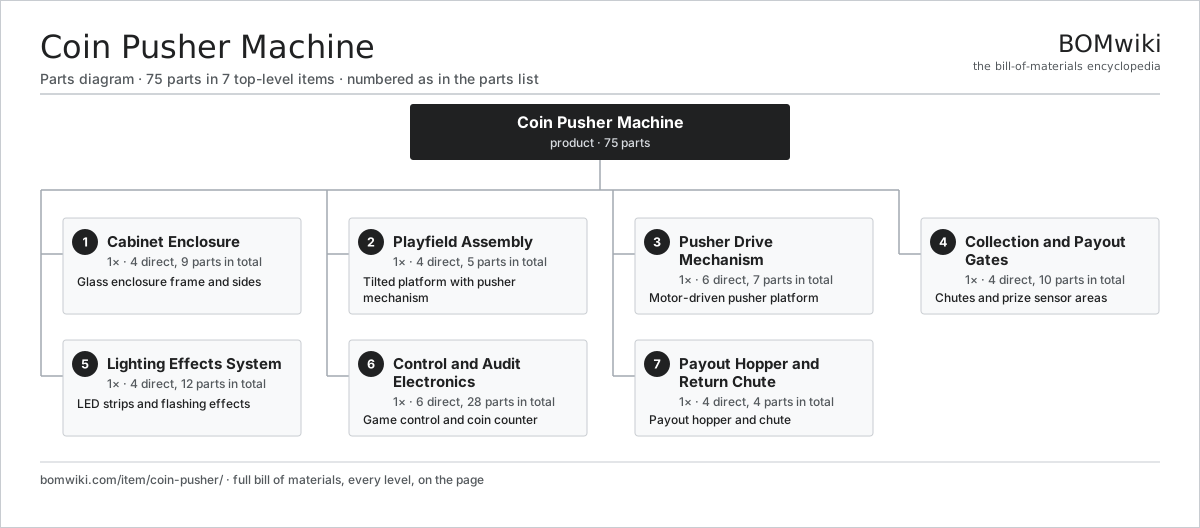
| # | Part | Qty | What it does |
|---|---|---|---|
| 1 | Cabinet Enclosure 4 parts | 1× | Glass enclosure frame and sides |
| 2 | Playfield Assembly 4 parts | 1× | Tilted platform with pusher mechanism |
| 3 | Pusher Drive Mechanism 6 parts | 1× | Motor-driven pusher platform |
| 4 | Collection and Payout Gates 4 parts | 1× | Chutes and prize sensor areas |
| 5 | Lighting Effects System 4 parts | 1× | LED strips and flashing effects |
| 6 | Control and Audit Electronics 6 parts | 1× | Game control and coin counter |
| 7 | Payout Hopper and Return Chute 4 parts | 1× | Payout hopper and chute |
3D model
No 3D model yet. Have a CAD file of this? Add a 3D model. STL renders right on this page; STEP, FreeCAD, and OpenSCAD sources are welcome too (openly licensed, like all 3D models on BOMwiki).
Build & assembly graph
expand / collapse · shared sub-assemblies converge · links to related products · est. labourTap an assembly to expand/collapse · tap a part to open it · use “Open page” for any node · drag to pan, scroll to zoom.
Bill of materials for Coin Pusher Machine
7 top-level lines · 39 rows shown · 75 parts total · indented to 3 levels| # | Item / sub-assembly | Part no. | Qty/assy | Ext. qty | Parts | Type |
|---|---|---|---|---|---|---|
| 1 | Cabinet Enclosure 4 parts | coin-pusher-cabinet | 1× | 1 | 9 | assembly |
| 1.1 | Tempered Glass Panel | coin-pusher-glass-panel | 3× | 3 | · | part |
| 1.2 | Sheet Metal Panel | sheet-panel | 2× | 2 | · | part |
| 1.3 | Fastener Set | fastener-set | 2× | 2 | · | part |
| 1.4 | Coil Spring | coil-spring | 2× | 2 | · | part |
| 2 | Playfield Assembly 4 parts | coin-pusher-playfield | 1× | 1 | 5 | assembly |
| 2.1 | Field Surface | coin-pusher-field-surface | 1× | 1 | · | part |
| 2.2 | Side Rail | coin-pusher-side-rail | 2× | 2 | · | part |
| 2.3 | Back Wall | coin-pusher-back-wall | 1× | 1 | · | part |
| 2.4 | Fastener Set | fastener-set | 1× | 1 | · | part |
| 3 | Pusher Drive Mechanism 6 parts | coin-pusher-pusher-drive | 1× | 1 | 7 | assembly |
| 3.1 | Blower Motor | blower-motor | 1× | 1 | · | part |
| 3.2 | Pusher Blade | coin-pusher-pusher-platform | 1× | 1 | · | part |
| 3.3 | Drive Cam | coin-pusher-drive-cam | 1× | 1 | · | part |
| 3.4 | Ball Bearing | ball-bearing | 2× | 2 | · | part |
| 3.5 | Drive Belt | drive-belt | 1× | 1 | · | part |
| 3.6 | Fastener Set | fastener-set | 1× | 1 | · | part |
| 4 | Collection and Payout Gates 4 parts | coin-pusher-collection-gates | 1× | 1 | 10 | assembly |
| 4.1 | Coin Chute | coin-pusher-chute | 3× | 3 | · | part |
| 4.2 | Optical Coin Gate | coin-pusher-optical-gate | 3× | 3 | · | part |
| 4.3 | Solenoid Prize Gate | coin-pusher-solenoid-gate | 1× | 1 | · | part |
| 4.4 | Connector | connector | 3× | 3 | · | part |
| 5 | Lighting Effects System 4 parts | coin-pusher-lighting | 1× | 1 | 12 | assembly |
| 5.1 | RGB LED Strip | coin-pusher-led-strip | 6× | 6 | · | part |
| 5.2 | Strobe Light | coin-pusher-strobe-light | 2× | 2 | · | part |
| 5.3 | Bare PCB | pcb-bare | 1× | 1 | · | part |
| 5.4 | Connector | connector | 3× | 3 | · | part |
| 6 | Control and Audit Electronics 6 parts | coin-pusher-electronics | 1× | 1 | 28 | assembly |
| 6.1 | Bare PCB | pcb-bare | 1× | 1 | · | part |
| 6.2 | Microcontroller | mcu | 1× | 1 | · | part |
| 6.3 | SMD Passive (R/C/L) | smd-passives | 20× | 20 | · | part |
| 6.4 | Power Supply | power-supply | 1× | 1 | · | part |
| 6.5 | Relay | relay | 1× | 1 | · | part |
| 6.6 | Connector | connector | 4× | 4 | · | part |
| 7 | Payout Hopper and Return Chute 4 parts | coin-pusher-coin-return | 1× | 1 | 4 | assembly |
| 7.1 | Blower Motor | blower-motor | 1× | 1 | · | part |
| 7.2 | Hopper Bucket | coin-pusher-hopper-bucket | 1× | 1 | · | part |
| 7.3 | Return Chute | coin-pusher-return-chute | 1× | 1 | · | part |
| 7.4 | Connector | connector | 1× | 1 | · | part |
Something wrong in this list? Report a problem with this BOM.
Related products
same domain, ranked by shared parts Automatic Card Shuffler
87 parts · shares 8 with this page
Automatic Card Shuffler
87 parts · shares 8 with this page
 Log Flume Ride
486 parts · shares 6 with this page
Log Flume Ride
486 parts · shares 6 with this page
 Pirate Ship Ride
478 parts · shares 6 with this page
Pirate Ship Ride
478 parts · shares 6 with this page
 Roller Coaster
657 parts · shares 6 with this page
Roller Coaster
657 parts · shares 6 with this page
 Teacup Ride
660 parts · shares 6 with this page
Bingo Blower
158 parts · shares 7 with this page
Teacup Ride
660 parts · shares 6 with this page
Bingo Blower
158 parts · shares 7 with this page
Sourcing: possible vendors
Browse the supplier directory → Prices, MOQ, and lead times are algorithmic estimates, not quotes, and not claims about these companies. Company mappings are curated by keyword; est. price band $20–$3k. How estimates work| Vendor | HQ | Specialty | MOQ | Lead time |
|---|---|---|---|---|
|
🇩🇰LEGO
lego.com ↗
|
Billund, DK | Construction toys | 2,000 units | 6–10 wks |
|
🇺🇸Mattel
mattel.com ↗
|
El Segundo, US | Toys | 2,000 units | 6–10 wks |
|
🇺🇸Hasbro
hasbro.com ↗
|
Pawtucket, US | Toys & games | 2,000 units | 6–10 wks |
| bandainamco.co.jp ↗ | Tokyo, JP | Toys & amusement | 2,000 units | 6–10 wks |
| spinmaster.com ↗ | Toronto, CA | Toys | 2,000 units | 6–10 wks |
749-word article