Coin Wrapping Machine
ProductOverview
A coin wrapping machine is the retail and banking counterpart to the teller cash recycler, focused exclusively on coins. Banks and supermarkets process thousands of dollars in loose coins daily, coin-fed laundromats, arcade change, cash register sweeps, vending machine empties, that must be counted, verified, and wrapped into standard rolls for deposit to the Federal Reserve or Federal Home Loan Bank. Manual coin counting is a nightmare: tedious, error-prone, and slow. A coin counter that merely counts is helpful; a counter that also wraps is the industry standard. This machine combines a precision optical counting stage, automatic paper-wrapper feed, and a heated crimping press into a single tabletop or floor-standing unit that produces a wrapped, labeled coin roll in less than 30 seconds.
The economics are compelling. A teller or store employee can manually count and wrap perhaps 30–50 coins per minute, roughly 600–1000 coins per shift. A machine delivers 4–6 rolls per minute, or 200–300 rolls daily (8000–12000 coins), with zero counting errors. One machine replaces 8–12 staff-hours per day. For a grocery chain with 50 stores, deploying coin counters in high-traffic locations can eliminate overnight coin-counting shifts entirely. Banks use larger models with multi-bin sorters in their processing centers, running 24/7, sorting and wrapping thousands of rolls per night.
How it Works
An operator fills the Hopper & Agitator with loose coins, a mixed batch from a cash register drawer, a coin-operated machine, or a deposit bag. The hopper can accept 20–40 liters at once (roughly 200–400 lbs of assorted denominations). The operator presses START on the Control & User Interface. The Drive Motor & Gearbox engages, spinning the Agitator Spiral inside the hopper. This rotating screw orients all coins to the same face-up orientation and advances them one at a time toward the Counting & Sorting Wheel.
The Counting & Sorting Wheel is the intelligent core. It's a precision-molded disk with 40–60 pockets, each sized to accept one coin. As the hopper's feed auger drops coins into the pockets, the Stepper Motor indexes the wheel tooth by tooth. Each denomination pocket has an optical sensor, one of five Optical Sensor pairs, that fires as the coin passes through. The Control & User Interface logs the sensor ID and increments the count for that denomination. So if the wheel has pockets numbered Penny (1¢), Nickel (5¢), Dime (10¢), Quarter (25¢), Dollar (100¢), the board tracks five separate counters. As coins arrive, the count climbs: 50 pennies, 40 nickels, 40 dimes, 40 quarters, 25 dollar coins (for example). These are the standard U.S. roll counts.
Once the target count is reached, say, 40 dimes, the Control & User Interface halts the hopper feed and signals the Wrapper Dispenser & Feed. The dispenser unwinds a pre-cut wrapper sleeve from its Wrapper Roll (either kraft paper or colored plastic, pre-printed with "Dimes – $4.00" or the equivalent). The Feed Servo indexes a precise length of wrapper and cuts it via the Cutter Assembly. The wrapper is inserted into the Feed Tube, a guide channel that positions it for wrapping.
In parallel, the counted coins slide down the Coin Transport Track, an inclined precision rail with Gravity Baffles that keep them single-file. The coins arrive at the mouth of the Crimping & Sealing Unit. The machine's Crimp Head (upper and lower dies) opens, and the wrapper is positioned around the column of coins. The Press Motor applies 500–1000 lbf of pressure, squeezing the wrapper around the coins. Simultaneously, the Heating Element in the crimp dies activates, warming to 150–200°C. This heat softens the wrapper material; the crimp pressure shapes and seals the ends of the wrapper around the coin roll. The machine holds pressure for 0.5–1.0 second, then releases. A completed wrapped roll, 40 dimes in a crimped paper sleeve, with both ends sealed, is ejected.
If the machine includes a Optional Sorter Wheel, the finished roll is conveyed onto the sorter disk. The sorter, indexed by the Sorter Motor, points the roll into a chute that directs it into one of several Collection Bins below (one bin per denomination). This allows the operator to continue feeding mixed coins: the machine separates and bins rolls by type. If no sorter, the roll simply falls into a single output bin, and the operator manually sorts and stacks finished rolls.
The Control & User Interface logs every wrap event: denomination, count, timestamp, and operator ID (if connected to a bank network). This audit trail serves the same function as a teller recycler's log, accountability for cash handled.
Counting & Verification
The heart of the machine is the optical counting stage. Each of the five denomination pockets on the Counting & Sorting Wheel is paired with a dedicated infrared Optical Sensor. As a coin passes through a pocket, the coin edge breaks the IR beam, and the phototransistor goes dark momentarily. The Control & User Interface counts this pulse and logs it to the corresponding denomination counter. The stepper motor advances the wheel to the next pocket with submillisecond accuracy, ensuring no double-counting or skipped pockets. If a pocket arrives empty (no coin detected), the board notes it as a "miss" but does not advance the count; the hopper feed continues until the miss is resolved or the operator manually resets.
Some machines include a secondary verification step: after reaching the target count for a denomination, the board halts the hopper, backs up the wheel by one position, and re-reads the just-passed coin. If it matches the expected denomination (re-sensed), the count is confirmed valid. If there is any mismatch, the machine triggers an alert, "Recount Error, Denomination Mismatch", and the operator must either manually inspect the problem coin or feed the batch again.
Wrapper & Crimp Design
The Wrapper Dispenser & Feed must be precise. Coin roll standards are strict: a dime roll is exactly 40 dimes (no more, no less) and must be wrapped in a 2.5 × 3.5 inch (approx.) wrapper. If the wrapper is too long, it wastes material; if too short, the edges don't overlap and the roll falls apart. The Feed Servo uses a stepper motor to control the Cutter Assembly's position. After each wrap, the servo advances the wrapper roll by exactly 3.5 inches (one roll's worth) and the cutter (a heated blade or guillotine) severs the wrapper, presenting a fresh sleeve for the next roll.
The Crimping & Sealing Unit is mechanically simple but thermally demanding. The two Crimp Heads, upper and lower, are precision-machined aluminum or stainless steel with a coin-roll cavity. When the machine is idle, the heads are open and separated. When a wrapper is positioned and coins are queued, the Press Motor (a stepper or pneumatic cylinder) closes the heads with 500–1000 pounds of pressure. The Heating Element in each head is thermostat-controlled to 150–200°C; the Thermal Sensor continuously monitors and adjusts via PID feedback to the Control & User Interface. The heat and pressure soften the wrapper material (paper becomes pliable; plastic becomes malleable) and fuse the overlapping edges into a single seal. After 0.5–1.0 second, the heads open, and the finished roll (now rigid and sealed) is ejected. The entire cycle time is 5–10 seconds per roll, but because the hopper is continuously fed while one roll is being crimped, the effective throughput is 4–6 rolls per minute in steady state.
Automation & Operator Experience
The machine is designed for minimal operator intervention. Fill hopper, press START, walk away. Every 3–5 minutes, remove the full collection bin and replace it with an empty one (or the finished rolls roll into the sorter's chutes). The Control & User Interface's LCD Panel displays real-time status: "Counting Dimes: 35/40", "Wrapping...", "Dime Roll Complete – Next: Quarters". If a jam occurs (coins stuck in the wheel, wrapper tear, heater failure), the board alerts the operator with an error code: "E02: Hopper Jam – Clear and Retry" or "E05: Heater Not Reached – Wait 5 min." The operator addresses the fault (usually clearing a debris jam or waiting for the heater to cool and restart) and presses RESET.
For high-volume deployments (e.g., a bank processing center with 24/7 operations), multiple machines run in parallel, fed by a centralized hopper or conveyor. Finished rolls are collected in bins, labeled with batch IDs, and transported directly to the Federal Reserve's processing plant. The audit trail from the machine's Control & User Interface (timestamp, denomination, count, operator/bank ID) matches the physical rolls, closing the reconciliation loop.
Maintenance & Supplies
The primary consumable is the wrapper stock. A Wrapper Roll contains approximately 5000–10000 pre-cut sleeves and typically lasts 1–2 weeks in a busy location. Wrapper rolls cost roughly $5–15 per roll depending on material (kraft paper vs. plastic) and denomination branding. The Heating Element has a finite lifespan, typically 2000–3000 operating hours, and should be replaced as part of annual preventive maintenance. The Optical Sensors are robust but can accumulate dust; cleaning the sensor lens with isopropyl alcohol every 500 hours maintains accuracy. The Agitator Spiral can wear or corrode if coins are wet; drying coins before loading extends spiral life. The Crimp Heads should be inspected every 6 months for wear (uneven pressure leads to poor seals); replacement heads are available as spare parts. Total cost of ownership over 5 years is typically dominated by wrapper supplies and electricity; mechanical repairs are rare in well-maintained machines.
Coin Wrapping Machine parts and their functions
8 top-level parts · 70 parts in total · full bill of materials below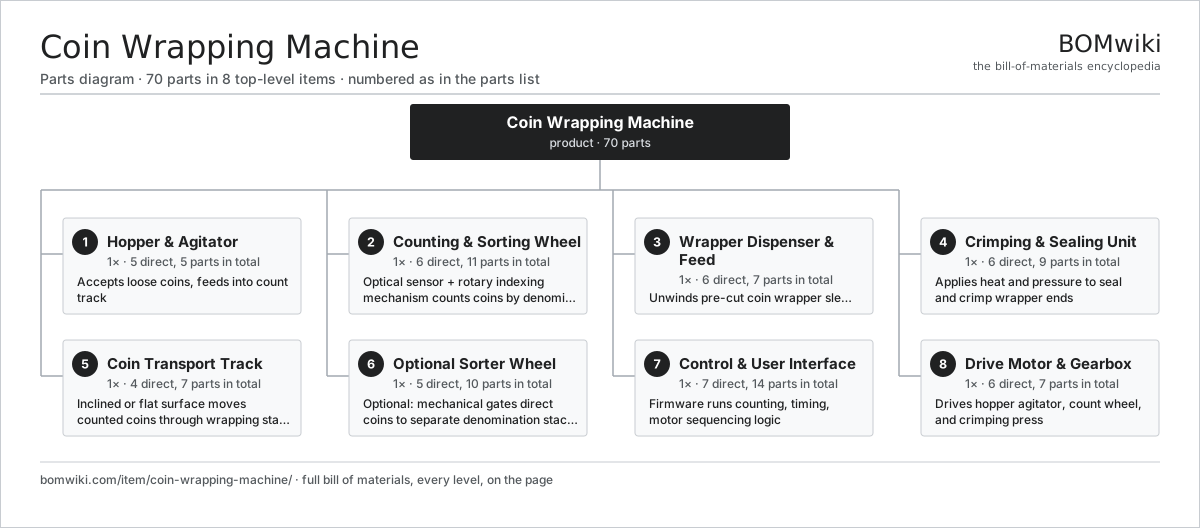
| # | Part | Qty | What it does |
|---|---|---|---|
| 1 | Hopper & Agitator 5 parts | 1× | Accepts loose coins, feeds into count track |
| 2 | Counting & Sorting Wheel 6 parts | 1× | Optical sensor + rotary indexing mechanism counts coins by denomination |
| 3 | Wrapper Dispenser & Feed 6 parts | 1× | Unwinds pre-cut coin wrapper sleeves, positions for insertion |
| 4 | Crimping & Sealing Unit 6 parts | 1× | Applies heat and pressure to seal and crimp wrapper ends |
| 5 | Coin Transport Track 4 parts | 1× | Inclined or flat surface moves counted coins through wrapping stage |
| 6 | Optional Sorter Wheel 5 parts | 1× | Optional: mechanical gates direct coins to separate denomination stacks |
| 7 | Control & User Interface 7 parts | 1× | Firmware runs counting, timing, motor sequencing logic |
| 8 | Drive Motor & Gearbox 6 parts | 1× | Drives hopper agitator, count wheel, and crimping press |
3D model
No 3D model yet. Have a CAD file of this? Add a 3D model. STL renders right on this page; STEP, FreeCAD, and OpenSCAD sources are welcome too (openly licensed, like all 3D models on BOMwiki).
Build & assembly graph
expand / collapse · shared sub-assemblies converge · links to related products · est. labourTap an assembly to expand/collapse · tap a part to open it · use “Open page” for any node · drag to pan, scroll to zoom.
Bill of materials for Coin Wrapping Machine
8 top-level lines · 53 rows shown · 70 parts total · indented to 3 levels| # | Item / sub-assembly | Part no. | Qty/assy | Ext. qty | Parts | Type |
|---|---|---|---|---|---|---|
| 1 | Hopper & Agitator 5 parts | coin-wrapping-machine-hopper | 1× | 1 | 5 | assembly |
| 1.1 | Hopper Bowl | coin-wrapping-machine-hopper-bowl | 1× | 1 | · | part |
| 1.2 | Agitator Spiral | coin-wrapping-machine-agitator-spiral | 1× | 1 | · | part |
| 1.3 | Agitator Motor | coin-wrapping-machine-agitator-motor | 1× | 1 | · | part |
| 1.4 | Fastener Set | fastener-set | 1× | 1 | · | part |
| 1.5 | Motor Housing | motor-housing | 1× | 1 | · | part |
| 2 | Counting & Sorting Wheel 6 parts | coin-wrapping-machine-counting-wheel | 1× | 1 | 11 | assembly |
| 2.1 | Wheel Disk | coin-wrapping-machine-wheel-disk | 1× | 1 | · | part |
| 2.2 | Optical Sensor | coin-wrapping-machine-optical-sensor | 5× | 5 | · | part |
| 2.3 | Stepper Motor | coin-wrapping-machine-stepper-motor | 1× | 1 | · | part |
| 2.4 | Bare PCB | pcb-bare | 1× | 1 | · | part |
| 2.5 | Connector | connector | 1× | 1 | · | part |
| 2.6 | Ball Bearing | ball-bearing | 2× | 2 | · | part |
| 3 | Wrapper Dispenser & Feed 6 parts | coin-wrapping-machine-paper-dispenser | 1× | 1 | 7 | assembly |
| 3.1 | Wrapper Roll | coin-wrapping-machine-wrapper-roll | 1× | 1 | · | part |
| 3.2 | Roller Guide | coin-wrapping-machine-roller-guide | 2× | 2 | · | part |
| 3.3 | Cutter Assembly | coin-wrapping-machine-cutter-assembly | 1× | 1 | · | part |
| 3.4 | Feed Servo | coin-wrapping-machine-feed-servo | 1× | 1 | · | part |
| 3.5 | Feed Tube | coin-wrapping-machine-feed-tube | 1× | 1 | · | part |
| 3.6 | Connector | connector | 1× | 1 | · | part |
| 4 | Crimping & Sealing Unit 6 parts | coin-wrapping-machine-crimping-unit | 1× | 1 | 9 | assembly |
| 4.1 | Crimp Head | coin-wrapping-machine-crimp-head | 2× | 2 | · | part |
| 4.2 | Heating Element | heating-element | 2× | 2 | · | part |
| 4.3 | Press Motor | coin-wrapping-machine-press-motor | 1× | 1 | · | part |
| 4.4 | Thermal Sensor | coin-wrapping-machine-thermal-sensor | 1× | 1 | · | part |
| 4.5 | Connector | connector | 2× | 2 | · | part |
| 4.6 | Fastener Set | fastener-set | 1× | 1 | · | part |
| 5 | Coin Transport Track 4 parts | coin-wrapping-machine-transport-track | 1× | 1 | 7 | assembly |
| 5.1 | Track Rails | coin-wrapping-machine-track-rails | 2× | 2 | · | part |
| 5.2 | Track Cover | coin-wrapping-machine-track-cover | 1× | 1 | · | part |
| 5.3 | Gravity Baffle | coin-wrapping-machine-gravity-baffle | 3× | 3 | · | part |
| 5.4 | Fastener Set | fastener-set | 1× | 1 | · | part |
| 6 | Optional Sorter Wheel 5 parts | coin-wrapping-machine-sorter-wheel | 1× | 1 | 10 | assembly |
| 6.1 | Sorter Plate | coin-wrapping-machine-sorter-plate | 1× | 1 | · | part |
| 6.2 | Sorter Motor | coin-wrapping-machine-sorter-motor | 1× | 1 | · | part |
| 6.3 | Collection Bin | coin-wrapping-machine-collection-bin | 6× | 6 | · | part |
| 6.4 | Fastener Set | fastener-set | 1× | 1 | · | part |
| 6.5 | Connector | connector | 1× | 1 | · | part |
| 7 | Control & User Interface 7 parts | coin-wrapping-machine-control-board | 1× | 1 | 14 | assembly |
| 7.1 | Microcontroller | mcu | 1× | 1 | · | part |
| 7.2 | Bare PCB | pcb-bare | 1× | 1 | · | part |
| 7.3 | SMD Passive (R/C/L) | smd-passives | 1× | 1 | · | part |
| 7.4 | Power MOSFET | mosfet | 4× | 4 | · | part |
| 7.5 | LCD Panel | lcd-panel | 1× | 1 | · | part |
| 7.6 | Relay | relay | 2× | 2 | · | part |
| 7.7 | Connector | connector | 4× | 4 | · | part |
| 8 | Drive Motor & Gearbox 6 parts | coin-wrapping-machine-main-motor | 1× | 1 | 7 | assembly |
| 8.1 | Ac Motor | coin-wrapping-machine-ac-motor | 1× | 1 | · | part |
| 8.2 | Gearbox | coin-wrapping-machine-gearbox | 1× | 1 | · | part |
| 8.3 | Drive Belt | coin-wrapping-machine-drive-belt | 2× | 2 | · | part |
| 8.4 | Belt Tensioner | coin-wrapping-machine-belt-tensioner | 1× | 1 | · | part |
| 8.5 | Motor Housing | motor-housing | 1× | 1 | · | part |
| 8.6 | Fastener Set | fastener-set | 1× | 1 | · | part |
Something wrong in this list? Report a problem with this BOM.
Related products
same domain, ranked by shared parts Cash Register
165 parts · shares 5 with this page
Rotary Deposit Safe
152 parts · shares 4 with this page
Cash Register
165 parts · shares 5 with this page
Rotary Deposit Safe
152 parts · shares 4 with this page
 Guillotine Paper Cutter
261 parts · shares 5 with this page
Guillotine Paper Cutter
261 parts · shares 5 with this page
Sourcing: possible vendors
Browse the supplier directory → Prices, MOQ, and lead times are algorithmic estimates, not quotes, and not claims about these companies. Company mappings are curated by keyword; est. price band $50–$15k. How estimates work| Vendor | HQ | Specialty | MOQ | Lead time |
|---|---|---|---|---|
|
🇯🇵Canon
canon.com ↗
|
Tokyo, JP | Imaging & optics | 500 units | 8–12 wks |
|
🇯🇵Ricoh
ricoh.com ↗
|
Tokyo, JP | Office imaging | 500 units | 8–12 wks |
|
🇺🇸Xerox
xerox.com ↗
|
Norwalk, US | Printers & copiers | 500 units | 8–12 wks |
|
🇯🇵Epson
epson.com ↗
|
Suwa, JP | Printers & projectors | 500 units | 8–12 wks |
|
🇯🇵Brother
brother.com ↗
|
Nagoya, JP | Printers & sewing | 500 units | 8–12 wks |
1,715-word article