Colorimeter
ProductOverview
A colorimeter is a handheld meter that quantifies the color of a surface by measuring how much light it reflects at three wavelengths corresponding to human color perception. It reports color in standardized units (Lab*, XYZ, or Kelvin) so colors can be matched, archived, and communicated across industries. Printers, fabric mills, cosmetics manufacturers, and quality inspectors use colorimeters to ensure batch-to-batch consistency and to verify that materials meet color specifications.
The Light Source illuminates the sample, and the Tristimulus Sensor Array collects the reflected light. Unlike a camera, which captures a spatial image, the colorimeter integrates light over its Measurement Aperture (typically 2–10 mm), computing a single color value. The three sensors in the array are matched to the CIE 1931 standard observer's sensitivity curves, the X, Y, and Z response functions, so the meter perceives color the way human eyes do.
The Signal Processor converts the raw sensor readings to standard color coordinates, applying calibration against a Calibration Standard white reference. The Display Module shows the result in the requested color space.
How it works
The Light Source emits stable white light, usually pulsed to reduce power draw and thermal drift. The light bounces off the sample and enters the Optical Head Assembly through the Measurement Aperture.
The Tristimulus Sensor Array is the heart of the measurement. Each of the three sensors pairs a Photodiode (silicon PIN photodiode) with a thin-film Optical Filter tuned to pass a specific band of wavelengths. The three filters approximate the X, Y, and Z response curves defined by the CIE 1931 standard observer, so the meter responds to color roughly as the average human eye does.
The Y channel is especially important: it measures luminance (brightness), and its spectral response peaks around 555 nm, matching the human eye's peak sensitivity under daylight. The X and Z channels capture the red and blue content, respectively.
A Transimpedance Preamp Array amplifies the photodiode currents (typically picoamps) to voltages, and the Signal Processor digitizes these with an ADC. The processor then applies a calibration matrix, derived at the factory:
''' [L* a* b*] = M × [raw_X raw_Y raw_Z] + offset '''
where M is calibrated against a white reference tile of known reflectance (typically a Spectralon or diffuse ceramic standard). Field users periodically measure this Calibration Standard to verify the calibration has not drifted.
Common color spaces reported by the Display Module:
- XYZ: The CIE tristimulus values, the "raw" data from the sensor matrix.
- Lab*: A more intuitive space where L* is lightness (0–100), a* is red–green (negative to positive), and b* is yellow–blue. Color differences are roughly perceptually uniform.
- xy chromaticity + Y: Separates hue/saturation (xy) from brightness (Y).
- Kelvin: Correlated color temperature, useful for light sources and white-balance adjustments.
Measurement geometry matters. Some colorimeters use a diffuse design: light enters at many angles and is collected in all directions, so surface texture is "averaged out." Others use 45/0° geometry: light at 45° incidence, collection normal to the surface, which highlights gloss and is sensitive to surface finish. The choice depends on the application: diffuse for judging the intrinsic color (e.g., paint batches), 45/0° for apparel and graphic arts where gloss matters.
Temperature drift is the main source of error. LEDs and filters shift slightly as temperature changes, so quality colorimeters use a Lamp Driver that stabilizes light output and include a Thermal Interface Pad to minimize sensor temperature rise from the light source.
Accuracy is typically ±0.5–2.0 ΔE (color difference units), depending on the meter grade. Professional versions cost more and are more stable; consumer versions are adequate for many tasks like matching paint or textile samples.
Colorimeter parts and their functions
10 top-level parts · 277 parts in total · full bill of materials below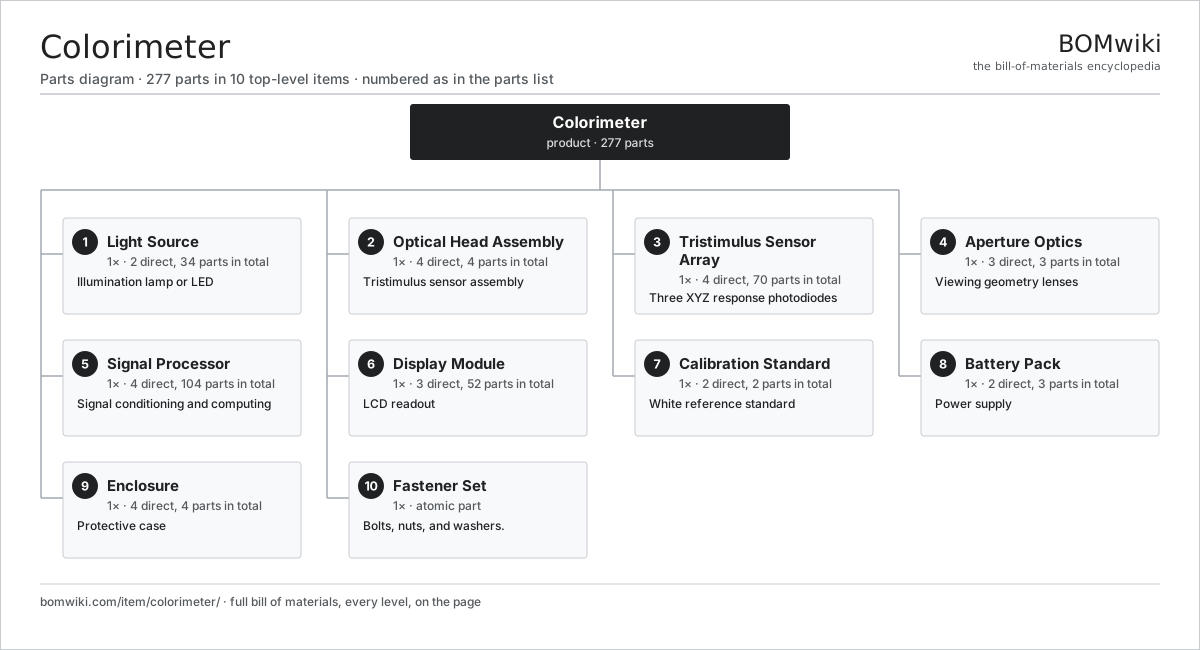
| # | Part | Qty | What it does |
|---|---|---|---|
| 1 | Light Source 2 parts | 1× | Illumination lamp or LED |
| 2 | Optical Head Assembly 4 parts | 1× | Tristimulus sensor assembly |
| 3 | Tristimulus Sensor Array 4 parts | 1× | Three XYZ response photodiodes |
| 4 | Aperture Optics 3 parts | 1× | Viewing geometry lenses |
| 5 | Signal Processor 4 parts | 1× | Signal conditioning and computing |
| 6 | Display Module 3 parts | 1× | LCD readout |
| 7 | Calibration Standard 2 parts | 1× | White reference standard |
| 8 | Battery Pack 2 parts | 1× | Power supply |
| 9 | Enclosure 4 parts | 1× | Protective case |
| 10 | Fastener Set | 1× | Bolts, nuts, and washers. |
3D model
No 3D model yet. Have a CAD file of this? Add a 3D model. STL renders right on this page; STEP, FreeCAD, and OpenSCAD sources are welcome too (openly licensed, like all 3D models on BOMwiki).
Build & assembly graph
expand / collapse · shared sub-assemblies converge · links to related products · est. labourTap an assembly to expand/collapse · tap a part to open it · use “Open page” for any node · drag to pan, scroll to zoom.
Bill of materials for Colorimeter
10 top-level lines · 53 rows shown · 277 parts total · indented to 3 levels| # | Item / sub-assembly | Part no. | Qty/assy | Ext. qty | Parts | Type |
|---|---|---|---|---|---|---|
| 1 | Light Source 2 parts | colorimeter-light-source | 1× | 1 | 34 | assembly |
| 1.1 | White LED or Xenon Lamp | colorimeter-led-lamp | 1× | 1 | · | part |
| 1.2 | Lamp Driver 4 parts | colorimeter-lamp-driver | 1× | 1 | 33 | assembly |
| 1.2.1 | Bare PCB | pcb-bare | 1× | 1 | · | part |
| 1.2.2 | Power MOSFET | mosfet | 1× | 1 | · | part |
| 1.2.3 | Power Inductor | power-inductor | 1× | 1 | · | part |
| 1.2.4 | SMD Passive (R/C/L) | smd-passives | 30× | 30 | · | part |
| 2 | Optical Head Assembly 4 parts | colorimeter-optical-head | 1× | 1 | 4 | assembly |
| 2.1 | Measurement Aperture | colorimeter-aperture | 1× | 1 | · | part |
| 2.2 | Collection Lens | colorimeter-collection-lens | 1× | 1 | · | part |
| 2.3 | O-Ring Set | oring-set | 1× | 1 | · | part |
| 2.4 | Fastener Set | fastener-set | 1× | 1 | · | part |
| 3 | Tristimulus Sensor Array 4 parts | colorimeter-sensor-array | 1× | 1 | 70 | assembly |
| 3.1 | X Filter + Photodiode 3 parts | colorimeter-photodiode-x | 1× | 1 | 3 | assembly |
| 3.1.1 | Optical Filter | colorimeter-optical-filter | 1× | 1 | · | part |
| 3.1.2 | Photodiode | colorimeter-photodiode | 1× | 1 | · | part |
| 3.1.3 | O-Ring Set | oring-set | 1× | 1 | · | part |
| 3.2 | Y Filter + Photodiode 3 parts | colorimeter-photodiode-y | 1× | 1 | 3 | assembly |
| 3.2.1 | Optical Filter | colorimeter-optical-filter | 1× | 1 | · | part |
| 3.2.2 | Photodiode | colorimeter-photodiode | 1× | 1 | · | part |
| 3.2.3 | O-Ring Set | oring-set | 1× | 1 | · | part |
| 3.3 | Z Filter + Photodiode 3 parts | colorimeter-photodiode-z | 1× | 1 | 3 | assembly |
| 3.3.1 | Optical Filter | colorimeter-optical-filter | 1× | 1 | · | part |
| 3.3.2 | Photodiode | colorimeter-photodiode | 1× | 1 | · | part |
| 3.3.3 | O-Ring Set | oring-set | 1× | 1 | · | part |
| 3.4 | Transimpedance Preamp Array 2 parts | colorimeter-preamp-array | 1× | 1 | 61 | assembly |
| 3.4.1 | Bare PCB | pcb-bare | 1× | 1 | · | part |
| 3.4.2 | SMD Passive (R/C/L) | smd-passives | 60× | 60 | · | part |
| 4 | Aperture Optics 3 parts | colorimeter-aperture-optics | 1× | 1 | 3 | assembly |
| 4.1 | Measurement Aperture | colorimeter-aperture | 1× | 1 | · | part |
| 4.2 | Diffuser Plate | colorimeter-diffuser | 1× | 1 | · | part |
| 4.3 | Fastener Set | fastener-set | 1× | 1 | · | part |
| 5 | Signal Processor 4 parts | colorimeter-processor | 1× | 1 | 104 | assembly |
| 5.1 | Bare PCB | pcb-bare | 1× | 1 | · | part |
| 5.2 | Microcontroller | mcu | 1× | 1 | · | part |
| 5.3 | SMD Passive (R/C/L) | smd-passives | 100× | 100 | · | part |
| 5.4 | Connector | connector | 2× | 2 | · | part |
| 6 | Display Module 3 parts | colorimeter-display | 1× | 1 | 52 | assembly |
| 6.1 | LCD Panel | lcd-panel | 1× | 1 | · | part |
| 6.2 | Bare PCB | pcb-bare | 1× | 1 | · | part |
| 6.3 | SMD Passive (R/C/L) | smd-passives | 50× | 50 | · | part |
| 7 | Calibration Standard 2 parts | colorimeter-calibration-standard | 1× | 1 | 2 | assembly |
| 7.1 | Reference Tile | colorimeter-reference-tile | 1× | 1 | · | part |
| 7.2 | Fastener Set | fastener-set | 1× | 1 | · | part |
| 8 | Battery Pack 2 parts | colorimeter-battery | 1× | 1 | 3 | assembly |
| 8.1 | Li-ion Cell, 18650 | li-cell-18650 | 2× | 2 | · | part |
| 8.2 | BMS Board | bms-board | 1× | 1 | · | part |
| 9 | Enclosure 4 parts | colorimeter-housing | 1× | 1 | 4 | assembly |
| 9.1 | Main Body | colorimeter-main-body | 1× | 1 | · | part |
| 9.2 | Probe Head | colorimeter-probe-head | 1× | 1 | · | part |
| 9.3 | Carrying Strap | colorimeter-strap | 1× | 1 | · | part |
| 9.4 | Fastener Set | fastener-set | 1× | 1 | · | part |
| 10 | Fastener Set | fastener-set | 1× | 1 | · | part |
Something wrong in this list? Report a problem with this BOM.
Related products
same domain, ranked by shared parts Gloss Meter
242 parts · shares 7 with this page
Terrestrial Laser Scanner
570 parts · shares 7 with this page
Gloss Meter
242 parts · shares 7 with this page
Terrestrial Laser Scanner
570 parts · shares 7 with this page
 Digital Cinema Projector
383 parts · shares 5 with this page
Digital Cinema Projector
383 parts · shares 5 with this page
 Laser Rangefinder
220 parts · shares 6 with this page
Laser Rangefinder
220 parts · shares 6 with this page
 Rotary Laser Level
236 parts · shares 6 with this page
Rotary Laser Level
236 parts · shares 6 with this page
 Cable Camera System
138 parts · shares 4 with this page
Cable Camera System
138 parts · shares 4 with this page
Sourcing: possible vendors
Browse the supplier directory → Prices, MOQ, and lead times are algorithmic estimates, not quotes, and not claims about these companies. Company mappings are curated by keyword; est. price band $100–$8k. How estimates work| Vendor | HQ | Specialty | MOQ | Lead time |
|---|---|---|---|---|
|
🇯🇵Canon
canon.com ↗
|
Tokyo, JP | Imaging & optics | 500 units | 10–16 wks |
|
🇯🇵Nikon
nikon.com ↗
|
Tokyo, JP | Imaging & optics | 500 units | 10–16 wks |
|
🇩🇪ZEISS
zeiss.com ↗
|
Oberkochen, DE | Optics & optoelectronics | 500 units | 10–16 wks |
| leica-camera.com ↗ | Wetzlar, DE | Cameras & optics | 500 units | 10–16 wks |
| flir.com ↗ | Wilsonville, US | Thermal imaging | 500 units | 10–16 wks |
626-word article