Concertina
ProductOverview
The concertina is a hexagonal aerophone (wind instrument) whose sound is produced by free reeds vibrated by air from a bellows pump. Unlike the bag of a bagpipe, which stores air passively, the concertina's Bellows are actively squeezed and pulled by the player's hands, pushing a controlled stream of air through the Reed Pans to the reeds. The Button Action selects which reeds sound, so the player can produce melody and accompaniment using only the buttons and bellows control.
The concertina is distinctive among reed instruments for its compact hexagonal or square form, its directional sound (radiating from the bellows ends), and its bisonoric characteristic (in English concertinas): the same button produces different pitches depending on whether the bellows are pushed in or pulled out. This unique constraint shaped centuries of concertina repertoire and playing technique.
The instrument emerged in 19th century Germany and Austria and spread rapidly throughout Europe, particularly to England and Ireland, where it became central to folk music traditions. The button keyboard layout, though unconventional, allows rapid melodic playing and a rich, reedy tone instantly recognizable across all contexts.
Bellows and air system
The Bellows are the air source and pressure regulator. They consist of a Bellows Frame, a hexagonal or square wooden frame, covered with airtight pleated Bellows Leather on all sides. When the player squeezes the bellows (pushing the two end plates together), the leather compresses, reducing the internal volume and forcing air out into the reed chambers. When the player pulls the bellows apart, the leather expands, drawing in fresh air through the Bellows Valve, a one-way flapper that allows air to enter from the outside but prevents it from exiting.
The bellows pressure (typically 15–30 millibars, about 0.2–0.3 kPa) is lower than a human breath but sufficient to vibrate the reeds clearly. The player modulates this pressure manually, squeezing harder for louder playing and more gently for softer tones. Skilled players can maintain remarkably steady pressure for hours, allowing a seamless flow of sound without wavering pitch or dynamics.
Reeds and pitch control
The concertina's sound comes from Reed Pans, chambers housing the actual sound producers, free reeds. These are simple but ingenious: a single thin piece of metal (traditionally brass, now often steel or bronze) is mounted over a slot in the Reed Block. When air flows across the slot, the reed vibrates, its fundamental frequency determined by its length, width, and thickness.
The Treble Reed Pan typically contains about 20–24 treble reeds, covering a range from roughly C5 (middle C and above) to F6. The Bass Reed Pan contains 12–14 bass reeds, covering lower pitches (G2–D4). Each reed vibrates at its natural frequency, creating a pure sine-wave-like pitch, though with a characteristic buzzing quality from the reed beating against its mounting.
The pitch of a reed cannot be adjusted during play; it is fixed by manufacture. If a reed goes flat (as reeds naturally do over time due to wear), it must be adjusted by carefully scraping material from the reed (raising pitch) or soldering additional mass onto it (lowering pitch), a specialized skill requiring expert knowledge and tools.
Button action and valve control
The Button Action is the control interface. Each button controls one Treble Valve or Bass Valve, which is a small flap that opens to allow air to reach its corresponding reed. When a button is pressed, its stem pushes open the valve flap; when released, a spring (the Button Spring) pulls the valve closed.
In an English concertina (the most common type), the buttons are arranged in a hexagonal grid on both end plates. Because the instrument is bisonoric, the same button position on both ends produces different notes depending on bellows direction: pressing a button while pushing the bellows produces one pitch, and pressing the same button while pulling produces a different pitch. This bisonoric design was originally a practical constraint (it simplified the mechanical design), but it became so characteristic of the English concertina that modern bisonoric instruments are intentionally designed this way for musical reasons.
The button layout on an English concertina is typically arranged so that the most common chords and scales are accessible to experienced players, much like a piano keyboard is designed for the left and right hands. A player can play complex polyphonic music using both hands alternately, pressing different buttons in rapid succession while managing the bellows pressure.
End plates and form
The End Plates are the hexagonal or square wooden outer shells (in English concertinas, usually hexagonal, about 10–15 cm across). These serve three purposes: they provide structural rigidity, they house the button array and button mechanisms, and they provide the grip points (Bellows Straps) for the player's hands.
The End Plate Face may be decoratively carved, inlaid, or engraved, and many concertinas are beautiful objects with artisanal craftsmanship visible in their finish. The Button Holes are precision-drilled to hold the button stems at exact spacings, and the interior is carefully fitted with the Valve Linkage that translates button presses into valve openings.
Playing position and technique
The concertina is held horizontally with one end plate in each hand, the thumbs hooked through the Bellows Straps. The fingers rest on the button array, and the player squeezes and pulls the bellows with the entire hand and arm. The bellows action requires constant mechanical control: pressing too hard risks damaging the leather; pressing too softly results in barely audible reeds.
The typical playing technique involves:
- Bellows control: managing pressure for even dynamics.
- Bisonoric adaptation: memorizing that button X produces different pitches on push vs. pull, and using this in melodies.
- Rapid button changes: alternating quickly between buttons for scale runs and ornaments.
- Bellows articulation: using subtle pressure changes to shape phrases and articulate notes.
A skilled player can execute rapid, complex melodic passages at speeds comparable to a fiddle or flute, making the concertina suitable for fast folk dances and virtuosic classical pieces.
Types and variations
The English concertina (bisonoric, hexagonal, typically 48 buttons) is the most common type, associated particularly with English and Irish folk music. The Anglo concertina (also bisonoric, typically 20–30 buttons) is smaller and more portable, popular in street performance and session playing. The Duet concertina (unisonoric, meaning the same button produces the same note on both push and pull) comes in various configurations (Crane, Jeffries, Maccann), designed to enable two-handed melody-and-accompaniment playing more like a piano.
The squeeze-box or accordion-like concertinas, sometimes classified separately, blend concertina construction with larger bellows and different reed configurations. In all cases, the fundamental operation, squeezing and pulling bellows to vibrate free reeds selected by buttons, remains constant.
Maintenance and longevity
Concertina reeds are remarkably durable if kept clean and dry. The main wear point is the bellows leather, which can dry out and crack in low humidity or develop leaks from punctures or rough handling. Replacing bellows is a major undertaking, requiring unstitching the old leather, fitting new material, and re-sealing, work typically done by specialist repair technicians.
The valves and springs require occasional adjustment or replacement, and buttons can crack if subjected to impacts. A well-maintained concertina can last a century or more; many Victorian-era concertinas are still in active use in folk music circles today. The instrument is one of the more durable reed instruments, partly because the reeds are inside the body (protected from dust and moisture) and partly because the design has remained essentially unchanged for 150 years, making repair knowledge and parts readily available.
Repertoire and cultural significance
The concertina is central to English, Irish, and Scandinavian folk music traditions. Its reedy tone, portable form, and ability to play melody and simple accompaniment made it a natural accompaniment to dancing and singing. Many traditional jigs, reels, and ballads are written specifically for concertina, and the instrument is standard in folk sessions alongside fiddle, bodhran (drum), and bodhrán.
In classical music, the concertina appears less frequently, though 19th century composers (including Berlioz) wrote for it, and contemporary composers occasionally revive interest in the instrument. Its warm, complex tone and expressive potential (through bellows control and vibrato techniques) give it a voice distinct from accordion or harmonica, and collectors and revival musicians continue to appreciate its unique character.
Concertina parts and their functions
6 top-level parts · 241 parts in total · full bill of materials below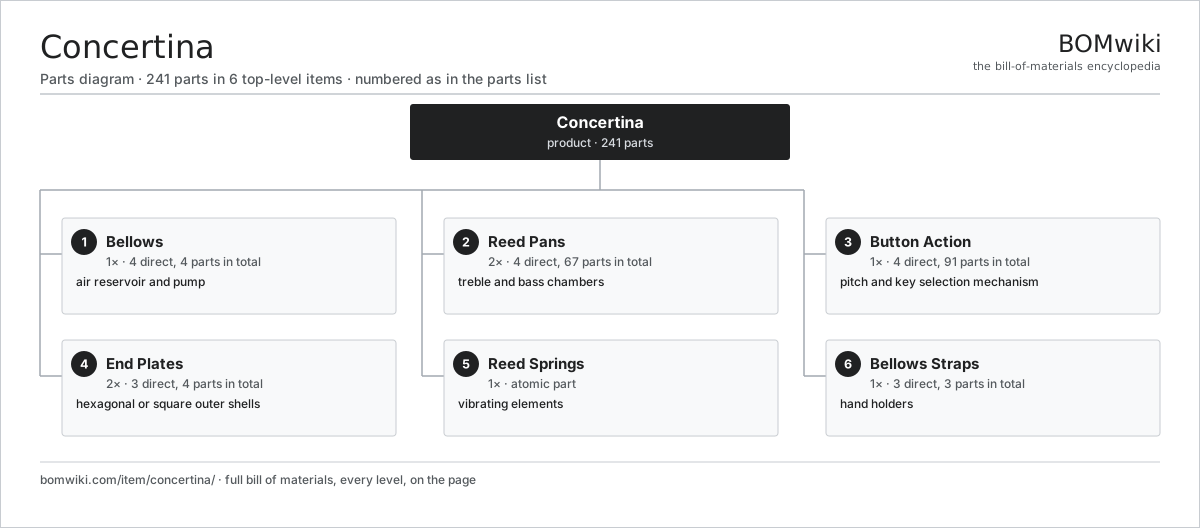
| # | Part | Qty | What it does |
|---|---|---|---|
| 1 | Bellows 4 parts | 1× | air reservoir and pump |
| 2 | Reed Pans 4 parts | 2× | treble and bass chambers |
| 3 | Button Action 4 parts | 1× | pitch and key selection mechanism |
| 4 | End Plates 3 parts | 2× | hexagonal or square outer shells |
| 5 | Reed Springs | 1× | vibrating elements |
| 6 | Bellows Straps 3 parts | 1× | hand holders |
3D model
No 3D model yet. Have a CAD file of this? Add a 3D model. STL renders right on this page; STEP, FreeCAD, and OpenSCAD sources are welcome too (openly licensed, like all 3D models on BOMwiki).
Build & assembly graph
expand / collapse · shared sub-assemblies converge · links to related products · est. labourTap an assembly to expand/collapse · tap a part to open it · use “Open page” for any node · drag to pan, scroll to zoom.
Bill of materials for Concertina
6 top-level lines · 28 rows shown · 241 parts total · indented to 3 levels| # | Item / sub-assembly | Part no. | Qty/assy | Ext. qty | Parts | Type |
|---|---|---|---|---|---|---|
| 1 | Bellows 4 parts | concertina-bellows | 1× | 1 | 4 | assembly |
| 1.1 | Bellows Frame | concertina-bellows-frame | 1× | 1 | · | part |
| 1.2 | Bellows Leather | concertina-bellows-leather | 1× | 1 | · | part |
| 1.3 | Bellows Valve | concertina-bellows-valve | 1× | 1 | · | part |
| 1.4 | Bellows Action | concertina-bellows-action | 1× | 1 | · | part |
| 2 | Reed Pans 4 parts | concertina-reed-pans | 2× | 2 | 67 | assembly |
| 2.1 | Treble Reed Pan 2 parts | concertina-treble-reed-pan | 1× | 2 | 40 | assembly |
| 2.1.1 | Treble Reed | concertina-treble-reed | 20× | 40 | · | part |
| 2.1.2 | Treble Valve | concertina-treble-valve | 20× | 40 | · | part |
| 2.2 | Bass Reed Pan 2 parts | concertina-bass-reed-pan | 1× | 2 | 24 | assembly |
| 2.2.1 | Bass Reed | concertina-bass-reed | 12× | 24 | · | part |
| 2.2.2 | Bass Valve | concertina-bass-valve | 12× | 24 | · | part |
| 2.3 | Reed Block | concertina-reed-block | 2× | 4 | · | part |
| 2.4 | Air Passages | concertina-air-passages | 1× | 2 | · | part |
| 3 | Button Action 4 parts | concertina-button-action | 1× | 1 | 91 | assembly |
| 3.1 | Button | concertina-button | 30× | 30 | · | part |
| 3.2 | Button Stem | concertina-button-stem | 30× | 30 | · | part |
| 3.3 | Valve Linkage | concertina-valve-linkage | 1× | 1 | · | part |
| 3.4 | Button Spring | concertina-button-spring | 30× | 30 | · | part |
| 4 | End Plates 3 parts | concertina-end-plates | 2× | 2 | 4 | assembly |
| 4.1 | End Plate | concertina-end-plate | 2× | 4 | · | part |
| 4.2 | End Plate Face | concertina-end-plate-face | 1× | 2 | · | part |
| 4.3 | Button Holes | concertina-button-holes | 1× | 2 | · | part |
| 5 | Reed Springs | concertina-reed-springs | 1× | 1 | · | part |
| 6 | Bellows Straps 3 parts | concertina-bellows-straps | 1× | 1 | 3 | assembly |
| 6.1 | Left Strap | concertina-strap-left | 1× | 1 | · | part |
| 6.2 | Right Strap | concertina-strap-right | 1× | 1 | · | part |
| 6.3 | Strap Leather | concertina-strap-leather | 1× | 1 | · | part |
Something wrong in this list? Report a problem with this BOM.
Sourcing: possible vendors
Browse the supplier directory → Prices, MOQ, and lead times are algorithmic estimates, not quotes, and not claims about these companies. Company mappings are curated by keyword; est. price band $50–$5k. How estimates work| Vendor | HQ | Specialty | MOQ | Lead time |
|---|---|---|---|---|
| yamaha.com ↗ | Hamamatsu, JP | Audio & instruments | 200 units | 8–14 wks |
|
🇺🇸Fender
fender.com ↗
|
Los Angeles, US | Guitars & amps | 200 units | 8–14 wks |
|
🇺🇸Gibson
gibson.com ↗
|
Nashville, US | Guitars | 200 units | 8–14 wks |
|
🇯🇵Roland
roland.com ↗
|
Hamamatsu, JP | Electronic instruments | 200 units | 8–14 wks |
| steinway.com ↗ | New York, US | Pianos | 200 units | 8–14 wks |
1,412-word article