Conference Speakerphone
ProductOverview
The conference speakerphone is a telecommunications device engineered specifically for multi-party voice communication in meeting rooms, offices, and training spaces. Unlike ordinary telephone handsets (which force a one-to-one conversation) or simple desktop speakers plugged into a computer, the conference phone integrates a full-duplex audio system with dedicated noise rejection and echo cancellation algorithms designed to let multiple people in a room speak and be heard clearly by remote participants.
Conference phones are essential equipment in any organization that conducts regular video calls, sales conference calls, or client presentations. They remain standard even in the age of Zoom and Teams because they provide a shared, high-quality experience for in-room participants without requiring each person to wear a headset.
How it works
Omnidirectional Microphone Array: The microphone array consists of 4–6 individual capsules distributed around the device's perimeter. Each capsule is an electret condenser or dynamic microphone tuned to capture human speech (100–8000 Hz). The preamplifier sums the signals from all capsules, effectively creating a 360-degree listening zone. This allows multiple speakers sitting around a table to all be heard equally, regardless of their distance from a single front-facing microphone.
Full-Duplex Operation: Unlike half-duplex systems (where only one party can speak at a time), the conference phone operates in full-duplex mode: incoming audio from the remote participant is played through the speaker while simultaneously, local voices are being captured by the microphone and sent back to the remote party. This bidirectional, overlapping audio flow is essential for natural conversation.
Echo Cancellation: The most critical component in a full-duplex system is echo cancellation. Without it, the remote participant would hear their own voice coming back to them as an echo through the speaker and microphone. The DSP echo canceller uses a technique called "acoustic echo cancellation (AEC)":
- The outgoing audio stream (what the remote party is saying) is analyzed.
- The DSP estimates what acoustic echo should be present in the microphone signal based on the speaker volume and room acoustics.
- The estimated echo is subtracted from the incoming microphone signal.
- The result is clean, echo-free audio sent back to the remote party.
The echo canceller is tuned to handle room reflections with tail lengths up to ~100 ms (typical for small to medium conference rooms).
Noise Suppression: In addition to echo, conference rooms contain background noise: HVAC systems, typing, pen tapping, traffic outside. The DSP runs noise suppression algorithms that detect and attenuate this noise by 10–20 dB without distorting the voices. The omnidirectional array also provides a degree of noise reduction through directional gain toward the center of the table.
Audio Codecs and Network Integration: The audio codec samples incoming analog voice at ~16 kHz and encodes it using standard telephony codecs (G.711, G.729, or others depending on the phone system). The DSP processor handles the real-time encoding and decoding of multiple audio streams while running echo cancellation and noise suppression algorithms in parallel.
Speaker and Amplifier: The speaker is a full-range driver (coaxial or 2-way design) rated at 3–10 W output. A Class D amplifier drives the speaker to deliver 80–95 dB SPL, loud enough to fill a small to medium conference room but not so loud as to cause discomfort or feedback.
User Interface: The control keypad allows the operator to dial numbers (using DTMF buttons), press feature buttons to mute the microphone, adjust volume, or put calls on hold. A caller ID display shows the remote party's number or name and the current call duration.
Daisy-Chaining and Bridging
Many conference phone models support daisy-chaining via RJ-11 connectors: multiple phones can be connected in series on a single telephone line. When configured this way:
- Typically 2–6 phones can be daisy-chained.
- Each phone operates semi-independently (its own speaker and microphone array).
- The first phone controls overall line connection; additional phones receive audio from the line and contribute their microphone signals.
- Advanced models include "bridging" logic to balance microphone levels across all phones.
This configuration allows a single telephone line to serve multiple meeting rooms simultaneously, useful in distributed offices or collaborative spaces.
Full-Duplex vs. Half-Duplex
Conference phones operate in full-duplex mode, which means:
- Both parties can speak and be heard simultaneously (like a normal phone call).
- Overlapping speech is preserved (one party can interrupt or interject naturally).
This contrasts with half-duplex systems (e.g., walkie-talkies):
- Only one party can transmit at a time; the other must listen.
- Overlapping speech is not possible; systems switch direction based on voice detection.
Half-duplex is simpler and cheaper to implement but creates unnatural, stilted conversations. Full-duplex requires sophisticated echo cancellation but is essential for professional conferencing.
Acoustic Echo Cancellation (AEC) Algorithm
The echo cancellation algorithm is a form of adaptive filtering:
- Reference Signal: The outgoing audio (speaker output) is captured as a reference.
- Estimated Echo: Using the reference and an adaptive filter (typically an FIR filter with 512–4096 taps), the DSP predicts what echo will appear in the microphone.
- Subtraction: The estimated echo is subtracted from the actual microphone signal.
- Adaptation: The filter coefficients are adjusted over time (typically every 10–100 ms) to track changes in room acoustics.
Modern DSP processors can run echo cancellation with tail lengths up to 500 ms or more, accommodating large halls or buildings with complex reflections. Voice-activity detection (VAD) helps the algorithm distinguish between speaker voice (which should be heavily canceled) and actual remote voice (which should pass through).
Noise Reduction Algorithms
Noise suppression typically uses one or more of these techniques:
- Spectral Subtraction: Estimates the noise floor during silence periods, then subtracts it from the signal during speech.
- Wiener Filtering: Adapts a filter to maximize signal-to-noise ratio in real-time.
- Multi-Channel Beamforming: Uses the multi-microphone array to focus on voices from the center of the table while rejecting noise from the sides and rear.
The result is cleaner, more intelligible speech for remote participants, especially in noisy offices or open floor plans.
Modern Competition and VoIP Integration
Conference phones originated as dedicated telephony devices (connected to analog phone lines via RJ-11). Modern variants integrate with:
- VoIP (Voice over IP): Many conference phones now connect via Ethernet (RJ-45) and support SIP (Session Initiation Protocol), allowing them to work with cloud PBX systems and VoIP providers.
- Unified Communications: Some phones integrate APIs to pair with Zoom, Teams, or other platforms, auto-joining meetings when scheduled.
- Wireless: Recent models support Bluetooth or WiFi for phone pairing, bridging cellular calls into the conference room.
However, dedicated conference phones remain popular because they:
- Provide guaranteed quality of service (no interference from other network traffic).
- Offer superior echo cancellation compared to generic audio devices.
- Are simpler to use (no software updates, driver issues, or Bluetooth pairing failures).
Maintenance and Longevity
Conference phones are remarkably durable:
- Microphone Capsules: No moving parts; can last 20+ years.
- Speaker: Coaxial or 2-way design with robust suspension; typical life 10–15 years.
- DSP and Electronics: Solid-state with no mechanical wear; expected life 10–15+ years.
Maintenance consists primarily of:
- Wiping the exterior and microphone apertures with a dry cloth annually to remove dust.
- Checking RJ-11 connections for corrosion if in older installations.
- Testing echo and noise reduction performance quarterly (can degrade if firmware is corrupted or if room acoustics change significantly).
The DSP chip is rarely user-replaceable, but the power adapter and speaker are field-replaceable in most models if failure occurs after 10+ years of use.
Conference Speakerphone parts and their functions
8 top-level parts · 36 parts in total · full bill of materials below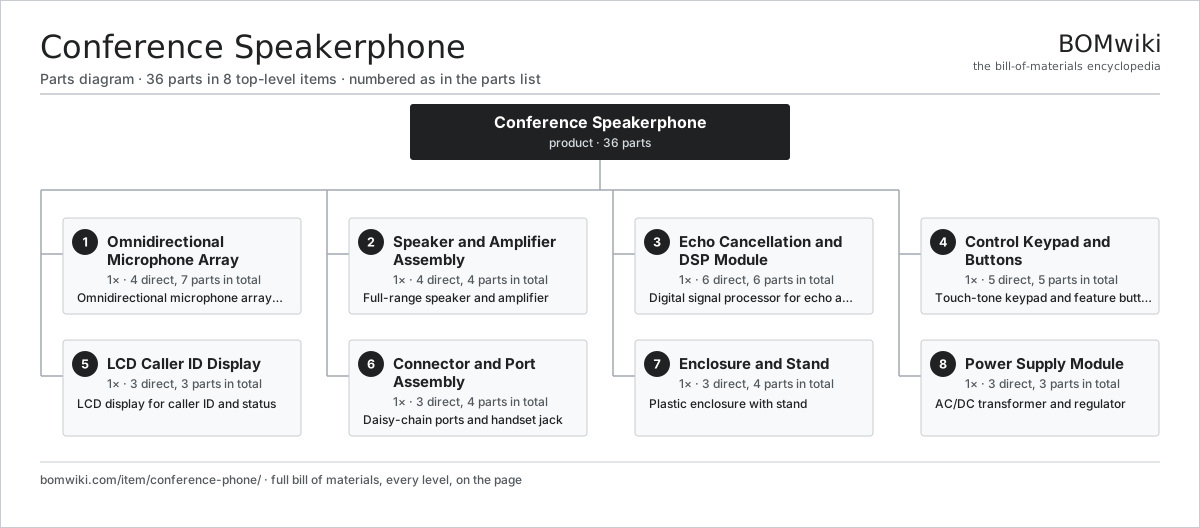
| # | Part | Qty | What it does |
|---|---|---|---|
| 1 | Omnidirectional Microphone Array 4 parts | 1× | Omnidirectional microphone array with preamp |
| 2 | Speaker and Amplifier Assembly 4 parts | 1× | Full-range speaker and amplifier |
| 3 | Echo Cancellation and DSP Module 6 parts | 1× | Digital signal processor for echo and noise cancellation |
| 4 | Control Keypad and Buttons 5 parts | 1× | Touch-tone keypad and feature buttons |
| 5 | LCD Caller ID Display 3 parts | 1× | LCD display for caller ID and status |
| 6 | Connector and Port Assembly 3 parts | 1× | Daisy-chain ports and handset jack |
| 7 | Enclosure and Stand 3 parts | 1× | Plastic enclosure with stand |
| 8 | Power Supply Module 3 parts | 1× | AC/DC transformer and regulator |
3D model
No 3D model yet. Have a CAD file of this? Add a 3D model. STL renders right on this page; STEP, FreeCAD, and OpenSCAD sources are welcome too (openly licensed, like all 3D models on BOMwiki).
Build & assembly graph
expand / collapse · shared sub-assemblies converge · links to related products · est. labourTap an assembly to expand/collapse · tap a part to open it · use “Open page” for any node · drag to pan, scroll to zoom.
Bill of materials for Conference Speakerphone
8 top-level lines · 39 rows shown · 36 parts total · indented to 3 levels| # | Item / sub-assembly | Part no. | Qty/assy | Ext. qty | Parts | Type |
|---|---|---|---|---|---|---|
| 1 | Omnidirectional Microphone Array 4 parts | conference-phone-mic-array | 1× | 1 | 7 | assembly |
| 1.1 | Microphone Capsule | conference-phone-mic-capsule | 4× | 4 | · | part |
| 1.2 | Microphone Preamplifier | conference-phone-preamp | 1× | 1 | · | part |
| 1.3 | SMD Passive (R/C/L) | smd-passives | 1× | 1 | · | part |
| 1.4 | Fastener Set | fastener-set | 1× | 1 | · | part |
| 2 | Speaker and Amplifier Assembly 4 parts | conference-phone-speaker | 1× | 1 | 4 | assembly |
| 2.1 | Speaker | speaker | 1× | 1 | · | part |
| 2.2 | Speaker Amplifier | conference-phone-speaker-amp | 1× | 1 | · | part |
| 2.3 | Speaker Enclosure | conference-phone-speaker-enclosure | 1× | 1 | · | part |
| 2.4 | Fastener Set | fastener-set | 1× | 1 | · | part |
| 3 | Echo Cancellation and DSP Module 6 parts | conference-phone-dsp-processor | 1× | 1 | 6 | assembly |
| 3.1 | DSP Processor IC | conference-phone-dsp-chip | 1× | 1 | · | part |
| 3.2 | Bare PCB | pcb-bare | 1× | 1 | · | part |
| 3.3 | Audio Codec | conference-phone-audio-codec | 1× | 1 | · | part |
| 3.4 | SMD Passive (R/C/L) | smd-passives | 1× | 1 | · | part |
| 3.5 | Connector | connector | 1× | 1 | · | part |
| 3.6 | Fastener Set | fastener-set | 1× | 1 | · | part |
| 4 | Control Keypad and Buttons 5 parts | conference-phone-keypad | 1× | 1 | 5 | assembly |
| 4.1 | DTMF Keypad | conference-phone-touch-buttons | 1× | 1 | · | part |
| 4.2 | Feature Button Set | conference-phone-feature-buttons | 1× | 1 | · | part |
| 4.3 | Bare PCB | pcb-bare | 1× | 1 | · | part |
| 4.4 | Connector | connector | 1× | 1 | · | part |
| 4.5 | Fastener Set | fastener-set | 1× | 1 | · | part |
| 5 | LCD Caller ID Display 3 parts | conference-phone-display | 1× | 1 | 3 | assembly |
| 5.1 | LCD Panel | lcd-panel | 1× | 1 | · | part |
| 5.2 | LCD Driver Board | conference-phone-display-driver | 1× | 1 | · | part |
| 5.3 | Fastener Set | fastener-set | 1× | 1 | · | part |
| 6 | Connector and Port Assembly 3 parts | conference-phone-connector-hub | 1× | 1 | 4 | assembly |
| 6.1 | RJ-11 Connector Jack | conference-phone-rj11-jack | 2× | 2 | · | part |
| 6.2 | Handset Jack | conference-phone-handset-port | 1× | 1 | · | part |
| 6.3 | Fastener Set | fastener-set | 1× | 1 | · | part |
| 7 | Enclosure and Stand 3 parts | conference-phone-case | 1× | 1 | 4 | assembly |
| 7.1 | Plastic Housing Shell | conference-phone-case-shell | 1× | 1 | · | part |
| 7.2 | Adjustable Stand Base | conference-phone-stand | 1× | 1 | · | part |
| 7.3 | Fastener Set | fastener-set | 2× | 2 | · | part |
| 8 | Power Supply Module 3 parts | conference-phone-power-adapter | 1× | 1 | 3 | assembly |
| 8.1 | Power Supply | power-supply | 1× | 1 | · | part |
| 8.2 | Connector | connector | 1× | 1 | · | part |
| 8.3 | Fastener Set | fastener-set | 1× | 1 | · | part |
Something wrong in this list? Report a problem with this BOM.
Related products
same domain, ranked by shared parts Counterfeit Bill Detector
34 parts · shares 4 with this page
Counterfeit Bill Detector
34 parts · shares 4 with this page
 Interactive Display Board
572 parts · shares 4 with this page
Interactive Display Board
572 parts · shares 4 with this page
 Pneumatic Tube Station
201 parts · shares 4 with this page
Pneumatic Tube Station
201 parts · shares 4 with this page
 POS Terminal
138 parts · shares 4 with this page
Queue Ticket Dispenser
307 parts · shares 4 with this page
POS Terminal
138 parts · shares 4 with this page
Queue Ticket Dispenser
307 parts · shares 4 with this page
 Cash Register
165 parts · shares 3 with this page
Cash Register
165 parts · shares 3 with this page
Sourcing: possible vendors
Browse the supplier directory → Prices, MOQ, and lead times are algorithmic estimates, not quotes, and not claims about these companies. Company mappings are curated by keyword; est. price band $50–$15k. How estimates work| Vendor | HQ | Specialty | MOQ | Lead time |
|---|---|---|---|---|
|
🇯🇵Canon
canon.com ↗
|
Tokyo, JP | Imaging & optics | 500 units | 8–12 wks |
|
🇯🇵Ricoh
ricoh.com ↗
|
Tokyo, JP | Office imaging | 500 units | 8–12 wks |
|
🇺🇸Xerox
xerox.com ↗
|
Norwalk, US | Printers & copiers | 500 units | 8–12 wks |
|
🇯🇵Epson
epson.com ↗
|
Suwa, JP | Printers & projectors | 500 units | 8–12 wks |
|
🇯🇵Brother
brother.com ↗
|
Nagoya, JP | Printers & sewing | 500 units | 8–12 wks |
1,361-word article