Construction Hoist
ProductOverview
A construction hoist (builder's hoist, man-and-material hoist) carries workers and material up the outside of a building under construction. It cannot use ropes hung from above, there is no finished structure to hang them from, so it climbs instead: electric motors on the cage turn pinions that mesh with a gear rack running the full height of a modular mast. Because the machine grips its own track, the mast can be extended floor by floor as the building rises, and the same principle drives mast-climbing work platforms and tower-crane operator lifts. EN 12159 governs personnel-rated hoists in Europe, ANSI A10.4 in the United States.
A typical mid-rise unit carries 2,000 kg or 25 workers at 0.65 m/s; dedicated high-rise hoists on supertall projects reach 1.6 m/s and several hundred metres of travel, since hoisting capacity is usually the constraint on a tall building's construction schedule.
Drive and mast
Each Drive Unit unit is a motor-gearbox module bolted to a plate on the cage: an 11 kW induction motor, two helical Helical Gear Pair reduction stages, and a case-hardened Drive Pinion of module 8, the de facto industry standard tooth size, engaging the rack. Passenger-rated hoists carry two or three drive units so that the failure of any one leaves enough braking and driving capacity, and each motor carries its own spring-applied Motor Brake sized to hold the fully loaded cage alone.
The Mast is the consumable, reconfigurable part of the system. Each Mast Section is a welded square lattice of steel tube, 1.5 m long and roughly 650–800 mm across, with a hardened Rack Segment bolted along one chord. Sections stack with four torqued corner bolts, and the rack joints are machined so the tooth pitch runs continuous across every splice, a pitch error at a joint hammers the pinions on every pass. The mast stands on the Base Chassis and is restrained by Wall Ties to the building face every 6–9 m, with a permitted free cantilever of about 12 m above the top tie. Erection is self-performed: new sections come up on the cage roof, and crews working through the interlocked Roof Hatch land and bolt each one, raising the hoist roughly a floor per work cycle.
Cage and enclosures
The Cage is a steel box of mesh and Sheet Metal Panel, typically 1.5 × 3.2 m, with interlocked Cage Doors at both ends so it can serve loading on either face. Twelve Guide Rollers embrace the mast tubes above and below the drive plate; their adjustment sets the pinion-rack mesh clearance, the single most important maintenance item on the machine. At ground level the Base Enclosure fences the hoistway to 2 m, entered only through the interlocked Base Gate, and Coil Spring buffers on the chassis take a descending overrun.
Each served floor gets a Landing Gate gate: a full-height mesh Gate Panel at the slab edge whose Gate Latch is released only by a striker on the arriving cage. The Gate Interlock feeds the safety chain, so an opened gate anywhere on the mast stops the cage, the same door logic as a permanent elevator, implemented in site-proof hardware.
Safety device
Overspeed protection is independent of the drives. A dedicated Safety Pinion meshes with the rack and spins the Overspeed Safety Device, a sealed centrifugal brake. If descent exceeds trip speed, typically rated speed plus about 0.3 m/s, flyweights engage a threaded cone brake that winds itself into engagement and decelerates the cage progressively over a metre or so, then holds it on the rack. The device is drop-tested at commissioning and at intervals (three-monthly is common practice) by deliberately releasing the motor brakes from a test box at ground level. Cam-operated Limit Switches provide normal terminal stops plus final limits that remove all power, and Hall Sensors give floor-level stopping for loaded pallet trucks.
Electrical system
The Control System cabinet rides on the cage. A variable-frequency drive built on IGBT Power Modules ramps the motors smoothly, VFD control replaced direct-on-line starting across the industry largely because it cut rack and pinion wear, while Relay contactors switch the brake circuits and enforce the interlock chain. Power reaches the moving cage through the Trailing Cable System: a rubber-sheathed Trailing Cable held to the mast by funnel Cable Guides and coiling into the Cable Basket at the base as the cage descends. The operator runs the hoist from the Operator Station, either attended with up/down control or, on modern units, floor-call automatic like a permanent elevator.
Construction Hoist parts and their functions
8 top-level parts · 457 parts in total · full bill of materials below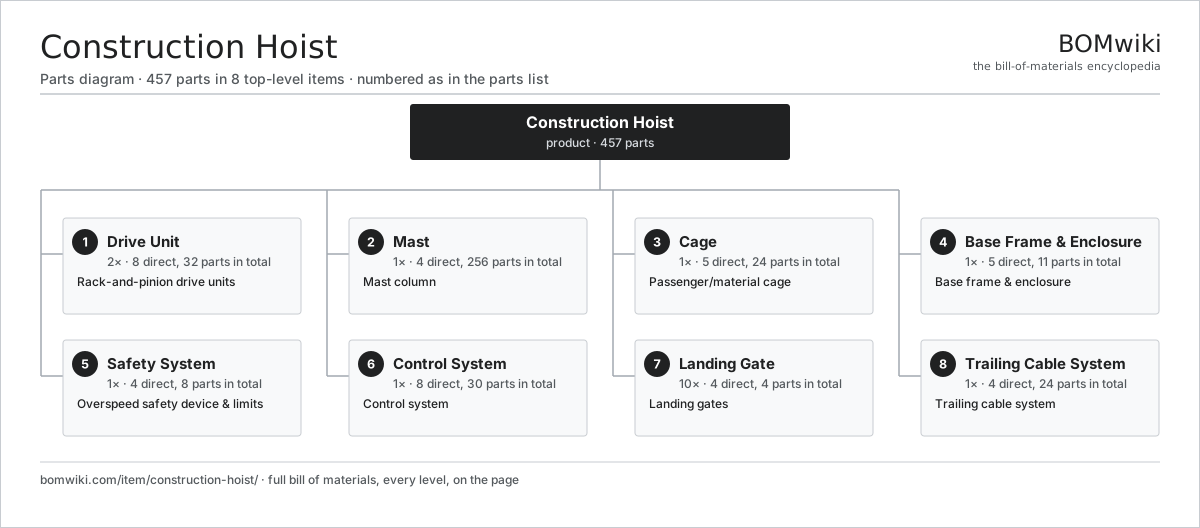
| # | Part | Qty | What it does |
|---|---|---|---|
| 1 | Drive Unit 8 parts | 2× | Rack-and-pinion drive units |
| 2 | Mast 4 parts | 1× | Mast column |
| 3 | Cage 5 parts | 1× | Passenger/material cage |
| 4 | Base Frame & Enclosure 5 parts | 1× | Base frame & enclosure |
| 5 | Safety System 4 parts | 1× | Overspeed safety device & limits |
| 6 | Control System 8 parts | 1× | Control system |
| 7 | Landing Gate 4 parts | 10× | Landing gates |
| 8 | Trailing Cable System 4 parts | 1× | Trailing cable system |
3D model
No 3D model yet. Have a CAD file of this? Add a 3D model. STL renders right on this page; STEP, FreeCAD, and OpenSCAD sources are welcome too (openly licensed, like all 3D models on BOMwiki).
Build & assembly graph
expand / collapse · shared sub-assemblies converge · links to related products · est. labourTap an assembly to expand/collapse · tap a part to open it · use “Open page” for any node · drag to pan, scroll to zoom.
Bill of materials for Construction Hoist
8 top-level lines · 57 rows shown · 457 parts total · indented to 3 levels| # | Item / sub-assembly | Part no. | Qty/assy | Ext. qty | Parts | Type |
|---|---|---|---|---|---|---|
| 1 | Drive Unit 8 parts | construction-hoist-drive | 2× | 2 | 32 | assembly |
| 1.1 | Stator Assembly 3 parts | stator-assembly | 1× | 2 | 3 | assembly |
| 1.1.1 | Stator Core (laminations) | stator-core | 1× | 2 | · | part |
| 1.1.2 | Copper Winding | copper-winding | 1× | 2 | · | part |
| 1.1.3 | Slot Insulation | stator-insulation | 1× | 2 | · | part |
| 1.2 | Rotor Assembly 4 parts | rotor-assembly | 1× | 2 | 19 | assembly |
| 1.2.1 | Rotor Shaft | rotor-shaft | 1× | 2 | · | part |
| 1.2.2 | Rotor Core | rotor-core | 1× | 2 | · | part |
| 1.2.3 | Neodymium Magnet | neodymium-magnet | 16× | 32 | · | part |
| 1.2.4 | Ball Bearing | ball-bearing | 1× | 2 | · | part |
| 1.3 | Motor Housing | motor-housing | 1× | 2 | · | part |
| 1.4 | Motor Brake | construction-hoist-motor-brake | 1× | 2 | · | part |
| 1.5 | Helical Gear Pair | gear-pair | 2× | 4 | · | part |
| 1.6 | Gearbox Housing | gearbox-housing | 1× | 2 | · | part |
| 1.7 | Drive Pinion | construction-hoist-pinion | 1× | 2 | · | part |
| 1.8 | Ball Bearing | ball-bearing | 4× | 8 | · | part |
| 2 | Mast 4 parts | construction-hoist-mast | 1× | 1 | 256 | assembly |
| 2.1 | Mast Section | construction-hoist-mast-section | 80× | 80 | · | part |
| 2.2 | Rack Segment | construction-hoist-rack-segment | 80× | 80 | · | part |
| 2.3 | Wall Tie | construction-hoist-wall-tie | 16× | 16 | · | part |
| 2.4 | Fastener Set | fastener-set | 80× | 80 | · | part |
| 3 | Cage 5 parts | construction-hoist-cage | 1× | 1 | 24 | assembly |
| 3.1 | Cage Frame | construction-hoist-cage-frame | 1× | 1 | · | part |
| 3.2 | Sheet Metal Panel | sheet-panel | 8× | 8 | · | part |
| 3.3 | Cage Door | construction-hoist-cage-door | 2× | 2 | · | part |
| 3.4 | Roof Hatch | construction-hoist-roof-hatch | 1× | 1 | · | part |
| 3.5 | Guide Roller | construction-hoist-guide-roller | 12× | 12 | · | part |
| 4 | Base Frame & Enclosure 5 parts | construction-hoist-base | 1× | 1 | 11 | assembly |
| 4.1 | Base Chassis | construction-hoist-base-chassis | 1× | 1 | · | part |
| 4.2 | Base Enclosure | construction-hoist-base-enclosure | 1× | 1 | · | part |
| 4.3 | Base Gate | construction-hoist-base-gate | 1× | 1 | · | part |
| 4.4 | Coil Spring | coil-spring | 4× | 4 | · | part |
| 4.5 | Fastener Set | fastener-set | 4× | 4 | · | part |
| 5 | Safety System 4 parts | construction-hoist-safety | 1× | 1 | 8 | assembly |
| 5.1 | Overspeed Safety Device | construction-hoist-overspeed-governor | 1× | 1 | · | part |
| 5.2 | Safety Pinion | construction-hoist-safety-pinion | 1× | 1 | · | part |
| 5.3 | Limit Switch | construction-hoist-limit-switch | 4× | 4 | · | part |
| 5.4 | Hall Sensor | hall-sensor | 2× | 2 | · | part |
| 6 | Control System 8 parts | construction-hoist-electrical | 1× | 1 | 30 | assembly |
| 6.1 | IGBT Power Module | igbt-module | 6× | 6 | · | part |
| 6.2 | Relay | relay | 6× | 6 | · | part |
| 6.3 | Bare PCB | pcb-bare | 1× | 1 | · | part |
| 6.4 | Microcontroller | mcu | 1× | 1 | · | part |
| 6.5 | Power Supply | power-supply | 1× | 1 | · | part |
| 6.6 | Connector | connector | 10× | 10 | · | part |
| 6.7 | Wire Bundle | wire-bundle | 4× | 4 | · | part |
| 6.8 | Operator Station | construction-hoist-cab-station | 1× | 1 | · | part |
| 7 | Landing Gate 4 parts | construction-hoist-landing | 10× | 10 | 4 | assembly |
| 7.1 | Gate Panel | construction-hoist-gate-panel | 1× | 10 | · | part |
| 7.2 | Gate Interlock | construction-hoist-gate-interlock | 1× | 10 | · | part |
| 7.3 | Gate Latch | construction-hoist-gate-latch | 1× | 10 | · | part |
| 7.4 | Fastener Set | fastener-set | 1× | 10 | · | part |
| 8 | Trailing Cable System 4 parts | construction-hoist-cable-system | 1× | 1 | 24 | assembly |
| 8.1 | Trailing Cable | construction-hoist-trailing-cable | 1× | 1 | · | part |
| 8.2 | Cable Guide | construction-hoist-cable-guide | 20× | 20 | · | part |
| 8.3 | Cable Basket | construction-hoist-cable-basket | 1× | 1 | · | part |
| 8.4 | Connector | connector | 2× | 2 | · | part |
Something wrong in this list? Report a problem with this BOM.
Related products
same domain, ranked by shared parts Main Beam Tunnel Boring Machine
10,126 parts · shares 21 with this page
Rebar Shearing and Bending Line
361 parts · shares 19 with this page
Main Beam Tunnel Boring Machine
10,126 parts · shares 21 with this page
Rebar Shearing and Bending Line
361 parts · shares 19 with this page
 Tower Crane
433 parts · shares 17 with this page
Tower Crane
433 parts · shares 17 with this page
 Bridge Girder Launching Gantry
1,542 parts · shares 19 with this page
Bridge Girder Launching Gantry
1,542 parts · shares 19 with this page
 Rebar Cage Welding Machine
1,702 parts · shares 19 with this page
Rebar Cage Welding Machine
1,702 parts · shares 19 with this page
 Tandem Vibratory Roller
369 parts · shares 19 with this page
Tandem Vibratory Roller
369 parts · shares 19 with this page
Sourcing: possible vendors
Browse the supplier directory → Prices, MOQ, and lead times are algorithmic estimates, not quotes, and not claims about these companies. Company mappings are curated by keyword; est. price band $15k–$2M. How estimates work| Vendor | HQ | Specialty | MOQ | Lead time |
|---|---|---|---|---|
| caterpillar.com ↗ | Irving, US | Construction & mining equipment | made to order | 16–28 wks |
|
🇯🇵Komatsu
komatsu.com ↗
|
Tokyo, JP | Construction & mining equipment | made to order | 16–28 wks |
|
🇸🇪Volvo CE
volvoce.com ↗
|
Gothenburg, SE | Construction equipment | made to order | 16–28 wks |
|
🇨🇭Liebherr
liebherr.com ↗
|
Bulle, CH | Cranes & heavy equipment | made to order | 16–28 wks |
|
🇨🇳XCMG
xcmg.com ↗
|
Xuzhou, CN | Construction machinery | made to order | 16–28 wks |
840-word article