Laser Detector Receiver
ProductOverview
A laser detector receiver is a handheld light sensor that automatically detects and tracks a construction laser line or rotating beam, providing instant feedback on whether the receiver is above, below, or aligned with the laser plane. Used in combination with pipe lasers, line lasers, and rotary lasers, the detector eliminates visual estimation and guesswork, allowing a single operator to rapidly map elevation changes, grade reference points, and 3D elevations across a site. The detector mounts on a grade rod or pole, displays position via an LED bar graph and numeric LCD, and provides audio beeping when on-plane, essential for rapid site layout, foundation work, and machine guidance.
Modern detectors work with both red (650 nm, visible) and infrared (1064 nm, invisible) lasers, making them compatible with all rotating and pipe laser models on the market.
How it works
The detector's sensor array consists of 13 silicon photodiodes in a vertical line, 1.5 mm apart. When a laser beam strikes the array, photons generate a small current proportional to light intensity. The transimpedance amplifier converts this current to a voltage, and the microcontroller samples all 13 channels via its analog-to-digital converter.
The firmware calculates the centroid (center-of-mass) of the light distribution: if the laser beam hits diodes 6 and 7, the centroid is between them; if it hits only diode 7, the centroid is at diode 7. This calculation is more accurate than a single large photodiode because the array provides sub-pixel resolution. The LED bar graph lights up the elements closest to the centroid (green for on-plane, red for off), giving the operator instant visual feedback.
Simultaneously, the processor calculates the numeric offset (positive for above laser, negative for below) and displays it on the LCD. The speaker provides three beeping modes: continuous when on-plane, slow pulses when above/below, and a low-battery chirp.
Photocell array and beam tracking
The sensor array spans ~18 mm vertically, allowing it to track a laser spot ±9 mm from centerline with 2 mm resolution. If the spot is larger than expected (e.g., a wide line laser), multiple adjacent diodes saturate; the firmware treats this as a valid detection and calculates the weighted centroid. If the laser is off or the beam is blocked, all diodes read dark current (<1 nA), and the processor enters a search/standby mode with slow beeping.
The optical bandpass filter (600–1100 nm) rejects solar background, tungsten lights, and other ambient sources, improving signal-to-noise ratio by a factor of 10. This is critical for daytime operation; without the filter, sunlight would overwhelm the faint laser signal.
Detection modes and accuracy
The detector automatically switches between red laser mode (650 nm line/rotary lasers) and infrared mode (1064 nm invisible lasers for grade lasers). The mode is selectable via jumper on the PCB or can be auto-detected by noting which wavelength produces a signal.
On-plane accuracy: ±5 mm per 10 m distance. This is limited by beam width (typical line lasers project 2–5 mm thick lines) and photodiode pitch. Close-range work (2–5 m) achieves ±2 mm; long-distance work (50+ m) degrades to ±10 mm due to atmospheric scatter and parallax.
Vertical range: The LCD can display heights from −3 m (detector high above laser reference) to +3 m (detector far below). This covers most site grading tasks. Some professional models include multi-turn potentiometer calibration to extend range or apply custom offsets for different rod heights.
Grade rod mounting and deployment
The detector mounts on grade rods and leveling staffs via a two-point clamp with rubber pads. The mounting height is adjustable (typically 0.5–2 m above the rod base), and a tilt adjustment arm allows ±5° fine-tuning of the sensor orientation perpendicular to the rod. This is critical: if the detector is tilted, the laser spot will not align with the array's center even if on-plane, causing false readings.
Field workflow:
- Setup: Mount detector on grade rod at a known height (e.g., 1.5 m above ground).
- Rough positioning: Walk toward the laser and listen for beeping. The audio feedback is continuous when on-plane.
- Fine alignment: Watch the LED bar graph; the center elements should be green.
- Record reading: Read the numeric LCD offset and note the rod height; the elevation of the ground point is then calculated as (laser height) − (rod height) − (LCD offset).
Multiple readings at different rod positions can map a grade plane or identify settlement patterns.
Audio feedback and visual integration
The piezo beeper generates three distinct tones:
- On-plane (continuous): 2 kHz tone, steady. Crew member adjusts machine or position until beep is continuous.
- Above laser (3 Hz pulse): Operator is above the laser plane; step backward or lower rod.
- Below laser (1 Hz pulse): Operator is below; step forward or raise rod.
- Low battery (0.5 Hz slow): Battery voltage <4.8 V; replace AA batteries soon.
The LED bar provides precise position feedback for sight work (machine operators can see the detector from 30 m away if it is mounted high on the grade rod). The combination of audio (spatial-free, always audible) and visual (precise, range-limited) makes the detector suitable for both tedious slope verification and high-speed grading operations.
Practical applications
Grading and earthwork: Grade laser is set to project the desired slope (e.g., 2% for swale drainage). As the excavator scrapes soil, the operator holds a detected rod at random points; the LCD shows if the ground is high or low relative to grade. Measurements at 20 m spacing identify high spots, which are then cut.
Foundation stakeout: Rotating laser is set up over a benchmark. The detector, held on a pole at the building corner, measures elevation. The difference compared to design elevation tells the crew how much to cut/fill.
Pipeline laying: Pipe laser projects a line along the sewer main. The detector, clamped to the incoming pipe or jacking equipment, verifies alignment and slope.
Machine guidance (GPS-free): In areas without GPS (tunnels, dense trees), a crew member holds a detected rod at the design corner while the machine operator watches the laser line relative to the detector. Real-time laser feedback allows grading without surveyor stakeout.
Accuracy limitations
Accuracy degrades with:
- Dirty or fogged optics: Clean the optical window regularly; dust and rain streaks cause signal loss.
- Laser beam width: Wide-beam lasers (>10 mm) lose centroid resolution; narrow-beam systems (1–2 mm) are more precise.
- Distance: Atmospheric scatter widens the beam at long range; 100+ m range loses ±10–20 mm accuracy.
- Vibration: Jackhammers and pile drivers create microsecond-scale motion; the detector averages over 0.1 second, so high-frequency vibration is filtered out, but impulsive shock can create measurement jitter.
- Temperature: Photodiode dark current increases ~0.5% per °C; cold sensors (−10 °C) are noisier but more sensitive; hot sensors (50 °C) lose sensitivity by 20%.
Most manufacturers specify accuracy at standard conditions (20 °C, daylight, 10–30 m range). Field users should apply a ±10 mm safety margin for critical work and use optical levels or total stations for verification on precision projects.
Laser Detector Receiver parts and their functions
6 top-level parts · 22 parts in total · full bill of materials below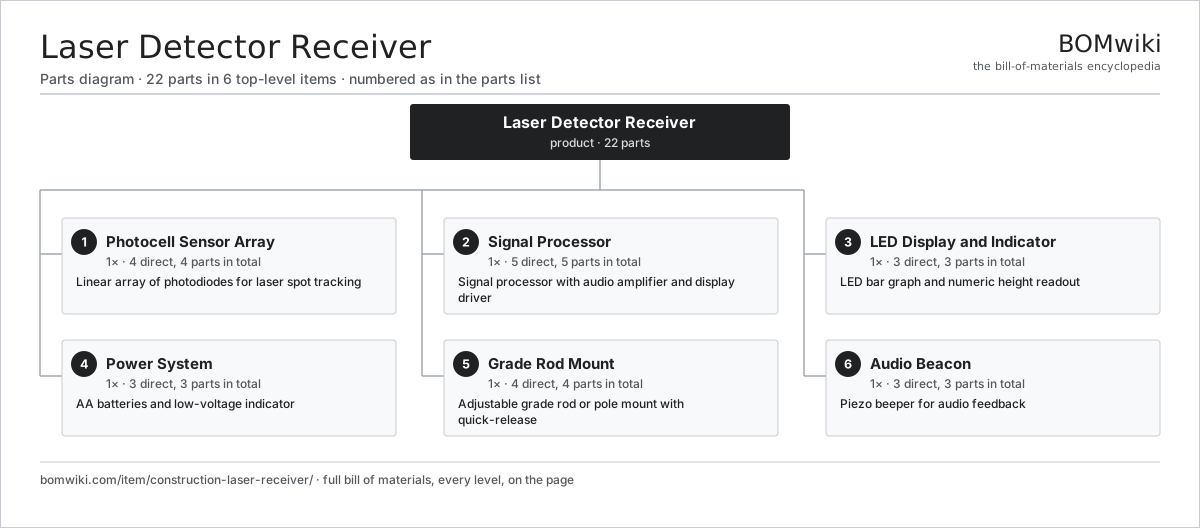
| # | Part | Qty | What it does |
|---|---|---|---|
| 1 | Photocell Sensor Array 4 parts | 1× | Linear array of photodiodes for laser spot tracking |
| 2 | Signal Processor 5 parts | 1× | Signal processor with audio amplifier and display driver |
| 3 | LED Display and Indicator 3 parts | 1× | LED bar graph and numeric height readout |
| 4 | Power System 3 parts | 1× | AA batteries and low-voltage indicator |
| 5 | Grade Rod Mount 4 parts | 1× | Adjustable grade rod or pole mount with quick-release |
| 6 | Audio Beacon 3 parts | 1× | Piezo beeper for audio feedback |
3D model
No 3D model yet. Have a CAD file of this? Add a 3D model. STL renders right on this page; STEP, FreeCAD, and OpenSCAD sources are welcome too (openly licensed, like all 3D models on BOMwiki).
Build & assembly graph
expand / collapse · shared sub-assemblies converge · links to related products · est. labourTap an assembly to expand/collapse · tap a part to open it · use “Open page” for any node · drag to pan, scroll to zoom.
Bill of materials for Laser Detector Receiver
6 top-level lines · 28 rows shown · 22 parts total · indented to 3 levels| # | Item / sub-assembly | Part no. | Qty/assy | Ext. qty | Parts | Type |
|---|---|---|---|---|---|---|
| 1 | Photocell Sensor Array 4 parts | construction-laser-photocell-array | 1× | 1 | 4 | assembly |
| 1.1 | Photodiode Array Chip | construction-laser-photodiode | 1× | 1 | · | part |
| 1.2 | Transimpedance Amp IC | construction-laser-tia | 1× | 1 | · | part |
| 1.3 | SMD Passive (R/C/L) | smd-passives | 1× | 1 | · | part |
| 1.4 | Optical Bandpass Filter | construction-laser-optical-filter | 1× | 1 | · | part |
| 2 | Signal Processor 5 parts | construction-laser-electronics | 1× | 1 | 5 | assembly |
| 2.1 | Microcontroller | mcu | 1× | 1 | · | part |
| 2.2 | Bare PCB | pcb-bare | 1× | 1 | · | part |
| 2.3 | Comparator IC | construction-laser-comparator | 1× | 1 | · | part |
| 2.4 | SMD Passive (R/C/L) | smd-passives | 1× | 1 | · | part |
| 2.5 | Relay | relay | 1× | 1 | · | part |
| 3 | LED Display and Indicator 3 parts | construction-laser-display | 1× | 1 | 3 | assembly |
| 3.1 | Bar-Graph LED Module | construction-laser-led-array | 1× | 1 | · | part |
| 3.2 | Construction Laser Lcd Panel | construction-laser-receiver-construction-laser-lcd-panel | 1× | 1 | · | part |
| 3.3 | SMD Passive (R/C/L) | smd-passives | 1× | 1 | · | part |
| 4 | Power System 3 parts | construction-laser-battery | 1× | 1 | 3 | assembly |
| 4.1 | Battery Carousel | construction-laser-battery-holder | 1× | 1 | · | part |
| 4.2 | Battery Monitor | construction-laser-voltage-monitor | 1× | 1 | · | part |
| 4.3 | SMD Passive (R/C/L) | smd-passives | 1× | 1 | · | part |
| 5 | Grade Rod Mount 4 parts | construction-laser-clamp | 1× | 1 | 4 | assembly |
| 5.1 | Clamp Body | construction-laser-clamp-body | 1× | 1 | · | part |
| 5.2 | Tilt Adjustment Arm | construction-laser-tilt-arm | 1× | 1 | · | part |
| 5.3 | Coil Spring | coil-spring | 1× | 1 | · | part |
| 5.4 | Fastener Set | fastener-set | 1× | 1 | · | part |
| 6 | Audio Beacon 3 parts | construction-laser-speaker | 1× | 1 | 3 | assembly |
| 6.1 | Speaker | speaker | 1× | 1 | · | part |
| 6.2 | Tone Generator IC | construction-laser-tone-generator | 1× | 1 | · | part |
| 6.3 | SMD Passive (R/C/L) | smd-passives | 1× | 1 | · | part |
Something wrong in this list? Report a problem with this BOM.
Related products
same domain, ranked by shared parts Magnetic Utility Locator
24 parts · shares 1 with this page
Magnetic Utility Locator
24 parts · shares 1 with this page
 Fume Hood
113 parts · shares 2 with this page
Superconductor Materials Lab
1,846 parts · shares 2 with this page
Total Station
86 parts · shares 2 with this page
Fume Hood
113 parts · shares 2 with this page
Superconductor Materials Lab
1,846 parts · shares 2 with this page
Total Station
86 parts · shares 2 with this page
 Analytical Balance
54 parts · shares 1 with this page
Analytical Balance
54 parts · shares 1 with this page
 Digital Theodolite
26 parts · shares 1 with this page
Digital Theodolite
26 parts · shares 1 with this page
Sourcing: possible vendors
Browse the supplier directory → Prices, MOQ, and lead times are algorithmic estimates, not quotes, and not claims about these companies. Company mappings are curated by keyword; est. price band $1k–$500k. How estimates work| Vendor | HQ | Specialty | MOQ | Lead time |
|---|---|---|---|---|
| thermofisher.com ↗ | Waltham, US | Lab instruments | 100 units | 10–18 wks |
|
🇺🇸Agilent
agilent.com ↗
|
Santa Clara, US | Analytical instruments | 100 units | 10–18 wks |
|
🇺🇸Bruker
bruker.com ↗
|
Billerica, US | Scientific instruments | 100 units | 10–18 wks |
|
🇯🇵Shimadzu
shimadzu.com ↗
|
Kyoto, JP | Analytical instruments | 100 units | 10–18 wks |
|
🇺🇸Waters
waters.com ↗
|
Milford, US | Chromatography & MS | 100 units | 10–18 wks |
1,253-word article