Continuous Casting Machine
ProductOverview
The continuous casting machine is used primarily by larger foundries and specialty metalcasters to produce uniform ingots for subsequent forging, rolling, or remelting. Unlike traditional stationary-mold casting (which requires breaking a large ingot from its mold), continuous casting draws molten metal directly from a tundish reservoir, through a water-cooled mold, and down through a series of guide rolls in a continuous strand. The strand is then cut into individual ingots by an automatic cutoff mechanism.
The process yields ingots with superior soundness (fewer internal voids and shrinkage cavities), scalp-free surfaces (no oxide layer requiring removal), and high dimensional consistency, ideal for subsequent hot working or precision remelt scrap processing. Casting speeds of 0.5–2 m/min and automated length control make continuous casting far more productive than traditional stationary-mold casting, which requires 2–4 hours per ingot.
How it works
Molten metal flows from a furnace or induction furnace into the tundish, an intermediate reservoir that decouples the furnace rhythm from the casting machine. The tundish serves three purposes: (1) it accumulates metal to provide steady flow to the mold independent of furnace tap schedule; (2) it allows temperature adjustment (reheating) if necessary; and (3) it permits inclusion floatation, improving metal cleanliness.
From the tundish, metal flows downward through a stopper rod (a ceramic-tipped plunger) that controls metal flow rate into the water-cooled copper mold. The mold (cross-section 100 × 100 to 300 × 300 mm typical) oscillates at 3–10 Hz with 10–20 mm amplitude, preventing the solidifying metal shell from sticking to the copper walls.
As metal enters the mold, a thin shell (1–5 mm thick) freezes immediately against the cold copper walls. Below the mold, the still-molten center is supported by guide rolls and cooled by sprayed water from a secondary cooling header. The strand progressively solidifies from the outside inward as it travels downward. By the time the strand exits the guide-roll zone (typically 2–4 m below the mold), it is fully solid.
A pinch-roll drive system, operating at constant speed (0.5–2 m/min), pulls the strand downward. The withdrawal speed is set by the operator via the PLC and is maintained constant by a speed feedback sensor. This constant-speed withdrawal ensures uniform ingot length and solidification.
Once the strand has cooled sufficiently (typically 50–100 mm below the last guide roll), it is ready for cutting. An automated torch carriage positions an oxy-fuel cutting torch perpendicular to the strand. The torch travels along the strand length, cutting it into individual ingots. An incremental encoder measures the strand length; when the setpoint is reached, the torch is triggered, severing the ingot. A pneumatic pusher ejects the cut ingot onto a discharge conveyor.
Temperature and cooling control
The metal temperature at the tundish must be 1400–1500 °C for gray or ductile iron; if too low, metal is stiff and may freeze before fully filling the mold, causing misruns. If too high, metal absorbs excessive gases and becomes brittle.
The cooling system operates in two stages. The primary circuit (mold jacket) cools the mold copper to ~100–200 °C via a 5 kW pump circulating ~300 LPM at 5 bar. Mold temperature is monitored by a thermocouple embedded in the copper; if mold temperature exceeds 250 °C, the metal shell may fail (hot tear or breakout), so tight temperature control is critical.
The secondary circuit (strand sprays) is modulated by a VFD-controlled pump. The PLC adjusts spray flow based on metal temperature feedback from thermocouples positioned below the mold. This maintains a controlled solidification rate: too fast and the strand surface cools while the interior remains molten (thermal stress); too slow and the strand remains soft, risking deformation under guide-roll pressure.
Metallurgical benefits
Continuous casting produces ingots with significantly fewer defects compared to stationary-mold casting. The high casting speed (1–2 m/min) minimizes segregation (the separation of elements by density during slow cooling). The water-cooled mold eliminates large gas bubbles near the surface, reducing "blister" defects. The resulting ingot is sound and homogeneous, requiring minimal scalping (surface removal) before hot rolling.
For foundries remelt scrap or produce specialty alloys, continuous-cast ingots are superior feed material: their low-sulfur, low-oxygen chemistry (achieved by controlled tundish metallurgy) produces cleaner melt in the remelting furnace.
Automation and data logging
Modern continuous casters integrate HMI touchscreen interfaces allowing operators to set casting speed, ingot length, mold-temperature target, and secondary-spray flow with simple button presses. The PLC stores all parameters and logs a complete cast history (metal temperature at tundish, mold temperature, casting speed, cooling-water temperature, torch-cut position) to an SD card or network database.
This data enables traceability: each ingot can be linked to its cast parameters, helping identify the root cause of defects and trending furnace performance over time.
Integration with remelting and forging
After cooling to ~200 °C, continuous-cast ingots are moved to a secondary remelting furnace (if further chemistry refinement is needed) or directly to a forging operation. Some foundries feed continuous-cast ingots back into a cupola or induction furnace as premium scrap, since the ingots have known chemistry and low impurity levels.
The smooth, scalp-free surface of a continuous-cast ingot reduces oxidation during reheating for forging, improving forged-part surface finish and dimensional consistency.
Troubleshooting and maintenance
Common issues include:
- Mold breakout: Metal breaks through the mold, typically from mold-sticking or thermal shock. Prevented by tight mold-temperature control and adequate oscillation.
- Surface cracks: Excessive secondary cooling or casting-speed variation. Corrected by smooth speed ramps and water-distribution balancing.
- Segregation: Casting too slowly or at too-low metal temperature. Fixed by raising temperature and/or increasing casting speed.
The water-cooling system requires regular maintenance: filters must be cleaned weekly, scale deposits in heat-exchanger tubes require annual chemical or mechanical cleaning, and circulating pumps should be inspected for bearing wear.
Continuous Casting Machine parts and their functions
8 top-level parts · 58 parts in total · full bill of materials below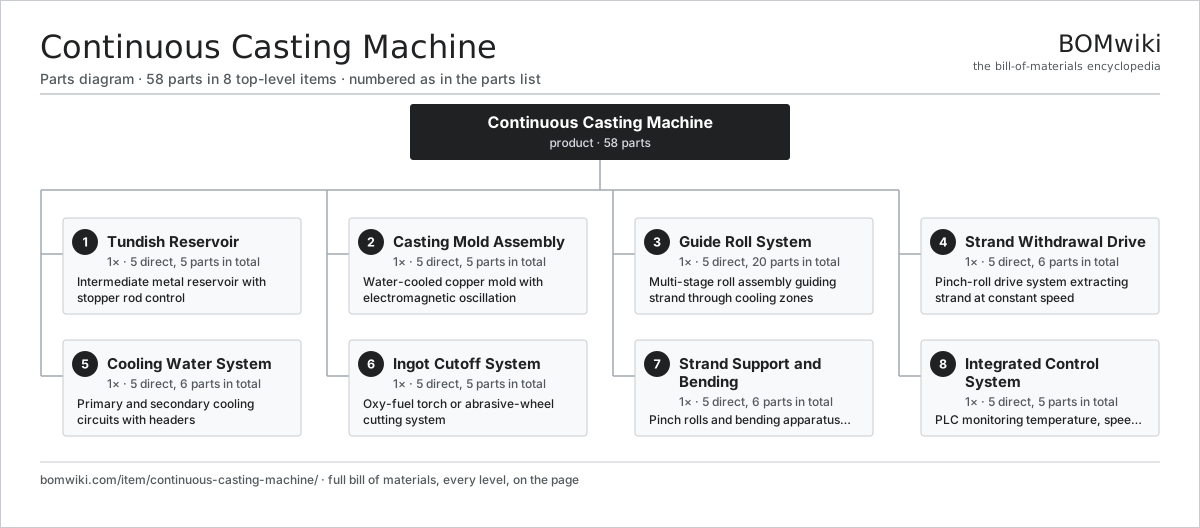
| # | Part | Qty | What it does |
|---|---|---|---|
| 1 | Tundish Reservoir 5 parts | 1× | Intermediate metal reservoir with stopper rod control |
| 2 | Casting Mold Assembly 5 parts | 1× | Water-cooled copper mold with electromagnetic oscillation |
| 3 | Guide Roll System 5 parts | 1× | Multi-stage roll assembly guiding strand through cooling zones |
| 4 | Strand Withdrawal Drive 5 parts | 1× | Pinch-roll drive system extracting strand at constant speed |
| 5 | Cooling Water System 5 parts | 1× | Primary and secondary cooling circuits with headers |
| 6 | Ingot Cutoff System 5 parts | 1× | Oxy-fuel torch or abrasive-wheel cutting system |
| 7 | Strand Support and Bending 5 parts | 1× | Pinch rolls and bending apparatus positioning strand |
| 8 | Integrated Control System 5 parts | 1× | PLC monitoring temperature, speed, and casting parameters |
3D model
No 3D model yet. Have a CAD file of this? Add a 3D model. STL renders right on this page; STEP, FreeCAD, and OpenSCAD sources are welcome too (openly licensed, like all 3D models on BOMwiki).
Build & assembly graph
expand / collapse · shared sub-assemblies converge · links to related products · est. labourTap an assembly to expand/collapse · tap a part to open it · use “Open page” for any node · drag to pan, scroll to zoom.
Bill of materials for Continuous Casting Machine
8 top-level lines · 48 rows shown · 58 parts total · indented to 3 levels| # | Item / sub-assembly | Part no. | Qty/assy | Ext. qty | Parts | Type |
|---|---|---|---|---|---|---|
| 1 | Tundish Reservoir 5 parts | continuous-casting-machine-tundish | 1× | 1 | 5 | assembly |
| 1.1 | Tundish Steel Shell | continuous-casting-machine-tundish-shell | 1× | 1 | · | part |
| 1.2 | Tundish Refractory Lining | continuous-casting-machine-tundish-lining | 1× | 1 | · | part |
| 1.3 | Stopper Rod | continuous-casting-machine-stopper-rod | 1× | 1 | · | part |
| 1.4 | Stopper Actuator | continuous-casting-machine-stopper-mechanism | 1× | 1 | · | part |
| 1.5 | Bottom Slide Gate | continuous-casting-machine-bottom-slide-gate | 1× | 1 | · | part |
| 2 | Casting Mold Assembly 5 parts | continuous-casting-machine-mold | 1× | 1 | 5 | assembly |
| 2.1 | Mold Copper Plates | continuous-casting-machine-mold-copper-insert | 1× | 1 | · | part |
| 2.2 | Mold Oscillator | continuous-casting-machine-mold-oscillator | 1× | 1 | · | part |
| 2.3 | Mold Flux Distribution | continuous-casting-machine-mold-flux-system | 1× | 1 | · | part |
| 2.4 | Mold Temperature Sensor | continuous-casting-machine-mold-thermocouple | 1× | 1 | · | part |
| 2.5 | Mold Water Jacket | continuous-casting-machine-mold-water-jacket | 1× | 1 | · | part |
| 3 | Guide Roll System 5 parts | continuous-casting-machine-guide-rolls | 1× | 1 | 20 | assembly |
| 3.1 | Primary Guide Rolls | continuous-casting-machine-primary-rolls | 2× | 2 | · | part |
| 3.2 | Secondary Guide Rolls | continuous-casting-machine-secondary-rolls | 4× | 4 | · | part |
| 3.3 | Roll Support Bearing | continuous-casting-machine-roll-bearing | 12× | 12 | · | part |
| 3.4 | Roll Spacing Actuator | continuous-casting-machine-roll-drive | 1× | 1 | · | part |
| 3.5 | Strand Cooling Header | continuous-casting-machine-cooling-header | 1× | 1 | · | part |
| 4 | Strand Withdrawal Drive 5 parts | continuous-casting-machine-withdrawal-system | 1× | 1 | 6 | assembly |
| 4.1 | Pinch Roll | continuous-casting-machine-pinch-roll | 2× | 2 | · | part |
| 4.2 | Withdrawal Drive Motor | continuous-casting-machine-pinch-roll-motor | 1× | 1 | · | part |
| 4.3 | Withdrawal Gearbox | continuous-casting-machine-pinch-roll-gearbox | 1× | 1 | · | part |
| 4.4 | Speed Encoder | continuous-casting-machine-speed-sensor | 1× | 1 | · | part |
| 4.5 | Strand Tension Brake | continuous-casting-machine-drag-brake | 1× | 1 | · | part |
| 5 | Cooling Water System 5 parts | continuous-casting-machine-water-cooling | 1× | 1 | 6 | assembly |
| 5.1 | Primary Cooling Pump | continuous-casting-machine-primary-pump | 1× | 1 | · | part |
| 5.2 | Secondary Cooling Pump | continuous-casting-machine-secondary-pump | 1× | 1 | · | part |
| 5.3 | Cooling Tower Heat Exchanger | continuous-casting-machine-cooling-tower | 1× | 1 | · | part |
| 5.4 | Water Inlet Filter | continuous-casting-machine-water-filter | 2× | 2 | · | part |
| 5.5 | Water Temperature Control Valve | continuous-casting-machine-thermostatic-valve | 1× | 1 | · | part |
| 6 | Ingot Cutoff System 5 parts | continuous-casting-machine-cutoff-mechanism | 1× | 1 | 5 | assembly |
| 6.1 | Torch Positioning Carriage | continuous-casting-machine-torch-carriage | 1× | 1 | · | part |
| 6.2 | Cutting Torch | continuous-casting-machine-oxy-fuel-torch | 1× | 1 | · | part |
| 6.3 | Torch Height Sensor | continuous-casting-machine-torch-height-sensor | 1× | 1 | · | part |
| 6.4 | Ingot Ejection Cylinder | continuous-casting-machine-ingot-pusher | 1× | 1 | · | part |
| 6.5 | Strand Length Encoder | continuous-casting-machine-length-counter | 1× | 1 | · | part |
| 7 | Strand Support and Bending 5 parts | continuous-casting-machine-strand-support | 1× | 1 | 6 | assembly |
| 7.1 | Bending Guide Roll | continuous-casting-machine-bending-roll | 2× | 2 | · | part |
| 7.2 | Bending Radius Adjuster | continuous-casting-machine-bending-actuator | 1× | 1 | · | part |
| 7.3 | Straightening Rolls | continuous-casting-machine-strand-straightener | 1× | 1 | · | part |
| 7.4 | Discharge Conveyor Motor | continuous-casting-machine-conveyor-drive | 1× | 1 | · | part |
| 7.5 | Ingot Roller Table | continuous-casting-machine-ingot-support-table | 1× | 1 | · | part |
| 8 | Integrated Control System 5 parts | continuous-casting-machine-control-system | 1× | 1 | 5 | assembly |
| 8.1 | Main Control PLC | continuous-casting-machine-main-plc | 1× | 1 | · | part |
| 8.2 | Withdrawal Speed VFD | continuous-casting-machine-vfd-withdrawal | 1× | 1 | · | part |
| 8.3 | Cooling Pump VFD | continuous-casting-machine-pump-vfd | 1× | 1 | · | part |
| 8.4 | Data Logger Module | continuous-casting-machine-data-logger | 1× | 1 | · | part |
| 8.5 | Operator HMI Touchscreen | continuous-casting-machine-hmi-touchscreen | 1× | 1 | · | part |
Something wrong in this list? Report a problem with this BOM.
Sourcing: possible vendors
Browse the supplier directory → Prices, MOQ, and lead times are algorithmic estimates, not quotes, and not claims about these companies. Company mappings are curated by keyword; est. price band $5k–$2M. How estimates work| Vendor | HQ | Specialty | MOQ | Lead time |
|---|---|---|---|---|
| atlascopco.com ↗ | Stockholm, SE | Compressors & industrial | 10 units | 12–20 wks |
|
🇦🇹Andritz
andritz.com ↗
|
Graz, AT | Process plants & machinery | 10 units | 12–20 wks |
| buhlergroup.com ↗ | Uzwil, CH | Food & materials processing | 10 units | 12–20 wks |
| gea.com ↗ | Düsseldorf, DE | Process technology | 10 units | 12–20 wks |
| mhi.com ↗ | Tokyo, JP | Heavy machinery | 10 units | 12–20 wks |
1,116-word article